
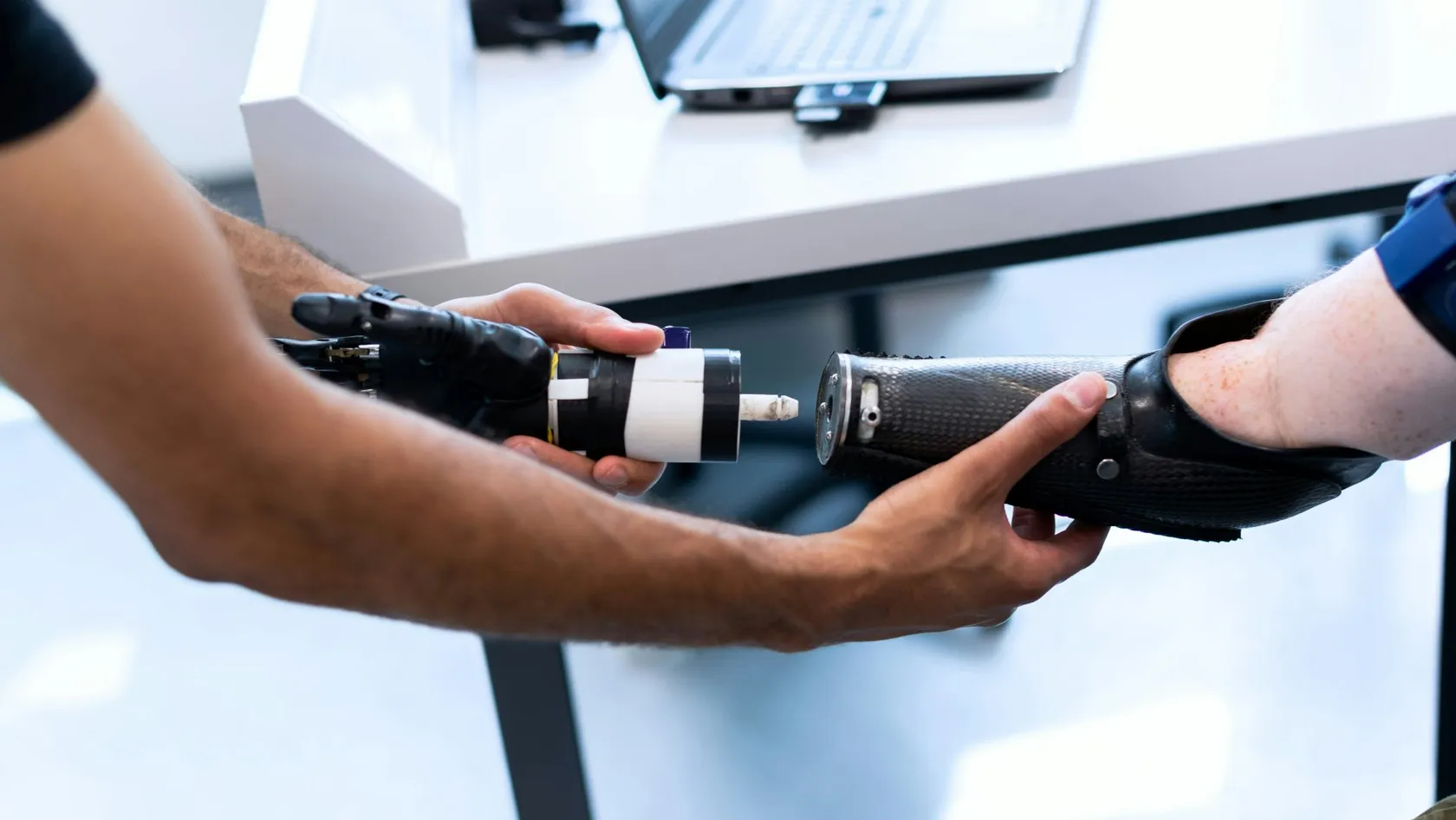
Robotic Rehabilitation
In a usual therapy session a stroke patient practices an arm movement 32 times. A rehabilitation robot multiplies that number, and across 101 trials it helped one extra patient in nine walk without a helper. See who gains, who should stay off the machines, and how a program of four to eight weeks is organized.
About This Department
Recovery is built from repetition. A robot lets you do far more of it, safely.
People who add robot-assisted gait training to physiotherapy after a stroke are more likely to walk without a helper than people who receive physiotherapy alone, a finding the 2025 Cochrane review drew from 101 randomized trials and 4,224 patients. Send us your reports and a short video of how you move today. A rehabilitation doctor will tell you whether a robotic program would change anything in your case, before you spend anything on travel.
A stroke, a spinal cord injury or a brain injury leaves many people able to move a little and unable to practice enough to move better. Robotic rehabilitation closes that gap. A motorized device carries part of the body's weight or guides the limb, so a person who cannot yet take ten steps alone can take several hundred in one session, with a therapist watching every one of them. Below you will find what the machines do, what the trials found, who gains and who does not, and how a program in Istanbul is organized for someone arriving from another country.
What is robotic rehabilitation?
Robotic rehabilitation uses motor-driven devices to move, support or resist a patient's limbs during therapy, so that weak muscles and a damaged nervous system can practice one movement many more times than hands-on therapy alone allows. A physiotherapist sets up the machine, stays beside it for the whole session and changes the settings as the patient improves. No robot runs a program by itself.
Three families of device cover nearly everything in clinical use.
This table scrolls sideways on a narrow screen. Swipe or drag to see every column.
| Device family | What it does | Who it suits |
|---|---|---|
| Treadmill gait robots. Lokomat is the most widely installed. G-EO and similar trainers move the feet on motorized plates. | A harness lifts part of the body weight while motorized leg braces move the hips and knees through a walking pattern on a treadmill. The therapist sets the weight support, the speed and how much of the work the motors do. | People who cannot walk, or who need one or two helpers to walk, after a stroke, an incomplete spinal cord injury, a brain injury or with multiple sclerosis. Children with cerebral palsy use a smaller set of braces. |
| Arm and hand robots. Armeo Spring and Armeo Power for the whole arm, Amadeo for the fingers, InMotion Arm, which is the commercial form of the MIT-Manus research robot. | A support cancels the weight of the arm, and motors guide or assist reaching, grasping and finger movement. Each movement steers a task on a screen. | A weak or partly paralyzed arm or hand after a stroke, a neck-level spinal cord injury or a brain injury. |
| Wearable exoskeletons and robotic tilt tables. EksoNR, ReWalk and HAL are exoskeletons. Erigo is a tilt table that moves the legs. | An exoskeleton is a battery-powered frame strapped to the legs and trunk that walks across the floor with a therapist alongside. A robotic tilt table brings a bed-bound patient upright a few degrees at a time while stepping the legs. | Exoskeletons need good trunk control and enough arm strength for crutches or a walker. The tilt table is for the earliest stage, when standing up makes the blood pressure fall. |
Published programs from rehabilitation units in Turkey name Lokomat, Armeo and Erigo more than any other systems, with the C-Mill treadmill and anti-gravity treadmills added for people who already walk. A device list on a website tells you little. Find out which machine the unit plans to use for your problem, and how many sessions on it the program contains.
Nearly every device links the movement to a screen. Reaching for a cup steers an object in a game, and each step on the treadmill moves a figure along a path. It looks like entertainment and it works as feedback, because the nervous system relearns faster when it sees the result of each attempt, and a task with a score keeps a tired patient working until the session ends.
Why the number of repetitions matters
In 312 stroke therapy sessions observed at seven rehabilitation sites, patients practiced a functional arm movement an average of 32 times per session and took an average of 357 steps, according to a 2009 study in the Archives of Physical Medicine and Rehabilitation.
Animal experiments on recovery after brain injury use many times that dose.
After a stroke or an incomplete spinal cord injury, surviving nerve pathways can take over part of the work of the damaged ones, a process doctors call neuroplasticity. Three things drive it, and all three come down to practice. The movement has to be the real task, such as stepping or reaching, and not a loosely related exercise. It has to be repeated in large numbers. And the patient has to be trying, because a limb moved passively while the person thinks about something else teaches the brain very little. Hands-on therapy struggles with the second of these. Walking a paralyzed adult across a room takes two or three therapists, one at each leg and one at the trunk, and their arms give out after a few minutes. A gait robot holds the body weight in a harness and moves both legs through the same correct pattern for half an hour without tiring. It also measures. Sensors in the braces record how much force the patient adds to each step, so the therapist can turn the motor help down in small stages and make the patient do a growing share of the work, which is the setting engineers call assist as needed.
The machine adds dose. Deciding what to practice, and when to stop using the machine, remains the therapist's job.
What the trials show
Robot-assisted therapy has been tested in more randomized trials than almost any other rehabilitation technology, and the results differ by body part and by how disabled the patient was at the start.
Walking after a stroke
The 2025 Cochrane review of electromechanical and robot-assisted gait training pooled 101 randomized trials with 4,224 stroke patients. Adding the robot to physiotherapy raised the odds of walking independently by 65 percent (odds ratio 1.65, moderate-certainty evidence), and the authors calculated that nine patients need to be treated for one more of them to walk without a helper. Independent walking in these trials meant covering 15 meters with no assistance from another person, with a cane allowed. Deaths did not rise in the robot groups. Neither did dropouts. Walking speed and the distance covered in six minutes showed differences too small to matter to a patient, 0.05 meters per second and 11 meters. Read those results together. A gait robot earns its place with the person who cannot yet walk alone, while someone who already walks slowly with a cane should expect little from it, and the reviewers themselves warn that some of the pooled trials enrolled exactly those patients, which pulls the average down.
Nobody knows how long the benefit lasts. At follow-up after the programs ended, the advantage in independent walking could no longer be confirmed (eight studies, 569 participants, low-certainty evidence), and the review calls for trials on the best weekly dose and on durability.
Arm and hand function after a stroke
For the arm, the 2018 Cochrane review of 45 trials and 1,619 patients found that robot-assisted arm training improved daily living scores, arm function and arm muscle strength after a stroke, with adverse events described as rare. The effects were small to moderate in size.
Then came RATULS. Published in The Lancet in 2019, it randomized 770 patients at four UK centers to robot-assisted training on the MIT-Manus system, to an equally intensive therapist-led program of task practice, or to usual care, with 45-minute sessions three times a week for 12 weeks, 36 sessions in all. At three months, 44 percent of the robot group had reached the target score on the Action Research Arm Test, against 50 percent with intensive task practice and 42 percent with usual care, and none of those differences was statistically significant. The robot group did improve on a measure of raw arm movement. That gain failed to carry over into using the arm for daily tasks. An arm robot therefore belongs inside a program where a therapist also practices real tasks with you, such as dressing, holding a cup and using a phone. Robot hours alone, however many, will not do it.
Spinal cord injury
A 2024 meta-analysis in the Annals of Rehabilitation Medicine combined 23 randomized trials with 690 spinal cord injury patients and found that robot-assisted gait training improved daily living scores, leg muscle strength, the Walking Index for Spinal Cord Injury and six-minute walking distance more than conventional rehabilitation did. Timing mattered. Patients treated in the first months after injury, and programs lasting longer than two months, showed the larger gains.
Completeness of the injury decides the goal. With an incomplete injury some signal still crosses the damaged segment and the robot is used to retrain walking, while with a complete injury no robot restores walking and the aims become standing tolerance, circulation, spasticity control and bone loading, or learning to use an exoskeleton as a mobility aid.
Other conditions
Multiple sclerosis, Parkinson's disease, traumatic brain injury and cerebral palsy in children are all treated on the same devices, in trials that are smaller than the stroke trials and less consistent in their results. Children go on the gait robot with pediatric leg braces, which the manufacturer sizes from a thigh length of 21 cm, reached at around four years of age.
Hip replacements, knee replacements and fractures need good conventional physiotherapy, and a robot adds little to it.
Who gains the most, and who should stay off the robot
The best candidates for a gait robot cannot walk without help, can sit upright for half an hour, can follow simple instructions, and had their stroke or injury weeks to months ago.
Time since the event matters, and it sets no cut-off. Recovery after a stroke runs steepest in the first three to six months, the spinal cord injury meta-analysis found larger gains in recently injured patients, and people also arrive two and three years after a stroke who can still gain strength, endurance and a better walking pattern. Their goals are set lower. They are stated plainly on the first day.
Sorting these groups before anyone buys a ticket is the purpose of the remote review.
For that review, send the hospital discharge summary with the date of the stroke or injury, the most recent brain or spine MRI or CT report, the current medication list including blood thinners and drugs for spasticity, a bone density result if one exists, and your height and weight. Add two short phone videos, filmed with the phone held sideways at hip height from three meters away. The first should show the patient standing up and walking, or attempting to, with whatever help is normally used. The second should show both arms reaching forward and both hands opening and closing. Write two or three lines as well on what the patient manages alone today, such as sitting without support, moving from bed to chair, or eating with the weak hand. Thirty seconds of video tells a rehabilitation doctor more than a page of description. The reply states whether a robot is likely to help, which one, and for how many weeks.
One session on a gait robot, start to finish
Measurement comes first. A therapist records thigh length, lower leg length, hip width and the range of each joint, sets the braces to match and stores the settings, which takes 20 to 30 minutes on the first day and 5 to 10 on later days.
You are wheeled up a ramp onto the treadmill. A padded harness goes around the pelvis and chest and clips to an overhead lift, the leg braces are strapped at the thigh and shin, and elastic foot straps hold the toes up so they clear the belt. The lift takes your weight, half of it or more in the early sessions. The belt starts at a crawl, slower than 2 km per hour.
Walking time runs 30 to 45 minutes. Over those minutes the therapist lowers the weight support and the motor guidance in small steps and raises the speed, watching a screen that shows how much force each of your legs produces. Heart rate and blood pressure are checked before you start, and again whenever you feel dizzy, hot or unwell.
Expect to be tired afterward. Sore hips and thighs on the second day are normal.
An arm session is simpler. You sit, the forearm rests in a support that cancels the weight of the arm, and you work through reaching and grasping tasks on a screen for 30 to 45 minutes. The largest arm trial used 45 minutes, three times a week, for 12 weeks.
Robot time fills one part of the day. Programs published by Turkish rehabilitation units describe two to five hours of therapy daily, of which the robot takes one, and the remaining hours go to hands-on physiotherapy, occupational therapy for the hand and for daily tasks, and speech and swallowing therapy where the stroke has affected them.
How long is a program, and how long will you be in Istanbul?
Plan on one to two months. Two weeks of daily therapy is the shortest program that justifies the journey, published packages in this market are built around four to eight weeks, and the spinal cord injury meta-analysis found better results from programs longer than two months. Thirty robotic sessions is a common package unit, which at five or six sessions a week means five to six weeks in the city.
Where you sleep depends on how much care you need outside therapy hours. People who cannot move from bed to chair without help, who have a urinary catheter or a pressure sore, or who need a nurse at night are admitted, and everyone else can live in a hotel or an apartment near the hospital and attend as a day patient. Day attendance costs less. It also suits a long program better.
Rehabilitation sets no waiting period before flying. You can travel the day after your last session.
Fitness to fly to Istanbul in the first place is a separate question. It belongs to the doctor who treated the original stroke or injury, so get that clearance in writing before booking, above all in the first weeks after a stroke, after recent surgery, or with a history of blood clots in the legs. Airlines need notice too. Request wheelchair assistance, an aisle chair and a seat with extra legroom when you buy the ticket.
Risks, and how each one is handled
Serious harm from robot-assisted therapy is rare in the published trials. Across 101 gait trials the Cochrane reviewers found no increase in deaths or in patients dropping out, the arm review of 45 trials described adverse events as rare, and none of the serious adverse events recorded among the 770 patients in RATULS was attributed to the treatment. The problems that do occur are minor and predictable.
Tell the therapist about any numb area of skin before the first session, because a patient who cannot feel a strap cutting in depends on someone else looking.
When the first assessment changes the plan
On the first day, the in-person assessment sometimes overrules the remote opinion. A knee that will not straighten, a blood pressure that falls each time the patient is stood up, or skin that has broken down during the journey can each take the gait robot out of the program for a week, or for good.
None of these ends the trip. Tight, spastic muscles are treated with botulinum toxin injections and stretching casts, and robot sessions begin once the joint has enough range. Low standing blood pressure is trained on a tilt table first. Anyone judged unsuitable for every robot still receives a full conventional program of several hours a day, and should ask for the quote to be rewritten to match before the first session is delivered.
Plans change when things go well, too. A patient who begins walking with one helper partway through the program should come off the treadmill robot and practice on the floor, on stairs and outdoors, since the trials show the robot adds nothing to speed or distance in people who already walk.
What decides the cost of a program
Two patients who both ask for robotic rehabilitation can receive quotes several times apart, and six details account for the gap.
Ward or hotel comes first. A month of inpatient nights with nursing outweighs every other line in the quote. Hours of therapy per day come second, and two hours against five is a different program. The number of robot sessions and the device used come third, with exoskeleton sessions priced above treadmill robot sessions in the lists that units publish, and program length multiplies all of it. Nursing needs add to the total where there is a catheter, a feeding tube, a tracheostomy or a pressure sore to dress. Added treatments form the sixth item, among them botulinum toxin for spasticity, custom splints and braces, a swallowing study, or a session in a gait analysis laboratory. The patient's own health moves the figure as well. Heavy body weight can mean two therapists for every transfer. Diabetes, heart disease or epilepsy bring extra monitoring and medical reviews, and each of those is a line in the quote.
Packages published by Turkish hospitals and medical travel agencies cover the rehabilitation doctor's assessment and weekly review, a fixed number of therapy and robot sessions, an interpreter, airport transfers, and either ward nights or hotel nights. Flights, travel insurance, medication, braces, injections for spasticity, sessions beyond the agreed count and treatment of any unrelated illness during the stay are the standard exclusions.
Five questions separate a real quote from a headline figure.
- How many robot sessions does the figure contain, on which device, and how many minutes of walking or arm time are in each one?
- How many hours of hands-on therapy are given each day, and on how many days a week?
- Does the figure include the companion's bed and meals?
- What happens to the price if the first-day assessment takes the robot out of the plan?
- Is a written discharge report with a home program part of the package?
A figure that means something comes after a rehabilitation doctor has read your reports and watched your videos. That review is free and commits you to nothing.
Traveling to Istanbul with limited mobility
One coordinator from the international patients team is assigned from your first message and stays with you until discharge. The team works in English, Arabic, French, Russian, Serbian, Romanian and Spanish, and arranges interpreting in other languages on request. Language counts for more in rehabilitation than in most departments, since a therapist's instructions (shift your weight, push through the heel, look ahead) only work if they are understood at the moment they are given. Bring a family member, and treat that person as part of the treatment. Patient rooms have a companion bed, so one person can stay overnight for the whole admission. For day patients, the international patients office arranges accommodation for the patient and the companion, along with transport between the hotel and the hospital, and you should say at the outset if you need a step-free room with a roll-in shower. Whoever comes with you should sit in on therapy during the final week to learn the transfers, the stretches and the home exercises, because that person will be the therapist once you are home.
An appointment confirmation and an invitation letter naming the hospital and the treating doctor go out about ten days before travel, and consulates ask for that letter with a medical visa application. Airport transfers are arranged by the same office. Mention in your first message that you need a wheelchair-accessible vehicle.
Halal, vegetarian and diabetic meals come from the hospital kitchen, and a prayer room is on site.
Rehabilitation involves close physical handling for hours every day. A request for a female physician is passed to the department and met wherever the rota allows, so make it early.
After you fly home
Discharge from a rehabilitation program should put three documents in your hand, namely a report with the scores measured on the first and the last day, a home exercise program with pictures or video, and a letter for your doctor or physiotherapist at home stating what was done and what to continue.
Some ground is lost if practice stops. The Cochrane gait review could not confirm that the robot's advantage was still present at follow-up after the programs ended, and the people who keep their gains are the ones who go on walking and exercising every day, with or without a machine. Few towns have a gait robot. The home program is therefore written for a hallway, a chair and a family member.
Your coordinator stays reachable on the same WhatsApp number after you leave, and questions about the home program can go there, with a short video where it helps.
See a doctor at home promptly for a fall followed by pain, a hot and swollen calf, a pressure mark that has not faded after a day, or weakness that is new or getting worse. Signs of a further stroke, meaning a drooping face, slurred speech, sudden loss of vision or sudden weakness on one side, call for your local emergency number before anything else.
Robotic rehabilitation FAQ
Is robotic rehabilitation better than normal physiotherapy?
How many sessions of robotic rehabilitation will I need?
Can I start years after my stroke?
How long do I need to stay in Istanbul?
Can my husband or wife stay with me?
Will the therapists understand me?
Can children with cerebral palsy use a gait robot?
References
- Mehrholz J, Kugler J, Pohl M, Elsner B. Electromechanical-assisted training for walking after stroke. Cochrane Database of Systematic Reviews. 2025;5(5):CD006185.
- Mehrholz J, Pohl M, Platz T, Kugler J, Elsner B. Electromechanical and robot-assisted arm training for improving activities of daily living, arm function, and arm muscle strength after stroke. Cochrane Database of Systematic Reviews. 2018;9(9):CD006876.
- Rodgers H, Bosomworth H, Krebs HI, et al. Robot assisted training for the upper limb after stroke (RATULS): a multicentre randomised controlled trial. Lancet. 2019;394(10192):51-62.
- Park JM, Kim YW, Lee SJ, Shin JC. Robot-Assisted Gait Training in Individuals With Spinal Cord Injury: A Systematic Review and Meta-Analysis of Randomized Controlled Trials. Annals of Rehabilitation Medicine. 2024;48(3):171-191.
- Lang CE, MacDonald JR, Reisman DS, et al. Observation of amounts of movement practice provided during stroke rehabilitation. Archives of Physical Medicine and Rehabilitation. 2009;90(10):1692-1698.
Editor's note
Written by the Biruni Hospital medical editorial team. Reviewed by Speech and Language Therapist Elif İkbal ESKİOĞLU, Speech and Language Therapy.
Medically reviewed by

Speech and Language Therapist Elif İkbal ESKİOĞLU
Speech and Language Therapy
Related Treatments
View All
Brain Injury Rehabilitation
A bleak outlook given in the first two weeks after a severe brain injury is frequently wrong. In the largest recent follow-up study, 12 percent of such patients were doing well at two weeks and 52 percent at one year. Learn what rehabilitation adds to that recovery, stage by stage, and when a patient is ready to travel.
Cancer Rehabilitation - Oncology Rehabilitation
Cancer rehabilitation treats the fatigue, weakness, stiffness, swelling, nerve damage, swallowing problems and loss of function that cancer and its treatment leave behind, before, during and after therapy. In one study 92 percent of women with metastatic breast cancer had a treatable impairment and fewer than a third were being treated. This page explains what is treated, the evidence on fatigue and lymphedema, prehabilitation, specialist problems and programs for patients from abroad.
Cardiac Rehabilitation - Heart Rehabilitation
A stent or a bypass repairs one artery. It does nothing to the disease that narrowed it. Cardiac rehabilitation is the monitored exercise, tablet review and risk factor treatment that does, and randomized trials link it to fewer repeat heart attacks and fewer hospital admissions in the following year.
Inpatient Rehabilitation
Should recovery happen on a hospital ward, or at home with visits to a clinic? A ward is the answer when someone needs therapy every day, a nurse at night and a doctor nearby, which is common after a stroke, a hip fracture, heart surgery, a lung flare-up or a long spell in intensive care.
Inpatient Rehabilitation - Acute Rehabilitation Unit
Acute does not mean emergency here. It means the intensive level of rehabilitation, with at least three hours of therapy a day on a hospital ward where a rehabilitation doctor sees you daily, and it suits people in the first months after a stroke, a spinal cord injury, a brain injury or major surgery.