
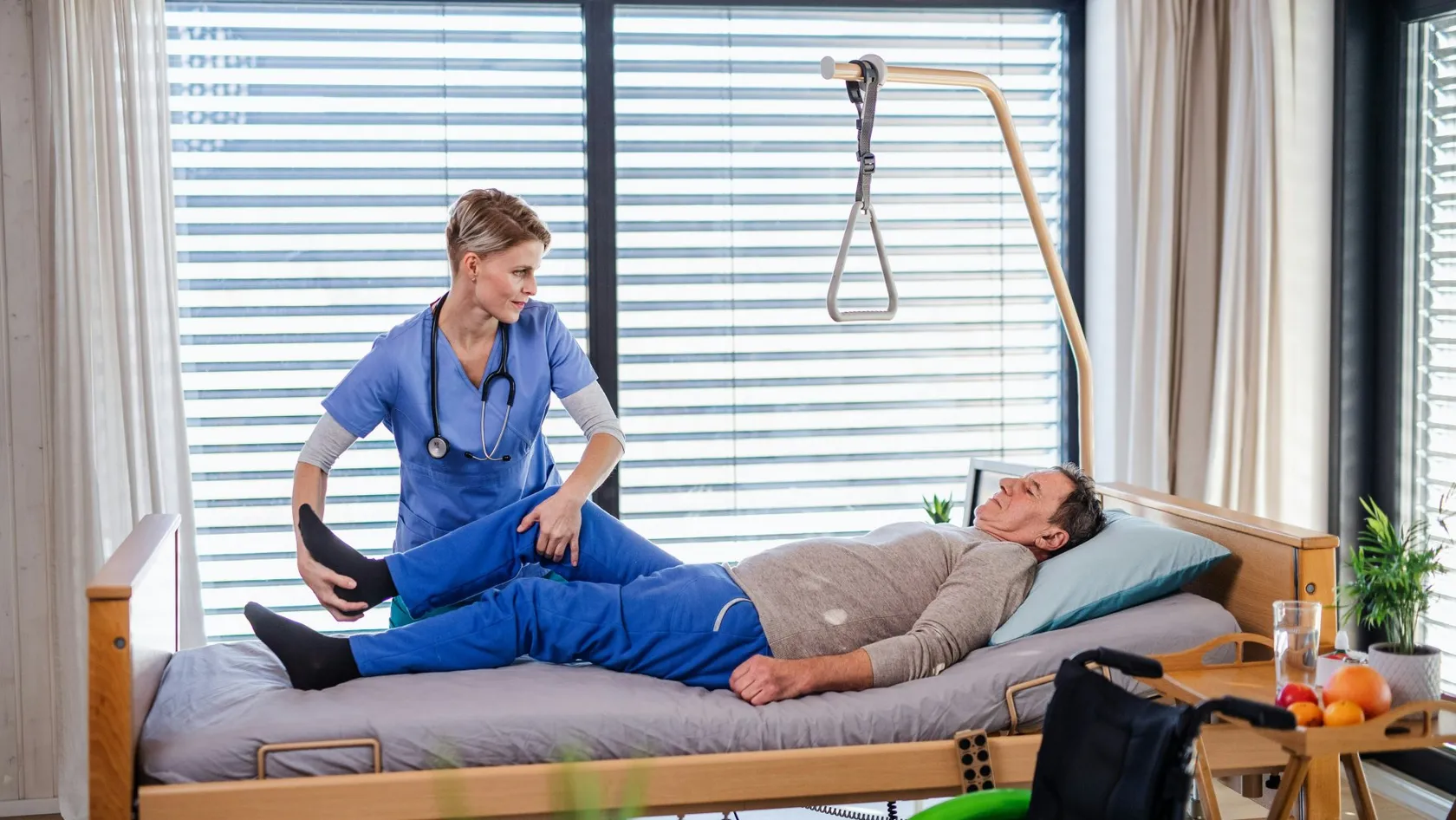
Inpatient Rehabilitation
Should recovery happen on a hospital ward, or at home with visits to a clinic? A ward is the answer when someone needs therapy every day, a nurse at night and a doctor nearby, which is common after a stroke, a hip fracture, heart surgery, a lung flare-up or a long spell in intensive care.
About This Department
More people go home after inpatient rehabilitation. Randomized trials have counted how many.
Inpatient rehabilitation means living on a hospital ward for a few weeks while therapists, nurses and a rehabilitation doctor rebuild walking, self-care, breathing or speech through daily training. Its benefit has been measured. Across 17 randomized trials with 4,780 older patients, reported in the BMJ in 2010, people who received it had a 36 percent lower risk of being sent to a nursing home at discharge, and a 28 percent lower risk of dying, than people given usual hospital care.
One clarification before anything else. In everyday English, rehab also means treatment for alcohol or drug dependence. This page covers medical rehabilitation after an illness, an injury or an operation, which is a different service with different staff.
What inpatient rehabilitation is
Inpatient rehabilitation is a hospital admission whose purpose is the recovery of function. By the time it starts, the medical crisis has passed. What remains is a body that cannot yet do what daily life demands, whether that means climbing a step, rising from a chair, breathing through a shower or holding a fork.
Three features set it apart from an ordinary ward. Therapy takes up several hours of every weekday and comes from more than one profession. Nurses follow a rehabilitation plan, so they deliberately help a little less each day. A doctor trained in physical medicine and rehabilitation sets the medical limits for exercise, treats pain and changes the medication as activity rises.
The patient does the work. Staff make it possible.
Inpatient or outpatient?
Clinics deliver the larger share of rehabilitation everywhere in the world, and for a great many people a clinic is the right place.
Travelers have a middle route. Several rehabilitation centers in Turkey publish programs in which the patient sleeps in a nearby hotel and spends the day in therapy, which costs less than a hospital bed and works only for someone who is safe overnight with a relative's help. If the patient needs a nurse at three in the morning, even once, the hotel option is the wrong one. Say plainly in your first message what the nights are like at present, because that answer decides between the two more than any diagnosis does.
Programs by condition
Wards organize rehabilitation by diagnosis, since a heart patient and a stroke patient need different exercise, different monitoring and different teaching.
Stroke, brain injury, spinal cord injury and multiple sclerosis
Neurological rehabilitation is the largest group. It retrains walking, balance, the use of a weak arm, speech, swallowing, memory and bladder control, and it runs longer than other programs because the nervous system relearns slowly. Evidence reaches beyond sudden injuries. For multiple sclerosis, an overview of 15 Cochrane reviews by Amatya, Khan and Galea, covering 164 randomized trials and 10,396 participants, found moderate-quality evidence that structured team programs, inpatient or outpatient, produced longer-term gains in what people could do and how far they took part in daily life.
Hip fracture, multiple injuries and complicated joint surgery
A broken hip in an older person is the classic case. Handoll and colleagues pooled 28 trials with 5,351 participants in a 2021 Cochrane review and found that, among 3,036 of them followed for six to twelve months, team-based rehabilitation on a ward left 41 fewer people in every 1,000 dead or in institutional care.
41 fewer in every 1,000People dead or in institutional care within a year of a hip fracture, when rehabilitation was delivered by a team on a ward. Cochrane review, 2021.
An uncomplicated hip or knee replacement rarely needs a ward program. Those who do need one had both sides operated together, a revision, a complication, or were frail before the operation.
After a heart attack, bypass or valve surgery
Cardiac rehabilitation combines graded exercise with teaching on medication, diet and risk factors, under monitoring of pulse, blood pressure and heart rhythm. Dibben and colleagues reviewed 85 trials that randomized 23,430 people with coronary heart disease. Within the first year, exercise-based programs cut the risk of another heart attack by 28 percent and the risk of any hospital admission by 42 percent, which works out at one admission avoided for every 12 people treated. The programs in those trials ran in hospitals, clinics and homes, and the benefit did not depend on the setting. So the reason to choose a ward is practical. It fits the patient who is too weak after surgery to travel to sessions, or who is abroad and wants a supervised start before flying home. Patients wear a heart monitor during the first sessions, and the exercise dose rises only while pulse, blood pressure and rhythm stay inside the limits the cardiologist has set.
1 in 12One hospital admission avoided in the first year for every 12 people who take part in exercise-based cardiac rehabilitation. Cochrane review, 2021.
Chronic lung disease after a flare-up
People with chronic obstructive pulmonary disease lose muscle fast during a hospital stay for a flare-up. Pulmonary rehabilitation rebuilds it with endurance and strength training, breathing techniques and teaching on inhalers and early warning signs. In the Cochrane review by Puhan and colleagues, which covered 20 studies and 1,477 participants, patients walked 62 meters farther in six minutes after rehabilitation, quality of life improved by nearly twice the amount patients can notice, and across eight studies the odds of being readmitted to hospital fell by more than half. Newer trials in that review showed smaller effects than older ones, and programs with more sessions did better. On the ward, oxygen levels are measured throughout each session, patients who need it train with extra oxygen, and the speed of the treadmill or the bicycle goes up only while the readings stay in the range the lung doctor has set. Help with stopping smoking belongs to the program.
62 metersExtra distance walked in six minutes after pulmonary rehabilitation that followed a flare-up. Cochrane review, 2016.
Older adults after a serious illness
Two weeks in bed with pneumonia can cost an 80-year-old the ability to live alone. Bachmann and colleagues, in the BMJ analysis quoted at the top of this page, found that rehabilitation wards designed for older patients raised the odds of better function at discharge by 75 percent. The price was time. Patients in the general geriatric programs stayed 24.5 days on average, against 15.1 days with usual care.
75 percent higher oddsOf better function at discharge from a rehabilitation ward designed for older patients, compared with usual hospital care. BMJ, 2010.
Weakness after intensive care or cancer treatment
Long spells on a ventilator, major cancer surgery and chemotherapy all strip muscle and stamina. Rehabilitation here is slower. Sessions are short, nutrition gets attention and rest is built into the day. Radiotherapy and chemotherapy are both given at Biruni Hospital on the same site, so a program can be planned around treatment days without moving the patient.
What to expect from the first day to the last
Days one and two. Everyone examines you. The rehabilitation doctor goes through the history and the medication, and each therapist takes baseline measurements, which might be walking distance in six minutes, grip strength, the number of times you can stand from a chair, a swallowing check or a memory test, depending on the diagnosis. You and the team then agree on goals, and the goals are written in plain words such as walk to the dining room with a frame.
An ordinary weekday. Washing and dressing come first and count as therapy. Sessions of 30 to 60 minutes follow through the morning and afternoon, with breaks between them, and US units describe three hours or more as the standard daily total. Expect to be tired.
Tiredness in the first week is normal and says nothing about how well the program will work.
Team review. Once a week the doctor, nurses and therapists sit down together, compare each patient with the written goals, and decide what to change. Families can ask for a summary of that meeting.
Final days. Every baseline test is repeated. The relative who will help at home practices the transfers, the exercises and any equipment under a therapist's eye, the home program is written out, and the doctor signs the travel clearance.
What to bring
Pack for a gym with a bed attached.
- Loose clothes for a week, such as track pants, T-shirts and a zipped top
- Flat, closed shoes with a non-slip sole
- Glasses, hearing aids and dentures, each in a labeled case
- All current medication in its original boxes, with a written list of doses
- Devices used at home, such as a CPAP machine, a glucose meter, a brace or a walking aid
- Medical records, with imaging on a disc or a USB stick
- A phone or tablet, its charger and a plug adapter for European sockets
Leave jewelry and large sums of cash at home. The companion needs the same kind of clothes, because they will be on the gym floor too.
Risks, and how the ward handles them
Exercise under supervision is safe, even for sick people. In the Cochrane review of pulmonary rehabilitation, five studies with 278 participants recorded side effects, and four of them saw none at all while the fifth saw one serious event. The real risks come from the illness and from lying still.
This table scrolls sideways on a narrow screen. Swipe or drag to see every column.
| Risk | Warning signs | What the ward does |
|---|---|---|
| Falls | Dizziness on standing, rushing to the bathroom alone | Risk score on day one, supervised transfers, a call bell within reach, balance training |
| Blood clot in the leg or lung | A swollen, warm, painful calf, or sudden breathlessness | Early walking, compression devices or blood thinning injections, a scan the same day if one is suspected |
| Heart strain during exercise | Chest pain, palpitations, unusual breathlessness | Exercise limits set by the doctor, pulse and blood pressure checks, heart monitoring for cardiac patients |
| Low oxygen | Blue lips, confusion, a reading that drops with effort | Oxygen levels measured during therapy, oxygen given when prescribed, paced exercise |
| Pressure sores | Red skin over the tailbone, hips or heels that does not fade | Turning schedule, daily skin checks, special mattresses and cushions |
| Infection | Fever, a wound that leaks or reddens, burning urine, a new cough | Wound reviews, early tests, antibiotics when needed |
| Low mood | Refusing therapy, poor sleep, loss of appetite | Screening, time with a psychologist, medication where it helps |
Any of these pauses therapy for a day or a few days. None of them ends a program when it is picked up early.
When the plan has to change
Bodies do not read schedules. A patient may recover faster than forecast and be ready to leave a week early, and a fair hospital says so instead of filling the booked days. The reverse happens as well. A chest infection, a wound problem or a heart rhythm disturbance can interrupt therapy, and since the rehabilitation ward at Biruni Hospital belongs to a general hospital, the specialists, the scanners and the intensive care unit needed to deal with it are under the same roof. Now and then the first assessment shows that rehabilitation is the wrong treatment for the moment, for example when a hip replacement has loosened or a heart valve needs repair before exercise is safe. That leads to a separate discussion, a separate consent and a separate quote, and the patient is free to have that treatment at home instead, with the assessment report in hand for the doctors there.
Arranging a stay from abroad
How long it lasts, and when you can fly
Length depends on the diagnosis and on how the patient responds. Patient guides from units in the United States quote stays of 10 to 21 days. European trials of geriatric rehabilitation averaged 24 days. A hip fracture program sits at the short end, a spinal cord injury program at the long end, and heart and lung programs fall between them. Programs that Turkish hospitals and medical travel agencies publish for patients from abroad run from two to eight weeks, and they run longer than domestic programs for a simple reason, which is that a patient who lives nearby carries on in a clinic the week after discharge while a traveler has to finish the job before the flight. The team at Biruni Hospital fixes the length after the first week, when the early measurements show the rate of progress. Ask for the planned length and the date of the first review in writing.
Flying in needs the treating doctor's agreement. Airline medical rules based on the manual of the International Air Transport Association accept passengers from 10 days after an uncomplicated heart attack and 10 days after major abdominal surgery, and the UK Civil Aviation Authority advises at least two weeks after a stroke. Most airlines ask for a medical information form, the MEDIF, for anyone recently in hospital. Oxygen on board has to be ordered in advance.
Flying out is easier. The doctor writes a dated fit-to-fly letter at discharge.
What decides the cost
The bill follows the plan. Weeks on the ward weigh most, followed by how much nursing the patient needs at night, how many kinds of therapy run each day, and whether the program needs monitoring equipment, as cardiac and lung programs do. Procedures, new scans, braces and equipment to take home are added only when they are used. Age, body weight, diabetes, kidney disease and blood thinning medication change the plan too, and that explains why two people with the same diagnosis get different quotes.
Published packages in this market cover the bed, meals for patient and companion, doctor and nursing care, the agreed therapy, routine blood tests, airport transfers and interpreting. Flights, travel insurance, medication for other illnesses, custom-made equipment, extra scans, the treatment of a complication and extra days fall outside them.
Questions for any hospital that sends a quote
Five answers make two quotes comparable.
- How many hours of therapy a day does the figure include, and how many of them are one-to-one
- Which professions deliver those hours
- What does an added week cost, and is there a refund for unused days
- Are the companion's bed and meals inside the figure
- Which tests and procedures would be charged separately
Insurance
Insurance needs early attention. Many travel and international health policies pay for emergencies abroad and exclude planned rehabilitation, so ask the insurer in writing before booking. Insurers who do cover it want a treatment plan and an itemized estimate. Both follow from the doctor's review of the file, which costs nothing.
The trip itself
One coordinator in the international patients office handles the case from the first message. The same person is there on the day of discharge. The office works in English, Arabic, French, Russian, Serbian, Romanian and Spanish, and it arranges an interpreter for any other language when asked. It books the airport pickup, the rides between hotel and hospital and the hotel nights before and after the admission. About ten days ahead of the flight it sends the appointment confirmation and an invitation letter with the names of the hospital and the treating doctor, which consulates expect to see with a medical visa application. A stay of several weeks can run past a short visa, so compare the dates for both travelers. Tell the coordinator whether the patient walks, uses a wheelchair or has to lie flat, since the airport pickup is arranged around that answer.
The room has a bed for one companion, who stays every night.
Food is prepared for halal, vegetarian and diabetic diets. There is a prayer room in the hospital. A woman who prefers a female doctor should mention it when she first writes, and the department meets the request whenever the duty rota allows.
After you fly home
Gains made on the ward fade without practice, so the discharge file is written for the people who take over. It holds the medical report in English, the test results from the first and last week side by side, the home exercise plan, the medication list, and a letter to the family doctor or local therapist setting out what should continue. For heart and lung patients it also states safe pulse and oxygen limits for exercise at home.
Once you are back home, your coordinator keeps the same WhatsApp number. Practical questions go there and are passed to the rehabilitation team. Emergencies do not. Chest pain, sudden breathlessness, new weakness of the face, arm or leg, a swollen painful calf, a high fever or a wound that opens all need a local doctor or emergency department the same day.
Inpatient rehabilitation FAQ
What is the difference between inpatient and outpatient rehabilitation?
How long does a rehabilitation stay in hospital last?
Can a relative stay in the room?
Will staff speak my language?
What happens if something goes wrong after I fly home?
References
- Bachmann S, Finger C, Huss A, Egger M, Stuck AE, Clough-Gorr KM. Inpatient rehabilitation specifically designed for geriatric patients: systematic review and meta-analysis of randomised controlled trials. BMJ. 2010;340:c1718.
- Dibben G, Faulkner J, Oldridge N, Rees K, Thompson DR, Zwisler AD, Taylor RS. Exercise-based cardiac rehabilitation for coronary heart disease. Cochrane Database Syst Rev. 2021;11(11):CD001800.
- Puhan MA, Gimeno-Santos E, Cates CJ, Troosters T. Pulmonary rehabilitation following exacerbations of chronic obstructive pulmonary disease. Cochrane Database Syst Rev. 2016;12(12):CD005305.
- Handoll HH, Cameron ID, Mak JC, Panagoda CE, Finnegan TP. Multidisciplinary rehabilitation for older people with hip fractures. Cochrane Database Syst Rev. 2021;11(11):CD007125.
- Amatya B, Khan F, Galea M. Rehabilitation for people with multiple sclerosis: an overview of Cochrane Reviews. Cochrane Database Syst Rev. 2019;1(1):CD012732.
Editor's note
Written by the Biruni Hospital medical editorial team. Reviewed by Assistant Professor Nazire BAĞATIR, Physical Therapy and Rehabilitation.
Medically reviewed by
Assistant Professor Nazire BAĞATIR
Physical Therapy and Rehabilitation
Related Treatments
View All
Brain Injury Rehabilitation
A bleak outlook given in the first two weeks after a severe brain injury is frequently wrong. In the largest recent follow-up study, 12 percent of such patients were doing well at two weeks and 52 percent at one year. Learn what rehabilitation adds to that recovery, stage by stage, and when a patient is ready to travel.
Cancer Rehabilitation - Oncology Rehabilitation
Cancer rehabilitation treats the fatigue, weakness, stiffness, swelling, nerve damage, swallowing problems and loss of function that cancer and its treatment leave behind, before, during and after therapy. In one study 92 percent of women with metastatic breast cancer had a treatable impairment and fewer than a third were being treated. This page explains what is treated, the evidence on fatigue and lymphedema, prehabilitation, specialist problems and programs for patients from abroad.
Cardiac Rehabilitation - Heart Rehabilitation
A stent or a bypass repairs one artery. It does nothing to the disease that narrowed it. Cardiac rehabilitation is the monitored exercise, tablet review and risk factor treatment that does, and randomized trials link it to fewer repeat heart attacks and fewer hospital admissions in the following year.
Inpatient Rehabilitation - Acute Rehabilitation Unit
Acute does not mean emergency here. It means the intensive level of rehabilitation, with at least three hours of therapy a day on a hospital ward where a rehabilitation doctor sees you daily, and it suits people in the first months after a stroke, a spinal cord injury, a brain injury or major surgery.
Lymphedema Rehabilitation - Lymphedema Therapy
Lymphedema rehabilitation treats the swelling that follows damage to the lymphatic system, most often in the arm after breast cancer and in the leg after pelvic cancer, through skin care, manual drainage, compression and exercise. More than one in five breast cancer survivors is affected, and swelling caught early by measurement responds to a few weeks in a compression garment. This page explains stages, risk, complete decongestive therapy, evidence, daily life and programs from abroad.