Retroperitoneal Lymph Node Dissection - RPLND
Testicular cancer that reaches the nodes at the back of the abdomen is still curable, and surgery can sometimes replace chemotherapy. This guide covers the three reasons for RPLND, what a leftover mass contains, nerve sparing for ejaculation, robotic or open surgery and a 10 to 14 day stay in Istanbul.
About This Department
Testicular cancer that reaches the lymph nodes is still curable. RPLND removes those nodes and keeps the nerves.
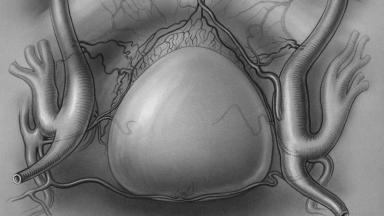
Testicular cancer spreads first to the lymph nodes beside the aorta and the vena cava, deep at the back of the abdomen. Retroperitoneal lymph node dissection removes them, either in place of chemotherapy for small nodes or after chemotherapy for a mass that stays behind. In US SEER data, five-year relative survival is 96 percent once testicular cancer has reached nearby nodes, and in a 2024 German series of nerve-sparing RPLND, 90.8 percent of men kept normal ejaculation.
A testicle was removed recently, and now a CT shows enlarged nodes at the back of the abdomen or a mass that stayed after chemotherapy.
The cure rates are high. The choices that follow matter for fertility and for the next forty years.
Whatever the plan, freeze a semen sample before RPLND or chemotherapy if you may want children. It takes one visit and removes the biggest worry from every decision on this page.
Three reasons for RPLND
Nonseminoma with small nodes
Primary RPLND, done before any chemotherapy, treats nonseminoma that has reached a few nodes while the blood markers are normal. It also finds teratoma, a part of the tumor that chemotherapy does not kill. A 2024 series from Cologne operated on 76 men with marker-negative stage IIA or IIB disease, 42 of them with nonseminoma. None received chemotherapy after surgery, 7 men (9.2 percent) relapsed outside the operated area and were treated with chemotherapy at that point, and 11 turned out to have no cancer in the nodes at all. That is the trade-off.
Seminoma with nodes of 1 to 3 cm
Seminoma that spreads to a few small nodes has long been treated with chemotherapy or radiotherapy, both effective and both with late side effects. The SEMS trial, published in the Journal of Clinical Oncology in 2023, tested surgery instead in 55 men at twelve centers in the US and Canada. Two years on, 81 percent were free of recurrence. The 12 men who relapsed were treated with chemotherapy or further surgery, and every one of them was free of disease at last follow-up, with two-year overall survival of 100 percent.
A mass left after chemotherapy
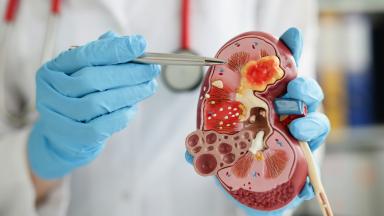
After chemotherapy for nonseminoma, any node mass still visible on CT with normal markers is removed. In seminoma the rules differ, and PET-CT helps decide. This post-chemotherapy RPLND is the most demanding version, because scar tissue binds the nodes to the great vessels. The surgeon removes the mass together with the whole template around it rather than the visible lump alone, because small deposits of teratoma can sit in nodes that still look normal on the scan.
What a leftover mass contains
No scan can tell these three apart. Only removing the mass does.
This table scrolls sideways on a narrow screen. Swipe or drag to see every column.
| Finding | Share | What it means |
|---|---|---|
| Necrosis or scar | 65 percent | Chemotherapy worked. Follow-up scans only. |
| Teratoma | 30 percent | Resistant to chemotherapy and able to grow. Surgery is the cure. |
| Viable cancer | 5 percent | The oncologist decides on further chemotherapy. |
Before the operation
- Fresh tumor markers.
- A CT of the chest, abdomen and pelvis less than four to six weeks old, because nodes can grow or shrink and the surgical plan is drawn from the most recent images rather than the ones taken at diagnosis.
- The pathology report from the orchiectomy, and the chemotherapy record if you had it.
- Sperm banking, if not done already.
- Lung function tests after bleomycin, so the anesthetist can keep oxygen levels low and safe.
Inside the operation
A modified one-sided template follows the drainage path of the affected testicle and leaves the nerves on the other side untouched. A full bilateral template is used when nodes are large or on both sides, often after chemotherapy.
Robotic, laparoscopic or open
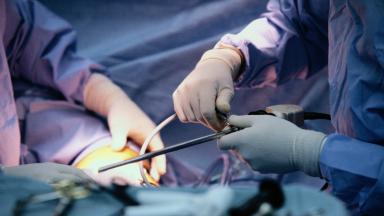
Open surgery through a midline cut remains the reference, and it was the approach in the SEMS trial. Both routes work. Robotic RPLND is gaining ground for primary surgery and for selected masses after chemotherapy. In the New Delhi robotic series of 37 post-chemotherapy cases, masses up to 9 cm were removed, a median of 19 nodes came out, and only one man had a recurrence after a median follow-up of 41 months. Robotic surgery works through five or six small ports, and when it suits the case it means less pain, a smaller scar and an earlier return to work, although the operating time can be longer and the surgeon must be ready to convert to an open incision if the scar around the vessels proves too dense. Large masses wrapped around the vessels, or a second operation in the same area, still call for open surgery. The route matters less than a surgeon who does this operation regularly, because a node left inside the template can cause a relapse in the operated field.
Ejaculation and fertility
RPLND does not affect erections, sensation or orgasm. What can change is ejaculation. If the sympathetic nerves are damaged, semen flows backward into the bladder or is not released at all, and natural conception becomes difficult. Nerve sparing keeps it in most men, 90.8 percent in the Cologne series and 86.4 percent in the New Delhi robotic series after chemotherapy, where scar tissue makes the nerves harder to protect. In SEMS, 3 of 55 men lost ejaculation. When ejaculation does not return, medication that tightens the bladder neck helps some men, and sperm can also be collected from the urine after orgasm or retrieved directly for assisted reproduction, so a dry orgasm does not end the chance of fatherhood. Bank first.
Risks
In SEMS, 7 percent of men had a short-term complication. In the Cologne series, 10.9 percent needed a procedure under local anesthesia to treat one. The specific risk of this operation is chylous ascites, a leak of milky lymph fluid into the abdomen that makes the belly swell in the days or weeks after surgery, often once normal eating resumes, and it is managed with a low-fat diet built on medium-chain fats, sometimes with drainage, until the lymph channels seal over a few weeks. Slow bowel recovery, bleeding, injury to a vessel or ureter, a hernia at the incision and blood clots complete the list. Each one is explained at the consent visit with the figures that apply to your own case, so nothing on this list comes as a surprise afterward. Deaths after primary RPLND in experienced centers are rare, and none were reported among the 55 men in SEMS or the 76 men in the Cologne series, which reflects careful selection as much as surgical skill.
A belly that keeps swelling after you start eating, fever, or a calf that turns painful and swollen needs a call the same day.
Recovery and length of stay
The Cologne primary RPLNDs took a mean of 131 minutes. Hospital stay averaged 4.5 days. Robotic primary surgery shortens that to two to four nights. Open bilateral surgery after chemotherapy runs longer, five to seven nights.
You walk on the first day. Food restarts slowly, and after a full template a low-fat diet for the first two weeks lowers the risk of a lymph leak. Office work returns at two to three weeks after robotic surgery and four to six after open surgery, while heavy lifting, the gym and contact sport wait six weeks so that the deep layers of the abdominal wall heal fully and the risk of a hernia at the incision stays low.
Your two weeks in Istanbul
Your coordinator, assigned from the first message, works in English, Arabic, French, Russian, Serbian, Romanian or Spanish and arranges interpreters for other languages. Ten days before travel the international patients office sends an appointment confirmation and a visa invitation letter, then books the airport transfer, every trip between hotel and hospital, and a hotel for you and a companion before and after the admission. One companion sleeps in your room on the ward. Halal, vegetarian and diabetic meals come from the hospital kitchen, and there is a prayer room on site. Bring the CT images on a disc or as a download link, the orchiectomy pathology report and the chemotherapy record, because the surgeon plans the template from the original material and not from a summary letter, and anything missing on arrival costs a day in Istanbul. Plan a light first week at home as well. Pack loose clothes.
After the pathology
Negative nodes, necrosis or completely removed teratoma lead to surveillance alone. Nothing more.
Follow-up continues once you are back home, with tumor markers and CT scans on a schedule that follows the European Association of Urology guidelines, updated in 2026. Viable cancer or nodes with a high risk of relapse are discussed with Biruni Hospital's medical oncology team, which can give chemotherapy in Istanbul or hand a written plan to your oncologist. Results sent to your coordinator on WhatsApp reach the surgeon, who replies with a written opinion.
Cost drivers
Primary or post-chemotherapy, one-sided or bilateral template, robotic or open. These three set the operating time and the number of ward nights, which together account for most of the difference between one quote and another for what is, on paper, the same operation. Published Istanbul packages for robotic RPLND list three hospital nights, preoperative tests and an oncology consultation. Flights, hotel after discharge and any chemotherapy sit outside, so ask in writing which of them a quote covers.
RPLND FAQ
Can RPLND replace chemotherapy?
Will I still be able to have children?
How long do I stay in Istanbul?
Is robotic RPLND possible after chemotherapy?
References
- Daneshmand S, Cary C, Masterson T, et al. Surgery in Early Metastatic Seminoma. A Phase II Trial of Retroperitoneal Lymph Node Dissection for Testicular Seminoma With Limited Retroperitoneal Lymphadenopathy. J Clin Oncol. 2023;41(16):3009-3018.
- Heidenreich J, Gößmann R, Seelemeyer F, Pfister D, Paffenholz P, Heidenreich A. Primary retroperitoneal lymph node dissection in testicular germ cell cancer in clinical stage IIA/B. Urologie. 2024;63(11):1129-1136.
- Vasudeo V, Khanna A, Pratihar SK, et al. Robot-assisted retroperitoneal lymph node dissection for post-chemotherapy residual mass in testicular cancer. Long-term experience from a tertiary care centre. J Minim Access Surg. 2023;19(2):288-295.
- Patrikidou A, Cazzaniga W, Oing C, et al. European Association of Urology Guidelines on Testicular Cancer. Summary of the 2026 Guidelines. Eur Urol. 2026;90(2):163-174.
Editor's note
Written by the Biruni Hospital medical editorial team. Reviewed by Prof. Dr. Barış NUHOĞLU, Urology.
Medically reviewed by

Prof. Dr. Barış NUHOĞLU
Urology
Last updated: