
Bladder Cancer Surgery
Bladder cancer is treated by two operations that share almost nothing. One scrapes tumor off the inside wall through the urethra in twenty minutes. The other removes the bladder and rebuilds the route urine takes out of the body. The short one is treated everywhere as a minor procedure, and how well it is done decides the staging, the recurrence rate and whether the long one ever becomes necessary.
About This Department
Most bladders stay in. A twenty minute operation decides which ones do not.
Bladder cancer gets treated by two operations that share almost nothing. One scrapes tumor off the inside wall through the urethra and takes twenty minutes, while the other removes the bladder and rebuilds the way urine leaves the body. The first one is treated everywhere as a minor procedure, and how well it is done determines the staging, the recurrence rate and whether the second one ever becomes necessary.
Two operations wearing one name
Ask a urologist about bladder cancer surgery and the answer depends entirely on one line in a pathology report, namely whether the tumor has reached the muscle in the bladder wall. Everything above that muscle is treated from the inside, through the urethra, with no cut made anywhere on the body, and everything that has entered the muscle is treated by removing the organ. Three men in four arrive in the first group and most of them stay there for life, with a disease that comes back repeatedly and rarely kills. The remaining quarter face a major abdominal operation and a permanent change in how urine leaves them, so one pathology line separates those two futures. One line decides everything. The operation that produces that line is the shortest one in this whole field.
Where these cancers sit
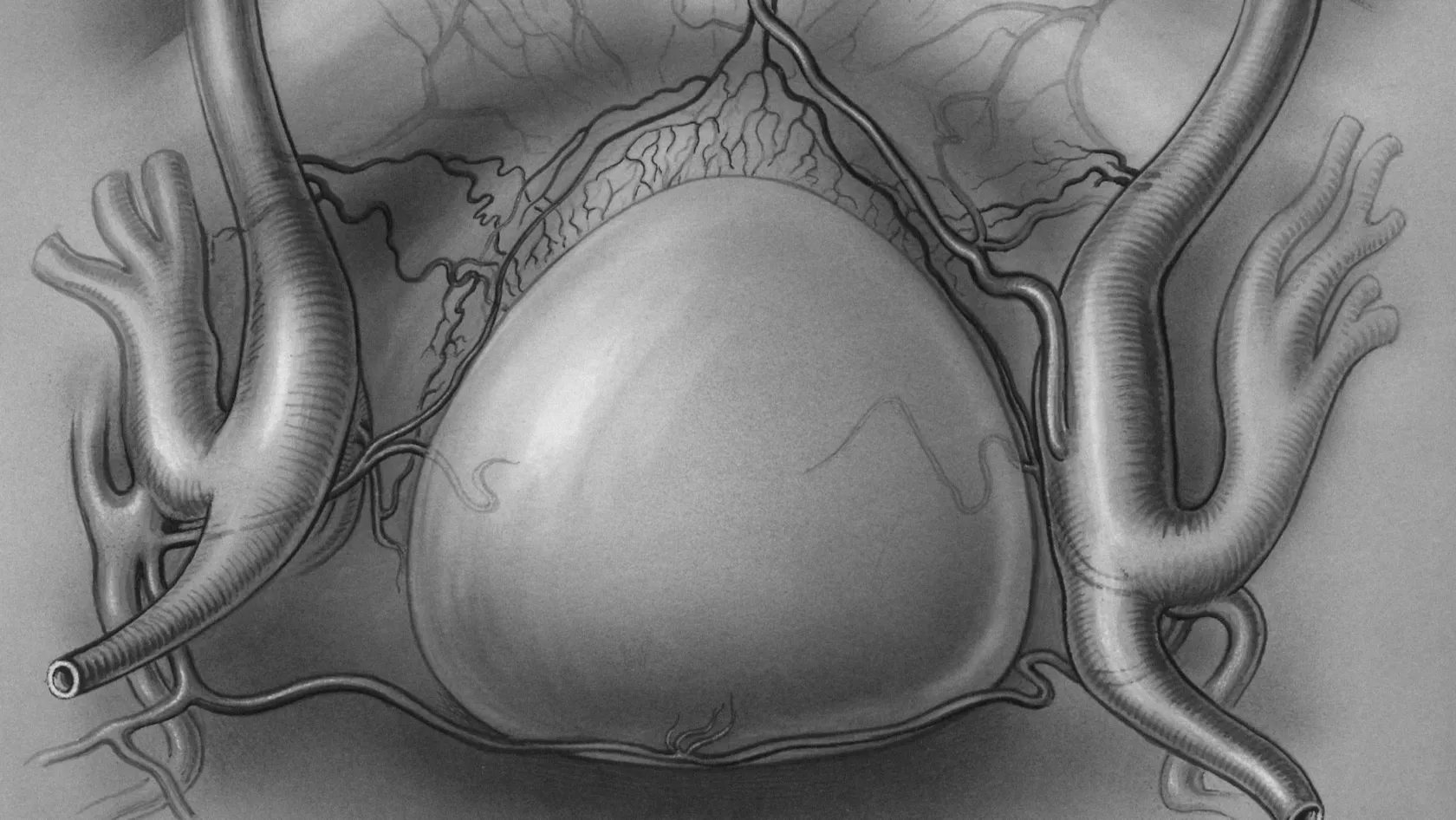
The bladder wall has four layers. The inner lining is where almost every one of these cancers begins, a thin sheet of cells that renews itself constantly and is bathed in whatever the kidneys have filtered out of the blood. Under it sits a loose connective layer carrying blood vessels, then the muscle that squeezes the bladder empty, then fat on the outside. Tumors grow into the cavity as small fronds on a stalk, or they creep sideways through the lining as a flat red patch that looks like inflammation, or they burrow downward. The first pattern is the easiest to see and the easiest to remove. The second pattern is carcinoma in situ, it is flat, it is frequently invisible under ordinary light, and it is the most dangerous of the three despite never having formed a lump. Two landmarks matter to the surgeon. The ureters enter through the back wall at two small openings, and a tumor sitting over one of them cannot be resected deeply without putting the kidney above it at risk.
Blood in the urine brings almost all of these men to a doctor, and painless blood that appears once and stops is the classic presentation everybody ignores.
The first resection decides the rest
An operating loop goes up the urethra under anesthesia and shaves the tumor off the wall in slices, and it takes twenty minutes in most cases and gets done by almost every urologist who has finished training, which is exactly why it goes wrong so quietly. This single procedure has to remove all visible cancer, sample deep enough that a pathologist can say which layer the tumor reached, and avoid making a hole in the bladder wall while doing both. A careless version achieves the third goal and neither of the others, the man walks out believing his tumor was removed, and his report then says the tumor was superficial when nobody actually looked deep enough to know.
Everything downstream inherits that error. All of it.
What has to be in the specimen
A pathologist deciding whether a tumor has entered the muscle needs muscle in the pot, because without it the deepest layer he can comment on is the one above, and the report will say so in a sentence most patients never notice. A systematic review of 31 studies covering 8,409 people with high grade disease found detrusor muscle present in the first specimen in anywhere from 30 to 100 percent of cases. Look for the word. That range reflects no biology at all. It measures how differently the same operation gets performed from one hospital to the next.
- Find the phrase detrusor muscle in your pathology report. Present, absent or not identified are the three things it can say.
- Where it says absent and your tumor was high grade or T1, the staging is provisional and a second resection is the standard answer.
- Where the report gives a grade without a stage, or a stage with no comment on muscle, request the full synoptic report from the laboratory.
- Send us that report rather than a summary letter, since the summary is where this detail disappears.
Why so much tumor gets left behind
Four things make a complete resection harder than it sounds. The bladder moves and changes shape as irrigation fluid runs in and out, so a tumor sitting on a fold at the start can be flat against the wall ten minutes later. Bleeding from the base obscures the view at exactly the moment the surgeon needs to see how deep he has gone. Cutting too deep perforates a wall that is thin at the dome and thinner still in an elderly bladder, and the fear of that perforation is what stops most surgeons short of the muscle. And flat disease at the edge of a visible tumor looks like ordinary irritated lining, so the margin gets judged by eye in a field that is red anyway. A fifth factor sits outside the operating room entirely. Lists run long, the pressure to finish is real, and a thorough resection of a large tumor takes forty minutes and not fifteen.
None of those problems has a technological answer. None. Each of them has a habit that reduces it, and habits are what separate units.
The second look
Repeat resection two to six weeks after the first is recommended for high risk disease, and the numbers behind that recommendation are blunt. Across those same 31 studies, tumor was still present at the repeat procedure in 17 to 67 percent of people originally staged Ta and in 20 to 71 percent of those staged T1. Upstaging happened too. Look again, in other words. Up to 8 percent of Ta cancers turned out to be T1 or worse, and up to 32 percent of T1 cancers turned out to have reached the muscle, which changes the treatment from an outpatient procedure into a conversation about removing the bladder.
This table scrolls sideways on a narrow screen. Drag or swipe to see every column.
| Finding | Reported range | What it changes |
|---|---|---|
| Residual tumor after Ta | 17 to 67 percent | Recurrence at one year, reported at 16 percent with a repeat against 58 percent without |
| Residual tumor after T1 | 20 to 71 percent | Progression was higher without a repeat in five of six controlled series |
| Upstaging from Ta | 0 to 8 percent | Moves a man into the high risk pathway with different follow up |
| Upstaging from T1 | 0 to 32 percent | Opens the conversation about removing the bladder |
| Overall mortality in controlled series | 22 to 30 percent with a repeat, 26 to 36 percent without | A modest signal from only two studies, reported honestly as weak |
Those ranges are wide because the studies differ in who they recruited and in how good the first resection was, and units whose first operations are thorough find less at the second look, which is the pattern you want and the one nobody publishes on themselves.
Where the leftover tumor is found
Between 36 and 86 percent of the tumor found at a repeat resection sits at the site of the original one. Read that sentence again, because it settles an argument that usually gets framed as biological, given that cancer coming back in the same spot within six weeks did not seed itself there, travel through the bloodstream or arise anew. It was never taken out. Nobody removed it. Bladder cancer does genuinely recur at new sites, since the whole lining shares the same exposure, and that is a separate phenomenon happening on a scale of months and years. What the second look keeps finding is the first operation's unfinished business.
A surgeon who accepts that finding becomes a better surgeon by the following week, without exception. A unit that refuses to look never finds out.
One dose in the first hours
The cheapest intervention in this disease
Cells shaved off a tumor float in the irrigation fluid and settle on raw bladder lining, where they implant and grow. Washing the bladder out with a chemotherapy drug within the first six hours kills them before they take hold, and the effect is large for something that costs almost nothing and adds no time to the anesthetic. Individual patient data from 11 randomized trials covering 2,278 people were pooled, comparing resection alone against resection followed by a single instillation of epirubicin, mitomycin C, pirarubicin or thiotepa, and the single dose cut the risk of recurrence by 35 percent, with a hazard ratio of 0.65 and a confidence interval from 0.58 to 0.74. Five year recurrence fell from 58.8 percent to 44.8 percent. Timing carries the whole effect. Hours and not days. Cells implant within hours, so a dose given the next morning has already missed most of what it was meant to prevent.
One dose. One in seven people avoided a recurrence entirely because of a wash that takes an hour.
The men who should not get it
The same pooled analysis found where the dose stops working and then went further than that, because in people whose tumors had already been recurring more than once a year, and in people scoring 5 or above on the European recurrence scale, the instillation prevented nothing at all. In that same high risk group the analysis picked up an increase in the overall risk of death, with a hazard ratio of 1.26 and five year death rates of 12.0 percent against 11.2 percent. Nobody has established a mechanism and the authors were careful to say so. Withhold it there. What they did say plainly is that a drug with no benefit in a subgroup should not be given to that subgroup.
- A first tumor, single, small and low grade. This is the clearest case for the immediate dose and the group that gains most.
- Several tumors at once, or a recurrence after a long gap. Still worth giving, and the benefit is real if smaller.
- Tumors returning more than once a year. No benefit was found, so the dose should be withheld and the plan should move to a course of treatment instead.
- Any suspicion that the bladder wall was perforated during the resection. The drug stays in its bottle, without exception, since chemotherapy leaking into the abdomen causes serious harm.
Seeing what white light misses
A dye that makes tumor glow
Solution put into the bladder an hour before the operation is taken up preferentially by cancer cells, which then fluoresce pink under blue light while normal lining stays blue. Raw data from prospective studies in 1,345 people were pooled. Blue light found significantly more Ta tumors and dramatically more carcinoma in situ, the flat disease that white light struggles with most. Almost a quarter of the people had at least one extra tumor visible only under blue light, and in 26.7 percent of them carcinoma in situ was seen by blue light alone. The cost of seeing more is seeing things that are not there. Inflammation, a healing resection scar and the after effects of previous bladder treatment all fluoresce, so a unit new to the technique biopsies a good deal of healthy lining during its first year. Experience corrects that, and the correction takes the same shape it takes everywhere else on this page.
Whether finding more changes anything
Detection counts as a surrogate while recurrence remains the outcome that matters, so the same analysis followed people for a year. Recurrence came out at 34.5 percent after blue light against 45.4 percent after white light alone, a relative risk of 0.761, and the effect held across risk groups and across primary and recurrent disease alike. What blue light does is make the first operation more complete, which is the theme of this entire page arriving from a different direction.
When the bladder has to come out
The other path, and who it suitsRadiotherapy combined with chemotherapy, after a complete resection, can preserve the bladder in carefully selected people. Candidates have a single tumor, no carcinoma in situ anywhere else in the bladder, no blockage of either kidney, and a bladder that still holds urine and empties it properly. The trade is a bladder kept against a lifetime of surveillance through that bladder and a chance of needing the operation later anyway. Any unit that presents removal as the only option has skipped a conversation you are entitled to have, and any unit that presents preservation as equivalent for everybody has oversold it. We say which of the two we think fits your case and we say why, in writing, before you travel.
Chemotherapy before the operation
Men referred for bladder removal frequently ask to have the surgery first and the chemotherapy afterward, which feels like the sensible order and is the wrong one, so consider the randomized trial that assigned 307 people with muscle invasive disease either to surgery alone or to three cycles of chemotherapy followed by surgery. Order matters. Median survival came out at 46 months in the surgery alone group and 77 months in the group given chemotherapy first. The mechanism showed up in the specimens. Cancer had been completely eliminated from the removed bladder in 38 percent of the chemotherapy group against 15 percent of the surgery alone group, and in both arms the people with no residual cancer lived longest.
- Chemotherapy first works on disease that has already left the bladder microscopically, which surgery cannot reach and scans cannot see.
- It gets delivered while you are still well, and after a major operation a substantial share of people are never fit enough to receive it.
- It provides a live test of whether your particular cancer responds to the drugs, and the answer to that guides everything afterward.
- Kidney function decides eligibility, so a blocked kidney needs draining before the question can even be asked.
Wide table. Scroll sideways on a narrow screen to reach the last column.
| Measure | Surgery alone | Chemotherapy then surgery |
|---|---|---|
| People assigned | 154 | 153 |
| Median survival | 46 months | 77 months |
| No cancer left in the removed bladder | 15 percent | 38 percent |
| Cost of the approach | Faster to the operation | Roughly three months of treatment before it |
Three months feels like a long delay to somebody who has just been told he has cancer. The trial says those months buy years.
How far the node dissection goes
A trial that argued against more surgery
Surgeons removing a bladder also remove the pelvic lymph nodes, and for two decades the profession assumed that taking more of them would save more lives. 592 people were randomly assigned during surgery to a standard dissection or to an extended one reaching up to the common iliac, presciatic and presacral groups, at 27 sites, by 36 surgeons, with 57 percent having already had chemotherapy. After a median of six years the extended group had five year disease free survival of 56 percent against 60 percent in the standard group. Overall survival came out at 59 percent against 63 percent. Neither difference favored the bigger operation. More surgery, no gain.
What the extra dissection costSerious adverse events occurred in 54 percent of the extended group against 44 percent of the standard group. Death within ninety days of surgery occurred in 19 of 292 people after the extended dissection and in 7 of 300 after the standard one, which is 7 percent against 2 percent. Read those two figures together with the survival curves and the conclusion assembles itself. A larger operation with no survival benefit and a tripled early mortality is a larger operation nobody should be selling. We do a standard bilateral dissection and we can explain in one sentence why, which is a better answer than a longer operating time offered as evidence of thoroughness.
Robot or open
What the randomized comparison showed
350 people at 15 centers were randomly assigned to robotic or open bladder removal, with the urinary diversion built outside the body in both arms. Two year progression free survival came out at 72.3 percent after robotic surgery and 71.6 percent after open surgery, a difference of 0.7 percentage points, which established that the robotic version is not worse. Complications were similar, occurring in 67 percent of the robotic group and 69 percent of the open group, while urinary infection was more frequent after robotic surgery at 35 percent against 26 percent, and a sluggish bowel afterward affected a fifth of each group.
How to use that result
Non inferior means as good, and it does not mean better, since robotic bladder removal buys less blood loss and smaller wounds, costs more, and delivers the same cancer outcome in the hands of surgeons experienced enough to be included in a trial. The decision belongs to the surgeon's own experience rather than to the equipment list.
This table scrolls sideways on a narrow screen. Drag or swipe to see every column.
| Measure | Robotic | Open |
|---|---|---|
| Free of progression at two years | 72.3 percent | 71.6 percent |
| Any adverse event | 67 percent | 69 percent |
| Urinary infection | 35 percent | 26 percent |
| Sluggish bowel afterward | 22 percent | 20 percent |
What replaces the bladder
A pipe or a pouch
Urine has to leave the body somehow and bowel is the only material available, so a conduit uses a short segment of small intestine as a pipe, joining the ureters to one end and bringing the other end out through the skin as a spout, with a bag worn over it. A neobladder uses a longer segment opened out and folded into a sphere, joined to the ureters above and to your own urethra below, so urine leaves the way it always did. Both take the same bowel, both add an hour or two to the operation, and both carry the same cancer outcome. Bowel either way.
The honest comparison nobody puts in a brochureA conduit is simpler, shorter, more forgiving of poor kidney function and easier for an older or frailer person to manage. Its cost is a bag and the way a bag changes how a man sees himself. A neobladder keeps the appearance and most of the function of normal urination, and its costs are real and frequently understated. Leaking at night affects a large share of people and many sleep with an alarm or empty by clock. Some people never empty the pouch properly by squeezing and have to pass a catheter several times a day for life, and that possibility has to be accepted in advance rather than discovered afterward. A neobladder needs good kidney function, a urethra free of cancer and a person able to commit to a training program lasting months. Choosing the pouch because the pipe sounds worse, without accepting the catheter possibility, is the commonest regret in this operation.
What decides it in practice
Kidney function, liver function, the state of the urethra, the cancer's position, the person's dexterity and eyesight, and an honest account of how much daily maintenance they want. We go through all seven before the date is set and we write down which one is driving the recommendation, since a unit offering a neobladder to everybody has stopped assessing and a unit offering a conduit to everybody has stopped listening.
The operation and the hospital stay
The day itself
Bladder removal runs four to seven hours under general anesthesia, and the diversion accounts for much of that. Out comes the bladder with the prostate in men and with the uterus and a cuff of vagina in women, along with the pelvic nodes, after which bowel gets divided, the segment taken, the remaining ends rejoined and the diversion built. Tubes come out of you afterward, usually a drain, stents running down from each kidney and a catheter of some kind, and each one leaves on its own schedule over the first two to three weeks. Two facts concerning the bowel deserve stating in advance. Taking a segment out shortens the intestine permanently, which changes how some people absorb food and loosens the stool for a period measured in months. And the join made between the two remaining ends is the most consequential stitch line in the whole operation, since a leak there is the complication that turns a ten day stay into a six week one.
Living with a diversion
The first six months
Conduits become routine faster than most people expect, with the learning taking two weeks and the confidence taking longer. A neobladder takes far more work, because a pouch made of bowel has no nerves telling you it is full and no muscle to squeeze it empty, so you learn to void by clock and by relaxing the pelvic floor while pressing gently on the abdomen. Daytime control arrives over three to six months and night control later, if at all, so anybody promising you a neobladder that behaves like a bladder within weeks has never managed one.
Surveillance, and why it never stops
Two different schedules
Anyone keeping his bladder has a camera passed into it at intervals that start at three months and stretch out over years, with the schedule set by risk rather than by the calendar. The appointments never end. This is the part of the disease people find hardest, since the appointments never truly end and each one carries the possibility of starting again. A man whose bladder has gone is watched differently, with scans and blood tests looking for recurrence in the pelvis, the nodes or elsewhere, and with the upper urinary tract watched because the lining of the kidneys and ureters shares the same vulnerability.
Stopping smoking changes both schedules. It is the only thing on this page you control yourself, and it lowers the chance of recurrence in people who have already been diagnosed.
Cost, travel and flying home
The two operations need completely different plans. Two lengths of stay, then. A resection through the urethra needs four to six nights here, covering assessment, the procedure, a night in hospital and a few days within reach while the bleeding settles. Bladder removal needs four to six weeks, which surprises people, and the arithmetic behind that number deserves laying out in full. Seven to twelve nights of it are spent in hospital, the stents stay in for two to three weeks after that, the first stoma or pouch training runs alongside all of it, and nobody should board a long flight with a fresh bowel join and a body still deciding whether it will develop a complication.
After a resection, most people fly at day three or four, once the urine has cleared and no clot has blocked anything, while after bladder removal we clear people only when the stents are out, the wound is dry, the bowel is working normally, kidney function is stable and they can manage the diversion without help. That point arrives between week four and week six for most people and later for some, and clot risk stays raised for six weeks after pelvic and bowel surgery, so injections continue at home for a month and stockings go on for the flight. Book a changeable ticket and assume you will change it.
Send us the resection pathology report in full rather than the summary, the operation note if you have it, the CT scan of the chest, abdomen and pelvis with the images themselves, your kidney function, your full medication list and a note of every previous abdominal operation. Send everything. A urologist reads all of it and writes back at no charge, and where our timing or our plan differs from what you were told at home, the reply will say so plainly. Cost here moves with four things, namely which operation is being done, whether chemotherapy is given first and where, which diversion is built, and how many nights the hospital stay runs to. Get those four in writing before you commit to anything. Send the images themselves and not only the radiology report, since a scan reported elsewhere gets read again here and the second reading occasionally changes the plan.
One person, start to finish. One coordinator carries the whole episode, which matters more for this than for almost anything else we do, since bladder removal is not a single visit but a sequence with chemotherapy, surgery and training in it. She stays reachable on WhatsApp long after you fly home. English, Arabic, French, Russian, Serbian, Romanian and Spanish are spoken in the building and anything else is interpreted on request, and a companion sleeps in the room, which for a stay this long counts as a necessity and not a courtesy. Hotel and airport transfers are arranged around the dates, halal, vegetarian and diabetic meals are ordinary here, a prayer room sits on the ground floor, and visa invitation letters go out roughly ten days ahead. Stoma supplies for three months go home with you, and follow up costs nothing once you are home, so send the blood tests, the scans and the kidney function results as they come and a urologist here will read every one of them.
No prices appear on this page. Any figure quoted before a urologist has read your pathology is a number chosen to win an inquiry.
Bladder cancer surgery FAQ
Seven questions arrive in almost every first message about this disease.
Will I lose my bladder?
Why does a second resection get recommended?
Should I have chemotherapy before surgery?
Conduit or neobladder?
Is the robot better for removing a bladder?
What is the single dose of chemotherapy after resection?
How long do we need to be in Istanbul?
References
- Cumberbatch MGK, Foerster B, Catto JWF, Kamat AM, Kassouf W, Jubber I, et al. Repeat transurethral resection in non-muscle-invasive bladder cancer, a systematic review. European Urology. 2018;73(6):925-933.
- Sylvester RJ, Oosterlinck W, Holmang S, Sydes MR, Birtle A, Gudjonsson S, et al. Systematic review and individual patient data meta-analysis of randomized trials comparing a single immediate instillation of chemotherapy after transurethral resection with transurethral resection alone in patients with stage pTa-pT1 urothelial carcinoma of the bladder. European Urology. 2016;69(2):231-244.
- Burger M, Grossman HB, Droller M, Schmidbauer J, Hermann G, Dragoescu O, et al. Photodynamic diagnosis of non-muscle-invasive bladder cancer with hexaminolevulinate cystoscopy, a meta-analysis of detection and recurrence based on raw data. European Urology. 2013;64(5):846-854.
- Grossman HB, Natale RB, Tangen CM, Speights VO, Vogelzang NJ, Trump DL, et al. Neoadjuvant chemotherapy plus cystectomy compared with cystectomy alone for locally advanced bladder cancer. New England Journal of Medicine. 2003;349(9):859-866.
- Lerner SP, Tangen C, Svatek RS, Daneshmand S, Pohar KS, Skinner E, et al. Standard or extended lymphadenectomy for muscle-invasive bladder cancer. New England Journal of Medicine. 2024;391(13):1206-1216.
- Parekh DJ, Reis IM, Castle EP, Gonzalgo ML, Woods ME, Svatek RS, et al. Robot-assisted radical cystectomy versus open radical cystectomy in patients with bladder cancer (RAZOR), an open-label, randomised, phase 3, non-inferiority trial. Lancet. 2018;391(10139):2525-2536.
Editor's note
Written by the Biruni Hospital medical editorial team. Reviewed by Gökhan Yazıcı, Urology.
Medically reviewed by

Gökhan Yazıcı
Urology
Related Treatments
View All
Fusion Biopsy Prostate - MRI-Guided Prostate Biopsy
Software builds a model of your prostate from the MRI and another from the live ultrasound, then deforms one onto the other so the lesion lands somewhere the needle can reach. Every step of that carries a few millimeters of error. This page covers where the error comes from, what the trials comparing the three targeting methods found, who draws the outline the needle aims at, and why good units still take cores from the rest of the gland.

Inflatable Penile Prosthesis
An inflatable penile prosthesis has three parts, and only one of them gets discussed. The reservoir sits inside the abdomen, decides where the operation gets difficult, and causes most of the reoperations men end up needing. This guide covers the hydraulics, the move from the space of Retzius to high submuscular placement, the evidence on palpability and auto inflation, the link between blood sugar control and infection, recovery week by week, and what the operation means in Istanbul.
Kidney Cancer Surgery - Renal Cancer Surgery
Kidney cancer surgery means two different operations, and the choice between them is made from a scan before anyone knows what the tumor is. The only randomized comparison found that sparing the kidney protected kidney function and did not extend life. This page works through that result, the clamp and the clock, biopsy before surgery, surveillance, and what changed when the disease has already spread.
Kidney Stone Surgery
Three measurements on a CT decide which kidney stone procedure suits you, and none of them is a brand name. The stone free rate a clinic advertises is a different kind of number, because it depends on how hard that clinic looked afterward. This page covers shockwaves, ureteroscopy and percutaneous surgery, what the randomized trials found, and why half of stone formers come back.
Laparoscopic Prostatectomy
Keyhole removal of the prostate inflates your abdomen with carbon dioxide, tips you head down for hours and works through straight rods that cannot bend at the tip. This page covers what each of those three does to your body, which route through the abdomen suits you, how to read the continence figure a clinic quotes, and where the randomized trials favor a robot instead.