
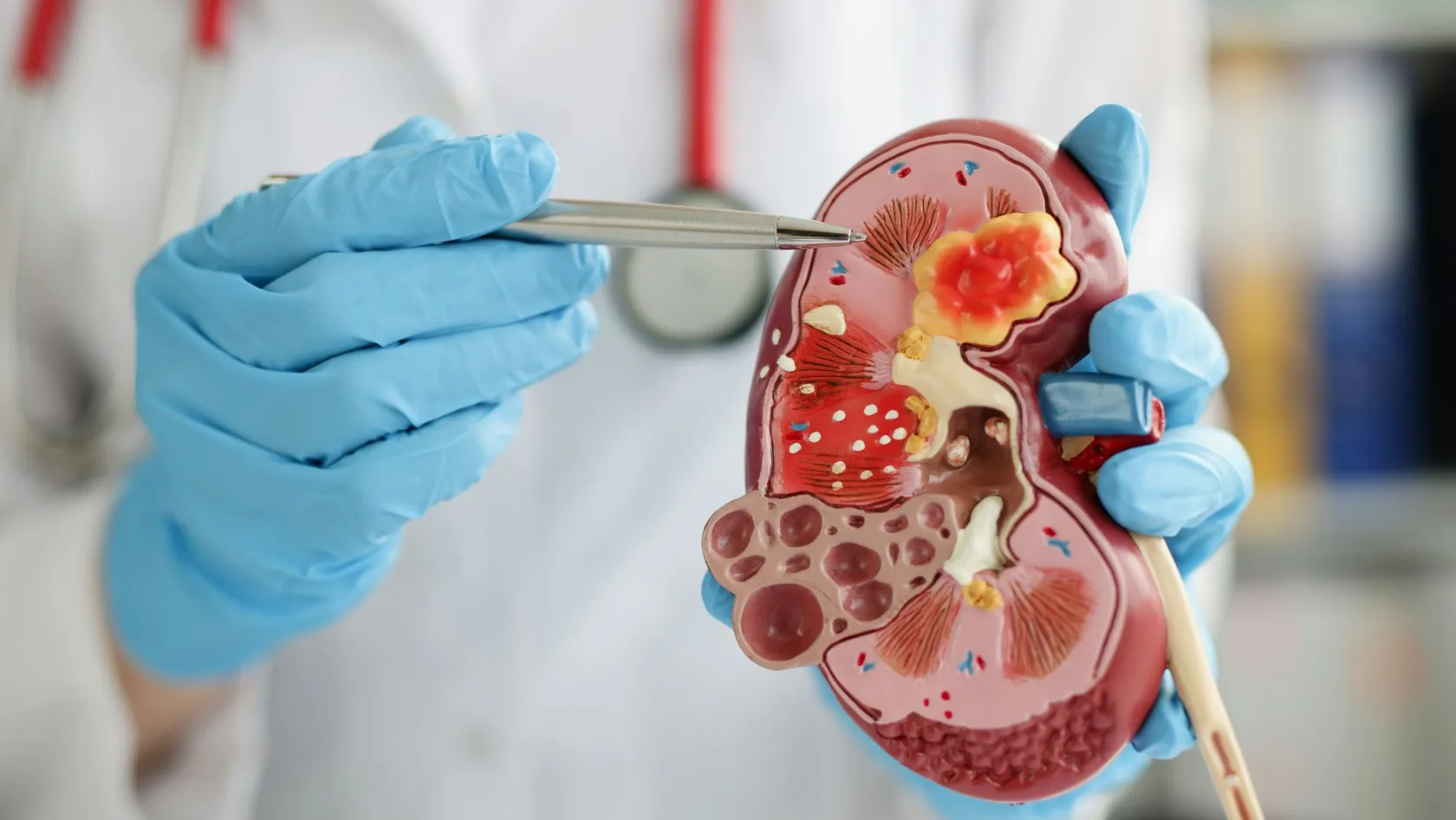
Kidney Cancer Surgery - Renal Cancer Surgery
Kidney cancer surgery means two different operations, and the choice between them is made from a scan before anyone knows what the tumor is. The only randomized comparison found that sparing the kidney protected kidney function and did not extend life. This page works through that result, the clamp and the clock, biopsy before surgery, surveillance, and what changed when the disease has already spread.
About This Department
Saving the kidney protects the kidney. Protecting the person is a separate question.
One randomized trial has ever compared removing a kidney with cutting the tumor out of it, and the result ran against what every surgeon expected. Kidney function held up far better after the sparing operation. Survival did not follow. This page works through that finding, what it does and does not license, and the five other decisions that sit around it.
A tumor nobody was looking for
Almost nobody arrives at this diagnosis through symptoms anymore.
Somebody scans your abdomen for gallstones, for back pain, for a stone that woke you at four in the morning, and the radiologist notices something on a kidney that has nothing to do with why you came. A generation ago the presentation was different and much worse, since people turned up with blood in the urine, a dull ache in the flank and a lump somebody could feel, and by then the cancer had usually been growing for years. Scanners changed that. Tumors now get caught at three centimeters instead of ten, which sounds like unqualified progress and mostly is, except that it has handed a large group of people a new and harder problem. A small mass on a scan is not the same object as a cancer somebody can feel, because some of these growths are not cancer at all, plenty of the ones that are cancer will never trouble the person carrying them, and the imaging that found the mass cannot reliably sort one from another.
First comes a decision that has nothing to do with which operation. Whether to operate at all.
Two operations wearing one name
Kidney cancer surgery describes two procedures that share almost nothing beyond the organ they concern. One takes the whole kidney. The other takes the tumor and leaves the kidney working. Both are routinely called an operation for kidney cancer, both appear under the same heading on hospital websites, and the gap between what they cost you is the real subject of this page.
Choosing between them happens before anybody knows what the tumor is. No biopsy is taken in most cases, the histology arrives a week after the operation, and the surgeon commits on the strength of a picture and a measurement.
Plain words for the terms on this page
Renal serves as the medical adjective for anything to do with the kidney, so renal cancer and kidney cancer name one disease. Renal cell carcinoma, shortened to RCC, covers the great majority of those cancers. Radical nephrectomy means removing the whole kidney along with the fat around it, while partial nephrectomy, also called nephron sparing surgery, means cutting the tumor out and repairing the kidney that remains around the hole. A nephron means the microscopic filtering unit, and each kidney holds around a million of them. eGFR gives a blood test estimate of how much filtering capacity you have left, where sixty and above counts as intact and thirty and below counts as advanced kidney disease. T1a labels a tumor up to four centimeters, T1b one between four and seven. Ischemia means the minutes during which blood flow to the kidney is clamped off while the tumor is cut away, cytoreductive nephrectomy means removing the primary tumor in somebody who already has secondary deposits elsewhere, and adjuvant treatment means drugs given after surgery to lower the chance of the cancer returning. Ablation means destroying a tumor in place with cold or heat instead of cutting it out. Oncocytoma and angiomyolipoma are two common benign growths that imitate cancer on a scan.
The two operations side by side
A radical nephrectomy lifts out the kidney, the fat capsule around it and sometimes the adrenal gland above, tying off the renal artery and vein and dividing the ureter, and that operation runs quicker, comes out technically easier, bleeds less and leaves nothing behind that could harbor tumor. A partial nephrectomy is a different kind of work. The surgeon exposes the kidney, finds the artery, usually clamps it, cuts the tumor out with a rim of normal tissue, closes the bleeding bed with sutures and releases the clamp against a clock. More can go wrong. Bleeding afterward, a leak of urine from the cut collecting system and a return to theater are all measurably more common.
What actually decides between them
Three things, in this order. How big the tumor is and where it sits inside the kidney, since a small growth on the outer surface is straightforward to shell out while one buried against the collecting system is not. How much kidney you have to lose, which depends on the other side and on your baseline blood tests, and finally whether the surgeon in front of you does the harder operation frequently enough to do it well.
The trial that surprised everybody
European centers spent eleven years recruiting people with a solitary kidney tumor of five centimeters or less and a normal kidney on the other side, then allocated them at random to have the whole kidney removed or to have the tumor cut out. Five hundred and forty one patients went in before the study closed early for slow recruitment. Everyone involved expected the sparing operation to win, or at worst to prove itself no worse, because that was the whole point of running the trial. Median follow up reached nine and a third years. At ten years, 81.1 percent of the group who lost a kidney were alive against 75.7 percent of the group whose kidney was spared, a hazard ratio of 1.50 that failed the noninferiority test and passed the test for superiority of the radical operation.
Of the 117 deaths recorded across the whole trial and its nine years of follow up, only 12 were caused by kidney cancer. Four followed removal of the kidney and eight followed sparing it. Whatever separated the two groups over a decade, it was mostly not this disease.
What the same trial said about the kidney
Four years later the investigators went back to the same patients and looked at blood tests. Kidney function had been measured all along.
Taking the lowest eGFR recorded during follow up for each person, 85.7 percent of those who lost a kidney dropped below sixty at some point against 64.7 percent of those whose kidney was spared, an absolute difference of twenty one percentage points. So the sparing operation did exactly what it was designed to do. Then the gap stopped widening. Advanced kidney disease, meaning an eGFR under thirty, appeared in 10.0 percent after removal and 6.3 percent after sparing, a difference of under four points that the confidence interval could not separate from zero. Kidney failure, an eGFR below fifteen, occurred in 1.5 percent and 1.6 percent respectively, which is to say identically, so the organ was protected in the middle of the scale and left unprotected at the end of it, and the end of the scale is where dialysis lives.
Holding both results at once
Two readings of this trial circulate and each one takes half the evidence. The enthusiasts point at the twenty one point gap in kidney function, note that chronic kidney disease shortens lives in every other setting, and conclude that the survival finding must be a fluke of an underpowered study that closed early. Skeptics point at the hazard ratio of 1.50 and ask why a kidney worth saving produced no survival dividend across a decade of follow up, and neither camp is being unreasonable, though both argue past the finding that actually reconciles them, which is that surgically induced kidney impairment behaves differently from the kidney disease caused by diabetes and hypertension. Losing a kidney to a knife leaves a healthy remnant working harder. Losing kidney tissue to decades of vascular damage leaves diseased tissue everywhere. Those two situations produce the same number on a blood test and do not carry the same future.
Which is the humbling part. The number was never the point.
Practice did not swing back toward removing kidneys after this trial reported, and it should not have. For a small tumor in an accessible position the sparing operation remains standard, partly because later observational work in far larger populations does associate it with better survival, and partly because the trial's own subgroup of confirmed cancers showed no significant difference at all. What the trial did kill is the argument that sparing a kidney is so obviously superior that it justifies stretching the operation into tumors too big or too deep for it, and units that keep making that argument are quoting an intuition rather than a result.
When the kidney has to come out whole
Some situations remove the choice, and a surgeon who offers to spare a kidney in any of them is either very good or not being straight with you.
- A tumor filling much of the kidney, where what would be left is too little to bother preserving.
- A tumor growing into the renal vein or up into the vena cava, which turns the operation into vascular surgery.
- Enlarged lymph nodes at the hilum, since these have to come out with the specimen.
- A tumor wrapped around the collecting system and the main vessels, where cutting it free means reconstructing the kidney's plumbing under a clamp.
- A person whose other kidney is entirely normal and whose tumor sits in a position that makes sparing it a long, bloody undertaking with no functional payoff.
Adrenal glands used to come out routinely with the kidney and no longer do. Unless the gland looks abnormal on the scan or the tumor sits at the very top of the kidney, it stays, and asking whether yours is being removed is a quick way to find out how current a unit's practice is.
Clamping, and the clock
Kidneys bleed. To cut a tumor out of one and sew the hole closed, most surgeons put a clamp across the renal artery first, which empties the working field and makes precise cutting possible, and from that moment the kidney is running without a blood supply while somebody works against a stopwatch. Warm ischemia names those minutes. Under twenty five is the figure surgeons quote among themselves, damage accumulates after that, and the injury is to the remnant they are trying to save rather than to the part being removed.
Narrow screens scroll this table sideways. Swipe or drag to reach every column.
| Approach | What happens | Trade off |
|---|---|---|
| Main artery clamped | The whole kidney goes without blood while the tumor is removed and the bed closed | A clear field and controlled cutting, paid for in ischemia minutes |
| Selective branch clamped | Only the branch feeding the tumor is occluded, so the rest keeps its circulation | Less tissue starved, more dissection and more bleeding in the field |
| No clamp at all | The tumor is enucleated with the kidney perfused throughout | Zero ischemia, greater blood loss, and it suits only small peripheral tumors |
Open, laparoscopic or robotic
How the surgeon gets in matters less than what gets done once inside, and marketing on hospital pages reverses that emphasis almost without exception.
Drag the table below sideways where a phone cuts off the last column.
| Route | Best suited to | What you notice |
|---|---|---|
| Robotic partial nephrectomy | Most tumors suitable for sparing, including awkward posterior ones | Small incisions, short stay, sewing under a clamp done comfortably |
| Laparoscopic radical nephrectomy | Whole kidney removal where no vein involvement exists | Three or four ports, one slightly larger to extract the specimen |
| Open surgery | Very large tumors, vein or vena cava involvement, complex reconstructions | A flank or midline incision, a longer stay, a slower first month |
| Ablation through the skin | Small peripheral tumors in people who should avoid an operation | A needle, sedation or a short anesthetic, home the same or next day |
Questions that separate units
Four of them, and they take a minute to answer.
- How many partial nephrectomies does this surgeon perform in a year, and what proportion of their kidney cancer work is partial rather than radical.
- What is the usual warm ischemia time here, and is it recorded in the operation note.
- Under what circumstances would a planned partial be converted to a radical during the operation.
- Is the adrenal gland being removed, and on what grounds.
The ones that turn out not to be cancer
Read the randomized trial's own entry criteria and one phrase stands out. Patients were enrolled with tumors suspicious for renal cell carcinoma. Proven cancer was never a requirement for entry, and when the analysts later narrowed the comparison to patients whose specimens came back malignant the numbers moved, which can only mean that somebody in that trial had been operated on for something other than cancer. Oncocytoma is the usual culprit, a benign growth that looks on a scan very much like the cancer it imitates, and fat poor angiomyolipoma is the other. No radiologist in the world separates these reliably by eye on a contrast scan.
A needle can. Percutaneous biopsy of a kidney tumor has become routine in units that think carefully about small masses, takes twenty minutes under local anesthetic and answers the one question the scan cannot, and the old objections to it have not held up, since tumor seeding along the needle track turned out to be vanishingly rare while the samples come back diagnostic far more reliably than the technique's reputation suggests. What a biopsy changes is who gets operated on. A person told their three centimeter mass is an oncocytoma stops being a cancer patient that afternoon, and a person whose biopsy shows a high grade clear cell cancer stops wondering whether surveillance would have been reasonable.
One question to put to a surgeon, then. Why not biopsy it first.
Watching instead of cutting
Twenty one studies covering 1,386 people followed small kidney masses with repeated scans rather than removing them, and a systematic review pooled what those scans showed. Mean age came to sixty nine. Average follow up ran thirty nine months. Across all the tumors, the mean growth rate came to 0.27 centimeters a year, which is slow enough that a three centimeter mass would take a decade and a half to reach seven. That much surprised nobody. The finding that matters more is what happened when investigators separated the benign masses from the malignant ones, because benign growths grew at 0.3 centimeters a year and cancers grew at 0.35, a difference no clinician could act on, which leaves growth rate, the one measurement surveillance programs are built around, unable to tell you whether the thing you are watching is cancer.
An uncomfortable result, with a practical consequence. Surveillance suits people whose competing health problems make an operation the larger risk, and it works because most small masses behave indolently rather than because watching them reveals anything. Anybody who wants to know what they are carrying needs the needle.
Freezing and burning in place
Between surgery and surveillance sits a third option. Needles are passed through the skin into the tumor under scan guidance and the tissue is destroyed where it lies, either by freezing it in repeated cycles or by heating it with radiofrequency current. Nothing comes out. The dead tumor stays in the kidney and shrinks slowly over years, which means follow up scans read differently and a radiologist has to know what was done.
Who it genuinely suits
Older people with other illnesses, anyone in whom an anesthetic is the bigger threat, people with a solitary kidney and a small peripheral tumor, and those with inherited syndromes who face repeated treatments over a lifetime. Local recurrence runs higher than after cutting the tumor out, though repeat ablation remains possible, while tumors near the collecting system or the bowel make poor candidates and anything much above three centimeters starts to outrun what a single needle can cover.
The year after the operation
For decades the answer to what happens next was nothing. Surgery removed the tumor, scans followed at intervals, and every drug tried afterward failed to improve on that. Immunotherapy changed the answer for one group of people.
What adjuvant treatment now buys
Nine hundred and ninety four people at high risk of recurrence after their kidney came out were randomized to a year of pembrolizumab or to placebo, seventeen infusions three weeks apart, with neither patient nor doctor knowing which. At two years, 77.3 percent of the treated group were alive and free of disease against 68.1 percent on placebo, a hazard ratio of 0.68. Survival at the same point stood at 96.6 percent against 93.5 percent. None of that comes free. Serious adverse events of any cause occurred in 32.4 percent of treated patients against 17.7 percent on placebo, and immune drugs cause thyroid, bowel, liver and skin problems that occasionally persist after the drug stops, while seventeen infusions across a year also means seventeen hospital appointments, which for anybody who flew in for surgery turns into a practical question about whether the drug can be given closer to home instead. In most countries it can, and settling that before you leave saves a great deal of trouble afterward.
High risk of recurrence is a defined category rather than a feeling. It rests on the stage, the grade and whether deposits elsewhere were removed at the same time, and anyone outside that category gains nothing from a year of infusions while keeping the whole side effect profile.
Surveillance after surgery means scans and blood tests on a schedule that thins out over five to ten years, tighter for higher stage disease and looser for a small tumor removed cleanly, with chest and abdomen both imaged every time because the lungs are where this cancer goes first and a missed deposit there costs more than any other. A creatinine measurement rides along. The kidney you kept is doing the work of two, and somebody should be watching it.
The day itself and the weeks after
Expect two to three hours under general anesthetic for a robotic partial nephrectomy. You wake with small port incisions, one drain in many units, a catheter that comes out the next morning and less pain than people expect from abdominal surgery. Radical nephrectomy through the same route takes less time again. Open surgery through a flank incision hurts considerably more for the first week, because the incision runs between ribs and every breath uses those muscles.
- Day one, sitting out of bed, drinking, walking the corridor. The urinary catheter usually goes.
- Days two to four, the drain comes out once its output is low and clear, and most people go home in this window after a keyhole operation.
- Week one to two, tiredness far out of proportion to the size of the wounds. This is normal and it lifts.
- Week two to six, no lifting beyond a few kilograms, particularly after a partial where a repaired kidney bed is healing under pressure.
- Six weeks onward, full activity for most people, with a blood test to see where the kidney has settled.
Two complications belong specifically to the sparing operation and both declare themselves after you think you are through the worst. Bleeding from the repaired bed can appear in the second week as sudden flank pain and blood in the urine, and a urine leak from a cut collecting system shows up as persistent drain output or a collection on a scan. Both get managed without another operation in most cases. Both give you a reason to stay reachable during the weeks when you feel recovered.
When it has already spread
Removing the primary tumor in somebody who already has deposits in the lungs or bones was standard practice for twenty years, supported by trials from the era before modern drugs, until 450 patients with intermediate or poor risk metastatic disease were randomized either to have the kidney removed and then start sunitinib or to take sunitinib alone and leave the tumor where it sat. Drug alone proved noninferior. Median survival came to 18.4 months without the operation against 13.9 months with it, and response rates and progression free survival showed no meaningful separation either. Nobody claims this abolishes surgery in advanced disease, since the trial deliberately enrolled people at higher risk and excluded the favorable group. What it abolished is the assumption that the kidney should come out first as a matter of course. Risk group does the work in that sentence. People with favorable features and a single small deposit were never enrolled, and for them surgery followed by removal of the deposit still produces the best results anybody has recorded.
A second trial tested the order rather than the operation. Ninety nine patients were assigned to immediate surgery followed by sunitinib or to three cycles of sunitinib followed by surgery, and the deferred group lived a median of 32.4 months against 15.0 months.
That trial closed early with too few patients to settle anything on its own, and its primary measure, the proportion free of progression at twenty eight weeks, came out identical between the arms at 42 and 43 percent. The survival difference is a secondary finding from a small study and should be read as such. Its mechanism repays attention, because giving the drug first reveals who responds to it. Fourteen of the forty nine patients in the deferred group progressed during those three cycles, and each was spared an operation that would have helped them not at all. Ninety eight percent of the deferred group actually received the drug against eighty percent of those operated on first, because surgery keeps a share of people from ever starting the treatment that was supposed to follow it.
Having the operation in Istanbul
Send the CT or MRI, your creatinine and eGFR, and anything a pathologist has already written, and a urologist reads all of it and writes back with a view on whether the kidney can be saved. That opinion costs nothing and obliges you to nothing. Our team works in English, Arabic, French, Russian, Serbian, Romanian and Spanish, with interpreting arranged for other languages on request, and one coordinator stays with you from the first message through to discharge and afterward on WhatsApp once you are home. A companion sleeps in your room on a bed we provide, hotel nights either side of the admission and every airport and clinic transfer are arranged for you, and an invitation letter for a visa application goes out roughly ten days before you fly. Meals come halal, vegetarian or adjusted for diabetes, and there is a prayer room on the ward floor.
We publish no figures on this page. How much the treatment costs turns on which operation you need, whether it is done by keyhole or open, how many nights the ward keeps you and whether a year of adjuvant infusions enters the plan, and none of that can be settled before somebody has read your scan. A price quoted before that point is a number chosen to win an inquiry.
Kidney cancer surgery FAQ
Seven questions arrive in almost every first message we receive.
Can I live normally with one kidney?
Is partial nephrectomy always better?
Should my tumor be biopsied before surgery?
My tumor is small and I am elderly. Must I have surgery?
Do I need treatment after the operation?
It has already spread. Is surgery still worth it?
How long before I can fly home?
References
- Van Poppel H, Da Pozzo L, Albrecht W, Matveev V, Bono A, Borkowski A, Colombel M, Klotz L, Skinner E, Keane T, Marreaud S, Collette S, Sylvester R. A prospective, randomised EORTC intergroup phase 3 study comparing the oncologic outcome of elective nephron-sparing surgery and radical nephrectomy for low-stage renal cell carcinoma. European Urology. 2011;59(4):543-552.
- Scosyrev E, Messing EM, Sylvester R, Campbell S, Van Poppel H. Renal function after nephron-sparing surgery versus radical nephrectomy. Results from EORTC randomized trial 30904. European Urology. 2014;65(2):372-377.
- Méjean A, Ravaud A, Thezenas S, Colas S, Beauval JB, Bensalah K, Geoffrois L, Thiery-Vuillemin A, Cormier L, Lang H, Guy L, Gravis G, Rolland F, Linassier C, Lechevallier E, Escudier B. Sunitinib alone or after nephrectomy in metastatic renal-cell carcinoma. New England Journal of Medicine. 2018;379(5):417-427.
- Bex A, Mulders P, Jewett M, Wagstaff J, van Thienen JV, Blank CU, van Velthoven R, Del Pilar Laguna M, Wood L, van Melick HHE, Aarts MJ, Lattouf JB, Powles T, Haanen J. Comparison of immediate versus deferred cytoreductive nephrectomy in patients with synchronous metastatic renal cell carcinoma receiving sunitinib. The SURTIME randomized clinical trial. JAMA Oncology. 2019;5(2):164-170.
- Choueiri TK, Tomczak P, Park SH, Venugopal B, Ferguson T, Chang YH, Hajek J, Symeonides SN, Lee JL, Sarwar N, Thiery-Vuillemin A, Gross-Goupil M, Mahave M, Haas NB, Sawrycki P, Powles T. Adjuvant pembrolizumab after nephrectomy in renal-cell carcinoma. New England Journal of Medicine. 2021;385(8):683-694.
- Nayyar M, Cheng P, Desai B, Cen S, Desai M, Gill I, Duddalwar V. Active surveillance of small renal masses. A review on the role of imaging with a focus on growth rate. Journal of Computer Assisted Tomography. 2016;40(4):517-523.
Editor's note
Written by the Biruni Hospital medical editorial team. Reviewed by Assoc. Prof. Dr. Emre SALABAŞ, Urology.
Medically reviewed by

Assoc. Prof. Dr. Emre SALABAŞ
Urology
Related Treatments
View All
Bladder Cancer Surgery
Bladder cancer is treated by two operations that share almost nothing. One scrapes tumor off the inside wall through the urethra in twenty minutes. The other removes the bladder and rebuilds the route urine takes out of the body. The short one is treated everywhere as a minor procedure, and how well it is done decides the staging, the recurrence rate and whether the long one ever becomes necessary.
Fusion Biopsy Prostate - MRI-Guided Prostate Biopsy
Software builds a model of your prostate from the MRI and another from the live ultrasound, then deforms one onto the other so the lesion lands somewhere the needle can reach. Every step of that carries a few millimeters of error. This page covers where the error comes from, what the trials comparing the three targeting methods found, who draws the outline the needle aims at, and why good units still take cores from the rest of the gland.

Inflatable Penile Prosthesis
An inflatable penile prosthesis has three parts, and only one of them gets discussed. The reservoir sits inside the abdomen, decides where the operation gets difficult, and causes most of the reoperations men end up needing. This guide covers the hydraulics, the move from the space of Retzius to high submuscular placement, the evidence on palpability and auto inflation, the link between blood sugar control and infection, recovery week by week, and what the operation means in Istanbul.
Kidney Stone Surgery
Three measurements on a CT decide which kidney stone procedure suits you, and none of them is a brand name. The stone free rate a clinic advertises is a different kind of number, because it depends on how hard that clinic looked afterward. This page covers shockwaves, ureteroscopy and percutaneous surgery, what the randomized trials found, and why half of stone formers come back.
Laparoscopic Prostatectomy
Keyhole removal of the prostate inflates your abdomen with carbon dioxide, tips you head down for hours and works through straight rods that cannot bend at the tip. This page covers what each of those three does to your body, which route through the abdomen suits you, how to read the continence figure a clinic quotes, and where the randomized trials favor a robot instead.