
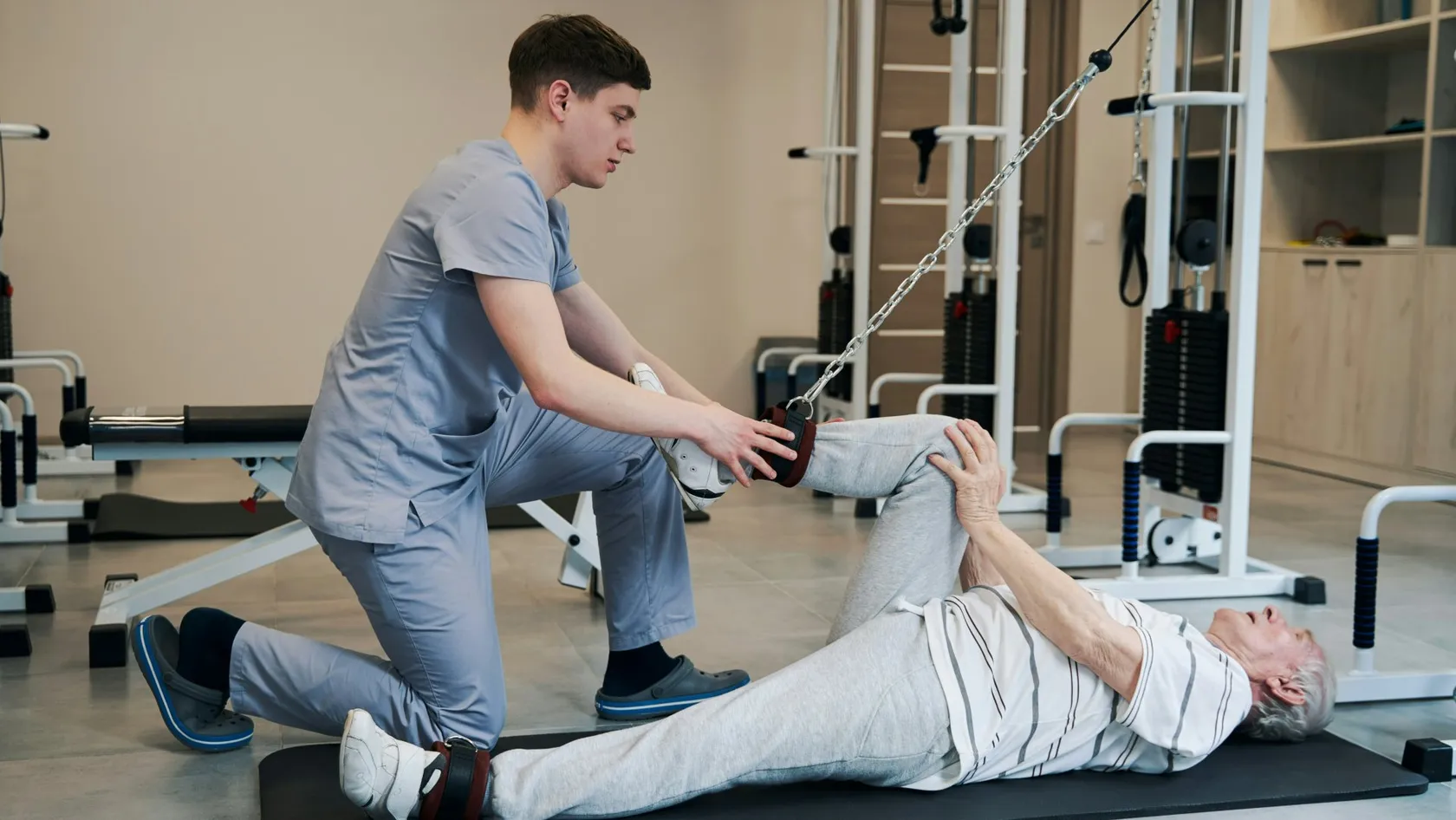
Post-ICU Rehabilitation ICU Recovery Rehabilitation
Every day in an intensive care bed costs muscle, and days of delirium can leave memory and concentration weaker for a year or more. Rehabilitation after intensive care rebuilds strength, breathing, swallowing, thinking and sleep in one program, because after a critical illness they fail together.
About This Department
Leaving intensive care alive is the first recovery. Strength, memory and sleep are the second, and they can be trained.
Post-intensive care syndrome is the name that critical care doctors gave in 2012 to the weakness, the memory and concentration problems and the anxiety or low mood that follow a life-threatening illness. The syndrome affects a large share of survivors, and its parts respond to treatment. In a trial published in The Lancet, 59 percent of ventilated patients who had physical and occupational therapy from the first days went home independent, against 35 percent with standard care. A five-year study in the New England Journal of Medicine found that the lungs of people who survived severe lung failure returned to normal or near normal.
Search engines know this service by two names, and the title of this page, Post-ICU Rehabilitation ICU Recovery Rehabilitation, carries both. They mean one thing. Both describe the treatment a person needs after the intensive care unit has saved their life and sent them out unable to climb a stair.
What intensive care leaves behind
Post-ICU rehabilitation treats a condition that had no name until 2012. That year a conference of the Society of Critical Care Medicine, reported by Needham and colleagues in Critical Care Medicine, agreed on the term post-intensive care syndrome for new or worsening problems in physical, cognitive or mental health that appear after a critical illness and last beyond the hospital stay. The same report applied the term to family members.
Relatives often notice it first. The patient has come home, the infection or the injury has healed, and yet nothing works the way it did.
Weak muscles and short breath
A body that lies still on a ventilator, sedated and fed through a tube, breaks down its own muscle for fuel. The breathing muscles waste along with the legs. Herridge and colleagues followed 109 survivors of acute respiratory distress syndrome, the most severe form of lung failure, for five years and published the results in the New England Journal of Medicine in 2011. Lung function returned to normal or near normal. Exercise capacity did not. At five years the median distance walked in six minutes was 436 meters, which is 76 percent of what healthy people of the same age and sex manage, and younger patients recovered faster than older ones. That pattern points to the muscles and to general fitness as the limit, since the lungs themselves had healed, and muscle is the one tissue that training is known to rebuild at any age. Patients and their family caregivers in the study carried physical and psychological problems for up to five years.
How muscle and breath are rebuilt
Memory, attention and planning
Pandharipande and colleagues enrolled 821 adults with respiratory failure or shock in the BRAIN-ICU study and tested their thinking after discharge, and three months out, 40 percent scored as low as people with a moderate traumatic brain injury and 26 percent as low as people with mild Alzheimer's disease. At twelve months the figures were 34 and 24 percent. Age made no difference. What predicted the damage was the number of days the patient had spent in delirium, the state of confusion that 74 percent of them went through in hospital.
How thinking is retrained
Anxiety, low mood and flashbacks
Many survivors remember intensive care as fragments. Alarms, faces in masks, the sense of being tied down, vivid dreams from the sedation that still feel real. Anxiety, depression and symptoms of post-traumatic stress follow, in relatives as well as patients.
How fear and low mood are treated
Swallowing, voice and the tracheostomy
A breathing tube that stays between the vocal cords for days leaves them swollen and weak. Food goes down the wrong way, the voice is hoarse, and some patients leave intensive care with a tracheostomy still in the neck.
How swallowing and voice return
Does rehabilitation after intensive care work?
Therapy that starts inside intensive care
The strongest evidence is for starting early. Schweickert and colleagues randomized 104 sedated, ventilated adults in two American university hospitals either to physical and occupational therapy that began within the first three days, during daily pauses in sedation, or to therapy as the ward team ordered it. At hospital discharge 29 of 49 patients in the early group, 59 percent, could wash, dress, eat, move and walk without help, compared with 19 of 55, or 35 percent, in the other group. Delirium lasted a median of two days against four. One serious event, a fall in oxygen level, occurred in 498 therapy sessions. The Lancet published the trial in 2009.
Programs that start after discharge
For programs that begin after the patient has left intensive care, the trials are fewer and smaller. A Cochrane review by Connolly and colleagues in 2015 found six of them, with 483 participants between them. Three reported better exercise capacity with the program and three found no difference, the programs themselves varied too much to pool, and the authors concluded that an overall effect could not yet be determined. They also counted the harm. Across all six trials it came to one minor muscle injury.
So the position is this. Rehabilitation after critical illness is safe, its logic is sound, its individual parts such as strength training, swallowing therapy and treatment of depression are proven in other conditions, and the trials of complete post-ICU programs are still too small to give a single figure. Anyone who quotes a success rate for this treatment is inventing it.
What recovers, and when
Recovery after critical illness runs on several clocks at once.
- First weeks. Severe weakness, poor appetite, broken sleep and confusion that comes and goes. This is the time for daily therapy on a ward, with nutrition, swallowing and tracheostomy care.
- Three months. Thinking scores in the range of a moderate brain injury in 40 percent of BRAIN-ICU patients. Cognitive training and psychology run alongside a growing walking distance.
- Twelve months. That share has fallen to 34 percent, and strength keeps improving, fastest in younger patients. The work has moved to a home program and a return to a job or to household roles.
- Five years. Lungs normal or near normal, and walking distance at 76 percent of predicted in the Herridge study. Exercise continues for life. Mood and sleep get treatment wherever they still cause trouble.
The first six months bring the steepest gains, which makes them the months to spend on training.
Who should come, and who should not
A good candidate has left intensive care, breathes without a ventilator, has the original illness under control, and can stay awake and follow instructions for half an hour at a time. Weakness can be profound. People arrive unable to stand, and that is the reason to come. An oxygen need, a tracheostomy, a feeding tube and a urinary catheter are all manageable on a rehabilitation ward and should simply be listed in the first message, and while the best time is the first three months after discharge, people who are still struggling at six or twelve months gain as well, more slowly.
Some patients should not travel yet. Anyone still dependent on a ventilator for part of the day belongs in a weaning unit near home. Dialysis that began in intensive care and has not stopped needs kidney doctors involved before any trip is planned. Active infection, a wound that is still being operated on, confusion severe enough that the patient cannot take part, and a collapsed lung that has not fully healed all mean waiting. And a person who left intensive care after two days, walks to the shops and feels tired needs a family doctor and time. A flight would add nothing.
Inside the program
Assessment. Two days of measurement come first. Therapists score muscle strength in twelve muscle groups, time a six-minute walk, and record hand grip, swallowing, memory, attention, mood, sleep and body weight. The rehabilitation doctor goes through the long medication list that every ICU survivor carries and asks the other specialists which tablets can now stop.
Daily work. Sessions stay short and frequent in the first week, because stamina is the thing that is missing. Twenty minutes of leg strengthening, a rest, ten minutes of walking, a rest, breathing muscle training, lunch with the dietitian's supplements, an hour of sleep, then occupational therapy on washing, dressing and the stairs, and cognitive exercises late in the afternoon when the gym work is done. By the third week the blocks have merged into two or three hours of activity a day.
Once a week the whole team reviews progress, with the numbers from day one on the table.
Risks, and how they are handled
Exercise itself has proved safe in this group. The dangers lie in how fragile the first months are. Survivors of critical illness return to hospital more often than other patients, and a rehabilitation ward watches for the reasons. Staff measure oxygen level during effort and give oxygen when the lung doctor has prescribed it. They check pulse and blood pressure before and after sessions, since heart rhythm problems are common after sepsis and heart surgery. Transfers stay supervised until a therapist has signed them off, which prevents most falls. A swallowing test before meals keeps food out of the lungs. Nurses inspect the skin over the tailbone and heels daily, and they review wounds, drain sites and the tracheostomy opening at each dressing change. Blood sugar, kidney function and blood count get rechecked in the first week, because all three are frequently abnormal after intensive care. Someone asks about low mood and nightmares directly, since few patients bring them up.
Fatigue tops the list of complaints and carries the least danger, and pacing manages it, which means stopping before exhaustion and resting by the clock.
When the plan changes
New fever, rising oxygen need, chest pain or confusion stops therapy the same hour. The rehabilitation service at Biruni Hospital works inside a general hospital, so the intensive care unit, the lung and heart specialists, imaging and the laboratory are on the same site, and a patient who needs them is moved along a corridor instead of across a city. Most interruptions last a few days. When the assessment finds a problem that needs its own treatment, such as a narrowed windpipe from the breathing tube, that becomes a separate decision with a separate consent and quote, and the family may choose to have it done at home.
Arranging it from abroad
How long, and the flight
Inpatient rehabilitation programs published for international patients in Turkey run from two to eight weeks, and post-ICU patients sit in the upper half of that range because they start from so low.
Nobody confirms the length before the first week is over.
The flight needs more planning than the stay. Airlines pressurize the cabin to the equivalent of 2,400 meters of altitude, so a person who needs a little oxygen on the ground needs more in the air, and airlines want a medical information form from the treating doctor and several days of notice to supply it. Passengers with a tracheostomy must carry their own suction device and spare tubes. Those who cannot sit upright fly on a stretcher booking or by air ambulance. Ten days before departure the international patients office sends the appointment confirmation and an invitation letter naming the hospital and the treating doctor, and it arranges the transfer from the airport in a vehicle suited to how the patient travels. Book an aisle seat near the toilet, ask for wheelchair assistance at both airports, and carry the discharge summary and the medication list in hand luggage. A relative should sit in the next seat.
What shapes the cost
Four things move the figure, and the table shows which way.
This table scrolls sideways on a narrow screen. Swipe or drag to see every column.
| Cost driver | Why it matters in this group |
|---|---|
| Weeks on the ward | The largest factor. Post-ICU patients start from very low strength and need longer stays |
| Nursing dependency | Oxygen, a tracheostomy, tube feeding and two helpers for every transfer all add nursing hours |
| Specialist input | A lung doctor, a kidney doctor or a cardiologist is needed alongside the rehabilitation team in many cases |
| Tests and procedures | A swallowing study with video, a scan of the windpipe or a sleep study is added only when the assessment calls for it |
Published packages in this market include the room and meals for patient and companion, doctor and nursing care, the agreed therapy, routine blood tests, transfers and interpreting, and they exclude flights, insurance, oxygen equipment for the journey, drugs for other conditions, extra scans and extra days.
One patient's figure comes after the doctor has read the file, and that reading costs nothing.
The stay
One coordinator looks after the family from the first message until discharge, in English, Arabic, French, Russian, Serbian, Romanian or Spanish, or through an interpreter in another language. The patient's room has a companion bed for one relative for every night of the admission. The kitchen prepares halal, vegetarian and diabetic meals and works to the dietitian's protein targets. A prayer room is on site. A female doctor can be requested in the first message and is arranged whenever the rota permits.
After you fly home
Recovery from critical illness takes a year or more, so most of it happens once you are back home. The discharge file is written with that in mind. It contains the medical report in English, the first and last test results, a home exercise plan with weekly targets, the diet plan, a shortened and explained medication list, and a letter for the family doctor that names the problems still open.
- See your own doctor within two weeks of landing and take the file
- Keep the exercise diary and repeat the six-minute walk once a month along a measured corridor or path
- Ask for a memory and mood review at three months if either still troubles you
- Message the coordinator on the same WhatsApp number with questions about the program
These need a local emergency department the same dayFever with shaking, breathlessness that is getting worse, chest pain, new confusion, coughing or choking on food, a swollen painful calf, or thoughts of self-harm. ICU survivors are readmitted more often than other patients in the first months, and early treatment keeps those readmissions short.
Post-ICU Rehabilitation ICU Recovery Rehabilitation FAQ
What is post-intensive care syndrome?
How long does recovery after intensive care take?
Can I fly if I still need oxygen?
Can a relative stay with the patient?
What happens if the patient gets worse after returning home?
References
- Needham DM, Davidson J, Cohen H, et al. Improving long-term outcomes after discharge from intensive care unit: report from a stakeholders' conference. Crit Care Med. 2012;40(2):502-9.
- Herridge MS, Tansey CM, Matte A, et al. Functional disability 5 years after acute respiratory distress syndrome. N Engl J Med. 2011;364(14):1293-304.
- Pandharipande PP, Girard TD, Jackson JC, et al. Long-term cognitive impairment after critical illness. N Engl J Med. 2013;369(14):1306-16.
- Schweickert WD, Pohlman MC, Pohlman AS, et al. Early physical and occupational therapy in mechanically ventilated, critically ill patients: a randomised controlled trial. Lancet. 2009;373(9678):1874-82.
- Connolly B, Salisbury L, O'Neill B, et al. Exercise rehabilitation following intensive care unit discharge for recovery from critical illness. Cochrane Database Syst Rev. 2015;2015(6):CD008632.
Editor's note
Written by the Biruni Hospital medical editorial team. Reviewed by Assistant Professor Koray KOÇHAN, Gastroenterology.
Medically reviewed by
Assistant Professor Koray KOÇHAN
Gastroenterology
Related Treatments
View All
Barrett's Esophagus Treatment
Most people told they have Barrett's esophagus have been told only half the story. The yearly cancer risk is 0.12 percent, and the grade of dysplasia in the biopsies decides whether the right plan is a daily tablet with endoscopy every few years, or radiofrequency ablation to remove the lining.
Capsule Endoscopy - Wireless Capsule Endoscopy
When a gastroscopy and a colonoscopy are both normal and the blood count keeps falling, the search moves to the small bowel, which neither instrument reaches. A swallowed capsule camera films that stretch in eight hours without sedation and finds a cause in six of ten patients examined for bleeding.
Colonoscopy
Ask one question before choosing where to have a colonoscopy, which is how often the doctor finds polyps. In a study of 314,872 examinations that figure ranged from 7 to 53 percent between doctors, and it predicted who later developed bowel cancer. This guide covers preparation in a hotel room, sedation, findings and the flight home.
Colorectal Polyp Removal
A large polyp in the colon does not automatically mean bowel surgery. Nearly all polyps, including flat ones wider than 20 millimeters, come out through the colonoscope, and the technique is chosen by size and shape.
Endoscopic Mucosal Resection - EMR
Endoscopic mucosal resection lifts a precancerous growth or an early cancer off the muscle wall with an injection and removes it with a snare through an ordinary endoscope, in the colon, esophagus, stomach or duodenum, without an operation. In a study of 479 patients with large colon polyps, 83.7 percent avoided surgery and none died of the procedure. This page explains what EMR removes, which lesions qualify, how it compares with ESD and surgery, evidence, risks, follow-up and care from abroad.