
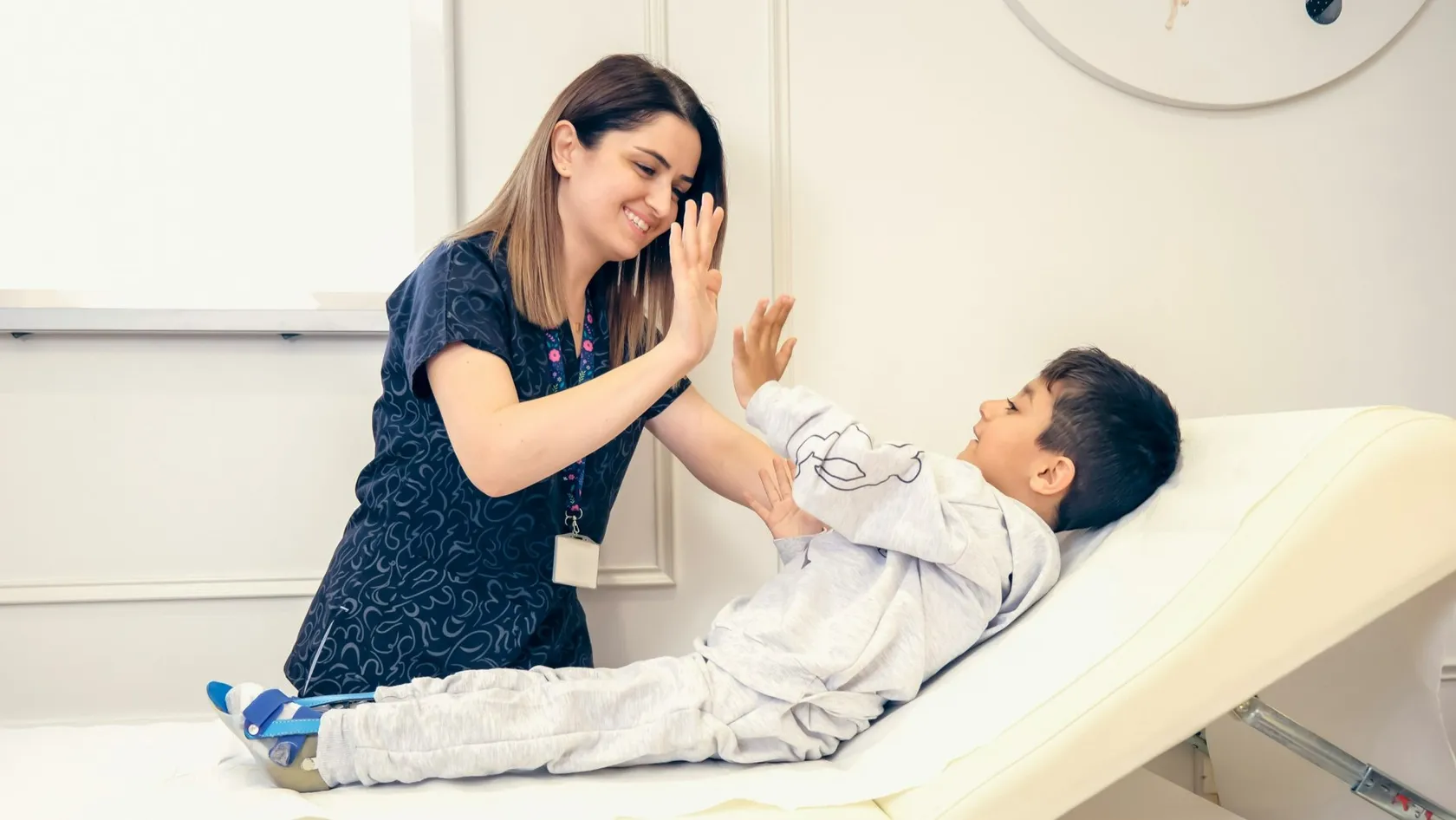
Pediatric Rehabilitation - Children's Rehabilitation
A child's brain is still being built, so the same hour of practice achieves more at two than at twelve. For cerebral palsy and other childhood conditions, researchers have now graded which therapies work and which waste a family's time. Read what each age needs and what a block of weeks away from home adds.
About This Department
Two in three children with cerebral palsy will walk. What they practice, and how many hours of it, shapes how well.
Those odds come from an international review in JAMA Pediatrics, which also found that three in four of these children will talk and one in two will have normal intelligence. Therapy cannot change the injury. It changes what a growing brain learns to do around it, and the methods that work have now been sorted from the ones that do not. Send us your child's reports and two short videos, and a rehabilitation physician will reply with goals that fit your child's age and level, free of charge.
A child who was born early, had a difficult birth, or has a condition of the brain, nerves or muscles develops along a different path from other children, and pediatric rehabilitation is the medical work of making that path lead as far as it can. Parents arrive with one question. They want to know whether more therapy, better therapy or therapy somewhere else would change where their child ends up.
Three things decide that. They are the diagnosis, the child's age and the methods used, and this page takes them in turn before describing how a family brings a child to Istanbul.
Which children does pediatric rehabilitation help?
Pediatric rehabilitation treats children from birth to 18 whose movement, speech, feeding or daily skills are limited by a condition of the brain, spinal cord, nerves, muscles or bones. Doctors sometimes call it habilitation, because a young child is learning a skill for the first time and has nothing to regain.
That is the first difference from adult rehabilitation. The second is growth. Bones lengthen faster than tight muscles can follow, so a child who walks well at six can lose ground at eleven without anything new having gone wrong in the brain, and a program has to look ahead to the next growth spurt as well as at today. A brace lasts a year. A hip that sat in joint at three can slide out by seven. The third difference is the family. A therapist sees a child for a few hours a week and a parent is there for the other hundred, so every method with good evidence behind it works through what happens at home, in the bath, at the table and on the floor with toys, and a program that sends parents to the waiting room has misunderstood its own job. School makes a fourth. Therapy has to fit around it, and for an older child the goals come from it.
This table scrolls sideways on a narrow screen. Swipe or drag to see every column.
| Condition | What therapy aims at | When it counts most |
|---|---|---|
| Cerebral palsy | Sitting, standing, walking, hand use, speech and feeding, prevention of contractures and hip displacement. | From diagnosis in the first year, with the steepest gains before school age. |
| Brachial plexus birth injury | Shoulder and elbow movement, prevention of stiffness, use of the arm in two-handed play. | The first months, and around any nerve or tendon surgery. |
| Spina bifida | Standing and walking with braces, wheelchair skills, skin care, bladder and bowel routines. | Before walking age, then at each growth spurt. |
| Muscle and nerve disease, such as Duchenne dystrophy and spinal muscular atrophy | Keeping joints supple, protecting breathing, the right seating and standing equipment. | Throughout, with reviews every few months as the condition changes. |
| Brain injury, brain tumor surgery, stroke or infection in childhood | Relearning movement, speech, memory and school skills. | The first six months after the event. |
| Developmental delay, Down syndrome, torticollis, toe walking, scoliosis | Reaching motor milestones, posture, strength and balance. | As soon as the delay or the posture is noticed. |
Cerebral palsy in more detail
Brachial plexus birth injury in more detail
Conditions that progress
What works, and what does not?
Parents of a child with a disability are offered more therapies than any other group of patients, and until recently nobody could tell them which ones were worth the hours. A team led from the University of Sydney changed that. Their systematic review of interventions for cerebral palsy, updated in Current Neurology and Neuroscience Reports in 2020, graded every studied treatment with a traffic light, green for do it, yellow for measure whether it is helping, red for stop.
The green list for movement has one thing in common. The child actively practices a real task, many times, toward a goal the child cares about.
- Goal-directed and task-specific training. Practicing the actual skill, such as getting up from the floor or climbing the school steps, in place of exercises that are supposed to lead to it.
- Constraint-induced movement therapy and bimanual training. Both are for a child with one weak hand. In the first the strong hand wears a mitt or cast for part of the day, and in the second the child practices tasks that need two hands.
- Treadmill and mobility training, strength training and fitness training for walking and endurance.
- Home programs with parent coaching.
- Botulinum toxin, with casting or occupational therapy afterward, for muscles that are too tight to train.
- Hip surveillance, meaning scheduled hip X-rays, so that a hip sliding out of joint is caught before it hurts.
In 2021 an international panel turned the evidence into a clinical practice guideline, published in Developmental Medicine and Child Neurology and built on 30 randomized trials. Its core recommendations describe a good program better than any brochure.
- The child and the family choose the goals.
- The whole task is practiced, in a setting as close to real life as possible.
- For walking goals, the child practices walking over the ground, in shoes, on real floors, and a treadmill can be added to that for extra steps.
- For hand goals, bimanual therapy, constraint therapy, goal-directed training and thinking-based approaches are all options.
- Parents are coached and supported, and the professionals work as one team.
Hours matter as much as method. The Cochrane review of constraint-induced movement therapy in children with one-sided cerebral palsy covered 36 trials and 1,264 children, in programs that averaged four weeks and 137 hours of practice. Constraint therapy beat low-dose usual therapy for using two hands together. It did no better than other intensive hand therapies that gave the same number of hours, and it was safe, the only problems being frustration and minor skin irritation under casts. Dose did the work. Session length in those trials ran from half an hour to eight hours a day, and the programs that worked were the ones that accumulated practice, much of it delivered by parents at home under a therapist's direction. A parent comparing programs should therefore count hours of active practice before anything else, and should know that a month-long package containing 24 one-hour sessions delivers less than a fifth of what those trials gave.
Ask for the timetable in hours.
How far will my child get?
In high-income countries, two in three people with cerebral palsy will walk, three in four will talk, and one in two will have normal intelligence, according to the international review published in JAMA Pediatrics in 2017. The same review showed that the diagnosis, once made between 12 and 24 months, can now be made before six months of age with an MRI scan and two structured examinations, which moves the start of therapy into the period when the brain adapts most readily.
For an individual child, the best guide is the Gross Motor Function Classification System, or GMFCS. It sorts children into five levels by what they do in everyday life, and a child's level stays the same through childhood in most cases.
This table scrolls sideways on a narrow screen. Swipe or drag to see every column.
| Level | At school age the child | Therapy concentrates on |
|---|---|---|
| Level I | Walks and runs without limits, with speed and balance a little reduced. | Sport, fitness, balance, handwriting and hand skills. |
| Level II | Walks without aids, with difficulty on stairs, slopes and long distances. | Strength, endurance, keeping the calves and hamstrings long through growth. |
| Level III | Walks with a walker or crutches, and uses a wheelchair for distance. | Walking efficiency, transfers, and protecting walking through the teenage growth spurt. |
| Level IV | Sits with support, moves in a powered wheelchair, may step with help for transfers. | Seating, standing frames, powered mobility, communication, hip surveillance. |
| Level V | Needs support for head and trunk and help with all daily care. | Comfort, positioning, feeding safety, chest health, hips and spine, and the carers' backs. |
Canadian researchers followed 657 children with cerebral palsy through 2,632 motor assessments and drew a development curve for each level, published in JAMA in 2002. Every curve rises steeply in the early years and then flattens. Children at Level I reached 90 percent of their eventual motor ability at around five years of age, and children at Level V before three.
Two messages follow from those curves.
The early years are when therapy hours buy the most. And a child of nine at Level IV is very unlikely to become a walker, whatever a clinic promises. Parents find the second message hard, and they are owed it, because families have sold homes to pay for programs that promised walking to children whose curve had flattened years before. After that point therapy still earns its place. It keeps what was gained, prepares the body for the growth spurts that threaten it, treats pain, and widens what the child can take part in at school and with friends, which by the teenage years counts for more to the child than how the walking looks.
Birth to two years
Two to six years
Six to twelve years
Teenagers
Should we bring our child to Istanbul?
Families travel for children's rehabilitation for one of three reasons. No specialist service exists where they live, the local service offers an hour a week when the child needs far more, or a specific treatment such as botulinum toxin with casting is unavailable at home.
What a block abroad can and cannot do
Good reasons to come
Three to four weeks suits a child between about two and twelve who has a clear, reachable goal, such as standing up from a chair alone, walking with a walker across a room, or using the weak hand to steady a bowl. It suits a child who has just had botulinum toxin or orthopedic surgery and needs daily therapy while the window is open, and it suits parents who have never been properly taught what to do at home, because three weeks beside a therapist is the most effective parent training there is.
Reasons to stay home
Do not travel in the hope of changing a GMFCS level, and do not travel for stem cells or oxygen chambers.
Children with uncontrolled seizures, a chest infection, poor weight gain from unsafe swallowing, or a painful hip that has not been X-rayed need those problems dealt with first, and a child who becomes deeply distressed away from home and routine may lose more than is gained. Families with no means of continuing anything at home should weigh the trip carefully, since gains from a block fade within months when practice stops.
What the weeks look like
The first two days
A rehabilitation physician examines the child, and the therapists take baseline measures, among them the Gross Motor Function Measure, a timed walk where the child walks, a hand function assessment, joint ranges, and a hip X-ray if none has been taken in the past year. Then comes the key conversation. You will be asked what you most want your child to be able to do, and the team will shape that into two or three goals with a task and a date in them.
A therapy day
Young children learn through play. They tire quickly. A day is therefore built from sessions of 30 to 45 minutes with rests, snacks and naps between them. Expect physiotherapy twice, occupational therapy once, and speech or feeding therapy where needed, within the two to five hours a day that rehabilitation units in Turkey describe in their published programs. A parent is in the room, and by the third week that parent should be running part of each session while the therapist watches and corrects, because nobody else will be there to do it at home.
What decides the cost
Pricing for children follows the same parts as for adults. Hours come first. The number of one-to-one therapy hours is the largest item, the one that varies most between quotes, and the one that length in weeks multiplies. Botulinum toxin goes by the dose, which follows body weight, and in small children it is given under sedation, which adds an anesthetist and a few hours in a day unit, while casts, orthoses, a walker or a standing frame made during the stay are separate items. Robotic gait training carries a fee per session. Hotel or apartment nights for the family form a large share of the total on a day program, since a child is admitted to a ward only when nursing needs require it. The child's own health counts too. Tube feeding, a tracheostomy, frequent seizures or a body size that needs two adults for every lift each add staff time.
Packages published in this market bundle the physician's assessment, a set number of therapy sessions, an interpreter and airport transfers, and many include a month of hotel accommodation. Flights, equipment, injections, imaging and extra sessions sit outside. Before comparing two offers, convert each to active therapy hours, find out who delivers them and whether the therapists are trained in pediatrics, and check that a written home program and a report with before and after scores are part of what you are paying for.
Your child's own figure follows a free review of the file.
The trip with a child
One coordinator from the international patients team is assigned from your first message and stays with your family until you leave. The team works in English, Arabic, French, Russian, Serbian, Romanian and Spanish and arranges interpreting in other languages on request. With a child, ask for the same interpreter each day. An appointment confirmation and an invitation letter naming the hospital and the treating doctor are sent about ten days before travel, for the visa application. The international patients office arranges airport transfers, transport between your accommodation and the hospital, and the accommodation itself, so tell the coordinator how many of you are coming, whether you need a cot or a kitchen, and whether the child travels in a wheelchair or a special seat. If your child is admitted, the room has a companion bed, so one parent stays every night. Halal, vegetarian and diabetic diets come from the hospital kitchen. So does texture-modified food for a child with swallowing difficulty, if you request it on the first day. A prayer room is on site. Some families prefer a female physician for a daughter. Say so in the first message, and the request is met wherever the rota allows.
Therapy sets no limit on flying, and you can leave the day after the last session.
Carry seizure medication and any feeds in hand luggage with a doctor's letter, and ask the airline in advance about taking a wheelchair or a postural seat on board.
Going home, and what can go wrong
Once you are back home, the most valuable thing you have is a program you can run yourself. Expect a written plan with photographs or video of each activity, a schedule that fits around school and meals, the measurements from the first and last day, and a letter for your child's doctor and therapist. Your coordinator stays reachable on the same WhatsApp number. Send a video. A local check every six months and a hip X-ray on the schedule the child's level calls for are the minimum, and a second block makes sense only once the home program has been followed and a new goal has come into reach.
Plan the next review before you leave. Growth does not wait.
Pediatric rehabilitation FAQ
At what age should children's rehabilitation start?
Will therapy make my child walk?
How long should we plan to stay in Istanbul?
Can both parents and a sibling come?
Will the therapists be able to communicate with my child?
Are stem cells or hyperbaric oxygen part of the program?
References
- Novak I, Morgan C, Fahey M, et al. State of the Evidence Traffic Lights 2019: Systematic Review of Interventions for Preventing and Treating Children with Cerebral Palsy. Current Neurology and Neuroscience Reports. 2020;20(2):3.
- Novak I, Morgan C, Adde L, et al. Early, Accurate Diagnosis and Early Intervention in Cerebral Palsy: Advances in Diagnosis and Treatment. JAMA Pediatrics. 2017;171(9):897-907.
- Jackman M, Sakzewski L, Morgan C, et al. Interventions to improve physical function for children and young people with cerebral palsy: international clinical practice guideline. Developmental Medicine and Child Neurology. 2022;64(5):536-549.
- Hoare BJ, Wallen MA, Thorley MN, Jackman ML, Carey LM, Imms C. Constraint-induced movement therapy in children with unilateral cerebral palsy. Cochrane Database of Systematic Reviews. 2019;4(4):CD004149.
- Rosenbaum PL, Walter SD, Hanna SE, et al. Prognosis for gross motor function in cerebral palsy: creation of motor development curves. JAMA. 2002;288(11):1357-1363.
Editor's note
Written by the Biruni Hospital medical editorial team. Reviewed by Assoc. Prof. Dr. Çiğdem ÇINAR, Physical Therapy and Rehabilitation.
Medically reviewed by

Assoc. Prof. Dr. Çiğdem ÇINAR
Physical Therapy and Rehabilitation
Related Treatments
View All
Brain Injury Rehabilitation
A bleak outlook given in the first two weeks after a severe brain injury is frequently wrong. In the largest recent follow-up study, 12 percent of such patients were doing well at two weeks and 52 percent at one year. Learn what rehabilitation adds to that recovery, stage by stage, and when a patient is ready to travel.

Cancer Rehabilitation - Oncology Rehabilitation
Cancer rehabilitation treats the fatigue, weakness, stiffness, swelling, nerve damage, swallowing problems and loss of function that cancer and its treatment leave behind, before, during and after therapy. In one study 92 percent of women with metastatic breast cancer had a treatable impairment and fewer than a third were being treated. This page explains what is treated, the evidence on fatigue and lymphedema, prehabilitation, specialist problems and programs for patients from abroad.

Cardiac Rehabilitation - Heart Rehabilitation
A stent or a bypass repairs one artery. It does nothing to the disease that narrowed it. Cardiac rehabilitation is the monitored exercise, tablet review and risk factor treatment that does, and randomized trials link it to fewer repeat heart attacks and fewer hospital admissions in the following year.
Inpatient Rehabilitation
Should recovery happen on a hospital ward, or at home with visits to a clinic? A ward is the answer when someone needs therapy every day, a nurse at night and a doctor nearby, which is common after a stroke, a hip fracture, heart surgery, a lung flare-up or a long spell in intensive care.
Inpatient Rehabilitation - Acute Rehabilitation Unit
Acute does not mean emergency here. It means the intensive level of rehabilitation, with at least three hours of therapy a day on a hospital ward where a rehabilitation doctor sees you daily, and it suits people in the first months after a stroke, a spinal cord injury, a brain injury or major surgery.