A child's brain, bones and glands are still growing, so radiotherapy for a child is planned by stricter rules than for an adult. The lowest dose that cures, the smallest volume, anesthesia for the youngest, and follow-up that continues for thirty years. Late deaths among survivors halved between the 1970s and the 1990s as those rules took hold.
About This Department
Pediatric Radiation Oncology
Every rule in children's radiotherapy comes down to one aim. The lowest dose that cures, to the smallest volume, and nothing more.
A child's brain, bones, glands and heart are still growing, and radiation that an adult would shrug off can change a child's height, hormones, hearing or school performance for life. So pediatric radiotherapy follows different rules, comes from teams that treat children every day, and gets watched for decades afterward. The rules work. Among 34,033 survivors of childhood cancer, deaths in the fifteen years after the five-year mark fell from 12.4 percent for children treated in the early 1970s to 6.0 percent for those treated in the 1990s, and lower radiation doses were a large part of the reason.
12.4% to 6.0%
Late deaths by decade of treatment, NEJM 2016
86 in 100
Children with medulloblastoma alive at 5 years on reduced-dose radiotherapy, J Clin Oncol 2006
Stable IQ
With proton therapy for medulloblastoma, against a decline with X-rays, J Clin Oncol 2020
Free
Review by a pediatric radiation oncologist
Free consultation
Parents can send the pathology report, the treatment protocol the child is on, the MRI or CT images, the operation note and the chemotherapy record so far, together with the child's age, weight and any anesthesia the child has had. A radiation oncologist replies with whether radiotherapy is due, at what dose and volume, whether a proton center would serve the child better, and how many weeks to plan. The review is free and there is no obligation.
Doctors write pediatric radiation therapy and parents search for children's radiation treatment, so this page carries both in its title, Pediatric Radiation Therapy - Children's Radiation Treatment. We wrote it for parents, in the order their questions come. Does the child need radiotherapy at all, what does it do to a growing body, how does a four-year-old lie still for it, and what should the family watch for in the decades after.
What makes radiotherapy different in a child
Radiation does the same thing in a child as in an adult. It damages the DNA of dividing cells, and tumor cells divide fastest. The difference lies in the tissue around the tumor. A six-year-old's brain is still laying down the circuits for reading and arithmetic, the growth plates of the spine and limbs are still open, the thyroid, the pituitary gland and the ovaries or testes are still forming, and every one of them is made of dividing cells too. A dose that leaves an adult's brain unchanged can cost a young child points of IQ every year for a decade, and a dose to the spine that an adult would not notice can shorten a child's final height by several centimeters.
Four rules follow from that. Doctors give the lowest dose that trials have shown to cure, and they have spent forty years finding out how low it can go. They draw the smallest volume that contains the tumor and its likely spread, on MRI, to the millimeter. They reserve radiotherapy for tumors that chemotherapy or surgery cannot handle alone, so children with leukemia, once nearly all irradiated, rarely are today. And when a child's age and tumor put the brain or the spine in the beams, proton therapy, which stops at a set depth and spares the tissue behind the target, is considered before X-rays.
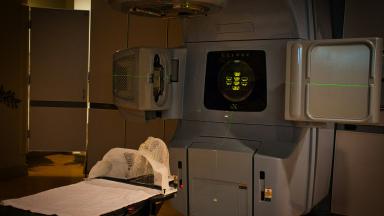
At Biruni Hospital children are treated on an Elekta Versa HD linear accelerator with intensity modulated X-ray beams, daily image guidance and an anesthesia team present for every session that needs it. The hospital has no proton facility. Where the review of a child's scans shows that protons would spare the brain, the heart or the growing spine to a degree that matters, the radiation oncologist says so and helps the family reach a proton center, in Europe or elsewhere, before any treatment is planned here.
Which tumors, which schedules
Fewer children are irradiated every decade
Cranial radiotherapy for acute lymphoblastic leukemia fell from 85 percent of children in the 1970s to 19 percent in the 1990s, abdominal radiotherapy for Wilms tumor from 78 to 43 percent, and chest radiotherapy for Hodgkin lymphoma from 87 to 61 percent. Armstrong and colleagues, N Engl J Med, 2016.
The tumors that still need radiotherapy, and the schedules used for them, come from cooperative trial groups in North America and Europe that treat thousands of children on shared protocols. The table gives the common ones.
This table scrolls sideways on a narrow screen. Swipe or drag to see every column.
Radiotherapy in the common childhood cancers
Tumor
Role of radiotherapy
Usual schedule
Medulloblastoma, age 3 and over
Essential. The whole brain and spine are treated, then the tumor bed receives a higher dose
23.4 gray to brain and spine in 13 sessions, boost to 54 to 55.8 gray, about 6 weeks
Ependymoma
After surgery, to the tumor bed
54 to 59.4 gray in 30 to 33 sessions
Low-grade glioma
Only when surgery and chemotherapy have failed or the tumor threatens vision
50.4 to 54 gray, about 6 weeks
Wilms tumor of the kidney
After surgery in higher stages, to the flank or the abdomen
10.8 gray in 6 sessions for most, over about a week
Rhabdomyosarcoma and Ewing sarcoma
To the primary site, with chemotherapy, when surgery cannot remove it cleanly
36 to 55.8 gray, 4 to 6 weeks
Hodgkin lymphoma
After chemotherapy, to the sites that responded slowly
20 to 30 gray, 2 to 3 weeks
Neuroblastoma, high risk
To the primary site after surgery and chemotherapy
21.6 gray in 12 sessions
Children under 3
Avoided wherever possible. Chemotherapy is used to delay it until the brain has grown
Decided case by case
What the long-term studies show
Lowering the dose without losing the cure
Medulloblastoma, the commonest malignant brain tumor of childhood
Whole-brain and spine radiotherapy for medulloblastoma once used 36 gray, and Packer and colleagues asked whether 23.4 gray with chemotherapy would cure as many children, which was a real gamble with a cancer that kills when it returns.
81 percent free of disease, 86 percent alive at five years
Among 379 children aged 3 to 21 with average-risk medulloblastoma treated with 23.4 gray to the brain and spine, a boost to the tumor bed and chemotherapy. Age, sex and the chemotherapy regimen made no difference. Packer and colleagues, J Clin Oncol, 2006.
What the lower dose still costs
Intelligence and school skills
Even at 23.4 gray the brain pays. Mulhern and colleagues tested 111 children with medulloblastoma repeatedly for up to six years after diagnosis.
1.59 IQ points a year
The average decline in IQ, with reading falling 2.95 and spelling 2.94 points a year, after risk-adapted radiotherapy for medulloblastoma. Children under 7 at diagnosis and those on the higher dose lost the most. Young age was the strongest risk factor. Mulhern and colleagues, J Clin Oncol, 2005.
Where protons make a measurable difference
The same protocol, two kinds of beam
Kahalley and colleagues followed 79 children with medulloblastoma treated on the same protocols at the same dose, 37 with protons and 42 with X-rays, for a mean of 4.3 years.
Stable IQ with protons, a decline with X-rays
The proton group held steady in global IQ, perceptual reasoning and working memory, while the X-ray group declined in global IQ, working memory and processing speed. Processing speed fell in both groups. Kahalley and colleagues, J Clin Oncol, 2020.
The long view, thirty years on
Why follow-up never ends
The Childhood Cancer Survivor Study follows people treated for cancer before the age of 21 in the United States and Canada. Today's doses owe their size to it.
62.3 percent had a chronic condition, 27.5 percent a severe one
Among 10,397 adult survivors treated between 1970 and 1986, compared with their siblings. Thirty years after diagnosis the cumulative figure reached 73.4 percent. Oeffinger and colleagues, N Engl J Med, 2006. The later analysis by Armstrong and colleagues showed that children treated in the 1990s with lower doses were dying of late effects far less often.
How to read these numbers
Two of these studies describe children treated in the 1970s and 1980s with doses and volumes that no protocol uses today, and the reduction in late deaths across the decades is the measure of what changed. None of them describes one child. A parent who reads them should take away three things. Radiotherapy cures most children who need it. Doctors keep the dose as low as the cure allows, for reasons the studies make plain. And a child who has had it needs a follow-up plan for life.
Keeping a child still, from play to anesthesia
A radiotherapy plan is accurate to a millimeter or two, and a child who moves that much receives the dose in the wrong place. How the team gets a child to lie still depends on age and temperament more than on anything medical.
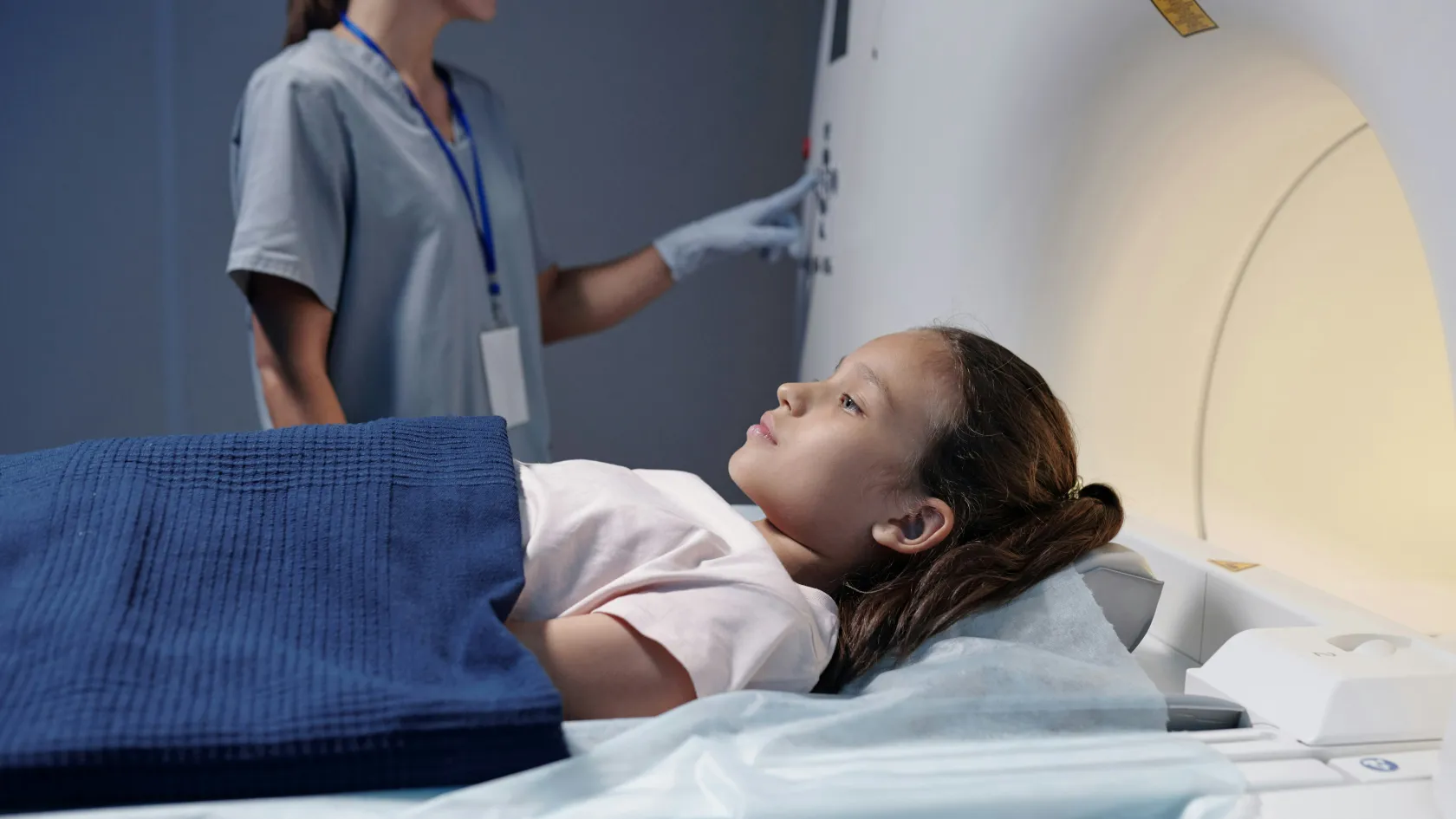
Children of about six and older usually manage awake. A play specialist or child life therapist explains the machine with a model or a doll, the child visits the room and lies on the couch before the first session, and a favorite cartoon plays on a screen or through goggles during treatment. The mask, molded in warm plastic, is decorated by the child before it hardens
Children under about five, and older children who cannot manage, have a short general anesthetic for every session, given by a pediatric anesthesiologist with propofol through a small line that stays in place for the course. The child is asleep for 20 to 30 minutes, wakes in a recovery room with a parent, and eats and plays within the hour
Daily anesthesia means daily fasting, which for a small child is planned to the hour, with the earliest slot of the morning given to the youngest patients so that nobody is hungry for long
A parent stays in the room until the child is asleep and is beside the bed when the child wakes. During the treatment itself everyone leaves the room, and staff watch by camera
Many children who start with anesthesia manage awake by the third or fourth week once the routine is familiar, and the team tries that when the child is ready
A course of treatment, day by day
Sessions run Monday to Friday. An awake child spends 15 to 20 minutes in the room, an anesthetized child about an hour from arrival to leaving. The whole course lasts from one week for Wilms tumor to six weeks for a brain tumor, with planning before it.
Consultation. The radiation oncologist, the pediatric oncologist and, for brain tumors, the neurosurgeon agree the dose and the volume from the protocol the child is on. Parents hear what the treatment will and will not do, and the child hears an honest version suited to their age.
Preparation. Blood tests, a hearing test if cisplatin has been given, growth and hormone baselines, and a neuropsychological baseline for any child whose brain will be in the beams, so that later changes can be measured against it.
Mask and planning scan. A CT in the treatment position, fused with the MRI, under anesthesia if the child needs it. The doctor outlines the target and every growing structure to protect, and the physicist builds the plan over three to seven working days.
Sessions. The same time each day, the same staff, the same routine. A sticker chart, a bead for each session, or a countdown on the wall, because children do better when they can see the end.
Weekly review. Weight, blood counts, skin, appetite, sleep and mood. Chemotherapy given alongside is coordinated with the pediatric oncology team on the same site.
Last day. A bell to ring, a certificate, and a treatment summary that the family will keep for the rest of the child's life.
Side effects now and side effects later
Call the team the same day about a temperature of 38 degrees or higher, vomiting that stops fluids going in, unusual sleepiness or a new headache, a rash or bruising, or any breathing difficulty. A child on chemotherapy with a fever is an emergency at any hour.
This table scrolls sideways on a narrow screen. Swipe or drag to see every column.
Side effects of radiotherapy in children
Effect
When
What is done
Tiredness, more sleep, less play
From the second week to a few weeks after
Rest is allowed, school work is lightened, and a wave of sleepiness one to two months after brain radiotherapy is expected and passes
Hair loss in the treated area
From the third week
Grows back within months, sometimes thinner. A soft hat and a plan for what to tell friends
Nausea and poor appetite
During treatment of the brain or abdomen
Anti-sickness medicine before each session, small frequent meals, a dietitian, a feeding tube if weight falls
Skin redness
From the third week
Moisturizer, loose clothes, no sun on the area for a year
Low blood counts
With chemotherapy or spine radiotherapy
Weekly blood tests, transfusion or growth factors when needed
Slower growth of irradiated bone
Years later
Spine and limbs measured every six months, and a spine treated evenly on both sides so that it grows straight
Hormone changes
One to ten years later
Yearly growth hormone, thyroid, puberty and cortisol tests after pituitary or thyroid exposure, with replacement when needed
Learning and memory
Emerging over years after brain radiotherapy
Neuropsychological testing every one to two years, school support, and the lowest dose and smallest volume from the start
Hearing loss
After cisplatin and radiotherapy to the ear
Hearing tests before, during and after, and hearing aids when needed
Fertility
After radiotherapy to the pelvis or the pituitary
Discussed before treatment, with ovary or sperm preservation offered where age allows
A second cancer in the treated area
Decades later, in a small minority
Lifelong follow-up and, for girls after chest radiotherapy, breast screening from the age of 25
When the plan changes
Children's protocols run to a calendar, and radiotherapy has its slot in it. A chest infection, a fever on chemotherapy or low blood counts can push that slot back by days, and a course already started continues through minor illness unless the child is unwell enough for admission. When a child is admitted, the daily session continues from the ward. Anesthesia occasionally has to be adjusted or, for a child who has become anxious, reintroduced. The MRI taken for planning sometimes shows more or less tumor than the referring scan, and the volume is redrawn before the first session rather than after it. All of this happens within one building, because the pediatric oncology ward, the anesthesia team and the radiotherapy department at Biruni Hospital share a site, and a decision that needs three specialists is taken in one meeting on the same day.
Weeks in Istanbul, cost and the family
The length of stay depends on the tumor.
One to eight weeks, by tumor
Wilms tumor needs one to two weeks including planning. Hodgkin lymphoma needs three to four. Sarcomas need five to seven. A brain tumor needs seven to eight, and children who receive chemotherapy in the same weeks stay for the chemotherapy calendar as well. A child under anesthesia adds no days, only hours.
The length of stay comes from the table above. Cost depends on the number of sessions, whether anesthesia is needed every day, the planning imaging, the mask, the baseline tests, chemotherapy given alongside, and any admission. Daily anesthesia separates a small child's course from an older child's, since every session needs an anesthesiologist, a nurse and a recovery bed. Published packages for children in Istanbul cover the consultation, planning, all sessions, weekly reviews, an interpreter and transfers, and leave out chemotherapy drugs, anesthesia in some cases, the hotel and flights, so ask whether anesthesia is inside the figure. A quote follows the doctor's review of the protocol and the scans, and that review is free.
Families stay together. An apartment near the hospital for two parents and siblings works better than a hotel room over six weeks, and the international patients office arranges it, along with the airport transfers, the daily rides and the invitation letter that goes out with the appointment confirmation ten days before travel, naming the hospital and the treating doctor and stating the length of treatment for the visa. One coordinator handles the case from the first message, in English, Arabic, French, Russian, Serbian, Romanian or Spanish, or through an interpreter, and a child who speaks none of those is helped by a play specialist for whom language matters less. Both parents may attend consultations. If the child is admitted, one parent sleeps in the room. Halal, vegetarian and diabetic meals are available, a prayer room is on site, and a female doctor can be requested when you first write.
After you fly home, for the next thirty years
The treatment summary is the most important document the child will ever own
It states the tumor, the dose to every organ that was in or near the beams, the dates, the technique and the chemotherapy given. Every doctor who sees the child in the next thirty years needs it, from the pediatrician measuring height to the cardiologist checking the heart, and the family should keep a copy in two places.
Follow-up belongs with a pediatric oncology survivorship clinic at home. The file from Istanbul sets out the schedule, which for most children means height and weight every six months, thyroid and hormone tests every year, hearing tests, a neuropsychological assessment every one to two years after brain radiotherapy, an echocardiogram after chest radiotherapy, and scans of the treated area at the intervals the protocol specifies. Once you are back home the coordinator stays reachable on the same WhatsApp number, and the radiation oncologist answers questions from the treating team at home. Fever, vomiting that stops fluids, unusual drowsiness or breathing difficulty need a local pediatric emergency department the same day.
It cures most children who need it, and the doses used today are the lowest that trials have shown to cure. It still carries late effects on growth, hormones and learning that depend on the child's age and the area treated, which is why follow-up continues for decades and why doctors avoid it in children under three wherever they can.
Will my child need anesthesia for every session?
Children under about five usually have a short general anesthetic each day, given by a pediatric anesthesiologist. Older children manage awake with play preparation and a cartoon during treatment. Many small children move from anesthesia to awake treatment during the course once the routine is familiar.
Should my child have proton therapy instead?
For some children, yes. A study of medulloblastoma found stable IQ after proton therapy against a decline after X-rays on the same protocol. Biruni Hospital has no proton facility. If the review of your child's scans shows that protons would spare the brain, heart or spine to a degree that matters, the doctor will say so and help you reach a proton center.
How long does a child's radiotherapy take?
From one week for Wilms tumor to six weeks for a brain tumor, plus three to seven working days of planning. Sessions are daily on weekdays and last 15 to 20 minutes awake or about an hour with anesthesia.
Can a parent stay with the child during treatment?
A parent stays until the child is asleep or settled and is there when the child wakes or comes off the couch. During the minutes the beam is on, everyone leaves the room and staff watch by camera. Both parents can attend consultations, and one sleeps in the room if the child is admitted.
What follow-up does my child need after radiotherapy?
Height and weight every six months, thyroid and hormone tests every year, hearing tests, neuropsychological assessment every one to two years after brain radiotherapy, and heart checks after chest radiotherapy, for life. The treatment summary from Istanbul sets out the schedule for the survivorship clinic at home.
References
Armstrong GT, Chen Y, Yasui Y, et al. Reduction in Late Mortality among 5-Year Survivors of Childhood Cancer. N Engl J Med. 2016;374(9):833-42.
Packer RJ, Gajjar A, Vezina G, et al. Phase III study of craniospinal radiation therapy followed by adjuvant chemotherapy for newly diagnosed average-risk medulloblastoma. J Clin Oncol. 2006;24(25):4202-8.
Mulhern RK, Palmer SL, Merchant TE, et al. Neurocognitive consequences of risk-adapted therapy for childhood medulloblastoma. J Clin Oncol. 2005;23(24):5511-9.
Kahalley LS, Peterson R, Ris MD, et al. Superior Intellectual Outcomes After Proton Radiotherapy Compared With Photon Radiotherapy for Pediatric Medulloblastoma. J Clin Oncol. 2020;38(5):454-461.
Oeffinger KC, Mertens AC, Sklar CA, et al. Chronic health conditions in adult survivors of childhood cancer. N Engl J Med. 2006;355(15):1572-82.
Editor's note
Written by the Biruni Hospital medical editorial team. Reviewed by Prof. Dr. Özcan YILDIZ, Medical Oncology.