
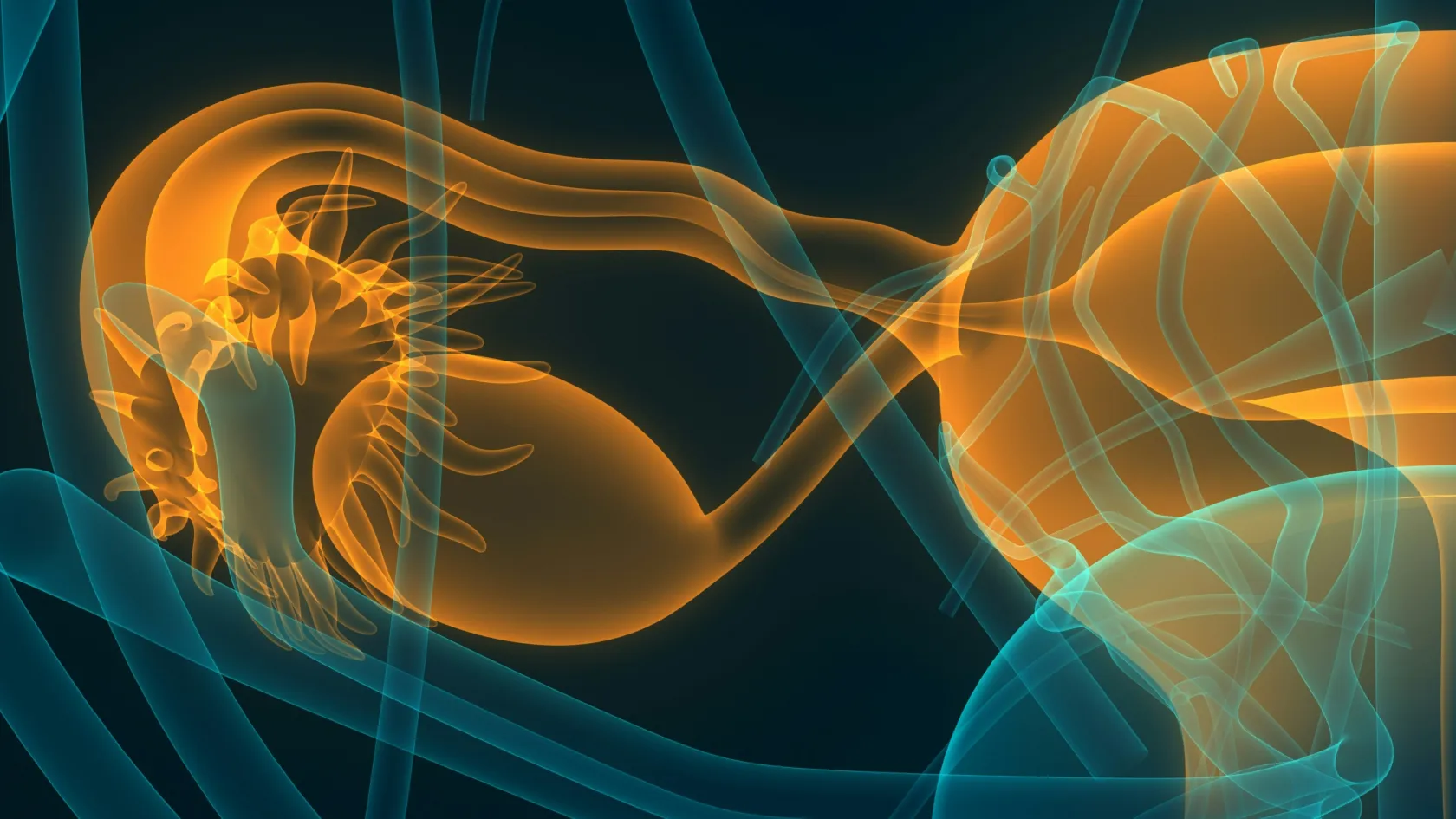
Cervical Cancer Radiation Therapy
More than a third of women given radiation for cervical cancer never receive the brachytherapy part. Four year survival was twelve points lower in that group.
About This Department
More than a third of women never received the brachytherapy part. Four year survival was twelve points lower.
A SEER analysis of 7,359 women with stage IB2 to IVA cervical cancer treated with external beam radiotherapy found that 37 percent of them never had the brachytherapy boost. After matching on patient characteristics, four-year overall survival came out at 58.2 percent with brachytherapy and 46.2 percent without. Use of it in the United States fell from 83 percent in 1988 to 58 percent in 2009.
One sequence, three parts, and a deadline
Radiation for cervical cancer behaves less like a course of treatment than like a sequence, and the sequence runs against a clock from the first day.
The three parts, and the order they come in
- External beam radiotherapy to the pelvis. Around 45 to 50 grays over five weeks, covering the cervix, the uterus, the upper vagina and the pelvic lymph nodes.
- Chemotherapy running through the radiation weeks. Weekly cisplatin, acting on the radiation rather than working alongside it as a second treatment.
- Brachytherapy, delivered from inside the body through an applicator placed in the cervix and vagina, which raises the dose at the tumor far above anything an external beam can safely reach.
All three have to happen, and the whole thing has to finish inside seven to eight weeks. Those two sentences carry more of the outcome than any equipment choice on the page.
Everything below follows from those two sentences. Patients hear a great deal about the external beam weeks and about the side effects, and far less about the brachytherapy and the calendar, which happen to be the two things that decide whether the treatment worked at all. That imbalance is the reason for the order of this page.
Brachytherapy is the part that cures, and the part most often skipped
Brachytherapy means placing a radioactive source inside the body, right against the tumor, for minutes at a time. Dose falls away sharply with distance from the source, so the cervix receives an enormous dose while the bladder and rectum a few centimeters away receive a fraction of it. No external beam arrangement achieves that. None. The machine name is irrelevant.
What happens when it is left out
Researchers took 7,359 women in the SEER database with stage IB2 to IVA cervical cancer treated with external beam radiotherapy between 1988 and 2009, and compared those who also received brachytherapy with those who did not, using propensity score matching to adjust for the differences between the two groups. Four-year cause-specific survival was 64.3 percent with brachytherapy and 51.5 percent without. Overall survival was 58.2 percent and 46.2 percent. Adjusted hazard ratios were 0.64 for cause-specific survival and 0.66 for overall survival. Sixty-three percent of the whole cohort received brachytherapy. More than a third did not.
Then comes the trend, which should worry patients more than the survival gap does. Brachytherapy use in the United States fell from 83 percent in 1988 to 58 percent in 2009, with a 23-point drop in a single year, 2003. Nothing in the evidence justified that decline, and what it tracked instead was the availability of the skill and the equipment, with the same authors reporting significant geographic variation in who ended up receiving it and who did not. Where you are treated changed whether you got the treatment.
Ask the question by name, and ask it early. Does this department perform brachytherapy for cervical cancer on site, and how many insertions are planned for me.
Two follow-up questions separate a real answer from a reassuring one. Whether the insertions happen in the same building or require a transfer somewhere else, and whether interstitial needles are available for anatomy that needs them. A department that sends patients elsewhere for brachytherapy can still deliver good treatment, and the arrangement has to be confirmed in writing before the external beam course begins, because a referral arranged in week four is a referral that will not happen inside the deadline. This is the single most common way a course of treatment for this disease goes wrong, and it goes wrong for logistical reasons rather than clinical ones.
The seven to eight week clock
Radiation kills tumor cells and surviving tumor cells divide. Stretch a course out and the surviving population gets time to replace what the treatment removed, so duration behaves like a dose in reverse.
Definitive work on this followed 1,224 women treated with external beam plus two intracavitary insertions, with a median follow-up of twelve years.
What prolongation cost in the largest series measuring it
Drag the table sideways on a narrow screen.
| Overall treatment time | Pelvic failure at ten years | Cause-specific survival at ten years |
|---|---|---|
| Seven weeks or less | 7 percent | 86 percent |
| Between seven and nine weeks | 22 percent | 78 percent |
| More than nine weeks | 36 percent | 55 percent |
The number to remember
Across the whole series, pelvic control fell by 0.85 percent for every extra day the course ran. The effect held across stages and across tumor sizes, with the single exception of stage IB tumors of three centimeters or less. Performing all the intracavitary insertions within four and a half weeks of starting lowered pelvic failure further, from 18 percent to 8.8 percent in smaller stage IB and IIA tumors and from 35 percent to 12.3 percent in stage IIB. The authors also recorded why courses got prolonged, and the answer was mundane. Interruptions happened in a quarter to a third of patients, mostly because of holidays, weekends and side effects of the treatment itself. None of those causes sounds like a clinical decision, and that is exactly the point, because a course lost two weeks to a public holiday and a bout of diarrhea carries the same penalty as a course lost two weeks to something serious.
So a treatment break never counts as a neutral pause. Managing a side effect well enough to keep going beats managing it comfortably by stopping, and anyone planning this treatment should ask what the department does when a patient develops diarrhea or low blood counts in week four.
Why the cisplatin runs at the same time
Giving chemotherapy during radiation rather than around it was the biggest single change in this disease in the last thirty years, and it happened after a national alert in 1999.
A meta-analysis of individual patient data from 18 randomized trials examined it properly. Across the 13 trials that compared chemoradiotherapy against the same radiotherapy alone, five-year survival improved by 6 percent in absolute terms, a hazard ratio of 0.81. The benefit appeared with platinum-based regimens at a hazard ratio of 0.83 and with non-platinum regimens at 0.77, which matters a great deal for patients who cannot tolerate cisplatin, and local recurrence, distant recurrence, progression and disease-free survival all improved alongside survival. Acute blood count and gut toxicity ran higher with the combination. Data on late toxicity were too sparse.
Six percent sounds modest until you set it against what else is on offer. No change to the radiation dose, the technique or the equipment has produced a comparable gain in this disease.
How it is given, and what to protect
Cisplatin goes in once a week for five or six weeks, on one day each week, alongside the external beam course. Missing doses matters less than interrupting the radiation, and a patient who can only tolerate four cycles has still had the substance of the treatment. A patient whose radiation stalls for a fortnight has not.
The 2024 change, and what it asks of you
For twenty-five years the answer to locally advanced cervical cancer was chemoradiation and then brachytherapy. Then 2024 happened.
What the trial did
INTERLACE randomized 500 women across 32 centers in Brazil, India, Italy, Mexico and the United Kingdom, between standard cisplatin-based chemoradiation and six weeks of weekly carboplatin and paclitaxel given first, followed by the same standard chemoradiation. Seventy percent had stage IIB disease and 43 percent had positive pelvic nodes. After a median follow-up of 67 months, five-year progression-free survival was 72 percent with induction chemotherapy and 64 percent without, a hazard ratio of 0.65. Five-year overall survival was 80 percent and 72 percent, a hazard ratio of 0.60. Grade 3 or worse adverse events rose from 48 percent to 59 percent. An eight-point gain in five-year survival is large for this disease, larger than anything the radiation itself has produced since concurrent chemotherapy arrived, and it came from six weeks of a drug combination that has been available for decades. The trial took ten years to recruit its 500 patients, across five countries on three continents, which is worth holding in mind when a practice has not caught up with it yet.
Two numbers from the trial worth holding a department to
Two details in that trial show what good delivery looks like. The median gap between finishing induction chemotherapy and starting chemoradiation was seven days, so the induction course did not delay the definitive treatment, and 92 percent of participants went on to receive both external beam radiotherapy and brachytherapy with a median overall treatment time of 45 days. Read those two numbers as the standard to hold a department to.
Practice still varies, since the result is recent. A department that has not heard of it is behind, and a department offering it without discussing the extra six weeks and the extra toxicity is moving too fast.
What MRI-guided brachytherapy changed
Brachytherapy used to be planned on plain x-ray films, with the dose prescribed to a geometric point and not to the tumor, so planning it on MRI with the applicator in place, and adapting the plan to what the tumor actually looks like at that moment, produces a different treatment wearing the same name. The name did not change. The treatment did.
EMBRACE-I followed 1,341 women at 24 centers in Europe, Asia and North America through chemoradiation followed by MRI-based image-guided adaptive brachytherapy, with the dose optimized for the individual anatomy in 98 percent of cases. The median dose delivered to 90 percent of the high-risk target was 90 grays in equivalent two-gray fractions, and at a median follow-up of 51 months five-year local control came out at 92 percent with cumulative five-year grade 3 to 5 morbidity of 6.8 percent for urinary events, 8.5 percent for gastrointestinal events, 5.7 percent for vaginal events and 3.2 percent for fistula.
Ninety-two percent local control came out of better planning and not out of a new machine. That is the most useful thing to know when a brochure leads with equipment.
Reading those numbers honestly
Ninety-two percent local control across all stages of locally advanced disease is the highest figure this treatment has ever produced, and it came from planning rather than from a new machine. The morbidity figures are the other half of the sentence, and they are not trivial. One woman in twelve had a serious gastrointestinal problem. Around one in thirty developed a fistula. Those are the costs of a treatment that cures most of the people who receive it, they fall far below what the older techniques produced, and they still belong in the conversation before consent and not after it.
What a brachytherapy insertion actually involves
Patients fear this step more than any other part of the treatment, mostly because nobody has described it.
- You are given a spinal or general anesthetic, so the placement itself is not felt.
- An applicator is positioned in the cervix and vagina. Larger or more irregular tumors also take thin needles passed into the tissue around the cervix, and that is what interstitial brachytherapy means.
- Imaging follows with the applicator still in place, MRI or CT, and the plan is built on those images while you wait in the department.
- The radioactive source travels through the applicator under computer control and dwells at calculated positions for a calculated number of seconds. The delivery itself takes minutes.
- The applicator is removed. Nothing radioactive stays inside you, so you are not a risk to anyone.
The applicator accounts for the discomfort and the anesthetic covers it. Most patients report the anticipation as worse than the event.
Early stage disease, where there is a real choice
Small tumors confined to the cervix respond to surgery and to radiation at broadly similar rates. That makes the choice a genuine one and it turns on what each option costs you rather than on which cures better.
Three routes, and the one to avoid
A narrow screen scrolls this table sideways.
| Route | What it involves | What it tends to cost |
|---|---|---|
| Radical hysterectomy with lymph node assessment | One operation, recovery of weeks, pathology that gives full information about the tumor | Surgical risk, bladder and sexual function changes, loss of fertility unless a fertility-sparing operation is possible |
| Definitive chemoradiation with brachytherapy | Around seven weeks of daily treatment plus insertions, no operation | Bowel, bladder and vaginal late effects, loss of ovarian function unless the ovaries are moved, vaginal shortening and dryness |
| Both, which is the outcome to avoid | Surgery followed by radiation when pathology shows high-risk features | The side effects of both treatments added together, which is materially worse than either alone |
That third row is the point. Where imaging or pathology suggests a strong chance that radiation will be needed after an operation, going straight to chemoradiation avoids stacking two sets of late effects on one pelvis. This is a discussion to have before the operation is scheduled, with a surgeon and a radiation oncologist who have both seen your scans, and it is one of the few places in cancer care where the sequence of a decision matters as much as the decision.
Side effects, during and long afterwards
The pelvis contains the bowel and the bladder. Both sit against the target, and that single fact accounts for nearly all of the toxicity in this treatment.
Two rules that cover most of it
Two practical rules cover most of it. Report bowel and bladder symptoms while they are still mild, since the measures that keep a course on schedule work far better started early than started in week five. And report a late symptom instead of assuming it is permanent, because bowel urgency, bleeding and bladder frequency after pelvic radiation all have treatments, and the commonest reason a woman lives with any of them for years is that nobody ever told her they were treatable. Say so at the follow-up appointment.
Ovaries, menopause and vaginal health
Pelvic radiation stops the ovaries working. For a premenopausal woman this is the part of the treatment with the longest reach into the rest of her life, and it gets covered in a single sentence more reliably than any other part of the plan.
Before treatment starts
Ovarian transposition moves the ovaries out of the radiation field, laparoscopically, and normally at the same time as any staging surgery. It does not always preserve function, because scattered dose still reaches them and because the blood supply gets disturbed, and it belongs in the conversation for every premenopausal woman facing pelvic radiation. Fertility preservation is a narrower conversation, since the uterus itself receives full dose and carrying a pregnancy afterwards is not possible, which leaves eggs or embryos and a surrogate as the route that exists. Both of these have to be raised before the first fraction, because neither survives the start of treatment, and both get missed when a referral moves quickly. Raise them yourself if nobody else does, and raise them at the first appointment rather than the second, because the window here is measured in days and it does not reopen once the external beam course has started.
Radiation also makes the vaginal tissue thinner, drier and less elastic, and it can narrow and shorten. That affects examinations, follow-up and sex.
Why none of this is optional
None of that counts as optional extra care, since it separates surviving this treatment from living well afterwards. Put it in the plan at the start.
What to be skeptical of
And one warning in the other direction
One in the other direction. Be equally wary of a department that offers brachytherapy but cannot say whether it plans on MRI or how many insertions you will need, because those answers separate a modern service from one using the name.
Having this treatment away from home
Of all the radiotherapy courses, this one needs the most planning to have away from home, and the deadline does that rather than the length.
How long you need to be here
Standard chemoradiation plus brachytherapy runs seven weeks from the first fraction to the last insertion, and with a planning week ahead of it and a recovery period afterwards a stay of around two months is realistic. Adding induction chemotherapy pushes the total closer to three. The schedule has no slack in it at all, so a two-week gap for a visa problem, a flight change or a family emergency in the middle of the course stops being an inconvenience and becomes a measurable loss of pelvic control, and that is the reason the whole stay has to be arranged before the first fraction and never extended partway through. Book the accommodation for longer than the schedule says, and apply for a visa longer than the accommodation, because extending a stay is administrative while shortening a course costs pelvic control. A week of spare time you never use is the cheapest insurance in this treatment.
Surveillance once you are back home runs for years and the early follow-up is the part that matters most, since most recurrences appear in the first two to three years. Leave with the dose report including the doses to bladder, rectum and bowel, the number of insertions performed and the target dose achieved, the treatment start and finish dates, and a written schedule for examination and imaging, all of it in a form the person following you at home can read without telephoning anybody here. Take the dilator instructions in writing too, along with a named contact for the symptoms that warrant a call before the next appointment.
How a quotation for this treatment is built
No prices appear on this page. Nobody can put a number on this treatment before reading the staging, so what follows is the anatomy of a quotation instead, item by item, so that the one you receive can be checked against something.
Six lines, and what each one buys
Swipe the table sideways on a small screen.
| Line on the quotation | What sits behind it |
|---|---|
| External beam course | Around 25 to 28 daily fractions, the planning behind them and daily image guidance. |
| Brachytherapy insertions | Theater time, anesthesia, the applicator, imaging with it in place, individual planning for each insertion, and the physics time that goes with all of it. This is the item to check is included. |
| Concurrent chemotherapy | Weekly cisplatin, plus day unit time, blood tests and the kidney function monitoring that goes with it. |
| Induction chemotherapy | Six extra weeks of carboplatin and paclitaxel where that route gets chosen. Priced separately. |
| Imaging | Staging MRI and PET-CT before treatment, MRI at each brachytherapy insertion, and surveillance imaging afterwards. |
| Length of stay | Two months of accommodation against three. For a patient who has traveled, this line is often larger than the medical one. |
The one line to check before anything else
Request a quotation that separates the external beam course, the brachytherapy insertions, the chemotherapy, the imaging and the living costs. In this treatment more than any other, a single combined figure hides the question that matters most, which is whether brachytherapy is in the price at all.
Cervical cancer radiation therapy FAQ
Do I definitely need brachytherapy?
For locally advanced disease treated with radiation, yes. Among 7,359 women treated with external beam radiotherapy, those who also received brachytherapy had four-year overall survival of 58.2 percent against 46.2 percent, and the adjusted hazard ratio for death was 0.66. External beam alone is an incomplete treatment, and more than a third of women in that analysis received the incomplete version.
Will I be radioactive after brachytherapy?
No. The source travels in through the applicator, dwells for a calculated number of seconds, and comes out with it. Nothing stays inside you, so there is no restriction on contact with children or anyone else.
How long does the whole thing take?
About seven weeks from the first external beam fraction to the last brachytherapy insertion, and finishing inside seven to eight weeks matters. Pelvic control fell by 0.85 percent for every extra day in the largest series measuring this. Adding induction chemotherapy first extends the total by six weeks.
Will I go through menopause?
Pelvic radiation stops the ovaries working, so a premenopausal woman will. Moving the ovaries out of the field beforehand sometimes preserves function and sometimes does not. Hormone replacement afterwards is appropriate for most women, and this disease is rarely a reason to withhold it. Raise all of this before the first fraction, because the window for the surgical option closes once treatment starts.
Can I still have children?
Not by carrying a pregnancy. The uterus receives full dose. Egg or embryo freezing before treatment with a surrogate afterwards is the route that exists, and it has to be arranged before the course begins.
Is surgery better than radiation for early disease?
Both routes cure small tumors confined to the cervix at broadly similar rates. What separates them is the cost to you. The situation worth avoiding is having both, which happens when an operation is followed by radiation for high-risk pathology, and it produces the side effects of both. Where the scans suggest that is likely, going straight to chemoradiation tends to be the better plan.
What about sex afterwards?
Intercourse becomes safe once healing allows, and resuming it helps keep the vaginal tissue healthy. Dryness, narrowing and pain are common, and all three have treatments, including dilators, moisturizers and local estrogen. What leaves them untreated is silence, so ask.
References
- Han K, Milosevic M, Fyles A, Pintilie M, Viswanathan AN. Trends in the utilization of brachytherapy in cervical cancer in the United States. International Journal of Radiation Oncology, Biology, Physics. 2013;87(1):111-119.
- Perez CA, Grigsby PW, Castro-Vita H, Lockett MA. Carcinoma of the uterine cervix. I. Impact of prolongation of overall treatment time and timing of brachytherapy on outcome of radiation therapy. International Journal of Radiation Oncology, Biology, Physics. 1995;32(5):1275-1288.
- Chemoradiotherapy for Cervical Cancer Meta-Analysis Collaboration. Reducing uncertainties about the effects of chemoradiotherapy for cervical cancer. A systematic review and meta-analysis of individual patient data from 18 randomized trials. Journal of Clinical Oncology. 2008;26(35):5802-5812.
- Pötter R, Tanderup K, Schmid MP, Jürgenliemk-Schulz I, Haie-Meder C, Fokdal LU, et al. MRI-guided adaptive brachytherapy in locally advanced cervical cancer (EMBRACE-I). A multicentre prospective cohort study. Lancet Oncology. 2021;22(4):538-547.
- McCormack M, Eminowicz G, Gallardo D, Diez P, Farrelly L, Kent C, et al. Induction chemotherapy followed by standard chemoradiotherapy versus standard chemoradiotherapy alone in patients with locally advanced cervical cancer (GCIG INTERLACE). An international, multicentre, randomised phase 3 trial. Lancet. 2024;404(10462):1525-1535.
Editor's note
Written by the Biruni Hospital medical editorial team. Reviewed by Prof. Dr. Metin GÜDEN, Radiation Oncology.
Medically reviewed by

Prof. Dr. Metin GÜDEN
Radiation Oncology
Related Treatments
View All-
Brachytherapy - Internal Radiation Therapy
A beam from outside has to cross healthy tissue to reach a tumor. Brachytherapy avoids that by placing a rice-sized radioactive source inside the tumor for a few minutes, then taking it out again. It is an essential part of curing cervical cancer and a tested option for womb, prostate and early breast cancer.
-
Brain Tumor Radiation Therapy
The plan for a brain tumor starts with what must be protected, the optic nerves, the brainstem, the hippocampus, and then shapes the dose around them. Radiosurgery in one to five sessions now treats most metastases, and six weeks of radiotherapy with temozolomide remains the standard after surgery for glioblastoma.
-

Breast Cancer Radiation Therapy
Ten times the local recurrence without radiotherapy. The same survival at ten years. Both figures come from one trial, and together they say what this treatment is actually for.
-

Chemoradiation Therapy - Concurrent Chemoradiotherapy
Blood test on Monday, a drip on Tuesday, radiotherapy every weekday, and the same again for six or seven weeks. Chemoradiation asks more of a patient than either treatment alone and, for several cancers, cures more. See the survival gains trial by trial, the side effects they came with, who is fit for it and how a long stay is organized.
-
Elekta Versa HD Radiation Therapy
The Elekta Versa HD is the linear accelerator on which Biruni Hospital delivers external beam radiation therapy, with a 160-leaf collimator, high dose rate beams and cone beam CT imaging before every session. This page covers the techniques, from VMAT to radiosurgery, the cancers treated, what large trials show about shorter courses for breast, prostate and metastases, the path from first visit to last session, side effects, and how patients from abroad arrange treatment.