
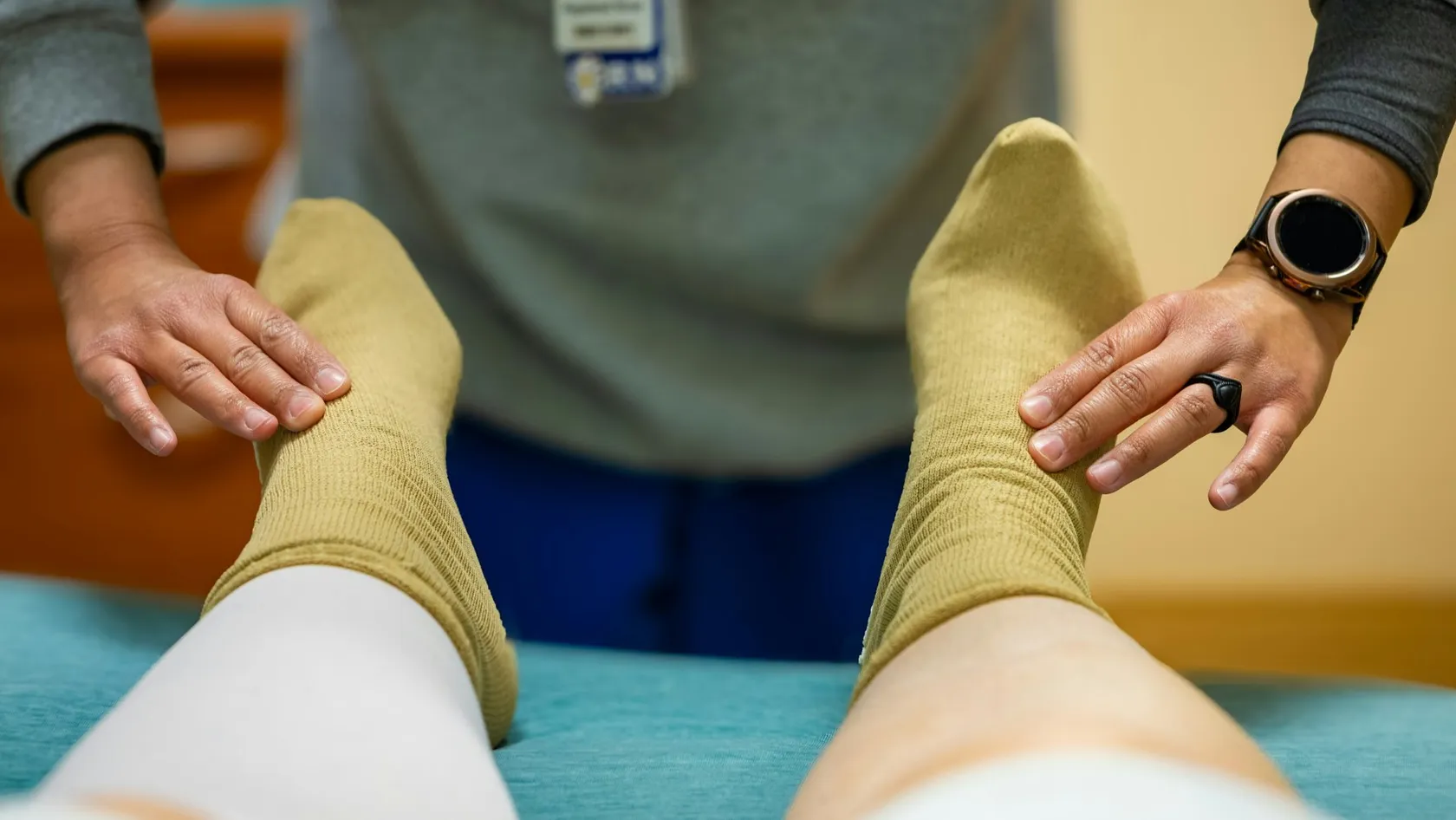
Orthopedic Rehabilitation
Orthopedic rehabilitation restores movement, strength and confidence after joint replacement, fractures, ligament and tendon repair, spinal surgery and amputation, while protecting the repair as it heals. Trials show that a fit patient after knee replacement does as well with a monitored home program as on a ward, and that frail hip fracture patients benefit from inpatient team care. This page explains settings, timetables by operation, milestones, evidence, setbacks and programs from abroad.
About This Department
After an uncomplicated knee replacement, ten days of inpatient rehabilitation walked no farther at six months than a monitored program at home. After a hip fracture, one more person in 25 stayed alive and at home with team rehabilitation on the ward.
The two findings sit side by side because orthopedic rehabilitation is one name for very different needs. The first comes from a randomized trial of 165 patients in Sydney (Buhagiar and colleagues, JAMA, 2017). The second comes from a Cochrane review of 28 trials with 5,351 older participants (Handoll and colleagues, 2021). Two different patients. A fit sixty-year-old with a new knee needs a program and a plan. A frail eighty-year-old with a broken hip needs a team around the bed. Between the two lie fractures, ligament repairs, spine surgery, shoulder operations and amputations, each with its own timetable for healing and its own risks of doing too much or too little. This page explains what orthopedic rehabilitation covers, how to choose between inpatient, outpatient and home programs, what the phases look like after the common operations, what the evidence says, and how patients from abroad can arrange a program at Biruni Hospital in Istanbul.
What orthopedic rehabilitation covers
Bones, joints, ligaments, tendons and the muscles that move them heal on a biological timetable of their own, and no therapy shortens it. Rehabilitation works alongside that timetable. It protects the repair while it is weak, loads it as it strengthens, and restores the movement, strength, balance and confidence that the injury and the operation took away.
The two errors are opposite. Too little movement leaves a stiff joint, a wasted muscle and a fearful patient. Too much, too early, tears a repair or loosens a fixation. The program walks the line.
- Joint replacement of the hip, knee and shoulder.
- Fractures of the hip, wrist, ankle, spine and pelvis, whether fixed with metal or treated in plaster.
- Ligament and tendon repair, above all the anterior cruciate ligament, the rotator cuff and the Achilles tendon.
- Spinal surgery for disc disease, stenosis, deformity and fracture.
- Amputation and prosthetic training.
- Multiple injuries after road accidents and falls, where several timetables run at once.
Who does the work
Four professions, one plan.
An orthopedic surgeon sets the limits, in writing, as a weight-bearing status and a range-of-motion allowance for each phase. A physiotherapist builds the program within them. An occupational therapist handles dressing, bathing, the kitchen and the return to work. A rehabilitation physician oversees pain, medicines, blood clot prevention and other illnesses when the patient is an inpatient, and a dietitian, a psychologist and an orthotist join when they are needed.
Inpatient, outpatient or home
| Setting | Suits | Typical length |
|---|---|---|
| Inpatient rehabilitation ward | Older or frail patients, hip fracture, multiple injuries, spinal surgery with weakness, both knees replaced at once, anyone who cannot yet manage stairs and self-care safely | One to three weeks |
| Daily outpatient program | Patients who are safe at home but need supervised therapy several times a week, including most joint replacements and ligament repairs | Four to twelve weeks |
| Monitored home program | Fit patients after uncomplicated joint replacement or simple fracture, with a therapist checking in by visit or video | Six to twelve weeks |
In the Sydney trial, patients after uncomplicated knee replacement who went home with a monitored program walked as far at 26 weeks, reported the same pain and function, and had no more complications than those given ten days in a rehabilitation ward first.
One trial, one group of patients.
That result relieves the fit patient and says nothing about the frail one, who was excluded from the trial. Hip fracture makes the clearest case for the ward. For everyone else, the honest advice is that the setting matters less than the dose of practice and the quality of supervision, and a program abroad combines, in the common pattern, a short inpatient or daily block with a home program continued in the patient's own country.
Rehabilitation by operation
The common operations
| Operation | Early phase | Return to daily life, then full recovery |
|---|---|---|
| Knee replacement | Walking with a frame or crutches on day one. Bending past 90 degrees within two weeks | Driving at four to six weeks. Stairs, shopping and light work by six to eight weeks. Six to twelve months for strength and stamina |
| Hip replacement | Walking on day one. Hip precautions depend on the surgical approach | Driving and desk work at four to six weeks. Three to six months |
| Hip fracture fixation | Standing and stepping within a day or two, weight bearing as the fixation allows | Home with support at two to four weeks in the fittest, longer in the frail. Many never regain their previous mobility, which is why the ward program matters |
| Anterior cruciate ligament reconstruction | Full extension and quadriceps activation in the first two weeks | Jogging at three to four months. Return to pivoting sport at nine to twelve months, after strength and hop tests |
| Rotator cuff repair | Sling for four to six weeks, passive movement only | Active movement from six weeks, strengthening from twelve. Six to twelve months |
| Lumbar spinal fusion | Walking on day one, no bending, lifting or twisting for six to twelve weeks | Desk work at four to six weeks. Six to twelve months, as the bone fuses |
Reading the table
Why do the timetables vary so much between patients?
- Weight bearing has four levels, from none through touch and partial to full, and the surgeon sets it for each phase.
- Range of motion may be limited by a brace with adjustable stops, especially after ligament and tendon repair.
- Precautions after hip replacement, such as not crossing the legs or bending past 90 degrees, depend on the surgical approach and have been relaxed in many centers.
Phases and milestones
- Protection, days to weeks. Pain and swelling control, wound care, safe transfers and walking with an aid, gentle movement within limits, muscle activation, and prevention of blood clots and chest infection.
- Restoration, weeks to months. Range of motion, strength, balance and walking pattern. The aid is discarded, stairs are mastered, and daily tasks return.
- Function, months. Endurance, speed, agility and the specific demands of work, sport or hobby. Hop tests, strength ratios and questionnaires decide readiness.
- Maintenance, for life. An exercise habit that protects the joint and the rest of the body. Most people stop too early, and the joint that is not used stiffens.
| Week | Movement and walking | Daily life |
|---|---|---|
| 1 | Straight leg, bend to 90. With frame or two crutches | Wash and dress sitting, stairs with help |
| 2 to 4 | Bend to 100 or more. One crutch, then none indoors | Kitchen, short outings |
| 6 | Bend to 110 or more. Outdoors without aid, 20 minutes | Driving, desk work |
| 12 | Full available bend. Uneven ground, longer distances | Most activities, light sport such as cycling and swimming |
What research shows
| Study | Question | Finding |
|---|---|---|
| Handoll 2021, Cochrane, 28 trials | Does team rehabilitation help older people after hip fracture | Fewer die or lose their home, 41 fewer per 1,000 treated as inpatients. Evidence of moderate certainty |
| Buhagiar 2017, JAMA, 165 patients | Does inpatient rehabilitation beat a home program after uncomplicated knee replacement | No difference in walking, pain, function or quality of life at 26 weeks |
| Artz 2015, meta-analysis, 18 trials | Does physiotherapy exercise after knee replacement help | Better function and less pain at three to four months. No long-term difference found, and the trials were small |
Does it matter whether exercises are done at home or in a clinic?
What the studies leave open
Four gaps deserve naming.
Evidence runs strongest for the first three months and weakest for the long term, where few trials have looked. Hip fracture and knee replacement are well studied. Most other operations are thin, where practice rests on surgical protocols and expert consensus. Nobody has settled the number of therapy hours that gives the best result for any orthopedic operation. And no trial has yet tested the pattern most international patients follow, which is an intensive block abroad and a home program afterward, so the case for it rests on the general finding that dose and early supervision matter and the practical fact that the block can be delivered where the surgeon is.
Pain, swelling and setbacks
When should I contact the team?
| Problem | How it shows | Response |
|---|---|---|
| Blood clot | Calf pain and swelling, breathlessness | Same-day scan and anticoagulation |
| Infection | Fever, wound redness or discharge, rising pain | Blood tests, joint aspiration, antibiotics, sometimes surgery |
| Stiffness | Bending stalls below the milestone | Intensified therapy, then manipulation if needed |
| Fixation problem | Pain on weight bearing, a new click or deformity | X-ray and surgical review |
| Fear of movement | Guarding, avoidance, slow progress with no physical cause | Graded exposure, education, psychological support |
Setbacks are the reason a rehabilitation program has a doctor in it and not only a therapist.
Coming from abroad
The surgeon's protocol and your part
Every operation leaves the theater with a protocol. It says how much weight the leg may take, how far the joint may bend, which movements are banned and for how long, and when each restriction lifts. The therapist reads it before the first session and the patient should read it too, because the person who lives with the joint for the other twenty-three hours of the day is the one who keeps or breaks the rules. A copy travels home. A second copy goes to the therapist in your own country.
Your part is larger than most people expect. Sessions supply perhaps five hours a week. Recovery happens in the other hundred and sixty, in the exercises done three times a day on the bedroom floor, in the walk that is a little longer than yesterday's, in the ice pack that goes on before the swelling builds rather than after, and in the decision to stop the painkillers on schedule rather than a week early because they seemed unnecessary. Therapists can teach all of that. Only the patient can do it.
Keep a diary. Degrees, meters, minutes, pain scores. Patients who measure improve faster, partly because measuring shows progress that feeling hides.
Older patients and frailty
Age changes the program more than any diagnosis does. An older patient after a fracture or a joint replacement loses muscle at a rate that a younger one never sees, three to five percent of leg strength in a week of bed rest, and regains it more slowly. Confusion in the first days is common and frightening and nearly always passes. Appetite fails, and protein intake decides whether the muscle comes back. Balance, eyesight, medicines and the state of the other joints all shape what can safely be asked of the patient, and a fall in the first month after surgery undoes months of work. This is why the hip fracture trials favor a ward with a doctor, a nurse, a dietitian and a therapist in daily contact, and why the same team model is used for any frail patient after any orthopedic operation, whatever the trial evidence for that particular procedure says.
Pack the medicine list and the glasses. The walking stick from home comes too, because a familiar one is safer than a new one.
Cost
The estimate follows the file review and depends on the setting, the length of the block, the sessions per day and any braces or aids supplied. Hospitals in this market quote rehabilitation per session, per day or per week, and include it in the package when the operation was done there.
Confirm what a day of rehabilitation includes and how equipment is priced.
References
- Buhagiar MA, Naylor JM, Harris IA, et al. Effect of inpatient rehabilitation vs a monitored home-based program on mobility in patients with total knee arthroplasty, the HIHO randomized clinical trial. JAMA. 2017;317(10):1037-1046.
- Handoll HH, Cameron ID, Mak JC, Panagoda CE, Finnegan TP. Multidisciplinary rehabilitation for older people with hip fractures. Cochrane Database Syst Rev. 2021, Issue 11, CD007125.
- Artz N, Elvers KT, Lowe CM, Sackley C, Jepson P, Beswick AD. Effectiveness of physiotherapy exercise following total knee replacement, systematic review and meta-analysis. BMC Musculoskelet Disord. 2015;16:15.
Editor's note
Written by the Biruni Hospital medical editorial team. Reviewed by Assistant Professor Nazire BAĞATIR, Physical Therapy and Rehabilitation.
Medically reviewed by

Assistant Professor Nazire BAĞATIR
Physical Therapy and Rehabilitation
Related Treatments
View All
Brain Injury Rehabilitation
A bleak outlook given in the first two weeks after a severe brain injury is frequently wrong. In the largest recent follow-up study, 12 percent of such patients were doing well at two weeks and 52 percent at one year. Learn what rehabilitation adds to that recovery, stage by stage, and when a patient is ready to travel.
Cancer Rehabilitation - Oncology Rehabilitation
Cancer rehabilitation treats the fatigue, weakness, stiffness, swelling, nerve damage, swallowing problems and loss of function that cancer and its treatment leave behind, before, during and after therapy. In one study 92 percent of women with metastatic breast cancer had a treatable impairment and fewer than a third were being treated. This page explains what is treated, the evidence on fatigue and lymphedema, prehabilitation, specialist problems and programs for patients from abroad.
Cardiac Rehabilitation - Heart Rehabilitation
A stent or a bypass repairs one artery. It does nothing to the disease that narrowed it. Cardiac rehabilitation is the monitored exercise, tablet review and risk factor treatment that does, and randomized trials link it to fewer repeat heart attacks and fewer hospital admissions in the following year.
Inpatient Rehabilitation
Should recovery happen on a hospital ward, or at home with visits to a clinic? A ward is the answer when someone needs therapy every day, a nurse at night and a doctor nearby, which is common after a stroke, a hip fracture, heart surgery, a lung flare-up or a long spell in intensive care.
Inpatient Rehabilitation - Acute Rehabilitation Unit
Acute does not mean emergency here. It means the intensive level of rehabilitation, with at least three hours of therapy a day on a hospital ward where a rehabilitation doctor sees you daily, and it suits people in the first months after a stroke, a spinal cord injury, a brain injury or major surgery.