
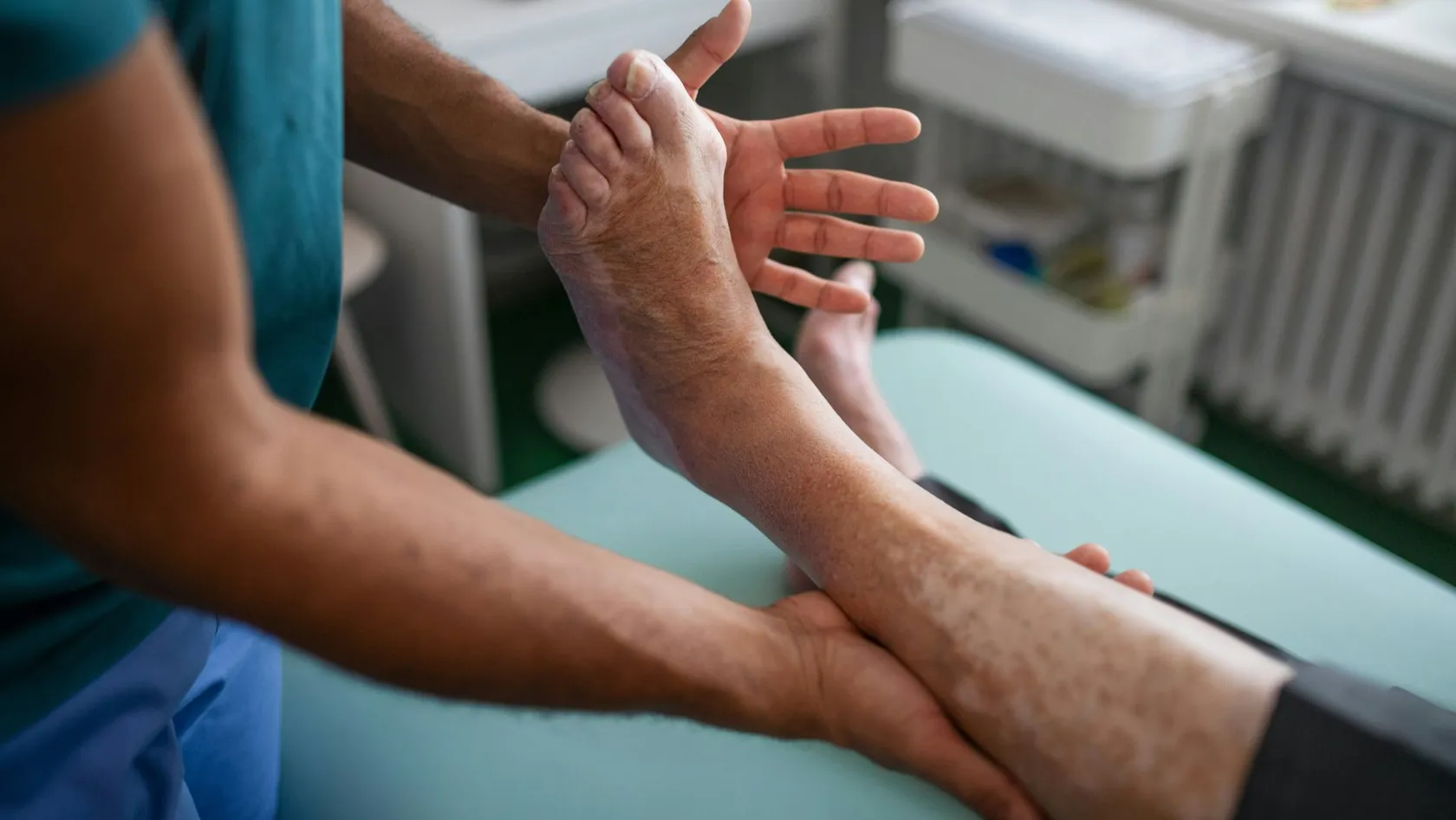
Lymphedema Rehabilitation - Lymphedema Therapy
Lymphedema rehabilitation treats the swelling that follows damage to the lymphatic system, most often in the arm after breast cancer and in the leg after pelvic cancer, through skin care, manual drainage, compression and exercise. More than one in five breast cancer survivors is affected, and swelling caught early by measurement responds to a few weeks in a compression garment. This page explains stages, risk, complete decongestive therapy, evidence, daily life and programs from abroad.
About This Department
More than one in five women treated for breast cancer develops lymphedema of the arm. Caught within months and treated with a sleeve for four weeks, the swelling went down and stayed down.
The first figure comes from a meta-analysis of 72 studies, which put the incidence at 21.4 percent in prospective cohorts and found it four times higher after removal of the armpit lymph nodes than after a sentinel node biopsy (DiSipio and colleagues, The Lancet Oncology, 2013). The second comes from a surveillance program in which 196 women had their arms measured before surgery and every three months afterward. Forty-three developed early swelling, at an average of seven months, and a compression garment worn for a little over four weeks brought the volume back down and kept it there (Stout Gergich and colleagues, Cancer, 2008). Lymphedema rehabilitation, or lymphedema therapy, is the specialist care that treats swelling of this kind, whether it follows cancer treatment, surgery, infection, injury or a condition present from birth, and this page explains what the condition is, who is at risk, what treatment involves, what the evidence supports, and how patients from abroad can arrange it at Biruni Hospital in Istanbul.
What lymphedema is
Lymph vessels drain the fluid that leaks out of blood vessels into the tissues and returns it to the circulation through a network of vessels and nodes. When part of that network is removed, scarred or blocked, fluid collects in the limb it served. The limb swells, feels heavy and tight, and over time the fluid thickens the tissue, so that early lymphedema is soft and pits under a finger while late lymphedema is firm and does not.
Is it the same as ordinary swelling?
Where does it occur?
Who gets it
- Extent of surgery. The number of nodes removed, and mastectomy compared with breast-conserving surgery.
- Radiation. Particularly to the armpit or groin.
- Body weight. Overweight and obesity double the risk after breast cancer and make treatment harder.
- Infection and injury of the limb. Each episode of cellulitis damages the remaining vessels further.
- Time. Most cases appear within two years of treatment, and some appear a decade later.
Complete decongestive therapy
Treatment has a name, complete decongestive therapy, and a structure that every certified lymphedema therapist follows. It has four parts and two phases.
None of the four parts works alone as well as all four together, and the one that matters most in the long run is the one the patient does at home, which is compression.
| Component | What it is | Its role |
|---|---|---|
| Skin care | Daily washing, moisturizing, prompt treatment of cuts and cracks, protection from insect bites and sunburn | Prevents cellulitis, which worsens lymphedema every time it strikes |
| Manual lymphatic drainage | A gentle, rhythmic skin-stretching massage that moves fluid toward working lymph vessels | Adds a modest reduction to bandaging, most useful in mild to moderate swelling |
| Compression | Multilayer bandages in the intensive phase, a fitted garment or wrap system afterward | The main tool. Reduces volume and holds the reduction |
| Exercise | Movement with compression on, from simple pumping to resistance training | Drives fluid through the vessels and keeps the limb strong |
- Phase one, intensive. Daily treatment for two to four weeks, with drainage, bandaging that stays on around the clock, exercise and skin care, until the volume stops falling.
- Phase two, maintenance. A compression garment by day, sometimes bandaging or a night garment, self-drainage, exercise and skin care, for life, with garments replaced every four to six months as they lose their elasticity.
What the trials say about drainage
A Cochrane review of six trials found that compression bandaging alone reduced excess volume by 30 to 39 percent in the intensive phase, that adding manual lymphatic drainage brought a further reduction of about 7 percent, and that women with mild to moderate swelling gained more from it than those with severe swelling. Every trial found drainage safe. Symptoms such as heaviness and pain improved in 60 to 80 percent of participants whatever treatment they received, and those who kept wearing a custom sleeve kept their reduction a year later (Ezzo and colleagues, Cochrane Database of Systematic Reviews, 2015).
- A correctly fitted garment is the single most important item, and fitting is a skill. A loose sleeve does nothing. A tight one, or one that bunches at the elbow, makes swelling worse.
- Bandaging is taught to the patient or a relative during the intensive phase, because it will be needed again during flare-ups.
- Measurements are taken with a tape at fixed points or by water displacement or an optical scanner, and recorded at every visit.
Catching it early
Surveillance
At the naval hospital in Bethesda, the program measured every woman's arms before breast surgery and again every three months. An increase of 3 percent over the baseline triggered four weeks in a compression sleeve, after which the sleeve was worn only for heavy activity or symptoms. The women who were treated this way had an average volume increase of 83 milliliters at diagnosis, lost 48 of them with the sleeve, and held that reduction for the following months. None of them, at that stage, had swelling that a doctor would have noticed on examination.
What are the first signs?
Exercise and daily life
For decades women with lymphedema were told to avoid lifting, carrying, blood pressure cuffs on that arm and flights without a sleeve. Some of that advice has survived scrutiny and some has not.
Everyday precautions
Do I really have to wear the garment every day?
Pumps, surgery and what to avoid
Pneumatic compression
Do compression pumps work?
Drugs
No medicine reduces lymphedema. Antibiotics treat the cellulitis it invites, and patients who suffer repeated episodes may be given a low daily dose to prevent them.
Coming from abroad
Lymphedema therapy suits treatment abroad well, because the intensive phase is short, the skills taught in it last for years, and the garments fitted during it travel home with the patient.
| Step | What happens | Timing |
|---|---|---|
| File review | Send the cancer treatment summary, any limb measurements, photographs of the limb, and a note of infections and previous treatment. The rehabilitation team reviews the file without charge and replies with a plan | Before travel |
| Assessment | Measurement of both limbs, staging, skin and vein check, and a scan for clots if the swelling is new or one-sided | Day one |
| Intensive phase | Daily drainage, bandaging, exercise and skin care, with teaching of self-care throughout | Two to four weeks in Istanbul |
| Fitting | Measurement for a custom or ready-made garment, and a second garment for washing days. A night garment or wrap system where needed | Final week |
| Home phase | Written maintenance plan, self-drainage taught by video, and the coordinator's WhatsApp number for questions once you are back home. Review by video or on a later visit | For life |
| Travel | Fit to fly at any point, with a garment worn on the flight. The coordinator arranges the invitation letter, transfers, daily transport and accommodation, in seven languages with interpreters for others | Any time |
Patients receiving cancer treatment at Biruni Hospital get lymphedema care built into the same stay. Ward rooms have a companion bed, the kitchen prepares halal, vegetarian and diabetic meals, a prayer room is on site, and a request for a female therapist or physician is met wherever the rota allows.
Living with it
Lymphedema lasts for life. That sentence lands hard, and it deserves a second one. Managed well, it becomes a routine rather than an illness.
The routine takes twenty minutes a day. Skin cream in the morning, the garment on before getting up while the limb is at its smallest, a few minutes of self-drainage and pumping exercises, a check of the skin at night, the garment off and washed. Flare-ups happen, after a long flight, a hot summer, an infection or a lapse, and a patient who was taught to bandage during the intensive phase deals with most of them at home in a week. Reviews include a measurement, garments get replaced on schedule, and a therapist sees the patient when the volume creeps up. Many patients report that the swelling itself troubles them less over time than the fear of it did at the start, and that the fear fades once they know what to do, which is the reason the intensive phase spends as many hours on teaching as on treatment and sends nobody home until they have bandaged their own limb correctly in front of the therapist.
What does not fade is the need for the garment. That remains the whole bargain.
Children and primary lymphedema
Primary lymphedema, present from birth or appearing in adolescence, follows the same treatment principles with adjustments for growth. Garments need frequent refitting, parents learn bandaging and skin care, and school and sport carry on as normal with a garment worn for exercise. Where a family pattern exists, the team offers genetic assessment. A child who learns the routine early carries it lightly.
Cost
An estimate follows the file review. It depends on the length of the intensive phase, the number of sessions a day, and garments, which are priced separately because the type and number vary with the limb and the stage. Hospitals in this market quote lymphedema therapy per session or as a package for the intensive phase.
Confirm whether garments and bandaging materials are included.
References
- DiSipio T, Rye S, Newman B, Hayes S. Incidence of unilateral arm lymphoedema after breast cancer, a systematic review and meta-analysis. Lancet Oncol. 2013;14(6):500-515.
- Stout Gergich NL, Pfalzer LA, McGarvey C, Springer B, Gerber LH, Soballe P. Preoperative assessment enables the early diagnosis and successful treatment of lymphedema. Cancer. 2008;112(12):2809-2819.
- Ezzo J, Manheimer E, McNeely ML, et al. Manual lymphatic drainage for lymphedema following breast cancer treatment. Cochrane Database Syst Rev. 2015, Issue 5, CD003475.
- Schmitz KH, Ahmed RL, Troxel A, et al. Weight lifting in women with breast-cancer-related lymphedema. N Engl J Med. 2009;361(7):664-673.
Editor's note
Written by the Biruni Hospital medical editorial team. Reviewed by Assistant Professor Nazire BAĞATIR, Physical Therapy and Rehabilitation.
Medically reviewed by
Assistant Professor Nazire BAĞATIR
Physical Therapy and Rehabilitation
Related Treatments
View All
Brain Injury Rehabilitation
A bleak outlook given in the first two weeks after a severe brain injury is frequently wrong. In the largest recent follow-up study, 12 percent of such patients were doing well at two weeks and 52 percent at one year. Learn what rehabilitation adds to that recovery, stage by stage, and when a patient is ready to travel.
Cancer Rehabilitation - Oncology Rehabilitation
Cancer rehabilitation treats the fatigue, weakness, stiffness, swelling, nerve damage, swallowing problems and loss of function that cancer and its treatment leave behind, before, during and after therapy. In one study 92 percent of women with metastatic breast cancer had a treatable impairment and fewer than a third were being treated. This page explains what is treated, the evidence on fatigue and lymphedema, prehabilitation, specialist problems and programs for patients from abroad.
Cardiac Rehabilitation - Heart Rehabilitation
A stent or a bypass repairs one artery. It does nothing to the disease that narrowed it. Cardiac rehabilitation is the monitored exercise, tablet review and risk factor treatment that does, and randomized trials link it to fewer repeat heart attacks and fewer hospital admissions in the following year.
Inpatient Rehabilitation
Should recovery happen on a hospital ward, or at home with visits to a clinic? A ward is the answer when someone needs therapy every day, a nurse at night and a doctor nearby, which is common after a stroke, a hip fracture, heart surgery, a lung flare-up or a long spell in intensive care.
Inpatient Rehabilitation - Acute Rehabilitation Unit
Acute does not mean emergency here. It means the intensive level of rehabilitation, with at least three hours of therapy a day on a hospital ward where a rehabilitation doctor sees you daily, and it suits people in the first months after a stroke, a spinal cord injury, a brain injury or major surgery.