Laparoscopic Nephrectomy
For a kidney tumor up to 7 cm, keeping the kidney protects its function for years, and the keyhole route now matches open surgery even for larger tumors. This guide covers partial, radical and simple nephrectomy, recovery, immunotherapy after high-risk pathology and a seven to ten day stay in Istanbul.
About This Department
The same operation through four small cuts. Home from hospital in two to four days.
Kidney cancer found while it is still confined to the kidney carries a five-year relative survival close to 93 percent in US SEER registry data, and most of these cancers are now removed laparoscopically. A 2023 meta-analysis of 18 studies found that even for tumors larger than 7 cm, the keyhole operation matched open surgery on survival and recurrence while cutting blood loss, transfusions and nearly three days from the hospital stay.
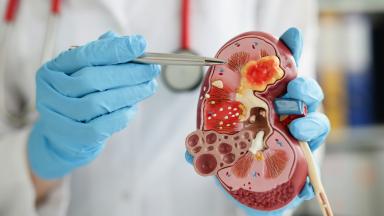
A scan has shown a mass in the kidney, or a kidney that no longer works and causes infection or pain, and the word nephrectomy has come up. One question decides the whole plan. Whole kidney or only the part holding the tumor.
For small tumors, keeping the kidney is the better operation.
Tumors up to 7 cm are removed with the kidney kept whenever their position allows it. Keyhole and open surgery give the same cancer results, even for tumors over 7 cm. Plan two to four nights in hospital and seven to ten days in Istanbul, and send your CT images for a free surgeon review before you book.
Whole kidney or part of it
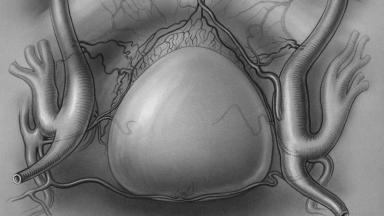
Laparoscopic nephrectomy covers three different operations done through the same small incisions.
Partial nephrectomy
- Removes the tumor with a rim of healthy tissue and leaves the rest of the kidney working.
- Fits tumors up to 7 cm.
Radical nephrectomy
- Removes the whole kidney with its surrounding fat, and sometimes the adrenal gland.
- Fits large or central tumors, where cutting out only the tumor would risk heavy bleeding or a damaged collecting system.
Simple nephrectomy
- Removes the kidney alone.
- Fits a kidney destroyed by stones, long blockage, reflux or repeated infection.
Kidney function is the reason the choice matters. A Memorial Sloan Kettering study of 662 patients with a single tumor of 4 cm or less and two healthy kidneys, published in Lancet Oncology in 2006, found that three years after surgery 80 percent of the partial nephrectomy group were still free of significant kidney function loss, meaning a filtration rate below 60, against 35 percent of the radical nephrectomy group. Radical removal multiplied that risk almost four times. The authors concluded that radical nephrectomy should no longer be regarded as the gold standard for small kidney tumors, and current European guidelines recommend keeping the kidney whenever the tumor allows it. A quarter of the patients in that study already had reduced kidney function before surgery without knowing it, which is why a blood test of kidney function comes before any decision. Partial removal is technically harder, and the choice rests on the tumor's size, its depth and how close it sits to the main vessels.
Keyhole against open surgery
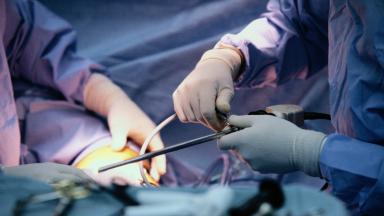
An open nephrectomy goes through a cut of 15 to 20 cm under the ribs. The laparoscopic version uses three to five ports of 5 to 12 mm and one short incision, low on the abdomen, to lift the kidney out in a bag.
Size no longer rules keyhole surgery out. The 2023 meta-analysis in World Journal of Surgical Oncology looked only at tumors larger than 7 cm, the group where open surgery was long assumed safer, and found no difference in overall survival, cancer-specific survival, recurrence or complications. The keyhole group lost 237 mL less blood on average, needed transfusion at roughly a third of the rate, and left hospital 2.95 days sooner, at the cost of 16 more minutes in theater.
Open surgery keeps a place for tumors that have grown into the main vein of the body, the vena cava, or into neighboring organs.
Reasons a kidney is removed
Renal cell carcinoma comes first by a wide margin. Most are found by chance on an ultrasound or CT done for something else, before they cause blood in the urine, flank pain or a lump. Kidneys shrunken by long blockage, large stones or childhood reflux, kidneys that keep causing infection, and some cases of polycystic kidney disease with pain or bleeding make up the benign group. Living kidney donation is a separate pathway with its own assessment and is planned with the transplant team.
Tests before the operation
Contrast CT of the abdomen in several phases shows the tumor, its relation to the kidney's vessels and collecting system, the renal vein and the vena cava. Chest CT checks the lungs. Blood creatinine and an estimated filtration rate measure kidney function, and when one kidney is suspected of not working, a nuclear medicine scan splits the function between left and right. Biopsy of a kidney mass is not routine. It helps when the scan is unclear, when lymphoma or spread from another cancer is possible, or before treatment other than surgery.
Send these for the free review. A urologic surgeon reads the CT images themselves along with the report and replies whether the tumor suits a partial or a radical operation, and whether the laparoscopic route fits.
How the surgery runs
Two to four hours under general anesthesia.
If bleeding or anatomy makes keyhole work unsafe, the surgeon converts to an open incision during the same anesthetic, and you sign consent for that possibility in advance.
What can go wrong
Bleeding is the main early risk, and the 2023 meta-analysis found it lower with keyhole than with open surgery. Partial nephrectomy carries two risks of its own, a leak of urine from the stitched kidney and bleeding from the cut surface in the first weeks, and both are treated without a second operation in most cases, with a drain, a small stent or embolization of the bleeding vessel. Injury to the bowel, spleen, liver or pancreas, all close to the kidney, is rare and is repaired during the operation when recognized. Shoulder-tip pain from the gas fades within two days. Over the long term, a hernia can form at the extraction cut, and the loss of kidney tissue raises the risk of chronic kidney disease, much more so after radical than after partial removal. Injections and early walking prevent clots in the leg. Your surgeon goes through each risk with you at the consent visit.
Blood in the urine, fever, or new pain in the flank in the first three weeks after a partial nephrectomy needs a call the same day.
The first six weeks
You walk the evening of the operation.
Drinking starts the same day and light food the next. The catheter comes out on day one or two, the drain soon after, and pain tablets replace the drip. Packages published by Istanbul hospitals for this operation plan two to four nights on the ward, and discharge to the hotel follows once you eat, pass urine normally, walk the corridor and need only tablets for pain. Gas pain in the shoulders, a bloated feeling and tiredness are normal in the first week. A pillow held against the belly helps when you cough. Showering is fine from day two, and the stitches under the skin dissolve on their own. Desk work returns at around two weeks. Driving waits until you can brake hard without pain, after two weeks for most, and lifting anything heavier than a full shopping bag waits six weeks to protect the extraction wound from a hernia. The small port scars fade over months.
Days in Istanbul and the flight
Plan seven to ten days in Istanbul from arrival to departure.
Published packages in this market advise five days in Turkey after discharge for monitoring. That window allows the clinic visit, a blood test of kidney function, the wound check and, in a cancer case, the final pathology report and the conversation about what it means. Fit-to-fly is written on your discharge summary once the wound is dry, kidney function is stable and you walk comfortably. On a long flight, get up every hour, drink water and wear compression stockings if they were prescribed, because the risk of clots in the leg stays raised for a few weeks after abdominal surgery.
If the pathology shows high risk
The final report gives the tumor type, its grade, its size and whether it reached the fat around the kidney or the renal vein. Low-risk results mean follow-up scans only.
High-risk clear cell cancer is different. In the KEYNOTE-564 trial, published in the New England Journal of Medicine in 2021, a year of pembrolizumab given every three weeks after nephrectomy raised the share of 994 patients free of disease at two years from 68.1 to 77.3 percent, with grade 3 or higher side effects of any cause in 32.4 percent against 17.7 percent on placebo.
Where European guidance stands
The European Association of Urology gives adjuvant pembrolizumab a weak recommendation for high-risk clear cell cancer. Trials of atezolizumab, of nivolumab with ipilimumab and of perioperative nivolumab were negative.
A weak recommendation means a shared decision. Some patients receive a year of treatment for a cancer that would never have come back. Biruni Hospital's medical oncology team gives this treatment on the same campus, and continuing it at home with your own oncologist works equally well with a written handover.
Life with one kidney
The remaining kidney grows to take on part of the lost work. A normal life with one healthy kidney is the rule. Yearly checks of blood pressure, creatinine and protein in the urine, avoiding regular use of anti-inflammatory painkillers such as ibuprofen, and good control of diabetes and blood pressure protect it. After cancer surgery, follow-up CT scans run on a schedule set by the pathology, more often in the first years. Follow-up continues once you are back home. Scan reports and blood results sent to your coordinator on WhatsApp reach the surgeon. The reply comes as a written opinion for your doctor.
Coming to Istanbul
Your coordinator is assigned from the first message. They work in English, Arabic, French, Russian, Serbian, Romanian or Spanish and arrange interpreters for other languages. Ten days before travel the international patients office sends an appointment confirmation and a visa invitation letter, then books the airport transfer, every trip between hotel and hospital, and accommodation for you and your companion before and after the admission, so the whole plan sits with one office from the first message to the flight home. One companion sleeps in your room. Halal, vegetarian and diabetic meals come from the hospital kitchen. There is a prayer room on site, and a request for a female surgeon goes to the department with your first message.
Laparoscopic nephrectomy FAQ
Can I live normally with one kidney?
Is laparoscopic nephrectomy safe for a large tumor?
How long do I stay in Istanbul?
Can a family member stay with me in the room?
What if a problem starts after I fly home?
Your CT or MRI images as a download link or disc with the written report, a recent creatinine blood test, a list of your medicines with blood thinners and diabetes tablets marked, and any biopsy or previous operation reports.
Reading a quote
Quotes differ. Packages published by Istanbul hospitals list pre-operative tests, anesthesia, the surgeon's fees, hospital nights, medication, transfers and in some cases companion accommodation. Diabetes, heart disease and blood thinners also move the total.
This table scrolls sideways on a narrow screen. Swipe or drag to see every column.
| Item | What to check | Effect |
|---|---|---|
| Operation | Partial or radical, laparoscopic or robotic | Partial takes longer and needs more skill. Robotic assistance adds equipment cost. |
| Extra steps | Lymph node removal, adrenal removal, a nuclear split-function scan | Each one is added to the operation or to the tests. |
| Nights | Two to four on the ward in published packages | A urine leak or slow recovery adds nights. |
| Pathology | Included in some packages, billed apart in others | Ask for it in writing. |
| Outside the package | Flights, hotel nights after discharge, immunotherapy | Plan these on top of the quote. |
Ask for a written quote that names all five lines, so that two hospitals can be compared on the same terms.
References
- Huang WC, Levey AS, Serio AM, et al. Chronic kidney disease after nephrectomy in patients with renal cortical tumours. A retrospective cohort study. Lancet Oncol. 2006;7(9):735-740.
- Wang L, Li KP, Yin S, Yang L, Zhu PY. Oncologic and perioperative outcomes of laparoscopic versus open radical nephrectomy for the treatment of renal tumor (> 7 cm). A systematic review and pooled analysis of comparative outcomes. World J Surg Oncol. 2023;21(1):35.
- Choueiri TK, Tomczak P, Park SH, et al. Adjuvant Pembrolizumab after Nephrectomy in Renal-Cell Carcinoma. N Engl J Med. 2021;385(8):683-694.
- Bedke J, Albiges L, Capitanio U, et al. The 2022 Updated European Association of Urology Guidelines on the Use of Adjuvant Immune Checkpoint Inhibitor Therapy for Renal Cell Carcinoma. Eur Urol. 2023;83(1):10-14.
Editor's note
Written by the Biruni Hospital medical editorial team. Reviewed by Assoc. Prof. Dr. Emre SALABAŞ, Urology.
Medically reviewed by

Assoc. Prof. Dr. Emre SALABAŞ
Urology
Last updated: