
Gastroscopy - Upper Endoscopy
The camera part of a gastroscopy lasts ten minutes. What decides whether those minutes answer your question is how long the endoscopist spends looking and which biopsies are taken, and you can ask about both before you book.
About This Department
The camera is inside you for ten minutes. At least seven of them should be spent looking.
Heartburn that returns after every course of tablets, food that sticks on the way down, pain high in the belly, anemia nobody has explained, black stools. Each of these leads a doctor to request a gastroscopy, and the test answers them directly, because a camera sees the lining of the esophagus, the stomach and the duodenum and takes samples from it during the same ten minutes. Serious harm is rare. The American Society for Gastrointestinal Endoscopy puts perforation during a diagnostic gastroscopy at between 1 in 2,500 and 1 in 11,000 procedures. This page explains how the test is done well, how to prepare, what it can find, and how to plan it as a short trip to Istanbul.
What the test looks at, and why it has two names
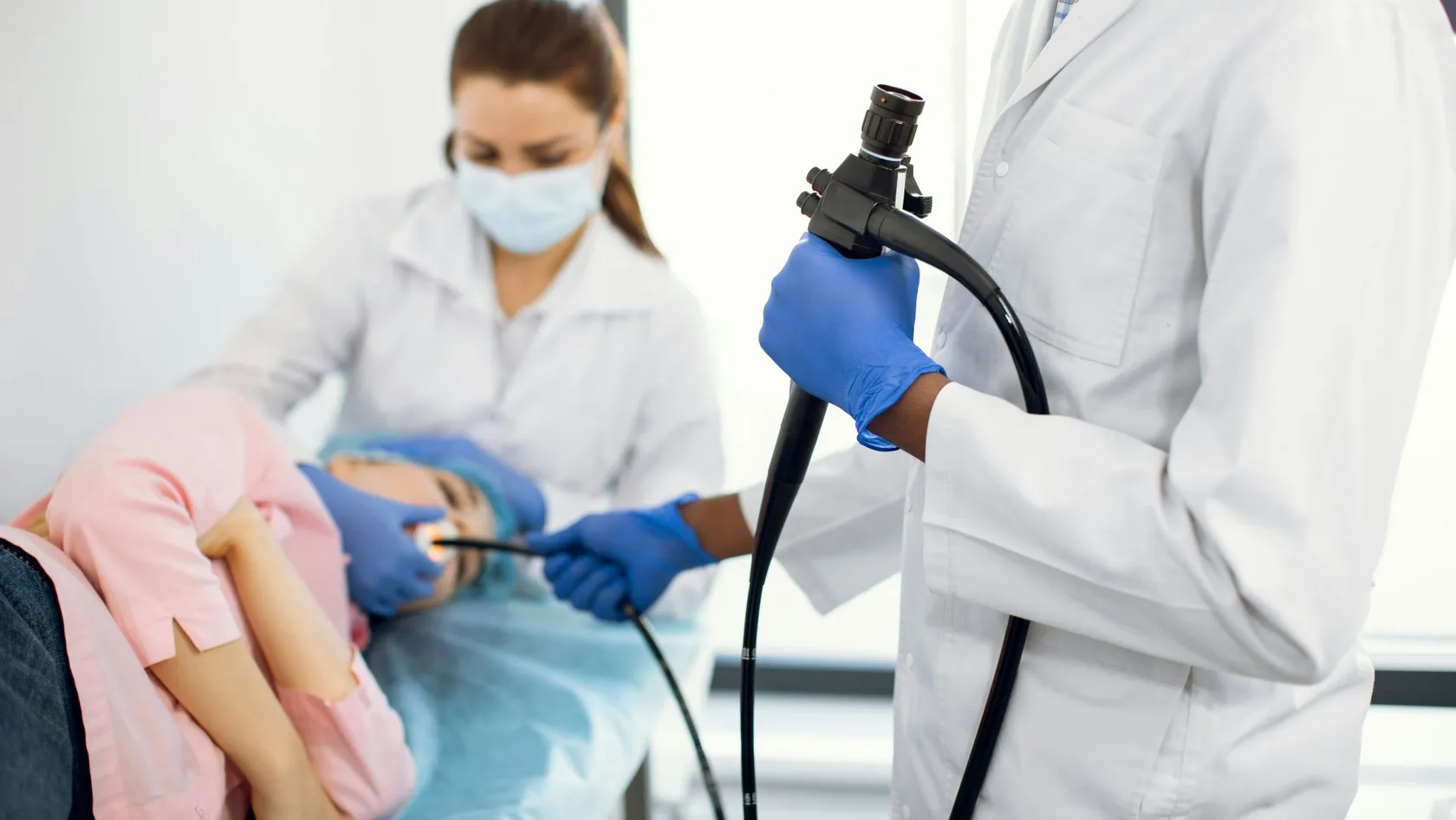
Gastroscopy - Upper Endoscopy appears on referral letters under several names, and every one of them describes a single test. Gastroscopy, upper endoscopy, upper GI endoscopy, EGD and OGD each mean that a thin flexible tube with a camera at its tip goes in through the mouth, travels down the esophagus, crosses the stomach and ends in the duodenum, the first part of the small intestine.
Endoscopy by itself only means looking inside the body with a camera. A colonoscopy counts as an endoscopy too.
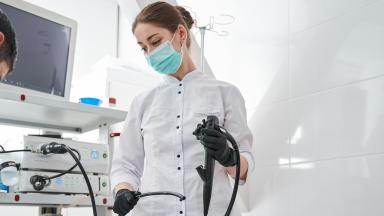
A standard gastroscope measures 9 to 10 millimeters across, close to a little finger. Inside it run a light, a camera, a channel that blows in air or carbon dioxide to open the folds of the stomach, and a working channel for instruments. Small forceps passed down that channel pinch off samples of the lining two or three millimeters wide, and you do not feel a biopsy being taken, because the lining of the gut has no nerves that register a cut the way skin does.
Breathing stays free throughout. The tube lies in the food pipe, behind the windpipe, and air keeps moving through the nose and around the mouthguard.
Who needs a gastroscopy, and who can skip it
Doctors sort upper digestive symptoms into two groups, and only one of them needs a camera quickly. That group covers trouble swallowing, food sticking in the chest, weight loss without trying, vomiting that does not settle, vomiting blood, black tarry stools and iron deficiency anemia. Guidelines call these alarm features, because each one can come from an ulcer, a narrowing or a tumor that acid tablets would only mask. Age counts as well. The 2017 joint guideline of the American College of Gastroenterology and the Canadian Association of Gastroenterology recommends a gastroscopy for anyone aged 60 or over with new indigestion, while a younger adult without alarm features gets a breath or stool test for Helicobacter pylori first and is treated if the result is positive.
That second route needs no camera at all.
Other reasons arrive from a doctor who already knows you. Reflux that has not improved after eight weeks of a proton pump inhibitor. A positive celiac blood test, which needs duodenal biopsies before anyone commits to a lifelong gluten-free diet. A stomach ulcer that has to be seen healed. Barrett's esophagus on a surveillance schedule. Stomach cancer in a parent, brother or sister. An assessment before weight loss surgery.
If your symptoms fit the second group and you are under 60, say so when you write. A reply telling you that a breath test near home comes first is a useful answer. It saves you a flight.
Sedated or awake
Four ways of having an upper endoscopy exist, and the choice shapes your day more than any other decision here.
| Option | During the test | Afterwards |
|---|---|---|
| Throat spray only | Fully awake. The throat is numb, you feel pressure and the urge to gag as the tube passes, and the discomfort lasts as long as the test does. | No drowsiness. You leave within the hour and may drive. |
| Conscious sedation | Midazolam, sometimes with a small dose of fentanyl, through a vein. You stay able to respond but feel calm, and many people remember little. | Sleepy for a few hours. No driving, alcohol or signing documents for 24 hours, and an adult must accompany you. |
| Deep sedation with propofol | An anesthesia team gives propofol and watches breathing, oxygen and blood pressure. You sleep through it. | Clear-headed sooner than after midazolam. The same 24 hour rules apply, and heart or lung disease means an anesthesia review first. |
| Transnasal endoscopy | A 5 to 6 millimeter scope passes through a numbed nostril. It misses the back of the tongue, so gagging is far less, and you can talk during the test. | No sedation and no recovery period. Biopsies are smaller, and treatment through the scope is limited. |
Sedation is the sensible default for someone who has traveled for the test. A sedated patient gags and retches less, which gives the endoscopist the quiet, still minutes that a careful inspection needs, and the memory of the procedure afterwards is faint or absent. Packages published by Turkish private hospitals and medical travel agencies list sedation as part of the procedure, commonly with an anesthesia team giving propofol, so the awake version is the one you have to request.
Choose the throat spray alone when you need a clear head the same afternoon.
Transnasal endoscopy suits people who fear gagging and cannot have sedation, though fewer units offer it. Put the question in your first message.
Preparing, including blood thinners and diabetes medicine
Six hours without food. Two hours without clear liquids.
Those fasting times come from the 2025 performance measures of the European Society of Gastrointestinal Endoscopy, and they exist for two reasons. Food left in the stomach hides the lining, and under sedation it can be breathed into the lungs. Water, black tea and clear apple juice count as clear liquids. Milk does not.
Blood thinners
Blood thinning medicine needs a plan made days ahead, and the plan depends on what will be done through the scope. The 2021 guideline of the British Society of Gastroenterology and the European Society of Gastrointestinal Endoscopy classes a diagnostic gastroscopy with biopsies as a low-risk procedure. For that, aspirin continues, clopidogrel, prasugrel and ticagrelor continue, warfarin continues as long as an INR checked during the week before sits inside your target range, and the newer anticoagulants apixaban, rivaroxaban, dabigatran and edoxaban are simply left out on the morning of the test. Removing a polyp, stretching a narrowing or banding varices falls into the high-risk class, where the same guideline stops clopidogrel seven days before, warfarin five days before and the newer anticoagulants three days before, always with the agreement of the doctor who prescribed them. Nobody with a coronary stent should stop an antiplatelet drug on their own decision. Decide before you travel whether you want treatment done during the same session if something treatable is found, because the two medicine plans differ and the wrong one means a second procedure on a second day.
Diabetes, weight loss injections and acid tablets
People with diabetes get a morning slot, and insulin or tablets are adjusted for the fast by the doctor who manages them.
Weekly injections such as semaglutide and tirzepatide slow the emptying of the stomach. Mention them early. The team may ask for a day of clear liquids before the fast, or for the dose to be timed differently, so that the stomach is empty when the camera arrives.
Acid tablets such as omeprazole and any recent antibiotic can turn a Helicobacter test falsely negative. When Helicobacter is the question, the standard instruction is no proton pump inhibitor for two weeks and no antibiotics for four weeks before the test, and your referring doctor decides whether that pause is safe in your case.
Bring a written list of every medicine with its dose. Loose dentures and tongue piercings come out before the test.
The day itself, in order
Plan on two to three hours inside the endoscopy unit for a test that lasts ten minutes.
Check-in and consent
Cannula and monitors
Throat spray and position
The inspection
Recovery
The conversation
ESGE asks units to book at least 20 minutes for each diagnostic gastroscopy and to spend at least 7 of them between the scope going in and the scope coming out.
Why one gastroscopy is better than another
One meta-analysis, published in Endoscopy International Open in 2014, pooled 10 studies and 3,787 patients with cancer of the esophagus or stomach, and found that 11.3 percent of those cancers had been missed at a gastroscopy performed during the three years before the diagnosis.
Early stomach cancer is flat, pale and easy to pass over.
That figure explains why the professional societies now publish measurable standards for this test, and why a patient choosing where to have it can use them. The ESGE update of 2025 and the quality indicators published jointly by the American College of Gastroenterology and the American Society for Gastrointestinal Endoscopy in 2025 agree on the essentials. The lining has to be clean, so many units give a small drink of simethicone beforehand to clear bubbles and mucus, and the report should grade how clearly the lining could be seen. The inspection has to take time, seven minutes or more from entry to exit. Photographs of fixed landmarks prove that every region was reached. Modern processors add virtual chromoendoscopy, a filtered light mode sold as NBI by Olympus, BLI and LCI by Fujifilm and i-scan by Pentax, which makes abnormal surface and vessel patterns stand out and which the ESGE document requires for certain higher-risk patients. And biopsies follow a protocol matched to the question. Celiac disease calls for at least four samples from the duodenum including the bulb, eosinophilic esophagitis for at least six from two levels of the esophagus, a stomach at risk for a five-sample map of the antrum, the angle and the body, and Barrett's esophagus for samples from all four walls at every two centimeters.
Too few samples, and a celiac or eosinophilic diagnosis slips through a test that looked normal.
Four questions separate a careful unit from a fast one, and any hospital should answer them in writing. How many minutes are booked per test. Whether the report includes photographs. Which biopsy protocol will be used for your particular question. Who reads the pathology, and how long that takes.
Results on the day and results that take longer
Everything the camera saw is known before you leave the building. Inflammation, ulcers, a hiatal hernia, a narrowing, varices, polyps and any suspicious area are described in the report with photographs, and the doctor goes through them with you and your companion the same day, once the sedative has worn off enough for the conversation to stay with you. A rapid urease test for Helicobacter pylori, done on one of the biopsies, changes color within hours.
Pathology takes longer. A laboratory needs three to seven working days to process, stain and read biopsies, and special stains add a few more.
Very few people need to wait in Istanbul for that. The coordinator assigned to you at the first message stays reachable on the same WhatsApp number after you fly home, and the pathology result and the doctor's written advice reach you through that channel. Request the endoscopy report in English before you leave, and ask for the pathology report to be issued in English as well, so that your own doctor can file both.
If the endoscopist finds something
Most findings at gastroscopy are treated with tablets at home. Gastritis, esophagitis from reflux, a hiatal hernia, a duodenal ulcer and Helicobacter infection all fall in that group, and the report names the drug, the dose and the number of weeks.
Some problems get fixed through the scope during the same sedation. Small polyps are snared and removed. A bleeding ulcer is clipped or cauterized. A tight ring or narrowing in the esophagus is stretched with a balloon. Whether this happens on the day depends on the consent you gave and on your blood thinner plan, which is the reason both are settled before you travel.
A suspicious area is a different situation, and it is the one people fear when they book. The endoscopist takes several biopsies and photographs and stops there. If pathology confirms a cancer of the esophagus or stomach, the next steps are a CT scan to stage it, sometimes an endoscopic ultrasound, and a meeting of surgeons and oncologists to agree a plan. At Biruni Hospital surgery, chemotherapy and radiotherapy are all delivered on the same site, so a patient who chooses to continue in Istanbul stays with one team and one set of records. Going home for treatment remains open to you, with the biopsies, the images and a written handover addressed to your own oncologist. Stage decides almost everything about these cancers. An early tumor confined to the lining can be removed through the scope by a technique called endoscopic submucosal dissection, with no open surgery, and that option exists only for tumors found while they are still small.
How safe is a gastroscopy?
Diagnostic gastroscopy ranks among the safest procedures in hospital medicine, and the figures below come from the adverse events review that the American Society for Gastrointestinal Endoscopy published in the journal Gastrointestinal Endoscopy in 2012.
Call the unit or go to an emergency department if any of these appear during the first days after the test.
- Chest, neck or belly pain that is severe or getting worse
- Fever or chills
- Vomiting blood, or black tarry stools
- Trouble swallowing or breathing
- A firm, swollen belly
Nights in Istanbul, and the flight home
Two nights cover a diagnostic gastroscopy.
Arrive the day before, so that the fast starts after a normal evening meal and the consultation, the consent and any anesthesia review are out of the way. Have the test the next morning, then rest at the hotel that afternoon with your companion, since the 24 hour rule after sedation rules out traveling alone, driving, alcohol and decisions that matter. Fly on the third day. No aviation rule sets a waiting period after a diagnostic gastroscopy. The limit comes entirely from the sedative. Treatment through the scope changes the timetable. After a polyp is removed or a narrowing is stretched, delayed bleeding can appear during the following one to two weeks, and the endoscopist gives you a date for flying in writing based on what was done. Allow a few extra days in your booking, and buy a changeable ticket. Adding a colonoscopy makes the trip one day longer, because the bowel preparation takes the afternoon and evening before. Both tests are then done during one sedation, the gastroscopy first.
What decides the cost of a gastroscopy
No figure appears on this page, because two people booking the same named test receive different totals for sound reasons, and the items below are those reasons.
| Item | Effect on the total |
|---|---|
| Type of sedation | Throat spray alone is the lowest. Propofol with an anesthesia team adds the team and the drug. |
| Biopsies and pathology | Pathology is charged per sample pot, so a six-sample protocol costs more than one quick sample. Special stains add to it. |
| Helicobacter testing | A rapid urease test is a separate line from pathology in many quotes. |
| Treatment through the scope | Polyp removal, clips, balloon dilation and banding each carry a device and a fee that a diagnostic quote leaves out. |
| A colonoscopy during the same sedation | Raises the total and lowers the cost per test. Sedation, room and recovery are shared. |
| Your own health | Heart or lung disease, sleep apnea or blood thinners can add an anesthesia consultation, an ECG or blood tests before the day. |
Packages published by Turkish hospitals and medical travel agencies for a gastroscopy tend to cover the specialist consultation, the procedure, sedation, a standard set of biopsies, an interpreter and transfers between airport, hotel and hospital. Flights, travel insurance, extra hotel nights, treatment through the scope and the care of a complication sit outside them.
When a quote arrives, check what it assumes. Does it name the sedation. How many biopsy samples does it count, and is pathology inside the figure. What happens to the total if a polyp is found and removed. Is the report in English included. A quote that answers those four points can be compared with another one. A headline number cannot.
Any figure that means something comes from a gastroenterologist reading your referral and your medicine list, and that review is free.
Language, companions and paperwork
Consent for an endoscopy only counts if you understood it. The international patients team at Biruni Hospital works in English, Arabic, French, Russian, Serbian, Romanian and Spanish, arranges interpreting in other languages on request, and assigns you one coordinator from the first message until you leave.
Bring one adult with you. Sedation makes a companion a medical requirement for the rest of the day, and the person who listened to the doctor's explanation while you were drowsy belongs beside you on the flight home too. The international patients office arranges the hotel for both of you, the airport transfer and the transport between hotel and hospital. Should the test turn into an admission, your companion stays too. Patient rooms have a companion bed. Tell the coordinator about anything else that affects the day, such as a fear of needles, hearing loss, or a wish for your companion to sit in on the consent conversation. Visa paperwork is handled by the same office, which issues an appointment confirmation and an invitation letter naming the hospital and the treating doctor, the document most consulates want with a medical visa application. It goes out ten days or so before travel.
Requests for a female physician are passed to the department and met wherever the rota allows. Make yours in the first message. The hospital kitchen handles halal, vegetarian and diabetic diets, and a prayer room is available on site.
Once you are home
Follow-up after a gastroscopy is mostly paper and tablets. Your own doctor receives the endoscopy report, the photographs and the pathology result, and prescribes what the report recommends.
Helicobacter treatment is the commonest example. It runs for 10 to 14 days with two antibiotics and an acid tablet, and cure is confirmed with a breath or stool test at least four weeks after the last antibiotic, a test any local laboratory can do.
Some findings need a repeat look. A stomach ulcer is checked again after six to eight weeks of treatment to confirm it has healed, Barrett's esophagus goes onto a surveillance schedule measured in years, and the interval for each is written into the report so that the next endoscopy can take place wherever suits you.
Questions that come up later go to your coordinator on WhatsApp, whether that is a side effect of the antibiotics, a line in the pathology report your doctor wants explained, or the timing of the next endoscopy. Warning signs from the safety section go to a local emergency department first.
Gastroscopy - Upper Endoscopy FAQ
Is a gastroscopy the same as an upper endoscopy?
Is a gastroscopy painful?
How long does a gastroscopy take?
Can a gastroscopy and a colonoscopy be done together?
How many days do I need to stay in Istanbul for a gastroscopy?
Will I be able to talk to the doctor in my own language?
What if the biopsy result arrives after I have flown home?
References
- Areia M, Esposito G, Leclercq P, et al. Performance measures for upper gastrointestinal endoscopy: a European Society of Gastrointestinal Endoscopy (ESGE) Quality Improvement Initiative - Update 2025. Endoscopy. 2025;57(11):1268-1297.
- Yadlapati R, Early D, Iyer PG, et al. Quality Indicators for Upper GI Endoscopy. The American Journal of Gastroenterology. 2025;120(2):290-312.
- ASGE Standards of Practice Committee, Ben-Menachem T, Decker GA, Early DS, et al. Adverse events of upper GI endoscopy. Gastrointestinal Endoscopy. 2012;76(4):707-718.
- Menon S, Trudgill N. How commonly is upper gastrointestinal cancer missed at endoscopy? A meta-analysis. Endoscopy International Open. 2014;2(2):E46-E50.
- Veitch AM, Radaelli F, Alikhan R, et al. Endoscopy in patients on antiplatelet or anticoagulant therapy: British Society of Gastroenterology (BSG) and European Society of Gastrointestinal Endoscopy (ESGE) guideline update. Gut. 2021;70(9):1611-1628.
Editor's note
Written by the Biruni Hospital medical editorial team. Reviewed by Assistant Professor Koray KOÇHAN, Gastroenterology.
Medically reviewed by
Assistant Professor Koray KOÇHAN
Gastroenterology
Related Treatments
View All
Barrett's Esophagus Treatment
Most people told they have Barrett's esophagus have been told only half the story. The yearly cancer risk is 0.12 percent, and the grade of dysplasia in the biopsies decides whether the right plan is a daily tablet with endoscopy every few years, or radiofrequency ablation to remove the lining.
Capsule Endoscopy - Wireless Capsule Endoscopy
When a gastroscopy and a colonoscopy are both normal and the blood count keeps falling, the search moves to the small bowel, which neither instrument reaches. A swallowed capsule camera films that stretch in eight hours without sedation and finds a cause in six of ten patients examined for bleeding.
Colonoscopy
Ask one question before choosing where to have a colonoscopy, which is how often the doctor finds polyps. In a study of 314,872 examinations that figure ranged from 7 to 53 percent between doctors, and it predicted who later developed bowel cancer. This guide covers preparation in a hotel room, sedation, findings and the flight home.
Colorectal Polyp Removal
A large polyp in the colon does not automatically mean bowel surgery. Nearly all polyps, including flat ones wider than 20 millimeters, come out through the colonoscope, and the technique is chosen by size and shape.
Endoscopic Mucosal Resection - EMR
Endoscopic mucosal resection lifts a precancerous growth or an early cancer off the muscle wall with an injection and removes it with a snare through an ordinary endoscope, in the colon, esophagus, stomach or duodenum, without an operation. In a study of 479 patients with large colon polyps, 83.7 percent avoided surgery and none died of the procedure. This page explains what EMR removes, which lesions qualify, how it compares with ESD and surgery, evidence, risks, follow-up and care from abroad.