
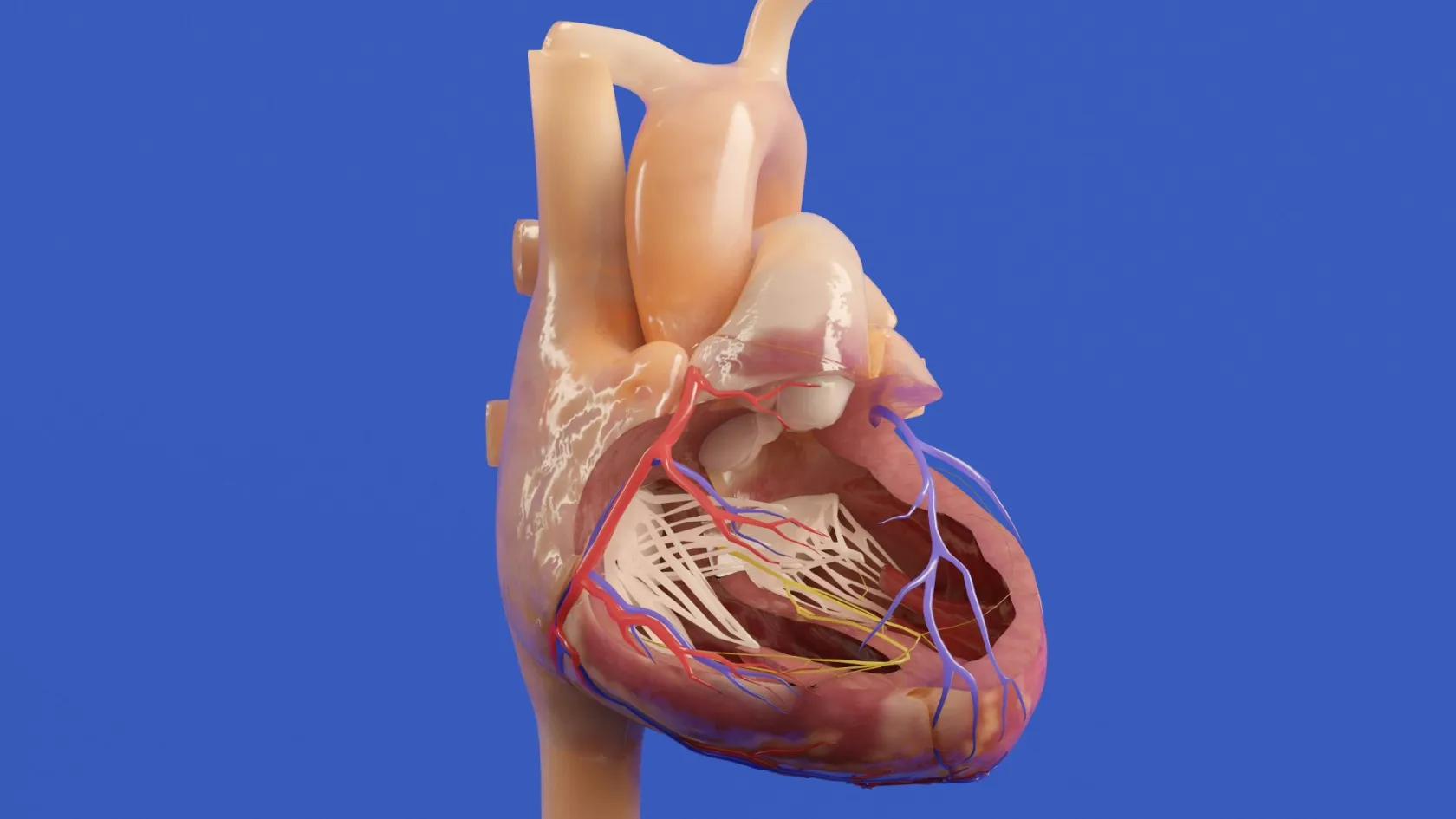
Transcatheter Mitral Valve Replacement - TMVR
Among 521 patients given a transcatheter mitral valve, one-year survival ran from 86 percent to 37 percent depending only on what the new valve was landed inside. Knowing which version of this procedure you are being offered changes everything else.
About This Department
In one registry of 521 patients treated with a transcatheter mitral valve, the chance of being alive a year later ranged from 86 percent to 37 percent depending on nothing more than what the new valve was landed inside. Those patients all had the same procedure name written on their notes. Anybody researching this treatment needs to know which of the four versions of it applies to them, because the numbers attached to each one are not close to each other.
Free consultation
Ask which version of this procedure you are being offered
Your images decide that, and not a conversation. The answer rather than from a conversation. Send the echocardiogram with its moving images, a cardiac CT if you have one, the operation note from any previous mitral surgery including the model and size of any ring or valve, your blood results and your medication list. A heart team reviews the file and tells you whether a catheter valve is possible, what the alternatives are including surgery and a clip, and what the published results are for patients with your specific anatomy. No fee, no obligation, and a coordinator replies in your own language.
Four procedures, one name
The first three are all done with a valve originally designed for the aortic position, used in the mitral position because it happens to fit. That is worth knowing and worth asking about, and it is not the scandal it sounds like, since a great deal of good medicine works that way. It does mean the device was never engineered for the job it is doing in your chest.
This is not a clip
Patients arrive confusing two entirely different catheter treatments for the mitral valve, and clinics do little to help. The difference matters because the evidence behind them is not remotely comparable.
- Edge-to-edge repair, the clip. A small device grips the two leaflets together at the point where they are failing to meet, narrowing the leak without replacing anything. Your own valve stays and keeps working.
- Valve replacement, this page. A whole prosthetic valve is delivered and seated in the mitral position, taking over the job completely. Your own leaflets are pushed aside or, in some devices, deliberately cut.
- Their evidence bases differ enormously. The clip has been tested in randomized trials against medical therapy in thousands of patients. Replacement has not been randomized against anything, in any published trial, ever.
- They suit different valves. A clip needs leaflets it can grasp and works poorly where the valve is calcified or where a previous prosthesis has failed. Replacement is exactly the answer in those situations.
- Blood thinning afterwards differs too. A replacement valve in the mitral position generally means anticoagulation, at least for a period and sometimes permanently. A clip usually does not.
If somebody has told you that you are having a catheter mitral procedure, ask which of those two it is before you read anything else about it.
The evidence gap
One sentence belongs here that you will not find on most pages about this treatment. No patient has ever been randomly assigned to a transcatheter mitral valve rather than to surgery, or rather than to a clip, in a published trial. Everything known about the procedure comes from single-arm studies of thirty to a hundred patients and from registries of people who were treated because somebody judged them too risky to operate on. That has two consequences and they pull in opposite directions. The first is that the mortality figures on this page look alarming next to surgical ones and should not be compared with them. A registry of catheter procedures in patients with an average surgical risk score above ten percent is describing a group that a surgeon had already declined. Reading their one-year mortality against a published surgical series tells you about the patients rather than about the treatments. The second cuts the other way. Without a randomized comparison, nobody can tell you how much of the benefit patients report is the valve and how much is regression to the mean, better medical treatment or the attention that comes with being enrolled in a study. The improvements in symptoms reported across these studies are large and consistent, which is genuinely encouraging, and they are not the same class of knowledge as a trial result. A doctor who tells you this plainly is being straight with you. One who quotes a survival figure without naming the anatomy it came from is not.
Inside a failed valve
The three anatomies compared
One study did what patients most need and reported all three landing zones side by side, in 521 patients treated across many centers. Read it as the clearest available answer to the question of what your own anatomy is likely to mean.
This table scrolls sideways on a narrow screen. Swipe or drag to see every column.
| Measure | Failed valve | Failed ring | Calcified annulus |
|---|---|---|---|
| Patients | 322 patients. | 141 patients. | 58 patients. |
| Procedure technically successful | 94.4 percent. | 80.9 percent. | 62.1 percent. |
| New valve blocked the outflow tract | 2.2 percent. | 5.0 percent. | 39.7 percent. |
| Died within thirty days | 6.2 percent. | 9.9 percent. | 34.5 percent. |
| Died within one year | 14.0 percent. | 30.6 percent. | 62.8 percent. |
| Risk of death against the failed valve group | Reference. | Twice as high. | More than five times as high. |
Every one of those differences was statistically significant. Nothing in that table is a reason to avoid the procedure, and everything in it is a reason to insist that the figures you are quoted come from patients whose valve looked like yours.
Inside a failed ring
A repair that has given way presents a harder target than a failed valve, and the reason is geometry. Surgical rings come in many shapes. Some are complete circles of firm material, some are partial bands leaving part of the annulus unsupported, and some are flexible enough to deform when a valve is expanded inside them. A round metal frame seated in an oval or incomplete opening tends to leave gaps at the edges.
One prospective study enrolled 30 such patients, whose average surgical risk score was 7.6 percent and three quarters of whom were severely limited by symptoms. The procedure was technically successful in 66.7 percent, and the commonest reason for falling short was needing a second valve during the same procedure, which happened to six patients. Nobody died during the procedure and nobody was converted to open surgery. Mortality was 6.7 percent at thirty days and 23.3 percent at one year. Among those who survived the year, 84.2 percent were in the two best symptom classes and none had more than trivial leakage, with an average pressure difference across the valve of 6 mm Hg. That is the pattern across all of this evidence, and it is worth naming. The procedure works well in the people it works in. The uncertainty is about who those people are. Bring the operation note from your repair. The make and size of the ring changes the plan more than almost anything else in your file, and a heart team that has to guess at it is planning with a hand tied.
A calcified annulus
Calcification is the hardest version of this procedure, and the one where the honest numbers are hardest to read. Calcium in the mitral annulus builds up with age, kidney disease and time on dialysis, and by the time it is severe enough to be causing valve trouble the patient usually has a great deal else wrong with them.
- Surgery here is genuinely dangerous. Cutting calcium out of the annulus risks tearing through the back wall of the heart, which is why so many of these patients are turned down for an operation and end up considering a catheter valve at all.
- Registry results are sobering. Technical success 62.1 percent, thirty-day mortality 34.5 percent, one-year mortality 62.8 percent, and blockage of the outflow tract in 39.7 percent. Those figures come from procedures done across many centers, many of them early in the learning curve.
- Prospective study conditions did better. Thirty-one patients treated within a formal trial had 74.2 percent technical success and 16.7 percent mortality at thirty days, rising to 34.5 percent at one year, with 83.3 percent of survivors in the two best symptom classes.
- Purpose-built devices did better still. A recent study of 103 patients with severe annular calcification used a device designed for the mitral position and reported technical success of 94.2 percent and thirty-day mortality of 6.8 percent, with 60.4 percent alive and free of a heart failure admission at twelve months.
- Read that last figure carefully. It is a combined measure of being alive and not readmitted, judged against a pre-set target rather than against a comparison group, and it is not a survival rate. Anybody quoting 60 percent to you as survival has misread the paper.
Direction of travel is encouraging. The destination has not been reached. If this is your anatomy, ask specifically how many of these the unit has done, with which device, and what happened to those patients.
Dedicated devices
Numbers like these describe patients who had already been refused surgery. Read them as a description of a difficult group being helped rather than as a comparison with what an operation would have achieved.
What can go wrong
- Blockage of the outflow tract. The signature complication of this procedure, dealt with in its own section below, and the reason a CT scan comes before any decision.
- Poor seating of the valve. The commonest reason a procedure is recorded as technically unsuccessful, and it sometimes means a second valve is placed during the same session. That happened to six of thirty patients in the failed-ring study.
- Leakage around the frame. A gap between the device and an irregular landing zone. Small leaks are tolerated, larger ones are plugged during the procedure or later, and this is one of the reasons an oval or incomplete ring is a harder target than a round prosthesis.
- Trouble where the equipment went in. Bleeding, tearing or clotting at the vein in the leg, or at the chest wall where a transapical route was used. The early study of a dedicated device recorded major vascular complications in a quarter of patients.
- Stroke. Reported as none in several of the small studies, which sounds better than it is, since none of them had enough patients to measure a risk of a few percent. Take the absence of a number as an absence of information.
- Clot forming on the new valve. A prosthesis in the mitral position sits in slower-moving blood than one on the aortic side, which is why anticoagulation after this procedure is taken seriously and why the plan should be written down before you fly home.
- A gradient higher than you would like. Placing a valve inside another valve narrows the opening, and average gradients across these devices run around 6 to 7 mm Hg. Acceptable in most people, and a reason for careful sizing in anybody with a small existing prosthesis.
The outflow tract problem
Blood leaves the heart through a channel that runs immediately alongside the mitral valve. A prosthesis seated in the mitral position takes up space, and the front leaflet of your own valve gets pushed forward into that channel. Where the geometry is unfavorable, the new valve fixes the leak and blocks the exit at the same time, which is the complication this treatment is defined by and the reason a great many patients are turned down.
This table scrolls sideways on a narrow screen. Swipe or drag to see every column.
| Step | What happens | What it means for you |
|---|---|---|
| The CT prediction | A scan is used to model where the device would sit and how much room the outflow channel would have left. | This is the test that decides whether you are offered the procedure at all. Ask what your predicted channel measured. |
| The observed rates | 2.2 percent inside a failed valve, 5.0 percent inside a ring, 39.7 percent in a calcified annulus. | Your anatomy, and not the skill of the operator, is what drives most of that spread. |
| Cutting the leaflet first | The front leaflet is split with an electrified wire before the valve goes in, so it cannot flap across the channel. | In a study of 30 patients the cut succeeded every time. All survived the procedure, and 93 percent were alive at thirty days. |
| What the same study concluded | Overall success was 73 percent, held back by leaks around the valve and by high gradients in the channel. | The authors wrote that important limitations remain. That is the sentence to quote back at anybody selling this too hard. |
| Alcohol to shrink the muscle | In selected patients a small branch artery is blocked deliberately weeks beforehand to thin the muscle bordering the channel. | It adds a separate procedure and a waiting period, so it belongs in the plan from the start rather than as a rescue. |
Ask three things about this before you agree to anything. Whether your CT was assessed for outflow obstruction, what the predicted measurement was, and what the plan is if the risk is judged high.
Who this is for
A heart team meeting is where that sorting happens, and a cardiac surgeon has to be in the room for it to mean anything. If your case was decided by a cardiologist alone, ask for a surgical opinion as well.
The honest summary
Three things are true at once about this treatment, and pages that pick only one of them are misleading you.
It reliably fixes the leak, in nearly everybody in whom the device seats properly. It has never been compared with anything in a randomized trial. And which version of it you are having matters more than any other single fact about your case.
Symptom improvement across every study here is large and consistent, which is not nothing. Patients who were severely limited before the procedure are mostly not severely limited a year afterwards, and heart failure admissions fall substantially. For somebody facing a reoperation they cannot survive, that is a genuine offer.
What has not been established is how those patients would have fared under a different plan, because nobody has ever run the comparison. Hold both facts. A treatment can be worth having and still be less proven than the marketing around it suggests.
Reading a quote
No figure appears on this page, and here the reason is stronger than usual. Until the CT has been analyzed nobody knows whether this procedure is possible for you, so a price quoted before that analysis is a price for something that may not happen. Six things to establish in writing. Whether the planning CT and its specialist analysis are inside the number, since that analysis is the assessment and it is skilled work. Which device the quote assumes, named, and whether it changes if a different one turns out to fit. What happens financially if the CT rules the procedure out, which is a real outcome for a meaningful share of patients and should not cost you the whole sum. Whether a second valve placed during the same session is covered. How many nights are budgeted, including intensive care, and the cost of extra ones. And whether a separate preparatory procedure, if the outflow tract risk requires one, sits inside the number or outside it.
Your own file moves the total more here than in most treatments. Kidney disease, a weak heart muscle, a previous sternotomy and severe calcification all lengthen the expected stay, and the anatomy that makes this procedure necessary is often the anatomy that makes it complicated. Packages published by Turkish hospitals and medical travel agencies for structural heart procedures generally include the airport transfer, pre-procedure testing, the operator and anesthesia fees, the catheter laboratory, the device, the planned nights, an interpreter and the review before departure. They generally exclude flights, insurance, additional intensive care, treatment of a complication and hotel nights past an agreed number. Read what arrives against both lists.
Coming to Istanbul
Plan on two to three weeks. Assessment and imaging take the first days, the procedure occupies part of one day, and hospital stay runs from a few nights to a week depending on which version you are having and how you were before it. Recovery is quicker than after mitral surgery, though most patients are watched more closely than a TAVI patient would be, because the anticoagulation and the valve position both need checking before anybody clears you to travel. Send the operation note first. For anybody who has had mitral surgery, the model and size of the implanted ring or valve is the piece of information that decides whether this is even possible, and hunting for it after you arrive wastes days. Add the echocardiogram as moving images, any CT you already have, recent kidney function and a full medication list including anything that thins the blood. Every case is reviewed by a heart team containing a cardiac surgeon as well as an interventional cardiologist, and you will be told what they concluded, including whether surgery was considered the better answer. One coordinator holds your file from first message to discharge. The international patients team works in English, Arabic, French, Russian, Serbian, Romanian and Spanish, with other languages arranged on request, and a request for a female physician in your first message lets the department plan for it.
Someone can stay overnight with you on the ward, where the rooms carry a companion bed, while intensive care follows its own visiting rules. Hospital meals cover halal, vegetarian and diabetic diets and a prayer room is available. The international patients office books accommodation for both of you, arranges the airport transfer and daily transport, and prepares the appointment confirmation and the invitation letter naming the hospital and your treating doctor for a medical visa application, generally about ten days before travel.
Flying home is usually cleared one to two weeks after the procedure, on condition that the access site is settled, the rhythm is stable, any anticoagulation is in range and the discharge echocardiogram shows the valve working with an acceptable gradient. A doctor examines you and writes that date. Take home a file naming the device with its model and size, the gradient and any leak measured before discharge, the anticoagulation plan with its target range and next test date, and the date of your first scan at home. Address it to a cardiologist and book that appointment before you leave, because the first months once you are back home are when a clot or a rising gradient would first appear. Your coordinator stays reachable on the same WhatsApp number, so a question about a test result or a wound reaches somebody holding your notes. Get in touch about breathlessness returning, swelling that comes back, a fever without an explanation, bleeding or bruising while on blood thinners, or pain and coldness in the leg used for access.
Transcatheter mitral valve replacement FAQ
Is this as well proven as the aortic version?
My surgical mitral valve has worn out. Is this a good option?
What is the difference between this and a MitraClip?
Why might I be turned down for it?
Will I need blood thinners?
Is the device made for the mitral valve?
How long will the new valve last?
How long should I plan to stay?
References
- Whisenant B, Kapadia SR, Eleid MF, Kodali SK, McCabe JM, Krishnaswamy A, Morse M, Smalling RW, Reisman M, Mack M, O'Neill WW, Bapat VN, Leon MB, Rihal CS, Makkar RR, Guerrero M. One-year outcomes of mitral valve-in-valve using the SAPIEN 3 transcatheter heart valve. JAMA Cardiology. 2020;5(11):1245-1252.
- Yoon SH, Whisenant BK, Bleiziffer S, Delgado V, Dhoble A, Schofer N, Eschenbach L, Bansal E, Murdoch DJ, Ancona M, Schmidt T, Yzeiraj E, Vincent F, Niikura H, Kim WK, Asami M, Unbehaun A, Hirji S, Fujita B, Silaschi M, Tang GHL, Kuwata S, Wong SC, Frangieh AH, Barker CM, Davies JE, Lauten A, Deuschl F, Nombela-Franco L, Rampat R, Nicz PFG, Masson JB, Wijeysundera HC, Sievert H, Blackman DJ, Gutierrez-Ibanes E, Sugiyama D, Chakravarty T, Hildick-Smith D, de Brito FS, Jensen C, Jung C, Smalling RW, Arnold M, Redwood S, Kasel AM, Maisano F, Treede H, Ensminger SM, Kar S, Kaneko T, Pilgrim T, Sorajja P, Van Belle E, Prendergast BD, Bapat V, Modine T, Schofer J, Frerker C, Kempfert J, Attizzani GF, Latib A, Schaefer U, Webb JG, Bax JJ, Makkar RR. Outcomes of transcatheter mitral valve replacement for degenerated bioprostheses, failed annuloplasty rings, and mitral annular calcification. European Heart Journal. 2019;40(5):441-451.
- Guerrero M, Wang DD, Pursnani A, Salinger M, Russell HM, Eleid M, Chakravarty T, Ng MH, Kodali SK, Meduri CU, Pershad A, Satler L, Waksman R, Palacios I, Smalling R, Reisman M, Gegenhuber M, Kaptzan T, Lewis B, Tommaso C, Krause P, Thaden J, Oh J, Douglas PS, Hahn RT, Kar S, Makkar R, Leon MB, Feldman T, Rihal C, O'Neill WW. Prospective evaluation of TMVR for failed surgical annuloplasty rings, MITRAL trial valve-in-ring arm 1-year outcomes. JACC Cardiovascular Interventions. 2021;14(8):846-858.
- Guerrero M, Wang DD, Eleid MF, Pursnani A, Salinger M, Russell HM, Kodali SK, George I, Bapat VN, Dangas GD, Tang GHL, Inglesis I, Meduri CU, Palacios I, Reisman M, Whisenant BK, Jermihov A, Kaptzan T, Lewis BR, Tommaso C, Krause P, Thaden J, Oh JK, Douglas PS, Hahn RT, Leon MB, Rihal CS, Feldman T, O'Neill WW. Prospective study of TMVR using balloon-expandable aortic transcatheter valves in MAC, MITRAL trial 1-year outcomes. JACC Cardiovascular Interventions. 2021;14(8):830-845.
- Sorajja P, Thourani VH, Rogers JH, Bethea B, Guerrero ME, Lim DS, Hebeler R, Cowger J, Allen KB, Sharma RP, Gossl M, Chehab BM, Farivar RS, Kliger CA, Yadav P, Blanke P, Asch FM, Ailawadi G. Transcatheter mitral valve replacement for severe mitral annular calcification, primary outcomes from the SUMMIT-MAC study. Journal of the American College of Cardiology. 2025;87(23):3243-3256.
- Zahr F, Song HK, Chadderdon S, Gada H, Mumtaz M, Byrne T, Kirshner M, Sharma S, Kodali S, George I, Merhi W, Yarboro L, Sorajja P, Bapat V, Bajwa T, Weiss E, Thaden JJ, Gearhart E, Lim S, Reardon M, Adams D, Mack M, Leon MB. 1-year outcomes following transfemoral transseptal transcatheter mitral valve replacement, Intrepid TMVR early feasibility study results. JACC Cardiovascular Interventions. 2023;16(23):2868-2879.
- Muller DWM, Sorajja P, Duncan A, Bethea B, Dahle G, Grayburn P, Babaliaros V, Guerrero M, Thourani VH, Bedogni F, Denti P, Dumonteil N, Modine T, Jansz P, Chuang ML, Blanke P, Leipsic J, Badhwar V. 2-year outcomes of transcatheter mitral valve replacement in patients with severe symptomatic mitral regurgitation. Journal of the American College of Cardiology. 2021;78(19):1847-1859.
- Khan JM, Babaliaros VC, Greenbaum AB, Foerst JR, Yazdani S, McCabe JM, Paone G, Eng MH, Leshnower BG, Gleason PT, Chen MY, Wang DD, Tian X, Stine AM, Rogers T, Lederman RJ. Anterior leaflet laceration to prevent ventricular outflow tract obstruction during transcatheter mitral valve replacement. Journal of the American College of Cardiology. 2019;73(20):2521-2534.
Editor's note
Written by the Biruni Hospital medical editorial team. Reviewed by Op. Dr. Mohammed N.I. SKAIK, Cardiovascular Surgery.
Medically reviewed by
Op. Dr. Mohammed N.I. SKAIK
Cardiovascular Surgery
Related Treatments
View All-
Aortic Aneurysm Repair - Aortic Aneurysm Surgery
Aortic aneurysm repair prevents rupture, which killed 37 percent of patients in emergency surgery against 6 percent in planned repair in a large screening trial. This guide explains when to watch and when to repair, size thresholds for men and women, EVAR against open surgery, long-term trial results, recovery and the stay in Istanbul.
-
Aortic Valve Repair
Being told the aortic valve leaks is usually followed by a conversation about which prosthesis to have. For a large group of patients there is a third answer, which is keeping the valve they were born with, and this page explains who qualifies.
-
Aortic Valve Replacement
The catheter valve wins the first year and the five-year data show the two routes ending up level. This page sets out what that means for a patient of 60 as opposed to a patient of 85, and which prosthesis belongs in each of them.
-
Coronary Angioplasty
In 5,179 patients with stable coronary disease, opening the narrowings did not reduce heart attacks or deaths. In somebody having a heart attack, the same procedure saves lives. Almost every argument about stents comes from confusing those two situations.
-
Endovascular Aneurysm Repair - EVAR
Three randomized trials compared keyhole aneurysm repair with open surgery and disagreed about long-term survival. They agreed on something else, and it is the part that decides how you will spend the next twenty years.