Total hip arthroplasty replaces a worn hip joint with an artificial ball and socket, relieving pain and restoring walking for most patients. In national registries, close to six in ten hip replacements were still working at 25 years. This guide covers implants, surgical approaches, dislocation, blood clot prevention, recovery week by week and the stay.
About This Department
Orthopedics
Total hip arthroplasty replaces a worn hip joint with an artificial one and relieves pain in the large majority of patients. In national registries, close to six in ten hip replacements were still working 25 years later.
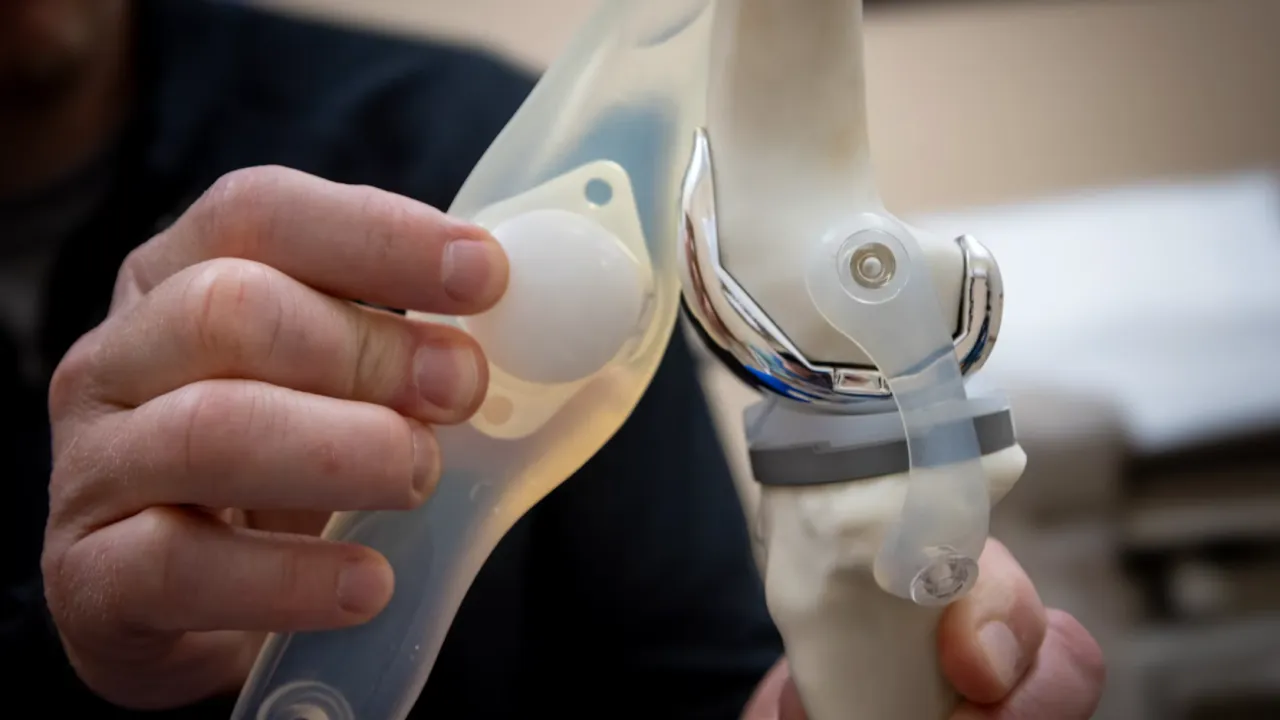
Hip replacement removes the damaged ball and socket of the hip and replaces them with a metal stem and head and a cup lined with plastic or ceramic. It is done mainly for osteoarthritis, and also for damage after fractures, childhood hip disease, rheumatoid arthritis or loss of blood supply to the bone. Patients walk on the day of surgery or the next morning and return to everyday life within six to twelve weeks. A Lancet review of studies with more than 15 years of follow-up found 58 percent of hip replacements in national registries still working at 25 years. Send us your hip X-rays and a description of your pain and walking distance, and an orthopedic surgeon will tell you whether replacement is the right step and how long to plan.
58%
Hip replacements still working at 25 years, national registries
0.64%
Symptomatic blood clots with aspirin after the first five days, 3,424 patients
Hip or groin pain that wakes you at night or limits walking to a short distance.
Stiffness that makes putting on socks, getting into a car or climbing stairs difficult.
Pain despite painkillers, weight loss, physiotherapy and a walking stick.
X-rays showing loss of joint space, bone spurs or a collapsed head of the femur.
What the operation replaces
1
The cup
A metal shell fixed into the pelvis, with a liner of highly cross-linked plastic or ceramic.
2
The head
A ball of ceramic or polished metal that moves in the liner, larger heads giving more stability.
3
The stem
A tapered stem fixed inside the thigh bone, with or without bone cement.
Bearing surfaces
Wear matters most. The surfaces that rub together decide how fast the joint wears, and today the commonest combinations are a ceramic or metal head on a highly cross-linked plastic liner, or ceramic on ceramic. Large metal-on-metal hips were widely abandoned after high failure rates and problems from metal debris, a lesson that reshaped how new implants are tested and regulated.
Cemented or uncemented
Fixing the implant to bone
Cemented implants hold at once. Uncemented implants have a rough or coated surface that bone grows into over weeks. Both give durable results, and many surgeons use an uncemented cup with a cemented or uncemented stem depending on bone quality and age.
Approaches
Posterior, lateral and anterior
Three routes exist. The surgeon reaches the hip from behind, from the side or from the front, and the posterior approach is the most widely used worldwide. The direct anterior approach works between muscles at the front and has been promoted for faster early recovery, while the lateral approaches divide part of the gluteal muscles. Long-term results are similar, and the surgeon's experience with an approach matters more than the approach itself.
Dislocation and soft tissue repair
What the meta-analysis showed
Dislocation of the new hip is one of the commonest early complications. A meta-analysis found that after the posterior approach, the dislocation rate was 4.46 percent when the soft tissues at the back of the hip were not repaired and 0.49 percent when they were, an eightfold difference. With repair, the three main approaches had similar rates, between 0.43 and 1.01 percent.
This table scrolls sideways on a narrow screen. Swipe or drag to see every column.
Dislocation rates by approach, pooled studies
Approach
Dislocation
Posterior without soft tissue repair
4.46 percent
Posterior with repair
0.49 to 1.01 percent
Anterolateral
0.70 percent
Direct lateral
0.43 percent
Blood tests, an electrocardiogram and a check of any heart or lung condition.
Treatment of any skin, dental or urinary infection before surgery.
Good control of diabetes, and stopping smoking.
A physiotherapy session.
Active infection anywhere in the body postpones surgery.
Severe obesity, uncontrolled diabetes and smoking raise the risk of complications.
Very young patients may face one or more revisions in their lifetime.
How long a hip replacement lasts
Assuming that estimates from national registries are less likely to be biased, patients and surgeons can expect a hip replacement to last 25 years in around 58% of patients.
Systematic review and meta-analysis, The Lancet, 2019
This table scrolls sideways on a narrow screen. Swipe or drag to see every column.
Hip replacement survival at 25 years
Source
Hip replacements
Still working at 25 years
Published case series
13,212
77.6 percent
National registries, Australia and Finland
215,676
57.9 percent
Who benefits most
Matching the operation to the patient
A Lancet series on hip replacement emphasized that patient factors should guide the decision, from the severity of pain and loss of function to age, activity and other illnesses. Results are judged both by implant survival in national registries and by patient-reported outcome scores, which capture pain and function as patients experience them.
Why is hip replacement called the operation of the century?
Few operations have changed so many lives. Since the 1960s, hip replacement has let millions of people with arthritis walk without pain again, and improvements in materials, fixation and surgical technique have extended its use from frail older people to younger, active patients who expect to return to work and sport.
Short-term objectives must not compromise long-term performance.
Review in The Lancet, 2007
What are the risks?
Serious complications are uncommon.
Most problems after hip replacement are minor and settle with time, such as swelling, bruising and temporary numbness around the scar. The serious ones, blood clots, infection, dislocation and fracture, each affect a small minority, and careful preparation, surgical technique and early walking lower all of them.
Warning signs after hip replacement
A swollen, painful calf, breathlessness or chest pain, fever with a red, hot or discharging wound, a sudden inability to bear weight, or the leg turning and shortening after a fall or twist need medical attention the same day.
How are blood clots prevented, and what is recovery like?
Preventing blood clots
Hip replacement raises the risk of clots in the legs and lungs. Early walking, compression and a blood-thinning medicine for several weeks lower it. A Canadian double-blind trial of 3,424 patients gave all of them rivaroxaban for five days, then either continued it or switched to aspirin, for a total of 35 days after hip replacement. Symptomatic clots occurred in 0.64 percent with aspirin and 0.70 percent with rivaroxaban, and bleeding was similar.
1
Days one to three
Walking with a frame or crutches the same day or the next, and physiotherapy twice a day, before moving to the hotel after two to four nights.
2
Weeks two to six
Crutches to a single stick, then none. Stitches or clips out around day 12 to 14. Driving after six weeks for most.
3
Months three to twelve
Return to most activities, including swimming, cycling, golf and walking long distances. Swelling and stiffness settle over a year.
Among patients who received 5 days of rivaroxaban prophylaxis after total hip or total knee arthroplasty, extended prophylaxis with aspirin was not significantly different from rivaroxaban in the prevention of symptomatic venous thromboembolism.
Randomized trial of 3,424 patients, New England Journal of Medicine, 2018
Protecting the new hip
In the first weeks, patients avoid the positions that strain the healing tissues, which depend on the approach. After a posterior approach, this means avoiding bending the hip past a right angle, crossing the legs and turning the knee inward. A raised toilet seat and a firm chair help.
Physiotherapy
Exercises at home
Daily exercises strengthen the gluteal and thigh muscles and restore normal walking. The physiotherapist gives a written program before discharge, and video sessions can continue from home.
Preparing before surgery helps
Strengthening exercises in the weeks before surgery, weight loss where needed and stopping smoking make recovery faster and safer. A short session with the physiotherapist before the operation means you already know the exercises when you wake.
These data demonstrate that adequate soft tissue repair greatly reduces the relative risk of dislocation using the posterior approach, and that the dislocation rates for the three most prevalent approaches are similar.
Meta-analysis of approaches, 2006
Other complications
Infection, fracture, leg length and nerves
Infection of the joint is uncommon and serious, and is prevented with antibiotics at surgery, sterile technique and care with any later infection. A fracture around the implant, a small difference in leg length, numbness near the scar and, rarely, nerve injury can occur. Wear and loosening many years later lead to a revision operation in some patients, which is a bigger operation than the first, and the main reason surgeons advise keeping a healthy weight, avoiding high-impact sports such as running on hard ground, and coming for an X-ray every few years even when the hip feels perfect.
How many days in Istanbul, and what decides the cost?
Total hip replacement is a frequently done and highly successful surgical intervention.
Series on hip replacement, The Lancet, 2018
Days, cost and the trip
Plan ten to fourteen days in Istanbul. The first day covers the consultation, tests and the anesthesia review. Surgery follows, with two to four nights in hospital, then physiotherapy at the hotel and a wound check before you fly. On the plane, continue the blood thinner, wear compression stockings, drink water and walk every hour. An aisle seat helps.
Cost depends on the implant, the fixation, the hospital stay and physiotherapy. Your own figure follows the free review of your X-rays.
One coordinator plans the visit, from the visa invitation letter sent ten days ahead to the transfer and a hotel near the hospital with step-free access for you and a companion. The team works in seven languages with halal meals and a prayer room available, and a female doctor is assigned on request when the schedule allows. Back home, the surgeon reviews X-rays at six weeks and one year and stays reachable on the same WhatsApp number.
The first weeks at home go best with help.
At home
Arrange a firm chair with arms, a raised toilet seat and clear walkways before you travel, and plan for someone to help with shopping and cooking for two to three weeks. Patients practice stairs with the physiotherapist before leaving hospital.
Total hip arthroplasty FAQ
How long does a new hip last in the long run?
In national registries, about 58 percent were still working at 25 years. Many last longer, especially in older and less active patients.
When can I walk after hip replacement?
The same day or the next morning, with a frame or crutches.
Which approach is best?
Long-term results are similar. With proper soft tissue repair, dislocation rates are low with all three main approaches, and the surgeon's experience matters most.
Is aspirin enough to prevent blood clots?
In a trial of 3,424 patients, aspirin after five days of rivaroxaban prevented clots as well as continuing rivaroxaban. The surgeon chooses based on your risk.
When can I fly home?
After ten to fourteen days, with a blood thinner, compression stockings and hourly walks on the plane.
Can my family come with me?
Yes. A companion stays at the hotel we arrange, and their help in the first weeks is valuable.
References
Learmonth ID, Young C, Rorabeck C. The operation of the century: total hip replacement. Lancet. 2007;370(9597):1508-1519.
Ferguson RJ, Palmer AJ, Taylor A, et al. Hip replacement. Lancet. 2018;392(10158):1662-1671.
Evans JT, Evans JP, Walker RW, et al. How long does a hip replacement last? A systematic review and meta-analysis of case series and national registry reports with more than 15 years of follow-up. Lancet. 2019;393(10172):647-654.
Kwon MS, Kuskowski M, Mulhall KJ, et al. Does surgical approach affect total hip arthroplasty dislocation rates? Clinical Orthopaedics and Related Research. 2006;447:34-38.
Anderson DR, Dunbar M, Murnaghan J, et al. Aspirin or Rivaroxaban for VTE Prophylaxis after Hip or Knee Arthroplasty. New England Journal of Medicine. 2018;378(8):699-707.
Editor's note
Written by the Biruni Hospital medical editorial team. Reviewed by Assistant Professor Şafak SAYAR, Orthopedics and Traumatology.