
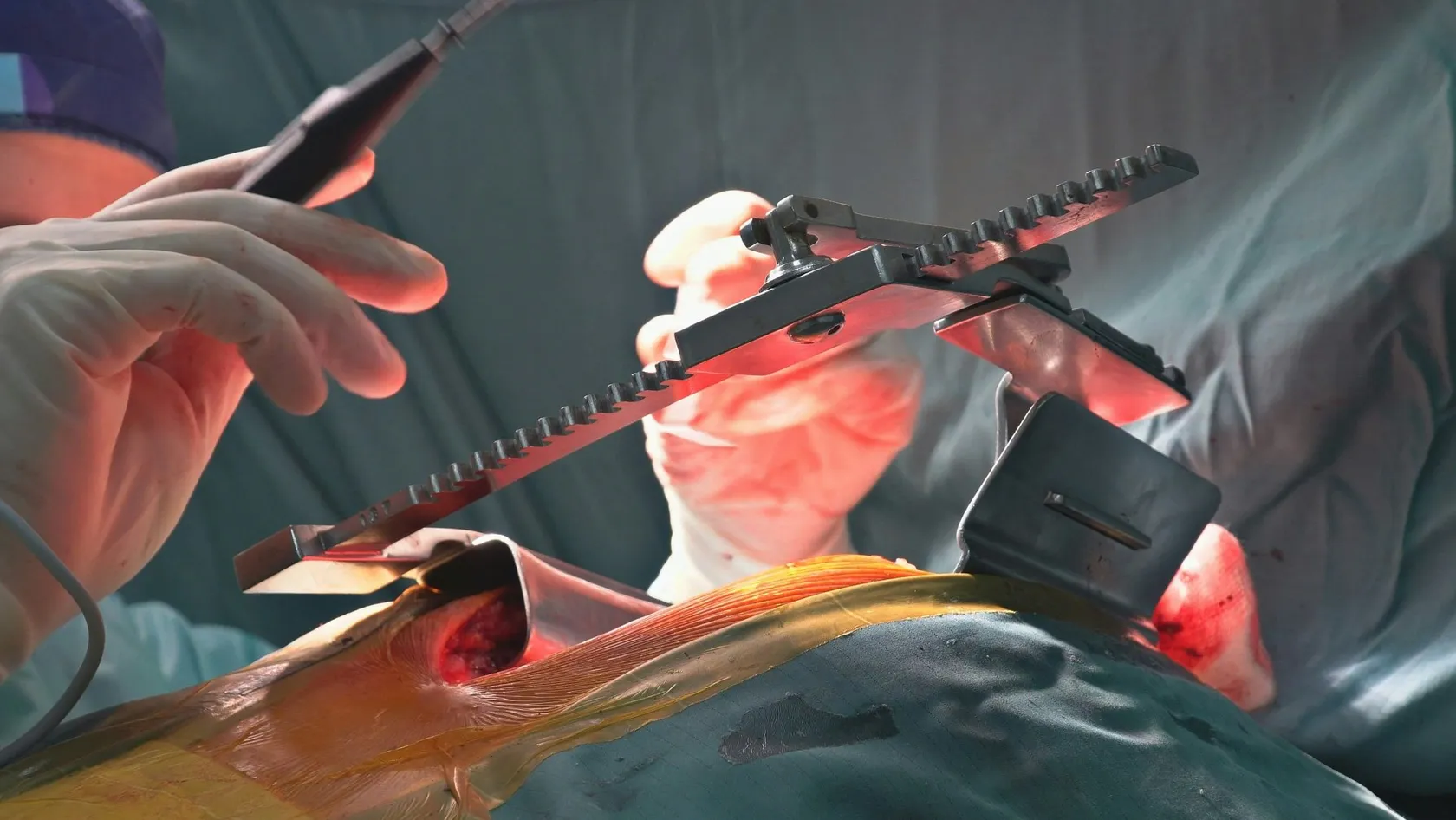
TLIF - Transforaminal Lumbar Interbody Fusion Surgery
Fusion is not automatically the answer to a slipped vertebra. Four randomized trials found no difference at two years between fusing the level and simply freeing the trapped nerve, and this page explains which group you fall into.
About This Department
A solid fusion in nine cases out of ten. The harder question is whether you need one.
A spine surgeon will read your MRI and your reports and tell you which group you fall into, at no cost, before you spend anything on flights.
Someone has shown you an MRI of your lower back, pointed at one level, and told you the disc there has collapsed and the vertebra above it has shifted forward. The operation offered to you takes out that disc, packs bone graft into a cage where the disc used to be, and locks the two vertebrae together with screws and rods so the movement stops, and published series put the fusion rate for that operation between 86 and 90 percent, with the pain in the leg going for the large majority of people who have it.
The consent form leaves out a second thing, and it changes the decision for a lot of readers. For patients whose main problem is a nerve squeezed by a low grade slip, four randomized trials pooled together found no meaningful difference at two years between adding the fusion and simply decompressing the nerve on its own. Which group you fall into depends on your own images and your own symptoms, so this page covers both.
What the operation does to your spine
Transforaminal lumbar interbody fusion reaches the disc through the side of the spinal canal, through the opening where the nerve root leaves. Surgeons call that opening the foramen, and the word transforaminal simply describes the route in. Working from one side lets the surgeon take pressure off the trapped nerve and clear the disc space through a single corridor, so the sac of nerves in the middle of the canal is pulled aside far less than it would be from a straight posterior approach. Four things happen once that corridor is open. The facet joint on the approach side comes off, which both widens the tunnel the nerve travels through and gives the surgeon local bone to use as graft, then out comes the disc and the cartilage gets scraped off the two bone surfaces above and below, because bone joins to bone and never to cartilage. A cage packed with that bone graft goes into the empty disc space, restoring the height the collapsed disc has lost and reopening the tunnel the nerve was being squeezed in. Screws go into the pedicles of both vertebrae, connected by two short rods, and their only job is to hold the level still for the year it takes the graft to turn into solid bone.
The metal is scaffolding. Your own bone is the fusion.
Which back problems it is used for
Degenerative spondylolisthesis, where one vertebra has slipped forward on the one below, is the commonest reason, followed by isthmic spondylolisthesis, which is a slip caused by a stress fracture in the small bony bridge at the back of the vertebra. Surgeons also use it for a recurrent disc herniation at a level that has already been operated on, for a segment that has become unstable after previous surgery, for spinal stenosis where the narrowing sits alongside instability, and occasionally for a single painful level in a degenerated disc that has failed everything else.
Leg pain, numbness and the heavy dead feeling that comes on after a few minutes of walking are the symptoms this operation treats best, while back pain on its own responds far less predictably, and any surgeon who promises you otherwise is telling you something the literature does not support.
Do you need the fusion, or only the decompression?
Spine surgeons have disagreed over this for a decade, and a reader planning to fly somewhere for surgery deserves both sides of it, including the half that does not suit a hospital.
Ghogawala and colleagues randomized 66 patients with a grade one degenerative slip and symptomatic stenosis to laminectomy alone or laminectomy plus instrumented fusion, published the result in the New England Journal of Medicine in 2016, and reported that the fusion group gained more physical health at two years, 15.2 points against 9.5 on the SF-36 physical component summary, with the gap holding at three and four years. The finding that mattered most came later in the follow up. By four years, 34 percent of the decompression-alone patients had needed another operation, against 14 percent of the fusion patients.
Then read the other side. Kaiser and colleagues pooled four randomized trials covering 523 patients in 2023 and found the difference in disability at two years to be almost nothing, 0.86 points on a hundred point scale, with a confidence interval running from minus 4.53 to plus 6.26. In the group that had no fusion, back pain came out slightly better. They concluded that decompression on its own suffices for most patients with a degenerative slip, and that the useful research question now concerns which minority genuinely benefits from adding the screws.
Both papers are honest. Each measured different things, over different lengths of time, in populations that were not identical. Neither team got it wrong.
What separates the two groups in the clinic is movement. A slip that shifts when you bend forward and back on flexion and extension X-rays, a level where the facet joints are already destroyed, a slip that has progressed on scans taken a year apart, a stress fracture in the pars, back pain that dominates the leg pain, or a decompression that has already been done at that level and has failed. In those cases, holding the segment still does something a decompression cannot. A stable slip with mostly leg symptoms and a good disc height is the case where the trials say the screws add little, and that single distinction is why a written opinion on your own flexion and extension films will tell you more than any general article, including this one.
Who this suits, and who should wait
Surgery earns its place when the nerve compression is visible on the scan, the symptoms match the level that is compressed, and three months or more of proper non-surgical treatment has failed, where proper means a supervised physiotherapy program and the injections tried wherever they were indicated. Four weeks of resting counts as neither.
Smoking deserves its own sentence. Nicotine narrows the small vessels that feed new bone, and stopping eight weeks before the operation is one of the few things entirely under your control that changes your own fusion rate.
Age on its own rules nobody out. A meta-analysis of minimally invasive TLIF in patients over 65 found a pooled fusion rate of 86 percent and improvements in disability and pain that comfortably exceeded the threshold for a change a patient would notice. The same review found major complications at 5 percent and minor complications at 20 percent in that age group, roughly twice the rate seen in younger patients, so the operation is offered on the understanding that the recovery is slower and the monitoring closer.
Open, minimally invasive and endoscopic
Three versions of TLIF surgery are in routine use, and they differ in how the surgeon gets to the disc, while what happens once there stays the same, starting with open TLIF, which strips the muscle off the bone on both sides to expose the whole segment. Minimally invasive TLIF goes through a tube pushed between the muscle fibers, with the screws placed through separate stab incisions under X-ray guidance, while endoscopic TLIF uses a camera and one or two ports smaller again and stands as the newest of the three. Same operation, three doors in.
This table scrolls sideways on a narrow screen. Swipe or drag to see every column.
| Measure | Open | Minimally invasive | Endoscopic |
|---|---|---|---|
| Blood loss | Highest of the three | Lower than open | Around 77 mL less than minimally invasive |
| Nights on the ward | Longest | Shorter than open | About two days shorter again |
| Time in the operating room | Shortest | Longer than open | Longest, by roughly half an hour |
| Back pain in the first two weeks | Most muscle soreness | Less than open | Lowest early pain scores |
| Disability and pain at two years | Same as the other two | Differences below what a patient notices | No difference found |
| Fusion rate | No difference found | No difference found | No difference found |
Pooling 17 studies that covered 1,850 patients with a low grade slip, one systematic review compared the minimally invasive route against the open one and found the smaller approach gave less bleeding and a shorter stay while taking longer in the operating room. At two years the differences in disability and back pain favored the smaller approach but sat below the threshold at which a patient can feel a change, and the authors graded the certainty of all of it as very low because most of the underlying studies were observational. Comparing endoscopic against minimally invasive, a pooled analysis of 13 studies and 1,015 patients found less blood loss, a hospital stay two days shorter and better back pain in the first two weeks, with everything equal by the final follow up.
Read those two paragraphs together and the picture is consistent. The smaller the approach, the easier the first two weeks, and by two years all three routes land in the same place for pain, for disability and for the chance of a solid fusion.
For someone flying home three weeks after surgery, an easier first two weeks matters. You spend them in a hotel in a foreign city.
Why not PLIF, ALIF or a disc replacement?
PLIF reaches the disc from directly behind, which means retracting the nerve sac across the midline and accepting a higher risk to it. ALIF comes in through the abdomen, gives the best correction of the curve of the lower back and needs a vascular surgeon to move the great vessels aside, and it carries its own list of complications that has nothing to do with the spine. Artificial disc replacement preserves movement, which is the opposite of what a slipping segment needs. Choosing the route depends on which level is involved, what the alignment needs, whether you have had abdominal surgery before, and where the compressed nerve sits, so a surgeon reading your scan will explain the reasoning for your own case, and a good reason will always come from your anatomy.
What happens on the day
One level takes two to three hours in the operating room. Add an hour or so for a second level.
Before you go to sleep
Position and the check X-ray
Decompression
Cage and graft
Screws, rods and closure
You will be helped out of bed the same evening or the following morning, catheter out, walking a short distance on the ward with a physiotherapist beside you.
Getting people upright early does real clinical work. It lowers the risk of clots and chest infection, and a patient walking on day one gives the clearest early sign that the operation went the way it should.
The risks, with the numbers
Published complication rates for TLIF surgery sit in the region of 9 to 14 percent taken as a whole, with the minimally invasive route at the lower end of that band. Definitions differ between studies. Most entries on the list below are managed and forgotten within a few weeks of the operation. Each of the rest appears below with its standard management, because a page that hides them is a page you should not trust on anything else.
Complication rates in patients over 65 run at twice those in younger patients, at 5 percent for major complications and 20 percent for minor ones in a pooled analysis of minimally invasive TLIF in that age group. The same analysis found that the improvements in pain and disability in those older patients were large and clinically real, which is the reason the operation is still offered at that age.
Recovery, week by week
Leg pain and the walking limit tend to improve immediately, sometimes on the first day out of bed, because the nerve was freed the moment the compression came off. Back pain behaves differently. The muscle and bone that were cut have to heal, so the back can feel worse than it did before surgery for two to three weeks, and people who were not warned find it frightening.
Days one to five are spent on the ward, walking a little further each day, learning to get in and out of bed by rolling onto your side and pushing up with one arm, and coming off the drip onto tablets. Wound care, the medication list and the physiotherapy program are taught before discharge, with a nurse watching you do each one. Weeks one to four are governed by three rules, and every spine unit teaches the same three. No bending forward at the waist. No twisting the trunk. Nothing heavier than a few kilos, which in practice means a full kettle and never a suitcase. Walking does the work here, starting at ten minutes several times a day and building steadily, and it is doing real work, because loading the spine through walking is part of what tells the graft to turn into bone. Driving waits until you are off strong painkillers and can perform an emergency stop without hesitating, which is somewhere between two and four weeks for most people and later for anyone who had a second level done. Sitting hurts most in this period, so long car journeys and long flights are handled with frequent breaks and a supportive cushion.
By six weeks the wound is a firm line, the walking distance has moved past what it was before surgery, and a desk job is realistic if the commute is manageable. Structured physiotherapy starts around this point and runs for two to three months, working on the deep abdominal and back muscles that stabilize the spine and that switch off after any lumbar operation.
Manual work, heavy lifting and impact sports wait for three to six months. Your surgeon sets the exact date from how the level looks on the scans taken then.
Bone continues to mature for a full year. A CT scan at six to twelve months is what confirms the fusion is solid, the last of the stiffness at the operated level usually settles inside that window, and full recovery, meaning the point at which you stop thinking about your back every day, is quoted at six to twelve months for a single level.
How long you stay, and when you can fly
Competitor pages answer this one least clearly of all, so the range below is given as published, with the disagreement left visible.
Packages published by hospitals and medical travel agencies for lumbar fusion put the ward stay at three to five nights and build in a total time abroad of roughly two to three weeks. Surgeons writing on air travel after spinal fusion are more cautious than that, and the guidance published most widely puts short flights at around two to four weeks after surgery and long haul flights at six to eight weeks, and the reason for waiting is the clot risk that comes with hours of sitting still, since a flight does nothing to the implants themselves. Those two pictures do not line up neatly, and pretending otherwise would not help you book anything.
What resolves it is your own surgeon, a wound check, and a written date.
A realistic plan for a single level fusion looks like this. You arrive two to three days before surgery for the blood tests, the anesthetic assessment and the final imaging. Three to five nights on the ward. Then eight to fourteen days in a hotel nearby, walking daily, with the wound reviewed and the stitches or clips dealt with before departure and a discharge summary, your imaging and a written fitness to fly opinion in your hand. Anyone having two levels done, anyone over 70, and anyone with a previous clot should plan on the longer end of that and expect the surgeon to say so. On the flight itself, a few things reduce the clot risk, and every source agrees on them. An aisle seat so you can stand up. Getting up and walking the cabin every hour or so. Compression stockings, ankle and calf exercises while seated, plenty of water and no alcohol. Tell the airline in advance, because extra legroom and early boarding are given once they know, and check your bags in, so nothing has to go into an overhead locker.
Say your return date out loud in the first message you send. A surgeon who knows you have a fixed flight can plan the operating date around it, and an honest answer on whether the date is realistic is better received before the tickets are bought.
If the plan changes in the operating room
Surgeons plan from images, and images taken lying still hide a good deal of what the surgeon finds once the level is open, so three changes come up frequently enough that you should know them before you sign a consent form in a country you do not live in.
First comes the extra level, where a segment next to the planned one turns out to be unstable or badly narrowed and leaving it would mean a second operation later. Next comes a change of approach, when a minimally invasive case gets converted to open because the anatomy, scar tissue from previous surgery or bleeding makes the tube route unsafe. Converting counts as a judgment made for your safety, and it forms a normal part of the operation. Third, a dural tear repaired on the spot mainly changes your first two days, since lying flat for a while forms part of the repair. None of the three means the operation went wrong.
Each of these changes the price. Ask, in writing and before you travel, what the quote assumes and what happens financially if a second level is added or an approach is converted. A hospital that answers that question plainly in an e-mail is telling you something useful about how the rest of the process will go.
Ask also who decides, and how your family is told while you are still asleep.
What moves the price, and how to read a quote
No figure appears on this page. Two people sent the same scan report can receive very different quotes, both of them correct, because a lumbar fusion is not one operation with one price, and a number published here would be wrong for nearly everyone reading it while putting you in the position of arguing about that number instead of describing your own back.
What actually moves the total, in this operation, is a short list.
Each extra level fused adds implants and operating time, which makes level count the largest single factor. The approach comes next, because a minimally invasive or endoscopic case uses more theater time and different consumables than an open one, and then the implants themselves, meaning the cage material and shape, whether cement augmented screws are needed for soft bone, and whether a graft substitute goes in alongside your own bone. Revision surgery at a level that has already been operated on costs more than a first operation at a virgin level, because scar tissue makes everything slower. Adding a decompression at a neighboring level, or correcting alignment across more than one segment, moves it again. And the number of nights you actually spend on the ward, which is a plan and never a promise. Your own health changes the plan too, and therefore the cost. Age, weight, diabetes, heart and lung disease, blood thinning medication, osteoporosis and previous surgery at the same site all affect the length of the operation, the type of implant, the monitoring afterward and how much rehabilitation the case is likely to need.
Packages published in this market usually cover airport transfers, the pre-operative tests and imaging, surgeon and anesthesia fees, the implants, a stated number of nights on the ward, an interpreter, a set number of hotel nights and the follow up appointments before you fly. Most packages leave out flights, travel insurance, any hospital night beyond the stated number, intensive care beyond what was planned, and the treatment of a complication. Those two lists are where quotes differ from each other far more than the headline differs.
Six questions that separate a real quote from a headline
How many levels does this figure assume, and what is added if a second level is fused? Are the cage and the screws named? Does the figure move if cement augmented screws turn out to be necessary in soft bone, and who makes that call? What does one extra night on the ward cost, and how many nights does the figure count? Are the pre-operative scans, blood tests and cardiology clearance inside the figure? How many physiotherapy sessions and hotel nights are included, and does your companion have a bed on those nights too? If a complication needs a second operation, who pays for it?
A figure that means anything comes from a surgeon who has read your MRI, your flexion and extension films and your medical history. That review costs nothing here and commits you to nothing.
Planning the trip
Spine surgery abroad has one practical difference from most other operations people travel for. You cannot carry your own bag, you cannot sit comfortably in a taxi, and for the first week you need somebody to hand you things. Everything below follows from that.
One person can stay in the room with you for the whole admission, because patient rooms at Biruni Hospital have a companion bed, and accommodation for both of you on the nights either side of the admission is arranged by the international patients office, along with the airport transfers and the transport between the hotel and the hospital. For a patient who has just had a lumbar fusion, that transport is the difference between a manageable week and a miserable one. The international patients team works in English, Arabic, French, Russian, Serbian, Romanian and Spanish, and interpreting in other languages is arranged on request. One coordinator takes your case from the first message and stays with you through discharge. That matters most at two specific moments in a spine case, namely the consent conversation, where you are being told what the surgeon will do if the level next door turns out to be unstable, and the ward round on the second morning, where you need to describe exactly where the numbness is.
Requests for a female surgeon or physician go to the department and are accommodated wherever the rota allows. Say so in your first message, while the rota can still be built around it.
For the visa, the international patients office issues an appointment confirmation and an invitation letter naming the hospital and the treating doctor, which is the document most consulates ask for with a medical visa application. It goes out about ten days before travel. Halal, vegetarian and diabetic diets are handled by the hospital kitchen, and there is a prayer room on site.
Pack for a back that cannot bend. Loose clothing that goes on without stooping, slip on shoes, and a long handled grabber if you already own one.
After you fly home
The fear nobody puts into words at the consultation is this one. Something goes wrong in week five, you are two thousand kilometers away, and the surgeon who operated on you has never met your family doctor.
Three things reduce that to a manageable problem. Start with what you leave with, meaning an operation note that names the implants and the levels, a discharge summary, your post-operative imaging on a disc or a drive, the medication list, the wound care instructions and the physiotherapy program. Any doctor anywhere can act on that file. Next, your coordinator stays reachable on the same WhatsApp number after you fly home, which means a photograph of a wound that worries you gets an answer the same day instead of becoming a week of worry. Third, a named doctor at home, arranged before you travel, checks the wound, removes anything that needs removing and supervises the rehabilitation.
Remote follow up in the months afterward is a conversation covering function more than images. How far you walk, what still wakes you at night, whether the numbness is receding from the foot upward, how the physiotherapy is going. The imaging that matters, a CT at six to twelve months to confirm the fusion, can be done at home and sent for review.
Request the operation note in English before you leave the ward. Obtaining it from another country three weeks later takes far longer.
Signs that mean call the same day
Some symptoms after a lumbar fusion can safely wait for the next scheduled contact. These cannot, and they apply wherever in the world you are when they happen.
New weakness in a leg or foot that was working normally. Numbness spreading around the back passage or the inner thighs, or a loss of control over the bladder or bowel, which together point to pressure on the nerves at the base of the spinal canal and are treated as an emergency everywhere. Clear fluid leaking from the wound. A wound that becomes red, hot, increasingly painful or starts to discharge, particularly with a fever. Swelling and pain in one calf. Sudden breathlessness or chest pain. Severe leg pain that returns after it had settled.
Go to the nearest emergency department for any of these, then message your coordinator with what you were told. Distance changes where you are seen, and it does not change how quickly you should be seen.
TLIF surgery FAQ
How long do I need to stay in Istanbul after TLIF surgery?
When can I fly home after a lumbar fusion?
Can my husband or wife stay in the room with me?
Will anyone speak my language?
What happens if I have a problem once I am back home?
Is a spinal fusion permanent?
Will I set off airport security scanners?
Written by the Biruni Hospital medical editorial team. Reviewed by Dr Yunus Emre Yavuz, Orthopedics and Traumatology.
References
- Ghogawala Z, Dziura J, Butler WE, Dai F, Terrin N, Magge SN, et al. Laminectomy plus Fusion versus Laminectomy Alone for Lumbar Spondylolisthesis. New England Journal of Medicine. 2016;374(15):1424-1434.
- Kaiser R, Kantorova L, Langaufova A, Slezakova S, Tuckova D, Klugar M, et al. Decompression alone versus decompression with instrumented fusion in the treatment of lumbar degenerative spondylolisthesis. A systematic review and meta-analysis of randomised trials. Journal of Neurology, Neurosurgery and Psychiatry. 2023;94(8):657-666.
- Huang J, Rabin EE, Stricsek GP, Swong KN. Outcomes and complications of minimally invasive transforaminal lumbar interbody fusion in the elderly. A systematic review and meta-analysis. Journal of Neurosurgery Spine. 2021;36(5):741-752.
- Azizi MI, Zaky MFA, Valerian A, Rizal LH, Nanza M. Comparative outcomes of minimally invasive versus open transforaminal lumbar interbody fusion for low-grade lumbar spondylolisthesis. A systematic review and meta-analysis. Journal of Clinical Orthopaedics and Trauma. 2026;82:103600.
- Haibier A, Yusufu A, Hang L, Abudurexiti T. Comparison of clinical outcomes and complications between endoscopic and minimally invasive transforaminal lumbar interbody fusion for lumbar degenerative diseases. A systematic review and meta-analysis. Journal of Orthopaedic Surgery and Research. 2024;19(1):92.
Editor's note
Written by the Biruni Hospital medical editorial team. Reviewed by Assistant Professor Özcan ÇIKLATEKERLİO, Neurosurgery.
Medically reviewed by

Assistant Professor Özcan ÇIKLATEKERLİO
Neurosurgery
Related Treatments
View All
ALIF - Anterior Lumbar Interbody Fusion Surgery
Coming in from the front restores the curve of the lower back better than any posterior route and leaves the back muscles untouched. It also carries one risk most pages will not name, and this page names it.

Brain AVM Surgery - Arteriovenous Malformation Surgery
An unruptured brain AVM bleeds at roughly 2.2 percent a year, and surgery spends its whole risk on a single morning. This page sets those two shapes of risk side by side, explains what the ARUBA trial does and does not say about your case, and shows how a Spetzler-Martin grade changes the answer.
Brain Tumor Surgery - Brain Tumor Removal
Brain surgery is one trade repeated all day, how much tumor comes out against what the brain around it still does. This page puts the published numbers on both sides of that trade.
Cervical Microdiscectomy - Minimally Invasive Neck Disc Surgery
Neck disc surgery is done from the front, through the space between your windpipe and your carotid artery, and almost everything that goes wrong that is not the disc happens in that corridor. What has been measured in it.

Chiari Malformation Surgery
A Chiari malformation is measured in millimeters and treated according to symptoms, and those two things come apart more often than patients are told. Most people with the finding never need an operation. This page sets out who does, what posterior fossa decompression removes, why surgeons still argue over opening the dura, and what the pooled studies say about both sides of that argument.