ALIF reaches the two lowest discs of the spine through a short incision in the abdomen, which lets the surgeon fit a larger cage and rebuild more of the lower back curve than a route from behind, at the cost of two risks men in particular should know about.
About This Department
Anterior spine surgery
Fixing the lower back from the front. A bigger cage and a better curve, with two risks you should know by name.
Send us your MRI and a spine surgeon will tell you whether the front route suits your level and your history, before you book anything.
About 6°
More lower back curve restored than with TLIF
Under 1%
Retrograde ejaculation across 8,028 pooled patients
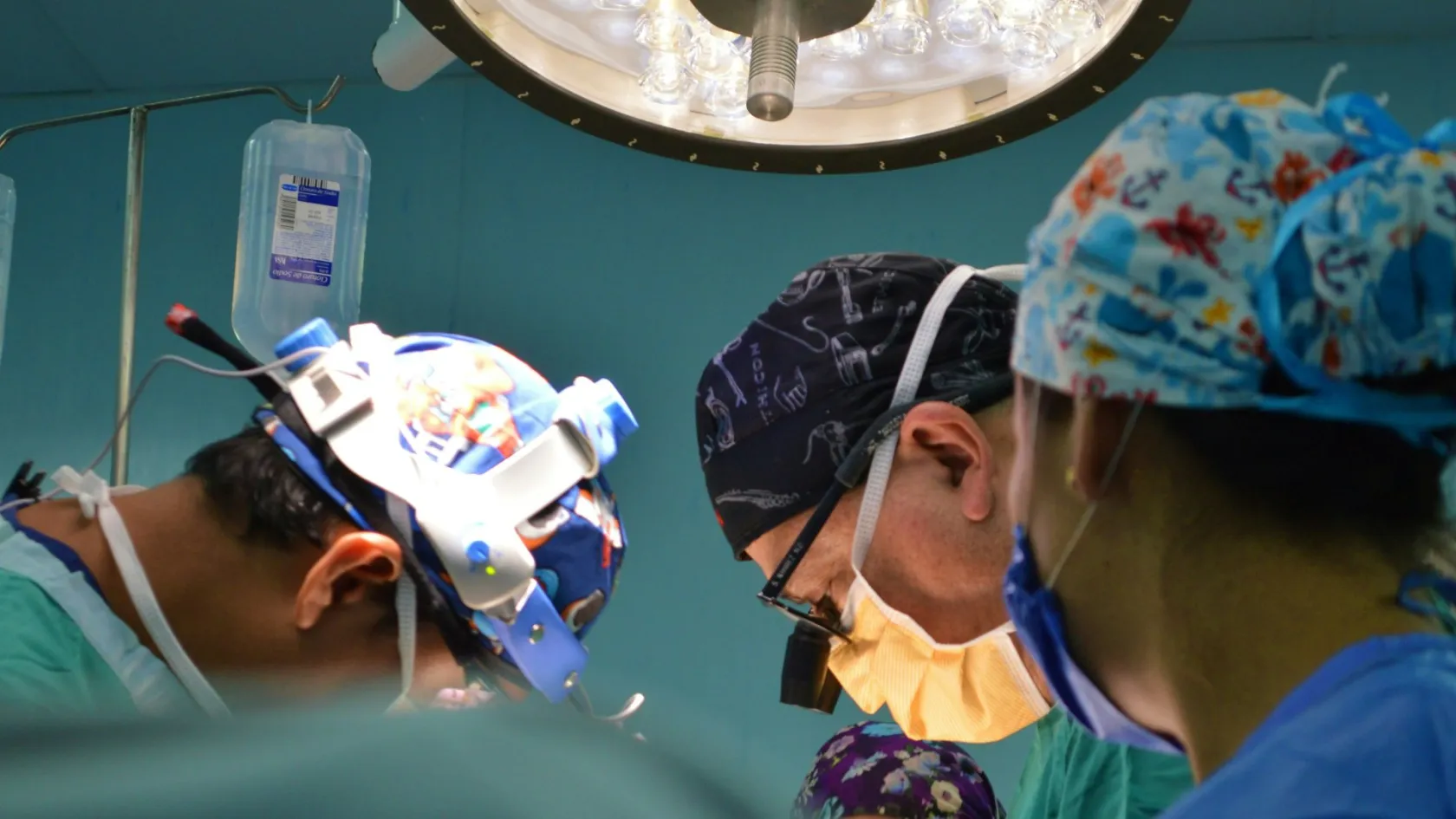
Most people who are offered ALIF are surprised by the same detail. The problem is in the lower back, yet the cut is on the belly. Anterior lumbar interbody fusion reaches the worn disc from the front, through a short incision below the navel, moving the abdominal contents and the large blood vessels gently to one side so the surgeon can see the whole front of the disc. The disc is cleared out completely, a large cage filled with bone graft is pressed into the space, and over the following months the two vertebrae grow into one solid block.
The back muscles are never cut, and that is a real advantage. The price is that the route runs past the aorta, the vena cava and the iliac vessels, and past a thin web of nerves that controls ejaculation in men. Both risks are uncommon. Neither is trivial, and a good decision weighs them against what the front approach does better than any route from behind.
01
Why a surgeon goes in from the front
A disc has to be removed before two vertebrae can be fused, and how much of it the surgeon can see decides how well the space can be prepared. From behind, the nerves and the spinal canal sit in the way. The surgeon works through a narrow window to one side of them, takes the disc out piece by piece, and fits a cage small enough to pass the nerve root.
From the front there is nothing to work around. Anterior lumbar interbody fusion exposes the full width of the disc, so it can be cleared to clean bone from edge to edge and replaced with a cage that covers most of the end plate. That cage can also be wedge shaped, taller at the front than at the back, which pushes the two vertebrae into the gentle inward curve the lower spine is meant to have. Surgeons call that curve lordosis.
Three practical gains follow from that view. The disc space can be opened back to something close to its original height, and when it is, the openings where the nerve roots exit widen with it. This indirect decompression can relieve leg pain without the surgeon ever touching the nerve. The big footprint of the cage spreads the load across the strongest rim of bone, which matters for fusion and for keeping the cage from sinking. And because the back muscles stay intact, the pain in the first weeks tends to sit in the belly wall rather than the spine.
The front route works best low down. L5-S1 and L4-L5 are where it is used most, because that is where the large vessels divide and leave a natural gap to work through. Higher levels are reachable but the vessels need more handling, so many surgeons switch to a side approach above L4.
02
ALIF and TLIF side by side
Fusion rates are close to identical. A meta-analysis comparing the two operations found solid bone in 88.6% of ALIF patients and 91.9% of TLIF patients, a gap too small to be meaningful, and pain and disability scores were also similar at follow-up. If both routes reach your level, the choice turns on alignment and on which complications you would rather risk.
This table scrolls sideways on a narrow screen. Swipe or drag to see every column.
What pooled studies report for the front and back routes
Measure
ALIF, from the front
TLIF, from behind
Bone fusion
88.6%
91.9%, no meaningful difference
Disc height restored
About 2.7 mm more on average
Less, limited by cage size
Lower back curve
About 6° more whole lumbar lordosis
Less, limited by the smaller cage
Tear in the nerve sac lining
0.4%
3.8%
Blood vessel injury
2.6%
Close to zero
Operating time and blood loss
Lower for stand-alone ALIF than open posterior fusion
Minimally invasive TLIF is the quickest
Complications at L5-S1
Fewer overall
Odds about 1.7 times higher
The figures in the first five rows come from one meta-analysis of the two operations. The last two rows come from newer pooled work. A 2023 review of 21 studies and 3,686 patients found stand-alone ALIF quicker and less bloody than posterior interbody fusion, with a shorter hospital stay than TLIF and no difference in adverse events. A 2025 meta-analysis limited to L5-S1, the level where the choice comes up most, found more complications and more repeat operations after TLIF, and better restoration of the lumbar curve after ALIF. Patient reported outcomes were the same in both groups.
Read that honestly. Neither route makes people feel better on average. ALIF tends to win on alignment and on the lowest level, TLIF wins on avoiding the abdomen entirely, and the surgeon looking at your images should be able to tell you which of those matters more for you.
03
Who the front route suits
Your history below the belly button matters as much as your spine. A previous operation in the abdomen or behind it leaves scar tissue around the vessels, and that changes the safety of the approach more than almost anything visible on an MRI.
Usually a good fit
A collapsed, painful disc at L4-L5 or L5-S1 that has not settled with at least several months of proper non-surgical care. A slip at L5-S1 caused by a stress fracture in the back of the vertebra, known as isthmic spondylolisthesis. A disc that has herniated again after one or more operations from behind, where going through the old scar would be harder. A posterior fusion that never became solid. A flattened lower back that needs its curve rebuilt.
Talk to us first
Earlier abdominal, pelvic or kidney surgery, radiotherapy to the abdomen, or a past retroperitoneal operation. Heavy calcium in the aorta or iliac arteries, or an aortic aneurysm. Severe obesity, which makes the exposure deeper, or tight central stenosis that needs the canal opened directly from behind. A level above L4, where a lateral approach is often safer. A man who plans to father children, for the reason in section 07.
None of the cautions is an automatic no. They are the questions a surgeon has to answer from your scans and your history, and some of them simply shift the plan toward a lateral or posterior route that reaches the same disc.
04
Stand-alone ALIF or front and back
The word ALIF on a quote can describe two quite different operations.
In a stand-alone ALIF everything happens through the abdominal incision. The cage is held in place by its own screws or a small plate fixed to the front of the vertebrae, and nobody turns you over. It suits a stable spine with good bone, a single level and no slip, or only a mild one.
A combined operation, often called a 360 or circumferential fusion, adds screws and rods from behind, either straight after the front stage under the same anesthetic or on a separate day. The surgeon reaches for this when the slip is larger, when the bone is soft, when two or more levels are fused, or when the nerves also need to be freed directly from behind. You then have two wounds and a somewhat slower first week, in exchange for a more rigid construct while the bone heals.
Ask which one is being proposed before you compare offers. A stand-alone price set against a combined price is not a like-for-like comparison, and the recovery is different too.
05
The operation in five stages
A single level stand-alone ALIF usually takes two to three hours under general anesthesia, lying on your back.
1
The incision
A cut of roughly 6 to 10 cm, usually low on the abdomen and slightly to the left, often running across rather than down so it heals into a less visible line.
2
The approach
The sac that holds the intestines is pushed aside without being opened, which is called the retroperitoneal route. The large vessels are then eased off the front of the spine. In many hospitals this stage is done by a vascular or general surgeon who specializes in it.
3
Clearing the disc
The spine surgeon removes the whole disc and scrapes the cartilage from the bone above and below, because bone will only knit to bone.
4
The cage
Trial spacers find the right height and angle under X-ray. The final cage, packed with bone graft or a graft substitute, is tapped into place and secured.
5
Closing, and turning if needed
The vessels fall back into place and the abdominal wall is closed in layers. In a combined operation you are turned onto your front for the screws and rods.
Some hospitals bring in an access surgeon for every case and some only for difficult anatomy. It is a reasonable question to ask, and a pooled analysis of 58 studies found complication rates low either way, with access surgeons tending to take on the harder cases.
06
Risks that come with the front approach
Every spinal fusion carries infection, blood clots, a fusion that fails to set and new wear at the level next door. ALIF shares those. Below are the ones that belong to the abdominal route.
Injury to a large blood vessel
The meta-analysis that compared ALIF with TLIF counted vessel injuries in 2.6% of ALIF cases. Most are small tears in a vein, most often the left iliac vein, recognized and repaired during the operation. A larger series of 8,028 patients put arterial injury at roughly 0.4% to 1.2%. This is the main reason the approach is planned around your vessel anatomy on imaging.
Retrograde ejaculation in men
Pooled rates sit below 1%, at about 0.4% to 1.0% across that same series of 8,028 patients. It is more likely at L5-S1 and when the surgeon opens the abdominal sac rather than going around it. Section 07 explains what it means.
A slow bowel after surgery
Handling the abdomen can make the intestines pause for a day or two, a condition called ileus, reported in about 2% of patients. It means bloating and nausea, and it is managed by easing back onto food slowly.
A warm leg, or a bulge in the belly wall
Moving the nerve chain that controls blood flow to the legs can leave one foot warmer than the other. It is harmless and usually fades. Less often, the muscles of the abdominal wall weaken on one side and bulge, and a true hernia at the incision is rare.
The cage settling into the bone
Called subsidence, this is more likely with soft bone and with stand-alone constructs. It is one reason a bone density scan is often requested beforehand, and one reason posterior screws are added for some patients.
On the other side of the ledger, the front route rarely puts the nerves at risk. A tear in the lining around them was nearly ten times less common than after TLIF in the same meta-analysis.
07
Men who still plan to have children
Erections, sensation and orgasm are not affected by this complication.
What changes is direction. A thin network of nerves lying on the front of the lowest lumbar disc closes the neck of the bladder at the moment of ejaculation. If those nerves are stretched or damaged, semen passes backward into the bladder instead of out. Desire and pleasure stay the same, but natural conception becomes difficult.
For most men it never happens, and in some who do notice it the function returns over the following months as the nerves recover. In a smaller group it is permanent. Fertility clinics can still recover sperm from urine for assisted conception, but that is a long way from what anyone expects when they agree to back surgery.
So if you want children in the future, say so at the first contact. Some surgeons suggest storing sperm before the operation. Others will favor a posterior or lateral route for a younger man at L5-S1. Either way the conversation belongs before surgery.
08
Recovery milestones
The first surprise is where it hurts. After ALIF many people say the belly is sorer than the back for the first week, especially when coughing, sitting up or getting out of bed. The milestones below are typical for one level, and your surgeon will adjust them to your construct and your bone.
This table scrolls sideways on a narrow screen. Swipe or drag to see every column.
A usual timeline after single level ALIF
When
What most people manage
Day of surgery or next morning
Standing and a first short walk with a physiotherapist. Sips of fluid, then soft food as the bowel wakes up.
Days 2 to 4
Walking the corridor, managing stairs, pain controlled with tablets. Discharge from the ward.
Weeks 1 to 2
Longer walks every day. Wound check and stitch or clip removal. Many people stop strong pain relief.
Weeks 4 to 6
Desk work and driving short distances, if your surgeon agrees. Still no lifting, twisting or bending under load.
Around 3 months
Structured physiotherapy for the core and back. Lifting gradually allowed. Manual work often resumes from here.
6 to 12 months
The bone bridge matures. A CT scan, if one is needed, confirms the fusion.
Smoking slows that last stage badly. If you smoke, stopping before surgery and staying stopped until the fusion is solid is the single change most likely to improve your result.
09
Nights in hospital, flights and the trip
Two to four nights on the ward is typical for a single level stand-alone ALIF, a little longer for a combined front and back fusion or for two levels. Packages in this market usually plan for about two to three weeks in Istanbul in total, which covers a day or two of tests before surgery, the admission, and enough time afterward for the wound check and for walking to become comfortable.
The flight home is where the plan needs most care. Sitting still for hours soon after major surgery raises the risk of a clot in the leg, so your surgeon will give you a written date for flying after seeing the wound and how well you are moving. Choose an aisle seat, stand and walk every hour, wear compression stockings and keep your bags checked so you are not lifting them into the overhead locker.
Your room has a companion bed, so one person stays with you every night of the admission. The international patients office arranges the hotel nights before and after, the airport transfers and the trips between hotel and hospital. A coordinator is assigned from your first message and works in English, Arabic, French, Russian, Serbian, Romanian or Spanish, with interpreters arranged for other languages. Language matters most twice. When the surgeon explains the consent form, and on the morning ward round when you describe how your legs feel, you need to be understood exactly.
If you would prefer a female surgeon or physician, say so in your first message and the department will accommodate it wherever the rota allows. The hospital kitchen handles halal, vegetarian and diabetic diets, and there is a prayer room on site. For the visa, the office sends an appointment confirmation and an invitation letter naming the hospital and your surgeon about ten days before travel.
10
Reading a quote for ALIF
We do not publish a single price, because the honest answer depends on your images. Four things move the figure more than anything else. The number of levels is the first. The second is whether the plan is stand-alone or front and back, which changes the implants, the theater time and the nights. Third comes the implant itself, since a plain cage, a cage with built-in screws and a separate anterior plate are priced differently, as are graft substitutes. Fourth is whether a separate access surgeon is part of the team.
When you compare offers, check that each one names the levels, the approach and the implant type, and says what is included. The usual inclusions are the pre-operative tests, the surgeon and anesthetist, the implants, the ward nights and the follow-up visits during your stay. Hotel nights, a staged second operation and extra imaging are often left out. A written quote after a surgeon has reviewed your MRI is worth far more than a figure given before anyone has seen it.
11
Back home, and warning signs
You fly home with an operation note naming the levels and the implants, a discharge summary in English, and copies of your imaging. Give them to your own doctor early, so the physiotherapy and the X-ray at around three months can be arranged locally without starting from nothing. Your coordinator stays on the same WhatsApp number after you leave, which makes sending a photo of the wound or a question about a new symptom simple.
Some symptoms cannot wait for a message. Go to the nearest emergency department, then tell your coordinator, if you notice any of these.
Pain, swelling or warmth in one calf, or sudden breathlessness or chest pain, which can mean a blood clot.
Fever with redness, swelling or fluid leaking from either wound.
A hard, swollen belly with vomiting.
New weakness in a leg, numbness around the genitals or buttocks, or loss of bladder or bowel control.
One leg that turns cold, pale or painful, which is different from the harmless warm leg described above.
ALIF surgery FAQ
Is ALIF better than TLIF?
Neither is better for everyone. Fusion and pain relief come out about the same in pooled studies, which is the reassuring part. ALIF restores more disc height and more of the lower back curve and is gentler on the nerves, while TLIF avoids the abdomen and its vessels entirely. At L5-S1, recent pooled data favor ALIF on complications and alignment. Your level, your history and whether you want more children decide it, and a surgeon reading your scans can tell you which way that points.
How long will I need to stay in Istanbul for ALIF?
Plan on about two to three weeks for a single level. That allows a day or two of tests, two to four nights on the ward, and time nearby for the wound check and for walking to settle before the flight. A combined front and back fusion or two levels usually adds a few days.
Can I have ALIF if I have had abdominal surgery before?
Sometimes. A small keyhole procedure years ago may change little, while major bowel, kidney or vascular surgery, or radiotherapy to the abdomen, can make the front route unsafe. Send the operation notes with your MRI, and the surgeon will say whether ALIF is still sensible or whether a lateral or posterior route is the better plan.
Will the scar on my abdomen be visible?
The incision is usually 6 to 10 cm long and placed low on the abdomen, often across the skin crease, so in most people it sits below the waistband. A combined operation adds a second scar in the middle of the lower back.
Does retrograde ejaculation after ALIF go away?
It affects fewer than 1 man in 100 in pooled studies. In some it improves over months as the nerves recover, in others it is permanent. Erections and orgasm are not affected, but natural conception becomes difficult, which is why men who want children should raise it before surgery.
Can someone stay in the hospital room with me?
Yes. Patient rooms at Biruni Hospital have a companion bed, so one person stays with you overnight for the whole admission. The international patients office arranges the hotel for both of you on the nights before and after, along with the transfers.
What should I send for a free review?
Your most recent lumbar MRI with the radiology report, standing X-rays of the lower back if you have them, a short note on where the pain is and how long it has lasted, the treatments you have already tried, and details of any previous abdominal or spinal surgery. The review costs nothing and carries no obligation.
References
Phan K, Thayaparan GK, Mobbs RJ. Anterior lumbar interbody fusion versus transforaminal lumbar interbody fusion. Systematic review and meta-analysis. British Journal of Neurosurgery. 2015;29(5):705-711.
Rathbone J, Rackham M, Nielsen D, Lee SM, Hing W, Riar S, et al. A systematic review of anterior lumbar interbody fusion (ALIF) versus posterior lumbar interbody fusion (PLIF), transforaminal lumbar interbody fusion (TLIF), posterolateral lumbar fusion (PLF). European Spine Journal. 2023;32(6):1911-1926.
Daniels AH, Daher M, Nassar JE, Haddad S, Boissiere L, Hurley RK, et al. Transforaminal versus anterior lumbar interbody fusion at L5-S1 for degenerative spine disease. A meta-analysis. Spine. 2025;50(12):E231-E239.
Phan K, Xu J, Scherman DB, Rao PJ, Mobbs RJ. Anterior lumbar interbody fusion with and without an "access surgeon". A systematic review and meta-analysis. Spine. 2017;42(10):E592-E601.
Feeley A, Feeley I, Clesham K, Butler J. Is there a variance in complication types associated with ALIF approaches? A systematic review. Acta Neurochirurgica. 2021;163(11):2991-3004.
Editor's note
Written by the Biruni Hospital medical editorial team. Reviewed by Assistant Professor Fikret BAŞKAN, Neurosurgery.