
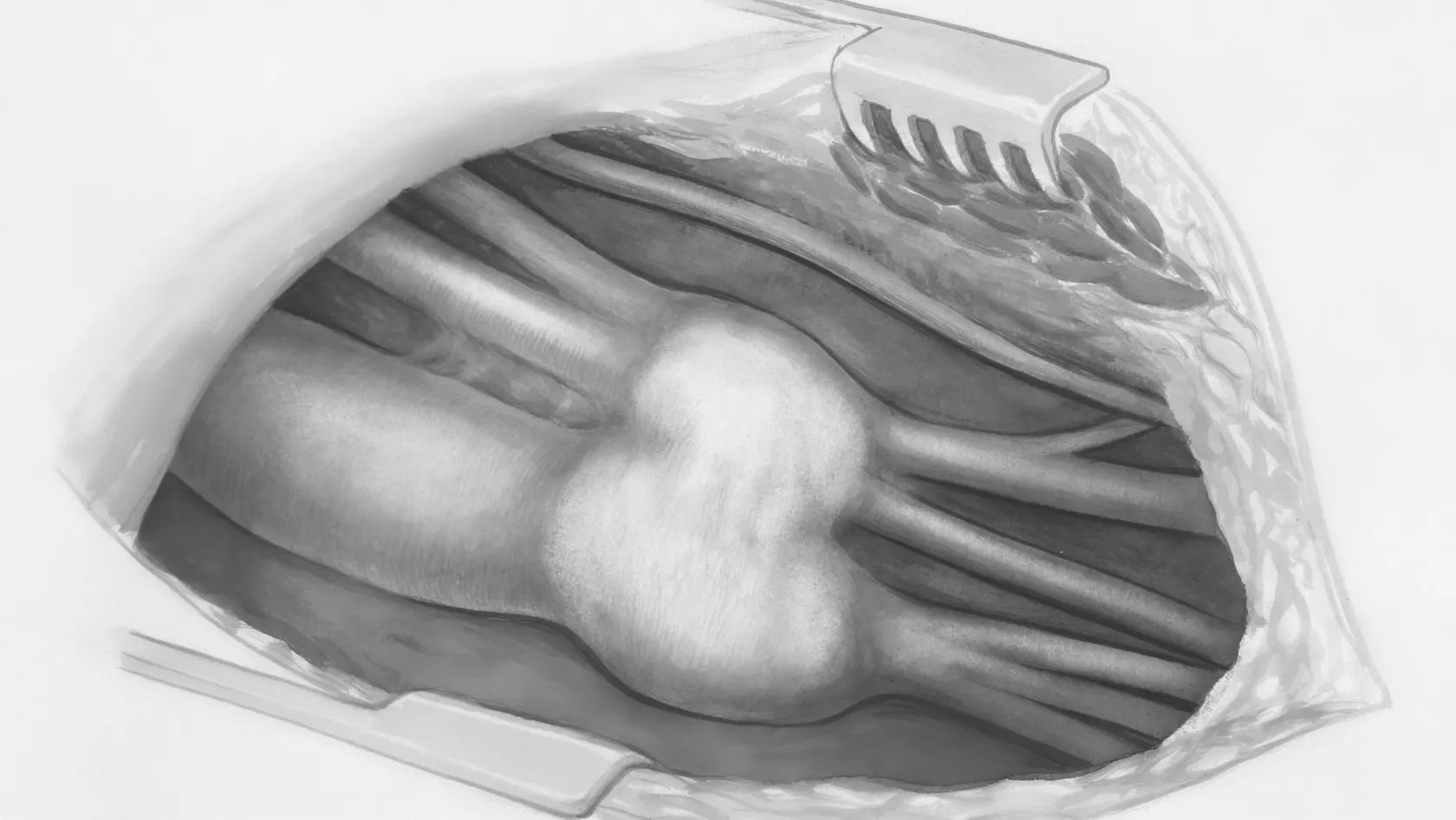
Selective Dorsal Rhizotomy - SDR
Selective dorsal rhizotomy takes spasticity out of a child's legs in a single afternoon and never gives it back, which leaves whatever strength was hiding underneath. Turning that strength into walking takes about a year of intensive physiotherapy, and this page sets out what the trials measured, who the operation suits, and why the rehabilitation plan decides everything.
About This Department
The operation takes an afternoon. The treatment takes a year.
Selective dorsal rhizotomy takes spasticity out of a child's legs and does not give it back. What it leaves behind is whatever strength was underneath, and turning that into walking is physiotherapy, in quantities most families have not been warned about.
What selective dorsal rhizotomy does
Sensation travels from the legs up into the spinal cord along nerve roots that enter at the back, and movement commands travel out along roots at the front. In cerebral palsy the loop between those two runs too hot. Signals coming in from the muscles provoke a reflex going out that is stronger than it should be, the muscle tightens, the tightening feeds the loop again, and the result is the stiffness a family knows as spasticity.
Rhizotomy interrupts part of that loop.
A surgeon exposes the sensory roots in the lower spine, splits each one into small bundles called rootlets, stimulates them one at a time while a neurophysiologist reads the muscle response, and divides the rootlets whose behavior is most abnormal. Roughly a quarter to a half of the sensory rootlets end up cut, the exact figure being a judgment made in the room, on the day, from the readings, and nothing on the motor side is touched at any point, so strength is never deliberately reduced. Two words in the name carry the whole idea. Dorsal means the back of the spinal cord, where sensation comes in, and that is the reason nothing on the movement side gets disturbed. Selective means the surgeon is choosing, rootlet by rootlet, guided by what the leg muscles do when each one is stimulated, and that choosing is what separates this operation from the older procedures that cut a fixed proportion and hoped for the best.
Spasticity, and what it is holding up
Every parent considering this operation has been told that spasticity is the enemy. That framing leaves something out, and the missing part decides whether the surgery helps your child or disappoints them.
Stiffness is doing two jobs at once
Tight legs stop a child from stepping cleanly, from squatting, from sitting comfortably in a chair. Those same tight legs also hold weight. A child whose quadriceps are permanently half contracted is using that tension to stay upright, and taking it away leaves them relying on real muscle strength that may never have been asked to do the job before. Some children stand up after rhizotomy and find their legs have gone soft under them for a few weeks. That is not a complication. That is the treatment working, and the weakness underneath becoming visible for the first time. Physiotherapists who work with these children call the first weeks an honest inventory, since a leg with no tone left in it shows exactly what it can and cannot do, with nothing borrowed and nothing hidden, and parents nobody warned find that stretch frightening while parents who were warned find it tolerable, a large difference produced by one conversation before surgery.
Which is why the physiotherapy is not aftercare.
Who the operation is for
A survey published in 2025 asked ten experienced centers across several continents what their selection criteria were, and found a great deal of variation on the details. On four points every one of them agreed.
Read the fourth one again. Operating on a child with no rehabilitation plan behind them means agreeing to do the easy half of a treatment and leaving the family with the hard half.
The age window, and why it is narrow
Centers publish ranges from three to ten years old, and the same international survey found the sweet spot sitting between five and seven. Two forces squeeze that window from either side. Both are real.
Too early and too late both cost something
Operate very young and a child may not yet cooperate with months of demanding therapy, while the walking pattern has not settled enough to know what you are correcting, and wait too long and years of pulling have already shortened tendons and twisted bones into fixed deformities that cutting a nerve root will never straighten, because those problems have stopped being about tone at all. Somewhere in between sits a child old enough to work and young enough that the damage is still mostly reversible, which is the window every experienced team is aiming at. Older children and adults are operated on in some centers, and the goal shifts when they are. Comfort, easier care, less pain, better sitting. Those are honest aims. Walking better becomes a much harder promise once the deformities have set, and a family being offered that promise for a fourteen year old should ask for the reasoning in detail and for the names of the measurements that will show whether it worked.
What the operation involves
Almost all of the difficulty in this operation sits in the testing rather than in the cutting, and knowing that changes what you should be asking when you compare two centers, because six stages run in order here and a neurophysiologist is present for four of them. The cutting itself is quick.
- Positioning and monitoring. Your child goes to sleep face down, and electrodes are placed on the leg muscles so a neurophysiologist can watch how each rootlet behaves. Anesthesia has to be light enough for those muscles to answer.
- Opening the spine. Most modern centers work through a single small window in one vertebra in the lower back, which spares the surrounding bone. Some use a longer opening across several levels, and both approaches are in normal use.
- Separating the roots. The sensory roots are identified and told apart from the motor roots. Each sensory root is then teased into three to seven finer rootlets.
- Testing each rootlet. A small current goes into a rootlet and the leg muscles answer. A normal rootlet produces a brief local response, while an abnormal one produces a spreading, sustained one, and that difference is what the surgeon is buying with all this time.
- Cutting. The rootlets that behave worst are divided. The proportion varies by child and by center, commonly landing between a quarter and a half of the sensory tissue at the levels being worked on.
- Closing. The bone window is replaced or the muscle layers are closed over it, and the wound is a single line a few centimeters long in the small of the back.
Three to five hours, and a flat week
Published descriptions put the operation at around four hours, with the testing taking longer than the cutting. Most children lie flat for a day or two afterward, then start moving with a physiotherapist, with the acute hospital stay running somewhere near a week before rehabilitation proper begins, and the pain in those first days is real, is treated properly, and comes alongside muscle spasms in the back and legs that are common and settle.
What the randomized evidence showed
Ninety children, three trials, one pooled answer
Three randomized trials compared rhizotomy plus physiotherapy against physiotherapy on its own in children with spastic diplegia, and in 2002 their data were pooled into a single analysis of 90 children, most of them under eight and most of them at level II or III. Both spasticity and gross motor function were measured with the standard scales, at baseline and again around nine to twelve months later.
This table scrolls sideways on a narrow screen. Swipe or drag to see every column.
| What was measured | Result | How to read it |
|---|---|---|
| Spasticity | Mean difference of 1.2 points on the Ashworth scale in favor of surgery | A large and unambiguous drop in tone, which is what the operation is designed to do |
| Gross motor function | Difference in change score of 4.0 points in favor of surgery | The authors described this as a small positive effect, and small is the honest word |
| Amount of tissue cut | More dorsal root tissue divided went with more functional improvement | A dose relationship, found inside the surgical group rather than between groups |
Four points is not nothing. It is also not a transformation, and any center that skips the number and reaches for adjectives has decided which half of the evidence you get to see.
The finding about how much to cut
Buried in that pooled analysis sits a result worth understanding before you compare centers. Among the operated children, the more dorsal root tissue a surgeon divided, the more the child's function improved.
That single sentence explains why two centers offering the same named operation can produce different results, and it also explains the caution that surrounds the question. Cutting more sensory tissue removes more tone, and it moves closer to numbness, bladder trouble and a child who cannot feel where their feet are. Every surgeon is working somewhere on that line. Asking where a particular team sits on that line, and why, is a fair question and a revealing one, since an answer that names one fixed percentage applied to every child tells you the selecting is not really happening. An answer that gives a range, describes the electrical patterns being looked for, and explains the trade made when a child is already weak, tells you something quite different, and any careful clinic has that answer ready in a form that takes two minutes to deliver.
What the long view shows
Randomized trials in this field stopped counting at twelve months, which leaves the question every parent is actually asking unanswered, and two research groups kept following their patients for decades, one in Sweden and one in South Africa, producing two sets of findings that deserve reading side by side because they emphasize very different things. Neither set is comfortable reading.
This table scrolls sideways on a narrow screen. Swipe or drag to see every column.
| Follow up | What held | What did not |
|---|---|---|
| 17 years, 18 children | Muscle tone stayed normalized across the whole period | Motor function peaked at three years then declined gradually, and contractures were not prevented |
| 30 years, 12 adults | Tone reduction sustained, hip and knee movement stable, no spasticity in adulthood | Walking still showed a mild crouch, and 8 of 17 gait measurements sat outside the normal range |
Two studies, two moods
Both cohorts stay small, and the two groups disagree in tone more than in fact. The Swedish group concluded that removing spasticity does not improve long term functioning and does not prevent contractures, though it may reduce the pain many adults with cerebral palsy live with, while the South African group, following patients three decades on, found adults walking without spasticity, several gait measurements sitting inside the normal range, and joint movement holding steady between years twenty and thirty.
How to hold both at once
Both hold, and reading them together beats picking one. Tone reduction stays permanent and reliable, and every study agrees on that much. What that tone reduction converts into over a lifetime depends on the child's starting strength, on the surgery, on the therapy, on the orthopedic care that follows, and on decades of ordinary life that no trial can control. Cerebral palsy carries on. Rhizotomy changes one of its features, thoroughly and forever, and leaves the rest of the condition in place. Notice also how few children sit inside these cohorts. Eighteen in one and twelve in the other, followed with unusual care over an unusual length of time, which makes them valuable and makes them fragile at the same time. Nobody should build a decision on either study alone, and nobody should be shown only the cheerful one.
How it compares with the alternatives
Spasticity in cerebral palsy has several established treatments, and a 2019 evidence review that graded the whole field placed rhizotomy among the ones that work, alongside botulinum toxin, intrathecal baclofen, oral medication and orthopedic surgery, each of which buys something quite different at a quite different price.
Botulinum toxin works on chosen muscles, lasts a few months and is repeatable, which makes it excellent for testing what a looser muscle would do before anything permanent happens. A baclofen pump delivers medication straight into the spinal fluid, covers both legs, and stays adjustable and removable at the price of an implanted device and its maintenance. Oral medication reaches the whole body, side effects included. Orthopedic surgery lengthens tendons and reshapes bones, addressing the damage that tone has already caused and leaving the tone alone, so it is frequently needed alongside rhizotomy as well as after it. Which of those five a team reaches for first is itself informative. A center that offers only one of them, and offers it to everybody who walks in, is not choosing between treatments so much as selling the one it happens to perform, and a family weighing this decision deserves to hear all five described by somebody with no stake in which one wins.
Rhizotomy sits apart from all of them in one respect.
It cannot be undone
Divided nerve rootlets do not grow back. No adjustment, no reversal, no removal of a device, no waiting for a drug to wear off. Whatever tone comes out on the day of surgery stays out for the rest of your child's life.
Which cuts in both directions
Permanence carries the appeal of rhizotomy, because a family gets one operation and one recovery rather than injections every few months for a childhood, or a pump that needs refilling and eventually replacing. Permanence also makes the selection unusually serious. A wrong candidate cannot be returned to their starting position, and a child who was relying on tone to stand may be left without either the tone or the strength. Every careful center takes months over the assessment for that reason, and any center willing to schedule your child quickly after a video call has skipped something that matters. Take the time. Nothing about spasticity in a five year old moves so fast that three more months of assessment costs your child anything, and the families who go on to regret this operation are almost never the ones who waited too long before agreeing to it.
The year of physiotherapy that follows
The surgery removes an obstacle. The year removes the excuse for not having built anything behind it, and only one of those two happens in an operating room.
Rehabilitation for a family flying in
What a rehabilitation plan has to specify
- Where the inpatient weeks happen. In the hospital that operated, or transferred to a rehabilitation unit, and for how many weeks.
- Who runs the first six months. Named therapists at home, or an extended stay, or blocks of return travel at agreed intervals.
- What the home program contains. Written exercises with photographs, in a language the family reads, reviewed and updated rather than handed over once.
- Who reviews progress and how often. Video reviews, measurement intervals, and the person responsible for changing the plan when it stalls.
- Who handles the orthopedic side. Hip surveillance, spine checks, orthoses and any tendon surgery later, which somebody at home has to own.
Bring the answers to those five questions to your consultation. A surgeon who wants to see them written down is a surgeon taking your child's whole year seriously rather than the four hours they are personally responsible for.
Risks and complications
Serious complications after this operation are uncommon in experienced hands, and uncommon is not the same as absent. Wound infection, bleeding, a leak of spinal fluid and the ordinary risks of a general anesthetic all belong on the consent form.
The ones particular to cutting sensory roots
Numbness or altered sensation in the legs and feet turns up in some children and usually fades over weeks to months. Bladder function can be disturbed temporarily, and a child who was dry may need time to become reliable again. Weakness beyond what was expected is the risk that selection exists to avoid, so strength testing before surgery is never a formality. Over a longer horizon, spinal deformity is described after rhizotomy, and that is one reason the single level approach with the bone replaced has become common, while back pain in adolescence and adulthood is reported often enough that a spine review belongs in long term follow up rather than being left to whoever the young person happens to see in twenty years. Numbers beat lists here. Ask any center you are considering for its own complication figures across its own last hundred children, and notice whether an answer arrives.
Centers that do not count cannot improve.
What rhizotomy does not fix
Weakness stays weakness. Poor balance stays poor balance. Fixed contractures and twisted bones stay exactly as they were, because those are mechanical problems and the operation is a neurological one.
The list worth reading before you decide
An operation aimed at the lumbar roots leaves the arms alone, so a child with tight hands keeps them. Dystonia, the twisting involuntary movement some children have alongside spasticity or in place of it, does not respond to this operation and can look worse once the stiffness masking it has gone, while speech, swallowing, seizures, learning and vision belong to other parts of the condition entirely and are untouched by anything done at the lumbar roots. Hip displacement still needs watching on a schedule, and many children still need tendon or bone surgery afterward, which is a normal part of the pathway and not a sign that anything failed.
Name what bothers you most, then ask whether tone is what causes it.
Recovery and flying home
One or two days flat, then sitting, then standing with help, then a physiotherapist twice a day. Discharge from the acute ward lands around a week for most children, and the total time spent inside a hospital depends entirely on whether the inpatient rehabilitation block happens in that same building or somewhere else altogether, which is a question with a very different answer in different countries.
The travel arithmetic
Clearance to fly comes at the wound check, and your surgeon writes a dated opinion for the airline and the insurer. What actually decides your booking is the rehabilitation plan rather than the wound, since a family staying for inpatient therapy is looking at three to six weeks in the country and a family flying home early is looking at a much shorter trip and a much heavier obligation waiting for them. Long flights with a child who cannot yet sit comfortably need planning, and an aisle seat with room to change position matters more than the airline usually understands.
Book the return flight last.
Cost, coordination and having SDR in Istanbul
No figure appears on this page, because a number written today would be wrong by the time you read it. What can be described is where the money goes, and for this operation the surprise is how much of it sits outside the operating room. Operating room time, the neurophysiology team and the ward days form one block. Inpatient rehabilitation weeks are a second block, often larger. Accommodation for a family through those weeks is a third. Comparing two quotes on the surgical fee alone compares the smallest part of the bill, and comparing them on the total without seeing the split tells you nothing at all of what you are actually buying.
What a written quote should separate outThe assessment visit and any gait analysis, the operation with intraoperative neurophysiological monitoring named as a line of its own, the acute ward nights, the inpatient rehabilitation weeks with the number of daily sessions stated, the outpatient blocks if any are included, orthoses, and accommodation and transfers for the child and both parents. Ask separately for the nightly rate if the stay runs long, and for what a second opinion from the rehabilitation team costs before you commit.
Families travel to Biruni Hospital for pediatric neurosurgery from Europe, the Gulf, North Africa and Central Asia. The international patients office covers English, Arabic, French, Russian, Serbian, Romanian and Spanish, with interpreting for other languages arranged in advance, and one coordinator carries the family from the first message through to discharge and stays reachable on WhatsApp afterward. Patient rooms include a companion bed so a parent stays every night, accommodation and transfers are arranged around the admission, a female physician can be requested, an invitation letter for the visa is issued around ten days ahead, halal and vegetarian and diabetic meals are routine, and a prayer room is open on site. Two parents traveling with a child is the ordinary arrangement for this operation rather than a special request, since one adult cannot manage a hospital stay, a rehabilitation timetable and a sibling at home at the same time, and the accommodation is booked on that assumption unless you say otherwise.
Follow up after you return home matters more here than on almost any other page of this site. Video reviews at agreed intervals, therapy reports going back to the team, measurement of the same scales that were used before surgery so the comparison means something, and a named person to contact when progress stalls in month five and nobody at home knows whether that is expected. Ask for that schedule in writing before you agree to a date.
Send a video of your child walking, undressed to shorts, from the front, the back and both sides. Add the therapy history, the scans, the current orthoses and any gait analysis already done. That package tells a pediatric neurosurgeon and a physiotherapist more in twenty minutes than any referral letter manages in two pages, and the review costs nothing. Being told that your child is not a candidate is a real answer and not a rejection.
SDR surgery FAQ
Will my child walk independently after SDR?
Can the operation be reversed if it goes wrong?
How much physiotherapy is really needed?
What age is best?
Will my child still need orthopedic surgery?
Does the benefit last into adulthood?
How long will we need to stay in the country?
Written by the Biruni Hospital medical editorial team. Reviewed by Dr Yunus Emre Yavuz, Neurosurgery.
References
- McLaughlin J, Bjornson K, Temkin N, Steinbok P, Wright V, Reiner A, et al. Selective dorsal rhizotomy. Meta-analysis of three randomized controlled trials. Developmental Medicine and Child Neurology. 2002;44(1):17-25.
- Tedroff K, Löwing K, Åström E. A prospective cohort study investigating gross motor function, pain, and health-related quality of life 17 years after selective dorsal rhizotomy in cerebral palsy. Developmental Medicine and Child Neurology. 2015;57(5):484-490.
- Langerak NG, Vaughan CL, Fieggen AG, Peacock WJ, Brassell SE, Novacheck TF, et al. A prospective gait follow-up study 30 years after selective dorsal rhizotomy. Journal of Neurosurgery Pediatrics. 2025;36(3):343-352.
- van Dijk LMM, Slot KM, Novacheck TF, Buizer AI, Langerak NG. Selective dorsal rhizotomy from indication to rehabilitation. A worldwide survey. Child's Nervous System. 2025;41(1):133.
- Novak I, Morgan C, Fahey M, Finch-Edmondson M, Galea C, Hines A, et al. State of the evidence traffic lights 2019. Systematic review of interventions for preventing and treating children with cerebral palsy. Current Neurology and Neuroscience Reports. 2020;20(2):3.
Editor's note
Written by the Biruni Hospital medical editorial team. Reviewed by Assistant Professor Özcan ÇIKLATEKERLİO, Neurosurgery.
Medically reviewed by
Assistant Professor Özcan ÇIKLATEKERLİO
Neurosurgery
Related Treatments
View All
ALIF - Anterior Lumbar Interbody Fusion Surgery
Coming in from the front restores the curve of the lower back better than any posterior route and leaves the back muscles untouched. It also carries one risk most pages will not name, and this page names it.

Brain AVM Surgery - Arteriovenous Malformation Surgery
An unruptured brain AVM bleeds at roughly 2.2 percent a year, and surgery spends its whole risk on a single morning. This page sets those two shapes of risk side by side, explains what the ARUBA trial does and does not say about your case, and shows how a Spetzler-Martin grade changes the answer.
Brain Tumor Surgery - Brain Tumor Removal
Brain surgery is one trade repeated all day, how much tumor comes out against what the brain around it still does. This page puts the published numbers on both sides of that trade.
Cervical Microdiscectomy - Minimally Invasive Neck Disc Surgery
Neck disc surgery is done from the front, through the space between your windpipe and your carotid artery, and almost everything that goes wrong that is not the disc happens in that corridor. What has been measured in it.
Chiari Malformation Surgery
A Chiari malformation is measured in millimeters and treated according to symptoms, and those two things come apart more often than patients are told. Most people with the finding never need an operation. This page sets out who does, what posterior fossa decompression removes, why surgeons still argue over opening the dura, and what the pooled studies say about both sides of that argument.