Radiation before the operation halved pelvic recurrence in the trial that set the standard, and total neoadjuvant therapy now lets about half of complete responders keep their rectum. This page explains the one-week and five-week courses, the sequence, the side effects and the months abroad.
About This Department
Radiation Oncology
Radiation given before the operation halves the chance of rectal cancer coming back in the pelvis. In some patients it removes the need for an operation at all.
A colonoscopy has found a tumor in the rectum. The biopsy confirms cancer, and the MRI report describes how far it has grown through the wall. For most tumors that reach beyond the wall or into nearby lymph nodes, treatment begins with radiation rather than with the operation, and that order was decided by a trial. In the German trial that settled it, published in the New England Journal of Medicine in 2004, giving chemoradiation before surgery instead of after cut the chance of the cancer returning in the pelvis from 13 percent to 6 percent at five years, with fewer serious side effects. Two things have changed since. Chemotherapy has moved in front of the operation as well, and half of the patients whose tumor disappears completely on treatment can now keep their rectum under close watch. This page walks through those choices, the one-week and five-week courses, the side effects that matter for years, and how to plan the months in Istanbul.
6% vs 13%
Pelvic recurrence at five years, radiation before against after surgery, NEJM 2004
5 x 5 Gy
Short course, one week
53%
Patients keeping their rectum at three years after total neoadjuvant therapy, OPRA trial
Free
Review of your MRI and biopsy
Free consultation
The review of your file is free and commits you to nothing. Send the colonoscopy and biopsy reports, the pelvic MRI with its images, the CT of chest and abdomen, the CEA blood test if it was done, your medicine list, and a line on whether keeping the rectum matters to you. A radiation oncologist, a colorectal surgeon and a medical oncologist read them together and reply with the sequence they would propose, how many weeks it takes and whether keeping the rectum is a realistic aim, and a coordinator writes to you in your own language.
Why the rectum gets radiation and the colon does not
Rectal Cancer Radiation Therapy is treated as a separate subject from colon cancer because of where the rectum sits. The last fifteen centimeters of the bowel lie inside the bony pelvis, wrapped in a fatty envelope and pressed against the bladder, the prostate or the uterus, the sacrum and, at the bottom, the muscles that keep you continent. No wide margin of loose tissue exists for a surgeon to take.
Colon cancer rarely comes back where it started. Cancer of the rectum used to, in a quarter of patients or more, and a recurrence in the pelvis is painful and hard to treat. Radiation exists to stop that. A second purpose came later. A tumor that shrinks before the operation comes out with clear margins more often, and a tumor sitting on the sphincter sometimes comes out without taking the sphincter with it.
Colon cancer is a surgical disease. Rectal cancer is a team disease.
The order in which surgery, radiation and chemotherapy are given changes the outcome, so the plan is made by all three specialists together before any of them starts.
2
Who needs it, by MRI stage
A pelvic MRI decides. It shows how deep the tumor has grown, whether lymph nodes look involved, how close the tumor comes to the membrane around the rectum called the mesorectal fascia, and whether tumor has entered veins outside the wall.
The table below is wider than most phone screens. Move it sideways to read every column.
Radiation by stage on MRI
Finding on MRI
Radiation
Notes
Tumor within the wall, no suspicious nodes, well clear of the fascia
Usually none
Surgery alone, or local removal for a small early tumor
Tumor through the wall, or suspicious nodes, high in the rectum
Case by case
Some centers operate first if margins look safe
Tumor through the wall or nodes, in the middle or lower rectum
Yes, before surgery
The most common situation
Tumor reaching the fascia, growing into other organs, tumor in the veins, four or more nodes, enlarged side-wall nodes
Yes, with chemotherapy in front as well
The high-risk group in the RAPIDO trial
Cancer that has already spread to the liver or lungs
Depends on the plan
Chemotherapy comes first, and pelvic radiation joins in when the spread is limited and both sites will be treated with intent to cure
The review may ask for the MRI to be repeated when it was done without a dedicated rectal protocol. The stage drives everything that follows. A poor scan produces a poor plan.
3
Radiation comes before the operation
For years, radiation was given after the operation to patients whose pathology looked worrying. The German Rectal Cancer Study Group tested the opposite order in 823 patients with tumors through the wall or with involved nodes.
823 patients. Same drugs, same dose, different order. Pelvic recurrence 6 percent against 13 percent at five years. Serious acute side effects 27 against 40 percent. Serious late effects 14 against 24 percent.
That result is the foundation of everything on this page. Recurrence in the pelvis halved. Side effects fell. Survival came out the same in both groups, 74 and 76 percent at five years, because what kills most rectal cancer patients is spread to the liver and lungs, and radiation to the pelvis has no reach there.
Two reasons explain the difference, and both are physical. Before surgery the tissues still have their blood supply, so oxygen reaches the tumor and radiation works better. The bowel that an operation pulls down into the pelvis has not yet moved into the beam.
4
Five days or five weeks
Two schedules exist.
They resemble each other more in effect than in daily life, since one is over in a week and the other fills five, and the choice between them shapes the whole calendar of a trip abroad.
The table below is wider than most phone screens. Move it sideways to read every column.
Short course and long course compared
Short course
Long course
Dose
25 Gy in 5 sessions, one week
50 to 50.4 Gy in 25 to 28 sessions, five to five and a half weeks
Chemotherapy during radiation
None
Capecitabine tablets twice daily on treatment days, or a fluorouracil infusion
Time to surgery
One week, or four to eight weeks after a delay
Eight to twelve weeks
Where it is used
Northern Europe, and increasingly everywhere as part of total neoadjuvant therapy
North America, much of Europe and Asia, and for tumors that need to shrink before they can be removed
Tumor shrinkage before the operation
Modest with immediate surgery, more with delay
Greater, and complete disappearance in 10 to 20 percent
The Stockholm III trial, reported in the Lancet Oncology in 2017, put the two head to head in 840 patients and found local recurrence equally low with either. It also found that waiting four to eight weeks after the short course lowered surgical complications from 53 percent to 41 percent, compared with operating within a week. Waiting is now the standard.
Which one for you
A tumor that must shrink to come out with clear margins, or one sitting close to the sphincter where shrinkage might save it, points toward the long course or toward total neoadjuvant therapy. A patient who cannot spend five weeks near a hospital, or who is frail, points toward the short course. Neither counts as second best.
5
Total neoadjuvant therapy
Radiation controls the pelvis. It does nothing for cancer cells that have already reached the liver or lungs, and in the years after the German trial distant spread became the main reason patients died. Chemotherapy given after surgery was supposed to deal with that, and many patients never received it, because recovery from a rectal operation takes months.
So the chemotherapy moved forward.
All of it. Total neoadjuvant therapy, TNT, means giving radiation and the full course of chemotherapy before the operation, in one of two orders, and it has become the default for any tumor that the MRI marks as high risk.
RAPIDO, Lancet Oncology 2021. 912 patients with high-risk tumors. One week of short-course radiation, then 18 weeks of chemotherapy, then surgery, against the older sequence of long-course chemoradiation, surgery and optional chemotherapy afterwards. Disease-related treatment failure at three years fell from 30.4 percent to 23.7 percent, while serious diarrhea during treatment rose from 9 percent to 18 percent.
PRODIGE 23, Lancet Oncology 2021. 461 patients in France with tumors through the wall. Twelve weeks of FOLFIRINOX chemotherapy, then long-course chemoradiation, then surgery, then a shorter course of chemotherapy afterwards, against chemoradiation and surgery alone. Disease-free survival at three years, 76 percent against 69 percent. Nerve damage from the chemotherapy was less in the new sequence, because less of it was given after the operation.
Both trials changed guidelines. For a high-risk tumor on MRI, treatment now runs for five to six months before the surgeon sees the patient, and for a fit person that is the sequence we propose. The price is paid in the chemotherapy itself. Tiredness. A blood count that has to be checked before every cycle. Numb fingertips that oxaliplatin leaves in some people for months.
6
Keeping the rectum with watch and wait
A rectal operation costs something even when it goes well. A low tumor means a permanent colostomy, and a tumor a little higher means a join near the anus and bowel function that never fully returns. When months of radiation and chemotherapy make a tumor disappear on examination, on MRI and on endoscopy, the question arises whether the operation is still needed.
The OPRA trial, published in the Journal of Clinical Oncology in 2022, answered it prospectively in 324 patients given total neoadjuvant therapy. Those with a complete response were offered watching in place of surgery. Examination, endoscopy and MRI every few months. Three years later, 53 percent of the patients in the group that received chemoradiation first and chemotherapy afterwards still had their rectum, and 41 percent in the group that received chemotherapy first. Disease-free survival, 76 percent, matched what surgery would have been expected to give. Tumors that regrew were operated on, with results as good as immediate surgery.
Watch and wait is a contract
It works only with a patient who will come back for every check, and a team that examines the rectum by finger, scope and MRI on a fixed calendar for at least two years.
If keeping the rectum matters to you, say so in the first message. It changes which sequence is chosen, since chemoradiation first and chemotherapy after gave more organ preservation in OPRA, and it changes how the follow-up is arranged between Istanbul and home.
7
Planning and the daily session
Rectal radiotherapy has a routine, and once you know it the weeks pass more easily.
Position. Face down on a board with a cutout for the belly, so that the small bowel falls forward and out of the beam, or on your back where lying prone is impossible.
Bladder. A full bladder pushes more bowel away. You drink a set amount of water at a set time before the planning scan and before every session, and the same amount each day.
Planning CT and target. Small tattoo dots mark the skin. The target covers the tumor, the whole rectum with its fatty envelope, and the lymph node regions along the pelvic side walls up to the point where the rectal vessels branch.
Shaping the dose. Intensity modulated beams bend the high-dose region around the bladder, the small bowel, the hip joints and, in men, the bulb of the penis.
The session. Ten to fifteen minutes, with a cone-beam CT taken first to confirm the position and the bladder filling. Nothing is felt.
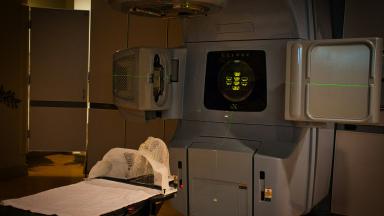
Radiotherapy at Biruni Hospital is delivered on an Elekta Versa HD linear accelerator. Planning takes five to seven working days from the scan to the first session.
8
Side effects during treatment and long after
Radiation to the pelvis is felt in the bowel, the bladder and the skin during treatment, and in bowel and sexual function for years afterwards. Both halves belong on the same page.
The table below is wider than most phone screens. Move it sideways to read every column.
Side effects of pelvic radiation for rectal cancer
Effect
When
What is done
Diarrhea, urgency, cramps
Weeks 2 to 6 of a long course, or weeks 2 to 3 after a short course
Low-fiber diet, loperamide, fluids. Settles within a month of the last session
Sore skin between the buttocks, burning on urination
From week 3
Barrier cream, sitz baths, plenty of water
Sore palms and soles, tiredness
With capecitabine, and toward the end of any course
Dose adjustment of the tablets, rest
Bowel function after a low join, called low anterior resection syndrome
First year after surgery, improving slowly
Diet, fiber supplements, pelvic floor training, and irrigation for the worst affected
Sexual function
From months after treatment
Discussed at consent. Medicines for men, dilator use from a few weeks after treatment for women
Fertility
Permanent
Egg, embryo or sperm freezing before the first session
Stress fracture of the sacrum
A year or two later, in a minority
Rest and pain relief. It heals
The German trial counted serious long-term effects at 14 percent after preoperative treatment. Beam shaping and the prone position were introduced to bring that figure down. Ask about bowel function before consenting. Of everything on the list, it is the one patients say nobody warned them of.
9
The operation that follows
Total mesorectal excision, TME, is the operation. The surgeon removes the rectum together with its fatty envelope in one intact piece, because tumor deposits hide in that fat, and the quality of that piece, graded by the pathologist, predicts recurrence as strongly as anything else.
A permanent colostomy depends on two measurements. The distance between the bottom of the tumor and the sphincter, and how much the tumor shrank. A join low in the pelvis is protected for a few months by a temporary ileostomy, a loop of small bowel brought out on the right side of the belly, which a second, smaller operation closes once the join has healed.
Surgery, radiation and chemotherapy are all delivered at Biruni Hospital on one site, so the same colorectal surgeon who reviewed your first MRI examines you after treatment and performs the operation, or continues to watch.
10
Timeline, and weeks in Istanbul
Treatment for this cancer is measured in months, and the calendar depends on which sequence is chosen.
The table below is wider than most phone screens. Move it sideways to read every column.
Time in Istanbul by treatment sequence
Sequence
Steps
Weeks away from home
Short course, then surgery after a delay
1 week of radiation, 4 to 8 weeks of waiting, operation, 5 to 7 days in hospital, 2 weeks of recovery before flying
2 to 3 weeks, home for the wait, then 4 weeks
Long-course chemoradiation, then surgery
5 to 5.5 weeks of radiation with tablets, 8 to 12 weeks of waiting, operation and recovery
7 weeks, home for the wait, then 4 weeks
Total neoadjuvant therapy, RAPIDO sequence
1 week of radiation, 18 weeks of chemotherapy every 2 or 3 weeks, reassessment, then surgery or watch and wait
Radiation here, chemotherapy at home or here, then 4 weeks for surgery, or repeated short visits for watching
Total neoadjuvant therapy, PRODIGE sequence
12 weeks of chemotherapy, 5 weeks of chemoradiation, waiting, then surgery
Chemotherapy at home or here, 7 weeks for chemoradiation, then 4 weeks for surgery
Three rules hold across every sequence.
Chemotherapy between radiation and surgery can be given by an oncologist at home on the protocol we write, and many patients choose that.
Radiation itself sets no limit on flying.
After the operation the surgeon sets the date, around two weeks, once you are eating, walking and managing any stoma with confidence.
11
How a quote is built
No price appears on this page. A rectal cancer quote is three quotes stacked, and the stack differs for every patient. Radiation forms the smallest of the three when the course is short and a larger one over five weeks, with planning, sessions and daily image guidance as its lines. Chemotherapy follows the drug, the number of cycles and body surface area, and FOLFIRINOX costs several times what capecitabine does. Surgery carries the operating time, the days in hospital, the stapling devices, a stoma kit, and the second operation to close a temporary ileostomy months later. Published packages from Turkish hospitals and medical travel agencies list radiotherapy, chemotherapy cycles and colorectal surgery separately, each covering consultation, the procedure, hospital days where planned, an interpreter and transfers, and leaving out flights, insurance, accommodation, stoma supplies at home and treatment of any complication.
A quote you can read states the sequence it assumes, the number of chemotherapy cycles, whether the ileostomy closure is inside the figure, and what happens if watch and wait replaces surgery. The figure follows the free review of your MRI.
12
Language, companion, paperwork
Biruni Hospital gives every international patient one coordinator from the first message to discharge, reachable on the same WhatsApp number after you have gone home. The international patients team works in English, Arabic, French, Russian, Serbian, Romanian and Spanish and arranges interpreters for other languages, which for this diagnosis matters at three points, the consent discussion on stoma and sexual function, the weekly review during radiation, and the conversation after restaging where surgery or watching is decided.
Bring an adult companion for the weeks of radiation if you can, and certainly for the operation, since the first days with a stoma are easier with someone else in the room. The international patients office books accommodation for both of you, close to the hospital, together with airport transfers and the daily car, and it stays in touch with whoever is at home during the months of chemotherapy between visits. For a visa it issues an appointment confirmation and an invitation letter naming the hospital and the treating doctor, ten days or so before travel. Rooms have a companion bed. The kitchen prepares halal, vegetarian and diabetic meals and follows the low-fiber diet radiation calls for. A prayer room is on site. A female physician is arranged where the rota allows, for anyone who requests one in the first message.
13
Follow-up at home
Once you get back home, the handover file goes to your oncologist and, if you are being watched instead of operated on, to a colorectal surgeon or gastroenterologist who will examine you. It holds the radiation summary with dose and fields, the chemotherapy given, the pathology if surgery was done, and the calendar of checks.
The table below is wider than most phone screens. Move it sideways to read every column.
Follow-up after rectal cancer treatment
Check
After surgery
Under watch and wait
Examination, and endoscopy of the rectum
Yearly
Every 3 months for 2 years, then every 6 months
Pelvic MRI
If symptoms
Every 3 to 6 months for 2 years
CEA blood test
Every 3 to 6 months for 3 years
The same
CT of chest and abdomen
Yearly for 3 to 5 years
The same
Colonoscopy
1 year after surgery, then at 3 years and 5 years
The same
Every one of these is available near you. Send the results. Your coordinator passes them to the team, and a new MRI is compared with the earlier ones here at no charge. A regrowth under watch and wait is treated with the operation that was postponed, and the results match immediate surgery.
14
Rectal Cancer Radiation Therapy FAQ
How long does radiation therapy for rectal cancer take?
One week for the short course of five sessions, or five to five and a half weeks for the long course of 25 to 28 sessions with chemotherapy tablets. Planning adds five to seven working days at the start.
Is radiation given before or after rectal cancer surgery?
Before. The German trial published in 2004 showed that preoperative chemoradiation halved pelvic recurrence, from 13 percent to 6 percent, with fewer side effects than the same treatment after surgery.
Can rectal cancer be treated without surgery?
In some patients, yes. After total neoadjuvant therapy, about half of patients in the OPRA trial whose tumor disappeared completely kept their rectum at three years under close surveillance. Tumors that regrow are operated on with results as good as immediate surgery.
Will I need a colostomy bag?
It depends on how close the tumor is to the sphincter and how much it shrinks with treatment. Many patients have a temporary ileostomy for a few months after a low join, closed in a second operation. A permanent colostomy is needed when the sphincter itself has to be removed.
How long do I need to stay in Istanbul?
Two to three weeks for a short course, seven weeks for a long course, and around four weeks for the operation. Chemotherapy between the two can be given at home on our protocol. The table above sets out each sequence.
Will the staff speak my language?
The international patients team works in English, Arabic, French, Russian, Serbian, Romanian and Spanish and arranges interpreters for other languages, including for the weekly review during radiation.
Does radiation affect fertility and sexual function?
Yes. Pelvic radiation ends fertility in women and in nearly all men, so egg, embryo or sperm freezing must be arranged before the first session. Sexual function changes in both sexes, from the radiation and the operation, and is discussed at consent.
References
Sauer R, Becker H, Hohenberger W, et al. Preoperative versus postoperative chemoradiotherapy for rectal cancer. The New England Journal of Medicine. 2004;351(17):1731-1740.
Erlandsson J, Holm T, Pettersson D, et al. Optimal fractionation of preoperative radiotherapy and timing to surgery for rectal cancer (Stockholm III): a multicentre, randomised, non-blinded, phase 3, non-inferiority trial. The Lancet Oncology. 2017;18(3):336-346.
Bahadoer RR, Dijkstra EA, van Etten B, et al. Short-course radiotherapy followed by chemotherapy before total mesorectal excision (TME) versus preoperative chemoradiotherapy, TME, and optional adjuvant chemotherapy in locally advanced rectal cancer (RAPIDO): a randomised, open-label, phase 3 trial. The Lancet Oncology. 2021;22(1):29-42.
Conroy T, Bosset JF, Etienne PL, et al. Neoadjuvant chemotherapy with FOLFIRINOX and preoperative chemoradiotherapy for patients with locally advanced rectal cancer (UNICANCER-PRODIGE 23): a multicentre, randomised, open-label, phase 3 trial. The Lancet Oncology. 2021;22(5):702-715.
Garcia-Aguilar J, Patil S, Gollub MJ, et al. Organ Preservation in Patients With Rectal Adenocarcinoma Treated With Total Neoadjuvant Therapy. Journal of Clinical Oncology. 2022;40(23):2546-2556.
Editor's note
Written by the Biruni Hospital medical editorial team. Reviewed by Prof. Dr. Metin GÜDEN, Radiation Oncology.