
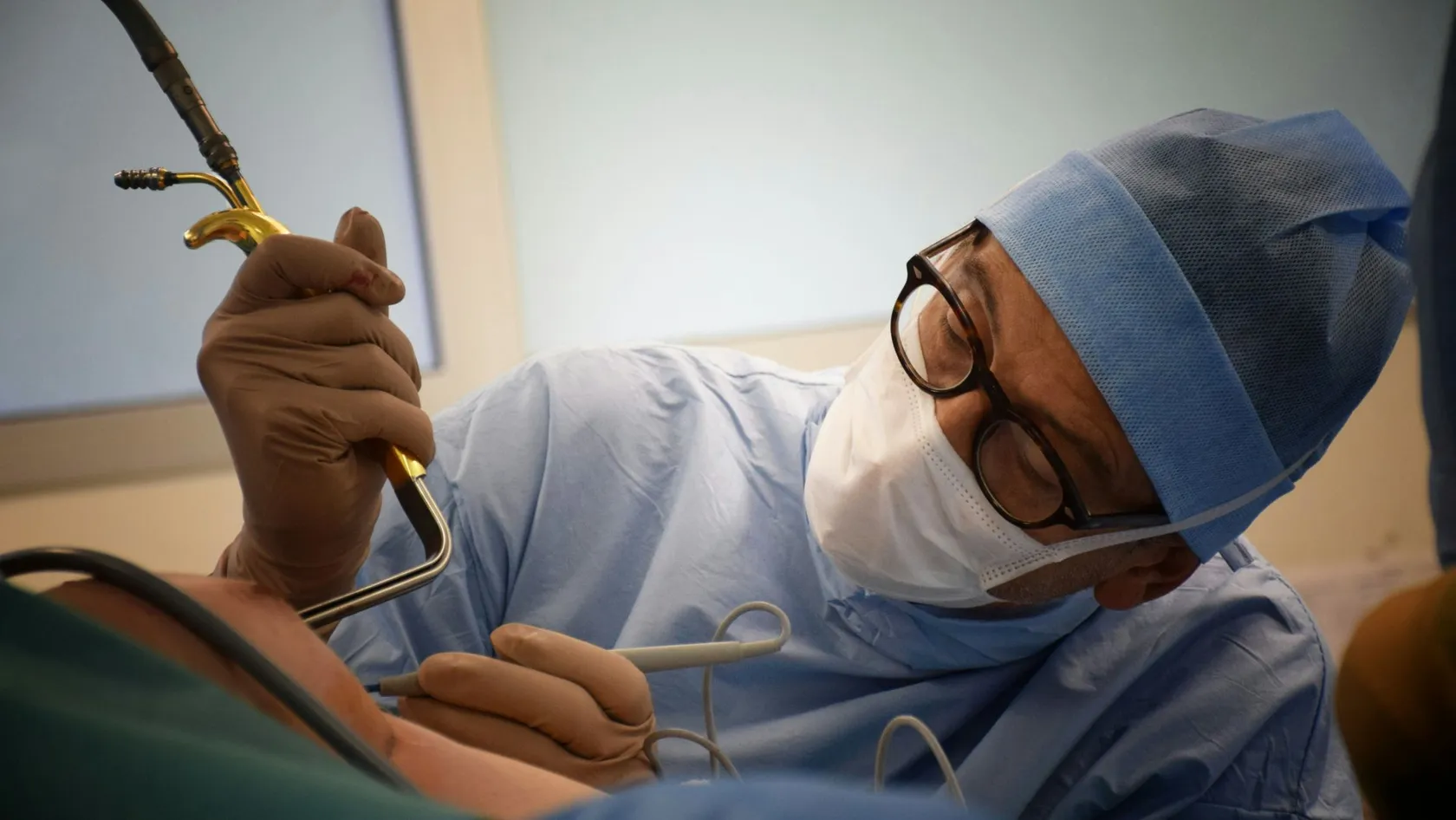
POEM Procedure - Per-Oral Endoscopic Myotomy
POEM treats achalasia from inside the esophagus, through the mouth, without an incision. In a randomized trial of 221 patients it matched laparoscopic Heller myotomy for symptom control at two years with fewer serious complications, and it beat balloon dilation 92 to 54 percent. It explains who qualifies, how POEM compares with surgery and dilation, the tests needed first, recovery day by day, the reflux that can follow and how it is managed, and how patients from abroad arrange it in Istanbul.
About This Department
In a trial of 221 patients with achalasia, POEM matched laparoscopic surgery for symptom control at two years. Without a single incision in the skin.
Per-oral endoscopic myotomy, or POEM, treats achalasia from inside the esophagus. The endoscope enters through the mouth, a short tunnel is made beneath the lining, and the muscle ring that refuses to relax is divided from within. The multicenter trial that compared it with laparoscopic Heller myotomy found clinical success in 83.0 percent of POEM patients and 81.7 percent of surgical patients at two years, with fewer serious adverse events after POEM (Werner and colleagues, New England Journal of Medicine, 2019). A second trial against balloon dilation found success in 92 percent of POEM patients against 54 percent (Ponds and colleagues, JAMA, 2019). This page explains what the procedure does, who qualifies, how it compares with surgery and dilation, what recovery looks like, the reflux that follows in some patients, what it costs and how patients from abroad arrange it at Biruni Hospital in Istanbul.
What POEM treats
Achalasia is a failure of the nerves that tell the esophagus to push and the valve at its lower end to open. Food collects above a muscle ring that will not relax. Patients regurgitate, lose weight, choke at night and learn to eat standing up, and by the time the diagnosis arrives, often years after the first symptom, the esophagus has begun to widen. Nothing restores the missing nerves. Every treatment that works does the same thing, which is to weaken or cut the muscle that stands in the way, and POEM does it from the inside.
The first 17 patients treated in Yokohama saw their swallowing score fall from a mean of 10 to 1.3 and their resting sphincter pressure fall from 52.4 to 19.9 millimeters of mercury, with no serious complication (Inoue and colleagues, Endoscopy, 2010).
Which conditions qualify
- Entry. Under general anesthesia, a small cut is made in the lining of the esophagus about ten centimeters above the stomach.
- Tunnel. The endoscope slides into the space beneath the lining and a tunnel is dissected downward, across the junction and two to three centimeters into the stomach wall.
- Myotomy. The inner circular muscle is divided along the length of the tunnel with an electrosurgical knife, freeing the sphincter.
- Closure. The endoscope withdraws and the entry cut is closed with clips. The tunnel itself seals on its own. There is no wound on the outside.
POEM, Heller myotomy or pneumatic dilation
Three treatments work. Each has its own shape, and the decision between them rests on the type of achalasia, the patient and the history.
How the choice is made
- Pneumatic dilation stretches the sphincter with a balloon and tears some muscle fibers. No anesthetic beyond sedation, home the same day, but the effect wears off and repeat sessions are the rule.
- Laparoscopic Heller myotomy divides the muscle from outside through small abdominal incisions and adds a partial wrap of the stomach to protect against reflux. Durable, and the standard against which POEM gets judged.
- POEM divides the muscle from inside, reaches higher than surgery can, and leaves no external wound. Its price comes as a higher rate of reflux, because no wrap gets added.
Clinical success at the 2-year follow-up was observed in 83.0 percent of patients in the POEM group and 81.7 percent of patients in the surgical group. Serious adverse events occurred in 2.7 percent and 7.3 percent (Werner and colleagues, 2019).
Before the procedure
The diagnosis must be secure. Achalasia affects roughly one new person per 100,000 a year, and its symptoms overlap with reflux disease, a stricture and, rarely, a cancer at the junction that mimics it. Anyone who arrives with a diagnosis made on symptoms alone has it confirmed before anything is cut.
The tests
Do I need manometry if I already have a barium study?
What happens in the days before?
Recovery, day by day
Quicker than surgery. Slower than a dilation.
- Day of the procedure. Nothing by mouth. Chest discomfort and a sore throat are expected and treated with simple analgesia. Antibiotics are given.
- Day one. A contrast swallow or an endoscopy checks that the entry site is sealed. Clear fluids begin. Most patients walk the corridor by the afternoon.
- Day two. Discharge for most patients, on a liquid diet, with a proton pump inhibitor and written instructions.
- Days three to seven. Progress from liquids to soft food. Patients from abroad are fit to fly at the end of the first week, once the follow-up check has been done.
- Weeks two to four. Normal diet. Desk work resumes in the second week, heavy work and exercise after a month.
Symptoms improve within days for most patients, since the mechanical block is gone the moment the muscle is divided. The measured result, on the Eckardt score, the barium column and the sphincter pressure, is taken at three months.
Results, risks and reflux
Two randomized trials define what a patient can expect.
| Measure | POEM | Comparator |
|---|---|---|
| Success at 2 years, against surgery (Werner 2019, 221 patients) | 83.0 percent | 81.7 percent with Heller myotomy and Dor wrap |
| Success at 2 years, against dilation (Ponds 2019, 133 patients) | 92 percent | 54 percent with a 30 and 35 millimeter balloon |
| Serious adverse events (Werner 2019) | 2.7 percent | 7.3 percent after surgery |
| Reflux esophagitis at 2 years (Werner 2019) | 44 percent | 29 percent after surgery |
| Reflux esophagitis (Ponds 2019) | 41 percent | 7 percent after dilation |
Reflux after POEM
Other risks are uncommon. Air escaping into the chest or abdomen during the tunnel is expected and is vented with a needle when it causes pressure. Bleeding inside the tunnel, a leak at the entry site and injury to the lining occur in a few percent and are managed endoscopically in nearly every case. Conversion to surgery, in the published series, happens to fewer than one patient in a hundred, and death after POEM remains a reportable rarity.
Coming from abroad
Few centers perform POEM in volume, the learning curve runs to dozens of cases, and the outcome depends on the hands that hold the endoscope, which makes this a procedure worth traveling for.
What should I send for the free case review?
How long do I need to stay in Istanbul?
Ten years on
POEM has been in use since 2008. The first long series now report a decade of follow-up, and what they show is a treatment whose benefit holds for most patients, with a slow decline in success over the years that resembles the decline seen after surgical myotomy. Some patients need a second procedure, in most series a dilation of the myotomy site, and a small number whose esophagus was already grossly dilated when they arrived reach the point where the organ itself has to be removed, which is the end stage of untreated achalasia and not a consequence of the treatment. The reflux question has not gone away, and the trials that follow patients past five years will decide whether the higher rate of esophagitis after POEM translates into a higher rate of Barrett's esophagus, which is the reason the yearly endoscopy stays on the plan for life. The centers with the longest experience, in Japan, Germany and the United States, have refined the technique over that decade, shortening the myotomy in type I and II disease to limit reflux and lengthening it in type III to reach the spasm, and a patient treated today benefits from lessons that the first hundred patients paid for.
For the patient deciding now, the practical reading of the evidence is this. POEM and laparoscopic Heller myotomy control symptoms equally well at two years. POEM causes fewer serious complications in the first weeks and more reflux in the years after, and the reflux is treatable. Balloon dilation asks the least of the patient and lasts the least. Type III achalasia, a previous failed operation or scarring in the abdomen gives a clear reason to choose POEM. A large hiatal hernia or severe pre-existing reflux gives a clear reason to choose surgery. Everyone else chooses between two good treatments, and the decision belongs to the patient, once the trade-off has been explained in plain words by a doctor who performs both or refers freely for the one they do not.
The esophagus does not regrow its nerves. The relief, though, lasts.
Cost
The estimate follows the file review and covers the procedure, general anesthesia, two nights in hospital, the tests done here and the first-week check. Hospitals in this market quote POEM as a package with the pre-procedure tests listed separately when they were done at home.
Confirm what the figure includes and whether the one-year endoscopy is priced with it.
References
- Werner YB, Hakanson B, Martinek J, et al. Endoscopic or surgical myotomy in patients with idiopathic achalasia. N Engl J Med. 2019;381(23):2219-2229.
- Ponds FA, Fockens P, Lei A, et al. Effect of peroral endoscopic myotomy vs pneumatic dilation on symptom severity and treatment outcomes among treatment-naive patients with achalasia. A randomized clinical trial. JAMA. 2019;322(2):134-144.
- Inoue H, Minami H, Kobayashi Y, et al. Peroral endoscopic myotomy (POEM) for esophageal achalasia. Endoscopy. 2010;42(4):265-271.
Editor's note
Written by the Biruni Hospital medical editorial team. Reviewed by İbrahim Yılmaz, Gastroenterology.
Medically reviewed by
İbrahim Yılmaz
Gastroenterology
Related Treatments
View All
Barrett's Esophagus Treatment
Most people told they have Barrett's esophagus have been told only half the story. The yearly cancer risk is 0.12 percent, and the grade of dysplasia in the biopsies decides whether the right plan is a daily tablet with endoscopy every few years, or radiofrequency ablation to remove the lining.
Capsule Endoscopy - Wireless Capsule Endoscopy
When a gastroscopy and a colonoscopy are both normal and the blood count keeps falling, the search moves to the small bowel, which neither instrument reaches. A swallowed capsule camera films that stretch in eight hours without sedation and finds a cause in six of ten patients examined for bleeding.

Colonoscopy
Ask one question before choosing where to have a colonoscopy, which is how often the doctor finds polyps. In a study of 314,872 examinations that figure ranged from 7 to 53 percent between doctors, and it predicted who later developed bowel cancer. This guide covers preparation in a hotel room, sedation, findings and the flight home.
Colorectal Polyp Removal
A large polyp in the colon does not automatically mean bowel surgery. Nearly all polyps, including flat ones wider than 20 millimeters, come out through the colonoscope, and the technique is chosen by size and shape.
Endoscopic Mucosal Resection - EMR
Endoscopic mucosal resection lifts a precancerous growth or an early cancer off the muscle wall with an injection and removes it with a snare through an ordinary endoscope, in the colon, esophagus, stomach or duodenum, without an operation. In a study of 479 patients with large colon polyps, 83.7 percent avoided surgery and none died of the procedure. This page explains what EMR removes, which lesions qualify, how it compares with ESD and surgery, evidence, risks, follow-up and care from abroad.