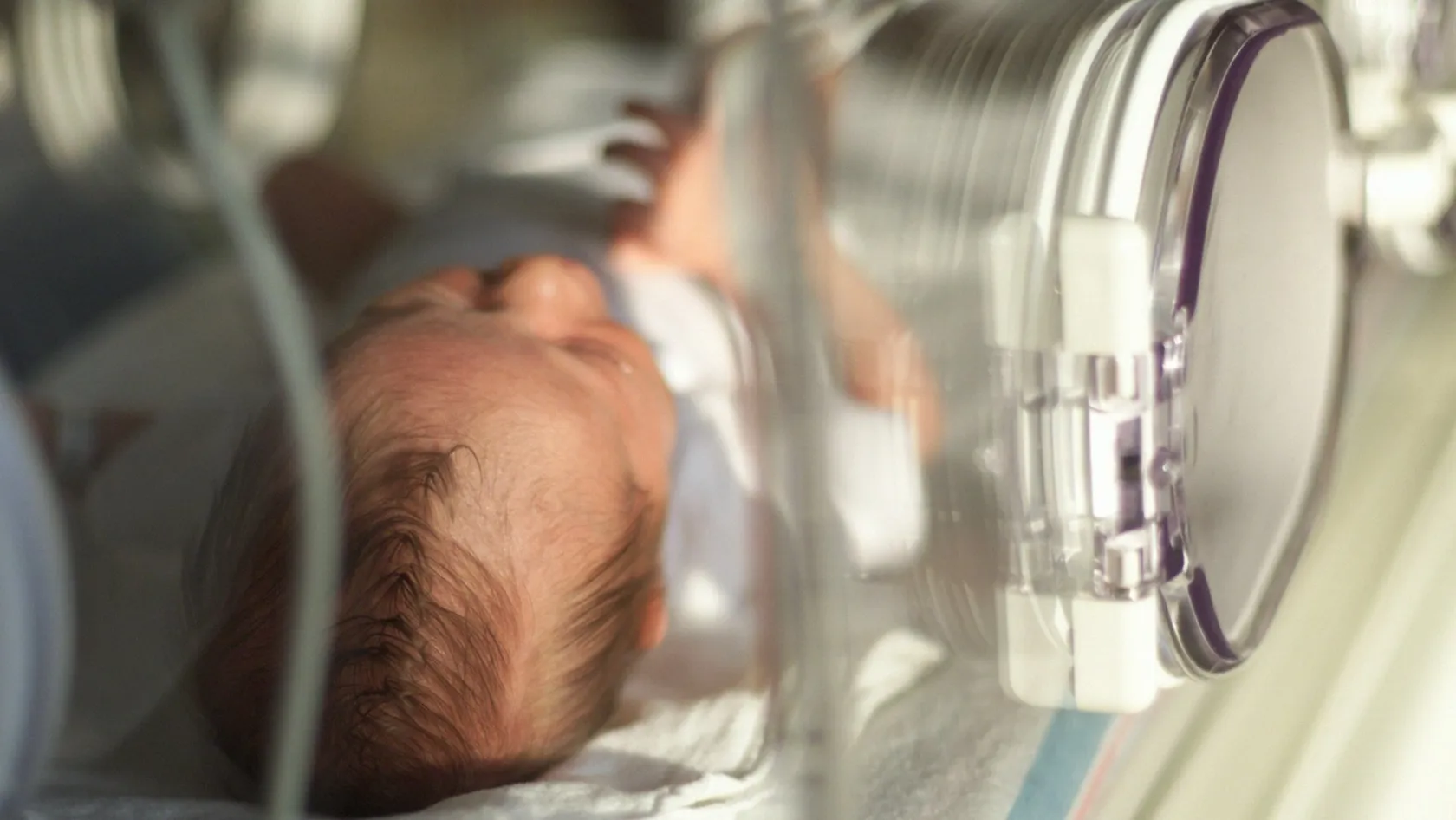
The Newborn Intensive Care Unit at Biruni Hospital in Istanbul looks after babies who need help in the first days of life. Most are not tiny premature infants. In a study of 233,844 deliveries, 7.2 percent of full-term babies were admitted, mainly for fast breathing, suspected infection, low blood sugar or jaundice. This page explains each reason, the equipment at the cot, how long babies stay and going home. A neonatologist reviews reports free of charge.
About This Department
Newborn intensive care
One full-term baby in fourteen spends time in newborn intensive care. Among babies born three to six weeks early, it is more than one in three.
Most parents picture a very premature baby, tiny and surrounded by machines, when they hear the words newborn intensive care. Most babies in the unit are nothing of the kind. A study of 233,844 deliveries in 19 hospitals in the United States found that 7.2 percent of babies born at full term and 36.5 percent of those born at 34 to 36 weeks were admitted, the majority for a few days of help with breathing, infection, blood sugar or jaundice (Hibbard and colleagues, JAMA, 2010). This page explains why a baby born at or near term is taken to the Newborn Intensive Care Unit at Biruni Hospital in Istanbul, what happens there, and how soon families usually go home.
7.2
Percent of 165,993 full-term babies admitted to newborn intensive care
36.5
Percent of babies born at 34 to 36 weeks who were admitted
0.98
Early infections per 1,000 live births in a national network
Free
Review of pregnancy or newborn reports by a neonatologist
A baby who looked fine at delivery can need the unit within hours. Three problems account for most of these admissions, and all three are usually short.
Fast or labored breathing
Before birth the lungs are full of fluid. Labor and the first cries clear it, and when that clearing is slow, which is more common after a cesarean without labor, the baby breathes fast and grunts for a day or two. Doctors call it transient tachypnea. Babies born a few weeks early may also lack surfactant, the coating that keeps air sacs open. Every week counts, as the figures show.
This table scrolls sideways on a narrow screen. Swipe or drag to see every column.
Breathing problems by week of birth, Hibbard and colleagues, JAMA, 2010
Problem
Born at 34 weeks
Born at 38 weeks
Respiratory distress syndrome
10.5 percent
0.3 percent
Transient fast breathing
6.4 percent
0.4 percent
Pneumonia
1.5 percent
0.1 percent
Respiratory failure
1.6 percent
0.2 percent
Treatment is oxygen or light air pressure through soft nasal prongs, fluids by vein while feeding waits, and a chest X-ray. Most babies are off support inside 72 hours.
Suspected infection
Infection in the first three days of life is rare, at 0.98 cases per 1,000 live births, and serious, so doctors treat first and confirm afterward.
That figure comes from 396,586 births in a national research network, where group B streptococcus caused 43 percent of cases and most of the affected babies were born at term (Stoll and colleagues, Pediatrics, 2011). Three in four needed intensive care. A baby with a fever, poor feeding, floppiness or breathing trouble, or whose mother had a fever in labor, has blood cultures taken and starts antibiotics by vein within the hour. If the cultures stay clean at 36 to 48 hours and the baby is well, the antibiotics stop. Parents sometimes feel that two days of treatment for an infection that was never there was a mistake, and it was not, because a newborn can go from slightly off to gravely ill in a few hours and no bedside test separates the two groups early enough to wait.
Low blood sugar
Babies of mothers with diabetes, babies who are small or large for their dates, and those born a little early are tested by heel prick in the first hours. Low readings are common in these groups. In a New Zealand trial 47 percent of 514 at-risk babies had at least one. A sugar gel rubbed inside the cheek, followed by a feed, is the first treatment.
Dextrose gel for low blood sugar in 237 babies, Harris and colleagues, Lancet, 2013
Outcome
Dextrose gel
Placebo gel
Sugar still low after two treatments
14 percent
24 percent
Serious side effects
None
None
When sugar stays low despite gel and feeds, the unit gives glucose by vein, usually for a day or two.
What parents ask
Is a newborn intensive care unit the same as a NICU?
Yes. Newborn, neonatal and NICU all describe the same unit, which looks after babies from birth through roughly the first month of life.
How long do full-term babies stay?
Two to five days is common for fast breathing, low sugar or jaundice, while a proven infection means seven to ten days of antibiotics and sometimes longer.
Can I breastfeed while my baby is in the unit?
Yes. If your baby cannot feed yet, start expressing within hours of the birth and the milk is given by tube or kept for later.
Can I hold my baby?
In almost every case, including under oxygen prongs. The nurse will help with the wires.
Did I do something wrong?
No. These conditions follow from the timing and manner of birth, the mother's health in pregnancy and chance. Blame has no place in it.
This table scrolls sideways on a narrow screen. Swipe or drag to see every column.
Equipment at the cot
Item
What it does
What parents should know
Incubator or warmer
Holds body temperature steady without clothes or blankets in the way
You can touch and talk through the doors
Monitor leads
Show heart rate, breathing and oxygen level
Movement sets off false alarms all day
Blue phototherapy lights
Break down bilirubin in the skin
The eye shields stay on while the lights are on
Line in the hand, foot or navel
Carries fluid, sugar and antibiotics
It is removed as soon as feeding is established
Feeding tube
Delivers milk while sucking is still weak
Your own expressed milk goes down it
Jaundice
Yellow skin in the first 24 hours of life, a baby too sleepy to feed, or pale stools need a bilirubin test the same day.
More than half of healthy newborns turn a little yellow in the first week as the liver learns to clear bilirubin, a pigment from worn-out red blood cells. It peaks around day three to five and fades. Very high levels can injure the brain, so guidance from the American Academy of Pediatrics sets treatment lines by the baby's age in hours and by risk factors such as early birth or blood group mismatch with the mother (Kemper and colleagues, Pediatrics, 2022). In the unit the process runs in order.
Measure. A skin meter screens, and a blood test confirms.
Plot. The level is placed on a chart against age in hours, since a number that is harmless on day four can matter on day one.
Treat with light. Blue lights above and below the baby, with eyes shielded, for a day or two. Feeding continues every two to three hours.
Recheck. Levels are repeated until they are falling without the lights.
Escalate rarely. Immune globulin or an exchange of blood is reserved for the few babies whose level keeps climbing.
Almost every baby needs only the lights.
Less common reasons
Meconium in the lungs
A baby who passed stool before birth and breathed it in needs oxygen, sometimes a ventilator, and close watching for the first days.
Most cases arise at or after the due date.
A difficult delivery
When the brain has gone short of oxygen, cooling treatment has to start within six hours of birth.
Assessment happens in the delivery room. Those who qualify are cooled to 33.5 degrees for three days in a unit equipped for it.
Conditions found before or at birth
Heart defects, bowel blockages and openings in the abdominal wall or spine are stabilized in the unit before and after surgery.
Many of these are seen on pregnancy scans, which allows the birth to be planned in a hospital where surgeons and the newborn team work side by side. Withdrawal from medicines taken in pregnancy, seizures and very low or high birth weight make up most of the remainder.
Going home
The tests for discharge are plain. Your baby breathes room air without effort, keeps warm in a cot, feeds well by breast or bottle, has a bilirubin level that is falling, and has finished any antibiotics. Nothing more. Before leaving, babies have the heel prick screening test, a hearing check and their first vaccines, and parents are shown safe sleep on the back, how to spot poor feeding or returning jaundice, and whom to call at night. For the large majority of babies admitted at or near term, the stay leaves no mark on later health or development, and a follow-up visit in the first week at home is enough. Bring questions to it. Parents who have watched monitors for days often find the silence of the first night at home unsettling, which is normal, and the unit would sooner answer a night call about nothing than miss a baby who has stopped feeding.
Babies born at 34 to 36 weeks feed slowly for a while. Expect that.
Families from abroad
Some mothers choose to give birth in Istanbul, often because a scan has shown a condition that will need a newborn team at delivery. Planning starts in pregnancy. One coordinator from the international patients office handles the file from the first message until mother and baby are discharged, and the WhatsApp line stays open once you are back home. The office works in English, Arabic, French, Russian, Serbian, Romanian and Spanish and brings in interpreters for other languages. It also finds accommodation close to the hospital, meets the family at the airport, runs the daily transport and prepares the invitation letter a consulate expects with a visa application. The kitchen serves halal, vegetarian and diabetic menus, a prayer room is available, and mothers who prefer a female physician should say so early, since the department meets that request wherever the rota allows. After the birth a companion bed in the mother's room lets a relative stay overnight.
Airlines set their own rules for pregnant passengers and for young babies, and the neonatologist gives written confirmation that your baby is fit to fly before the journey home. Send the pregnancy records and scan reports first. The review is free.
Cost
A short stay for breathing, sugar or jaundice costs far less than weeks of care for a very early baby, and the days in the unit decide most of the total. Surgery, a ventilator and long antibiotic courses add to it.
Hospitals in this market price newborn care per day according to the level of support, separately from the delivery itself. Request the list of what a day includes. Nobody can give a meaningful figure before the reports have been read, and a neonatologist reads them without charge, so the sensible first step for a family comparing hospitals is to send the file and ask for the estimate in writing.
References
Consortium on Safe Labor, Hibbard JU, Wilkins I, et al. Respiratory morbidity in late preterm births. JAMA. 2010;304(4):419-425.
Stoll BJ, Hansen NI, Sanchez PJ, et al. Early onset neonatal sepsis: the burden of group B streptococcal and E. coli disease continues. Pediatrics. 2011;127(5):817-826.
Harris DL, Weston PJ, Signal M, Chase JG, Harding JE. Dextrose gel for neonatal hypoglycaemia (the Sugar Babies Study): a randomised, double-blind, placebo-controlled trial. Lancet. 2013;382(9910):2077-2083.
Kemper AR, Newman TB, Slaughter JL, et al. Clinical practice guideline revision: management of hyperbilirubinemia in the newborn infant 35 or more weeks of gestation. Pediatrics. 2022;150(3):e2022058859.
Editor's note
Written by the Biruni Hospital medical editorial team. Reviewed by Prof. Dr. Mehmet İlke BÜGET, Anesthesia and Reanimation.