
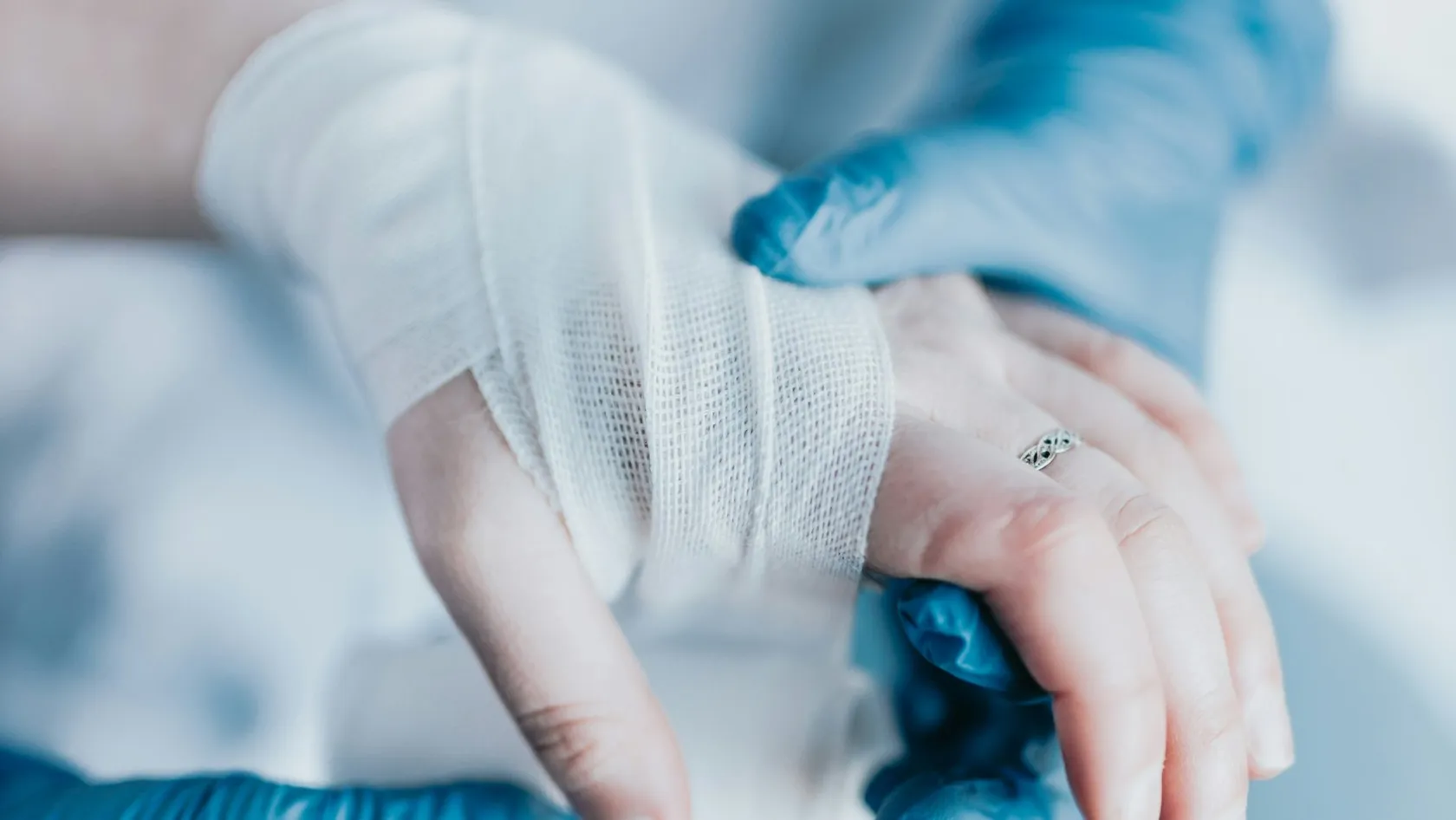
Burn Unit (Burn Center)
Burn care runs on one figure, the percentage of the body surface burned, and a systematic review of 28 studies found that referring hospitals overestimate it in half or more of cases. Fluid volume, the transfer decision and the survival estimate are all calculated from that number, which is why this page starts with how it is measured and who should be measuring it.
About This Department
One number gets estimated in the first hour. Almost everything that follows is calculated from it.
Across 28 studies and 6,461 patients, hospitals sending a burn on to a specialist unit overestimated its size in half or more of cases, and their assessment of depth matched the burn center in only 55 percent.
The number everything is calculated from
Burn care runs on one figure, the percentage of the body surface that is burned, written as TBSA. Fluid volumes come out of it. The transfer decision turns on it. Survival estimates rest on it. Nutrition targets follow from it. A single number, produced by somebody looking at a patient in a resuscitation room, and the rest of the week follows from whatever they write down. Nobody gets it right more than half the time. Researchers pooled 28 studies and 6,461 patients, comparing the assessment made by the hospital that first saw the patient against the assessment made at the burn center. In most of the studies that compared the two directly, the referring hospital overestimated the size in half or more of cases, while depth agreed in 55 percent. The direction of the error is the part that matters, because an overestimate leads to a fluid prescription that is too large, and too much fluid after a burn is not a harmless cushion.
This table scrolls sideways on a phone. Drag it across to reach the last column.
| Method | How it works | Where it fails |
|---|---|---|
| Rule of nines | The adult body divided into blocks of nine percent, meaning each arm nine, each leg eighteen, front and back of the trunk eighteen each | Children, whose heads are proportionally much larger, and scattered patchy burns |
| Lund and Browder chart | A diagram with age adjusted percentages for each body part, filled in by shading the burned areas | Nothing much, other than that it takes longer and needs the chart to hand |
| Palm method | The patient own palm with fingers closed counts as roughly one percent, used for small or scattered burns | Large burns, where the errors accumulate quickly |
What counts, and what does not
Simple redness, meaning skin that is red and painful with no blister, is a superficial burn and it is excluded from the TBSA figure entirely. Including sunburn style redness is the commonest single reason an estimate comes out too high. Anything that has blistered or gone deeper counts, and a good assessment waits until the burn has been cleaned and loose blistered skin removed, since dirt and soot make everything look worse than it is.
The fluid calculation, and the harm of getting it wrong
Large burns leak fluid out of the circulation into the tissues for the first day or two, so replacing it is the treatment that keeps the kidneys and the circulation going. Body weight and TBSA give the volume, and half of the first day total goes in in the first eight hours from the moment of the burn rather than from the moment of arrival. That calculation only starts things off. None of it amounts to a prescription to be delivered regardless of what the patient does, and the single most important number after it is urine output, measured hourly, which tells the team whether the rate is right and gets adjusted up or down against it.
A multicenter study looked at what happens when the fluid given exceeds the predicted volume. In patients with a mean burn of 44.5 percent TBSA, receiving an average of 5.2 milliliters per kilogram per percent TBSA in the first 24 hours, the excess raised the odds of pneumonia by 1.92, of bloodstream infection by 2.33, of acute respiratory distress syndrome by 1.55, of multiorgan failure by 1.49 and of death by 1.74. Too much fluid is not caution. It swells the lungs, swells the limbs and, in the worst cases, raises the pressure inside the abdomen until the organs inside it fail.
Put that next to the previous section and the chain is visible. An overestimated burn produces an overcalculated volume, and the overcalculated volume produces the complications above. Nothing argues harder for getting the patient in front of somebody who measures burns every week.
Which hospital, and when a transfer is due
Burn centers publish referral criteria, and the criteria are unusually specific because the consequences of keeping the wrong patient are unusually bad.
Whether that referral happens changes what follows. A statewide analysis found that 66 percent of burn patients treated in facilities without a specialist burn team met the referral criteria and had not been transferred, while patients treated at verified burn centers had roughly half the odds of an infectious complication, with an adjusted odds ratio of 0.5, and shorter hospital stays.
Two thirds of those patients belonged somewhere else.
What the numbers predict
Families ask for a percentage in the first hours and the honest response is that a reasonable estimate exists, that it describes groups rather than individuals, and that it is built from three things.
Slide this table sideways on a small screen to reach the second column.
| Element | What it contributes |
|---|---|
| Age in years | Added directly. A 60 year old starts 30 points above a 30 year old with the same burn |
| Percentage of body surface burned | Added directly. This is why the estimate in the first section matters so much |
| Inhalation injury | Adds 17 points, which is the single largest jump available and the reason the airway is assessed before anything else |
| How well the total performs | It separated survivors from non survivors with an area under the curve of 0.96 across 4,389 consecutive admissions |
| What the same series showed overall | Mortality across all burn center admissions ran at 6.5 percent, which is lower than most people expect |
Read the last row carefully. Most burns admitted to a burn center are survived. The scores families find online are built from the small minority of very large burns. A number produced by a calculator on a phone, without the depth assessment and without knowing whether smoke was involved, tells you almost nothing that applies to the person in the bed.
Smoke, and the injury you cannot see
Skin shows and the airway does not, so inhalation injury becomes the thing burn teams assess first and families hear of last, and hot gas and soot damage the lining of the airway, and the swelling that follows builds over hours rather than appearing at once. A patient who is talking normally on arrival can be unable to breathe six hours later, and once the swelling has closed the airway a breathing tube can no longer be passed. Burn teams therefore place a breathing tube in somebody who still looks comfortable, and they treat a face burn with singed nasal hairs, a hoarse voice or soot around the mouth as urgent well before anybody is short of breath. Waiting for breathlessness in this situation means waiting until the option has gone. Ask, in the first hour, whether the burn happened in an enclosed space and whether anybody has looked at the vocal cords, because those two answers change the next six hours more than the burn on the skin does.
Among 1,058 burn patients, inhalation injury on its own raised mortality by up to 20 percent above what age and burn size alone predicted. Pneumonia on its own raised it by up to 40 percent. The two together raised it by roughly 60 percent. Those figures are why the revised Baux score adds 17 points for inhalation injury and why a burn that happened in an enclosed space is treated differently from an identical burn that happened outdoors.
Carbon monoxide comes with it. You cannot see it or smell it, it binds to the blood far more tightly than oxygen does, and a normal reading on a finger probe does not exclude it, so high flow oxygen goes on at the scene and not after a blood test.
Taking the burn off
Dead skin left in place is not a dressing. Dead skin works as a culture medium sitting on an open wound, and the shift to removing it early is the single biggest change in burn surgery of the last fifty years.
What the evidence says about doing it early
Pooling six randomized trials, a meta-analysis found that early excision and grafting cut mortality in patients without inhalation injury, with a relative risk of 0.36, and shortened hospital stay by nearly nine days. Blood pays for it, since excising a large burn bleeds heavily and transfusion requirements rise, and burn surgeons make that trade every time, so a unit needs a blood bank able to supply on the day it operates.
The fire that keeps burning
Severe burns reset the body metabolism upward and hold it there for months. The heart rate sits high, the body temperature runs above normal, muscle is broken down for fuel, and a patient can lose a quarter of their body weight without anybody doing anything wrong.
Feeding comes first and it starts early, through a tube into the stomach where eating has stopped, at targets calculated from the burn size. Staff keep the room warm, uncomfortably so for visitors, because a cold patient burns through more of themselves to stay warm.
Drugs help with the rest. In a randomized trial of 25 children with burns over 40 percent of the body surface, a beta blocker given for two weeks reversed the muscle breakdown. Net muscle protein balance rose 82 percent above baseline in the treated group, while the untreated children lost 9 percent of their fat free mass. Blunting the stress hormone response turns out to protect muscle in a way that feeding alone does not.
This part continues long after discharge. The raised metabolism, the muscle loss and the fatigue outlast the wounds by many months, and a patient who is told to expect that copes with it far better than one who assumes something has gone wrong.
Why burns get infected
Skin does the work of a barrier. A large burn removes it across a wide area, leaves a warm moist surface behind, and adds intravenous lines, a urinary catheter and often a breathing tube on top of that. Infection kills more of the patients who survive the first days than anything else does. What a burn unit does in response is mostly negative. Nobody gives antibiotics routinely to prevent infection, because doing so selects out resistant organisms and the units that tried it ended up with worse organisms rather than fewer infections. Topical antimicrobials go on the wound. Dressing changes happen under clean conditions. Lines come out the moment they stop earning their place. And the burn itself is closed as fast as surgery allows, because a closed wound stops being a route in.
Spotting infection in a burn patient is harder than anywhere else in the hospital, because the burn itself produces fever, a fast heart rate and a high white cell count without any infection at all. A burn unit reads the change and not the value. A rising requirement for fluid, a falling platelet count, a new intolerance of feed or a wound that looked healthy yesterday and looks gray today all carry more weight than a temperature chart, and this is the clearest example of why experience in this specialty is not interchangeable with experience in general intensive care.
Pain, dressings and the itch nobody warns about
Pain after a burn comes in two forms and they need different answers. Constant background pain from the wound responds to regular medication. The pain of a dressing change behaves differently, being brief, severe and predictable, and it is the part patients dread for days in advance.
Then the itch arrives. Healing burns itch intensely, it starts as the wounds close and it can continue for a year or more, it disturbs sleep and it drives scratching that damages new skin and fresh grafts. Moisturizer several times a day, antihistamines, pressure garments where they are worn for other reasons and, in stubborn cases, gabapentin all help. It deserves to be raised before the patient asks, because most people assume itching this severe means something is wrong.
Scars, and an honest look at pressure garments
Burns healed inside two weeks usually leave little behind. One that takes longer, or one that needed a graft, produces a scar that thickens, tightens and stays red for a year or more before it settles.
Tight scars across a joint are the functional problem before the cosmetic one. A scar contracting over a hand, an elbow, a neck or an armpit pulls the joint out of position and the range of movement disappears, so splinting, stretching and therapy start while the wounds are still healing and never after everything has settled.
Silicone sheets and gels, massage, sun protection and, for established scars, steroid injections and laser treatment all sit in the same picture, which is a field with wide practice variation and thinner evidence than its confidence suggests. A unit that says so is more trustworthy than one that promises a result.
Children, and the smaller margins
Scalds from hot drinks, kettles and bath water account for most burns in small children, and almost everything in managing them differs from an adult with the same percentage burned.
One further point belongs here plainly. Burn units assess whether the injury matches the history given, because a small number of childhood burns are not accidents and the pattern of the burn is often the only thing that raises the question. That assessment happens routinely, it accuses nobody, and every family in a good unit goes through it.
Getting back
The wounds close and the long part starts. Recovery from a major burn is measured in years and it is the stretch nobody prepares families for.
What recovery actually looks like
Length of stay, and what the numbers say about the years after
Burn units plan on roughly one inpatient day for every percent of body surface burned, which is a planning figure and never a promise and which shortens considerably where the burn is closed early. Pooling 21 studies and 1,298 survivors of major burns, averaging 25.8 percent TBSA, researchers found return to work reported between 52 and 80 percent and discharge to independent living between 27 and 97 percent, with survivors sitting consistently below their level of function before the injury. What the numbers do not capture is how uneven the recovery feels, since strength and stamina return long before confidence does. Those ranges are wide because the studies behind them cover very different burns, and a wide range honestly reported beats a single number that describes nobody. Both halves of that belong in the conversation. Most people go back to work. Most people also come back changed.
Whether to travel for this
Two completely different questions arrive under the same search, and separating them is the useful thing this page can do. Fresh burns do not travel. Fluid resuscitation runs in the first hours, the airway can close inside a morning, and a flight during that window costs exactly the time the treatment needs. The right destination for an acute burn is the nearest hospital with a burn team, and a family abroad should be getting their relative to one rather than looking for a better one further away. Reconstruction works the other way. Months or years after the injury, once the scars have matured and the wounds are long closed, the operations that free a joint or resurface unstable skin are elective, planned from photographs, and entirely suited to being done somewhere other than where the burn happened. Nothing about them is urgent, which is exactly what makes traveling for them sensible.
Send photographs before anything else. Good ones, in daylight, from several angles, with the joint shown both relaxed and stretched as far as it goes, alongside the operative notes from the original admission if you have them. Back comes a written opinion naming what is achievable, in how many stages and over what period, and where further surgery would add little, it says so.
What drives the cost
No figure appears on this page, for a practical reason. Burn care gets priced on time in hospital and on trips to the operating room, and a reconstruction on how many stages it takes. Nobody can know either before seeing the photographs.
This table scrolls sideways on a phone. Drag it across to reach the second column.
| Driver | Which way it moves the total |
|---|---|
| The percentage burned, for acute care | The largest driver of everything, since it sets the length of stay, the number of operations and the intensive care requirement |
| Number of operations | Large burns are closed in stages across several trips to the operating room, and each one is costed separately |
| Whether intensive care is needed | A ventilated bed costs more than a ward bed in every health system, and inhalation injury is what usually decides it |
| Blood products | Excising a large burn bleeds heavily, so transfusion sits inside the surgical cost rather than beside it |
| For reconstruction, the number of stages | A single contracture release is one operation. A neck, a hand and an axilla is a program across months, sometimes with tissue expansion in between |
| Therapy and garments afterwards | Splints, pressure garments and hand therapy run for months and are quoted separately by most services |
Find out whether the quotation covers one stage or the whole plan, what happens financially if a graft fails and needs redoing, and whether the therapy and garments afterwards are inside it. A figure that means anything comes only after a surgeon has seen the photographs, and that review costs nothing.
What we arrange
Reconstruction rarely takes one visit, so the practical side gets planned as a sequence.
Learn the coordinator name before anything is agreed. A service that cannot produce one has already told you how a three stage plan will be managed.
What to ask a burn service
Each question below has a short answer, and a long vague reply to any of them is itself an answer.
Slide this table sideways on a small screen to reach the second column.
| Ask this | Why the answer matters |
|---|---|
| Is this a designated burn unit with its own team, or a plastic surgery service that admits burns | The referral criteria exist because these are different things, and the outcome data follow the difference |
| Who estimates the burn size and depth, and with which chart | The whole treatment is calculated from that number, and half of the errors in burns start here |
| How is fluid titrated after the first calculation | The right answer names hourly urine output. An answer that only names the formula is describing a prescription rather than a treatment |
| How early do you excise and graft, and how many operations should we expect | Early closure is what the trials support, and a plan stated as a series prevents a great deal of distress |
| For reconstruction, how many stages, over what period, and what will it not achieve | The last part of that question is the one that separates a surgeon from a salesman |
The second question is the one nobody thinks to ask and the one with the widest consequences.
Questions we are asked, a burn unit FAQ
How is the size of a burn worked out, and does it matter who does it
Somebody estimates it as a percentage of body surface, using the rule of nines in adults, an age adjusted chart in children, or the patient own palm for small burns. It matters enormously who does it. A systematic review of 28 studies and 6,461 patients found that referring hospitals overestimated the size in half or more of cases and agreed with the burn center on depth only 55 percent of the time. Fluid volume, the transfer decision and the survival estimate are all calculated from that figure, so an error at the start propagates through everything that follows it. The commonest single mistake is counting simple redness, meaning skin that is red and sore with no blister, which does not belong in the figure at all, and a good assessment is also made after the burn has been cleaned and loose blistered skin removed, because soot and dirt make everything look deeper and wider than it is.
Is more fluid safer
No, and the evidence is clear. In a multicenter study of patients with a mean burn of 44.5 percent, fluid given above the predicted volume raised the odds of pneumonia by 1.92, of bloodstream infection by 2.33, of acute respiratory distress syndrome by 1.55, of multiorgan failure by 1.49 and of death by 1.74. The calculation only starts things off, and hourly urine output is what the rate gets adjusted against.
When does a burn need a specialist unit
Partial thickness burns over ten percent of the body, any full thickness burn, burns of the face, hands, feet, genitals or across a joint, electrical and chemical burns, any inhalation injury, and burned children in a hospital not equipped for children. A statewide analysis found 66 percent of burn patients treated outside specialist units met these criteria, and patients at verified burn centers had about half the odds of an infectious complication.
Will the scar go away
It fades and softens over a year or more, and it does not disappear. Burns healed inside two weeks leave little. The functional problem is a scar crossing a joint, so therapy and splinting start while the wounds are still healing.
Do pressure garments work
Less well than their reputation suggests. A meta-analysis of six randomized trials and 316 patients found no improvement in global scar scores, a small reduction in scar height, and no effect on vascularity, pliability or color, though they still help with itch and are reasonable on limbs, and anybody prescribing them for a year should be able to say what they expect from them.
Should we fly a burned relative abroad for treatment
Not with a fresh burn. Resuscitation runs in the first hours and the airway can close inside a morning, so the nearest hospital with a burn team is the right one, while reconstruction behaves differently and travels well, because contracture release, resurfacing and laser treatment are planned operations on a mature scar months or years later. Send photographs and the operative notes for a written opinion first.
Why is the room so hot
Because a large burn resets the metabolism upward and a cold patient burns through their own muscle to stay warm. Warm rooms, early feeding and, in severe burns, a beta blocker all aim at the same thing.
How long will the whole thing take
Plan on roughly one day in hospital for each percent of body surface burned, shorter where the burn is closed early, and after that scars are at their most active between two and six months and mature over a year or more, with reconstruction planned once they have settled. A systematic review of 1,298 survivors found return to work reported between 52 and 80 percent.
References
- Brekke RL, Almeland SK, Hufthammer KO, Hansson E. Agreement of clinical assessment of burn size and burn depth between referring hospitals and burn centres, a systematic review. Burns. 2023;49(3):493-515.
- Klein MB, Hayden D, Elson C, et al. The association between fluid administration and outcome following major burn, a multicenter study. Ann Surg. 2007;245(4):622-628.
- Huang Z, Forst L, Friedman LS. Burn center referral practice evaluation and treatment outcomes comparison among verified, nonverified burn centers, and nonburn centers, a statewide perspective. J Burn Care Res. 2021;42(3):439-447.
- Dokter J, Meijs J, Oen IMMH, et al. External validation of the revised Baux score for the prediction of mortality in patients with acute burn injury. J Trauma Acute Care Surg. 2014;76(3):840-845.
- Shirani KZ, Pruitt BA, Mason AD. The influence of inhalation injury and pneumonia on burn mortality. Ann Surg. 1987;205(1):82-87.
- Ong YS, Samuel M, Song C. Meta-analysis of early excision of burns. Burns. 2006;32(2):145-150.
- Herndon DN, Hart DW, Wolf SE, Chinkes DL, Wolfe RR. Reversal of catabolism by beta-blockade after severe burns. N Engl J Med. 2001;345(17):1223-1229.
- Anzarut A, Olson J, Singh P, Rowe BH, Tredget EE. The effectiveness of pressure garment therapy for the prevention of abnormal scarring after burn injury, a meta-analysis. J Plast Reconstr Aesthet Surg. 2009;62(1):77-84.
- Jawad AM, Kadhum M, Evans J, Cubitt JJ, Martin N. Recovery of functional independence following major burn, a systematic review. Burns. 2024;50(6):1406-1423.
Editor's note
Written by the Biruni Hospital medical editorial team. Reviewed by Assoc. Prof. Dr. Suna KOÇ, Anesthesia and Reanimation.
Medically reviewed by
Assoc. Prof. Dr. Suna KOÇ
Anesthesia and Reanimation
Related Treatments
View All
Bone Marrow Transplant Unit (BMT Unit)
Between the mid 1990s and the mid 2000s, death within 200 days of an allogeneic transplant that was not caused by relapse fell by 60 percent, and almost none of that came from a new drug. This page is about the part nobody photographs, meaning the filtered room, the rules that have evidence behind them and the ones that do not, the laboratory chain behind the cells, and what a family can actually do.
Burn ICU (Burn Intensive Care Unit)
Age, burn size and smoke inhalation are the three numbers that set the outlook after a major burn. This page walks through fluids, early surgery and grafting, the long healing phase, and when a burn patient can be flown abroad.
Cancer Pain Management Unit
The Cancer Pain Management Unit at Biruni Hospital in Istanbul treats pain caused by cancer and by its treatment. Two in three people with advanced cancer report pain, and reviews show nearly one in three receive medication too weak for it. The unit uses stepwise medicines, radiotherapy for bone pain, nerve blocks and spinal pumps, and plans follow-up for patients who return home abroad. The pain team reviews reports and current medicines free of charge.
Cancer Patient ICU Care
Cancer once counted as a reason not to offer an intensive care bed at all. Pooled data from 7,354 critically ill cancer patients retired that rule, and the argument now is about which patient, for what, and how long full support runs before anybody formally reassesses it.
Cardiac Care Unit (CCU)
The Cardiac Care Unit at Biruni Hospital in Istanbul monitors and treats people during and after a heart attack, a dangerous heart rhythm or sudden heart failure. In a French registry of 14,423 patients, six-month mortality after a major heart attack fell from 17.2 percent in 1995 to 5.3 percent in 2015. This page covers the path from chest pain to the unit, what is watched, angioplasty, going home and flying. The heart team reviews reports free of charge.