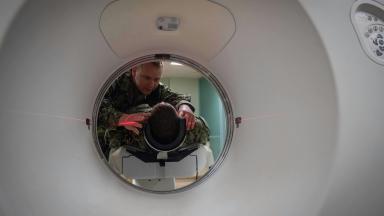
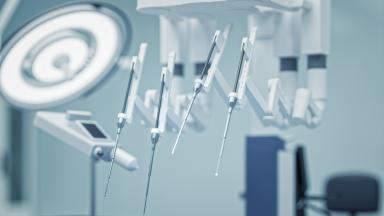
A fusion biopsy lays the MRI over live ultrasound so the needle goes to the suspicious area rather than sampling blind. In the PRECISION trial it found significant cancer in 38 percent of men against 26 percent with the standard biopsy, and 28 percent of men needed no biopsy at all.
About This Department
Urology
A standard prostate biopsy takes twelve samples blind. A fusion biopsy takes them where the MRI says the cancer is.
Your PSA has come back raised, perhaps twice, and someone has said the word biopsy. For decades that meant a probe in the rectum and twelve needles fired in a fixed pattern, hoping to hit a cancer nobody could see. Two studies changed the order of events. In PROMIS, an MRI scan found 93 percent of the cancers that mattered where the blind biopsy found 48 percent. In PRECISION, men who had an MRI first and needles aimed only at what it showed were diagnosed with significant cancer more often, 38 against 26 percent, with fewer harmless cancers picked up along the way, and 28 percent of them needed no biopsy at all. Fusion puts those two facts to work. Software lays the MRI over the live ultrasound so the needle goes to the target. This page explains how it is done, which route through the body is safer, what the scores on your MRI report mean, and how to arrange the test during a short stay in Istanbul.
38% vs 26%
Significant cancers found, MRI-targeted against standard biopsy, PRECISION trial
28%
Men whose MRI was clear and who needed no biopsy at all
93% vs 48%
Sensitivity for significant cancer, MRI against ultrasound biopsy, PROMIS study
Free
Review of your PSA history and MRI
Free consultation
The review of your file is free and commits you to nothing. Send every PSA result you have with its date, the report and images of any prostate MRI, the report of any earlier biopsy, your medicine list including blood thinners, and your age. A urologist tells you whether an MRI or a biopsy comes next, which route he would use, and whether the MRI you already have is good enough to fuse, and a coordinator answers in your own language.
MRI-Guided Prostate Biopsy (Fusion Prostate Biopsy) is a biopsy in which the needle is aimed at a spot chosen on an MRI scan taken beforehand. An MRI shows the prostate in fine detail and marks any area that looks suspicious. On the day, an ultrasound probe shows the prostate live, and software fuses the two pictures so that the suspicious area from the MRI appears on the ultrasound screen as a target. The urologist steers the needle to it.
A standard biopsy has no target. Twelve samples come from fixed positions. A cancer small enough or oddly placed enough to sit between them goes unfound, while a tiny cancer of no consequence that happens to lie under a needle gets found, named and sometimes treated.
Aim first. Then sample. Two to four cores come from each target, and a smaller set of systematic samples from the rest of the gland makes sure that nothing the MRI could not see is left unchecked.
The two trials that changed the order
Two studies, five years apart, moved the MRI from an optional extra to the first step, and their numbers are the ones every guideline now quotes.
A wide table follows. On a phone, slide it sideways.
PROMIS and PRECISION
PROMIS, Lancet 2017
PRECISION, New England Journal of Medicine 2018
Question
How good is MRI at finding significant cancer, against the standard biopsy, when both are checked against a full mapping biopsy of the whole gland
Does MRI first, with needles aimed only at what it shows, find more significant cancer than a standard biopsy
Men
576 with a raised PSA and no previous biopsy, in 11 British centers
500 with a suspicion of cancer and no previous biopsy, in 25 centers in 11 countries
Design
Every man had an MRI, a standard biopsy and a mapping biopsy, each read blind to the others
Randomized to MRI with targeted biopsy, or standard 12-core biopsy
Sensitivity for significant cancer
MRI 93 percent, standard biopsy 48 percent
Not measured this way
Significant cancer diagnosed
38 percent with MRI-targeted biopsy, 26 percent with standard biopsy
Harmless cancer diagnosed
5 percent fewer with an MRI-first pathway
13 percentage points fewer with MRI-targeted biopsy
Biopsies avoided
27 percent of men could skip a first biopsy
28 percent of men in the MRI group had a clear scan and were not biopsied
PROMIS showed that the picture was better than the blind needle. PRECISION showed that acting on the picture changed the diagnosis.
Guidelines in Europe and North America now place an MRI before the first biopsy, and a biopsy without one is the exception that needs a reason.
One number in PROMIS deserves its own line. Specificity came to 41 percent, which means a suspicious area on the scan turns out to be harmless in more than half of men. Hence the biopsy. A worrying MRI report calls for a targeted biopsy, and the biopsy, far more reliably than the report, gives the answer.
Who is sent for one
A raised PSA
The commonest reason. A PSA above the threshold for your age on two tests a few weeks apart, or one that has climbed quickly, leads to an MRI and, if the scan shows a target, to this biopsy.
An abnormal examination
A hard area or nodule felt on examination is sent for MRI and biopsy whatever the PSA reads.
A negative biopsy that did not settle the question
Many men arrive with a standard biopsy that found nothing and a PSA that has kept rising. The blind needles missed the front of the gland or the top of it, where a fusion biopsy reaches by design. This group gains the most.
Active surveillance
Men with a small, low-grade cancer who are being watched rather than treated have the MRI repeated at intervals, and a fusion biopsy when the scan changes, so that a cancer that is growing is caught while it is still curable.
Men whose MRI shows nothing suspicious and whose PSA density is low can, in most cases, avoid a biopsy and be followed with PSA tests. The review says so plainly when that applies to you.
Reading the MRI score
Prostate MRI reports use a five-point scale called PI-RADS, and the number decides what happens next.
A wide table follows. On a phone, slide it sideways.
PI-RADS scores
Score
What it means
Usual next step
1
Normal
PSA follow-up, no biopsy
2
Almost certainly benign
PSA follow-up, no biopsy in most men
3
Uncertain
Biopsy if the PSA density is raised or the PSA keeps rising, otherwise follow-up. The judgment call
4
Probably cancer
Targeted biopsy
5
Very likely cancer, or a lesion 15 mm or larger
Targeted biopsy
Two things make the score reliable. The scanner and the protocol, which for prostate work means a 1.5 or 3 Tesla machine running diffusion and contrast sequences, and the radiologist, who reports better with volume. An MRI from home serves for fusion when it meets both tests. When it does not, the scan is repeated here before the biopsy, a decision made from your images rather than from the report alone, and one that costs a day of the trip rather than a wasted biopsy.
Through the skin or through the rectum
The needle reaches the prostate by one of two routes, and the choice is about infection.
Through the rectum is the traditional way. The probe sits in the rectum and the needle passes through its wall, which carries gut bacteria into the gland and is the reason antibiotics are given and the reason sepsis still happens. Through the perineum, the skin between the scrotum and the anus, the needle never touches the bowel.
The numbers come from England, where 73,630 biopsies were compared in BJU International in 2020, and they run as follows. Readmission with sepsis 1.0 percent after the perineal route against 1.4 percent after the rectal route. Readmission with urinary retention 1.9 against 1.0 percent. Bleeding and death the same. One fewer readmission for sepsis in every 278 men, at the cost of three more readmissions for retention.
The perineal route is now recommended by the European Association of Urology as the default, and it reaches the front of the gland more easily, which is where the cancers missed by earlier biopsies hide. Discomfort counts against it. It used to need a general anesthetic, and local anesthetic techniques now let most men have it awake or lightly sedated. The rectal route keeps a place for men who cannot lie in the position the perineal approach needs.
Three ways of fusing the images
Cognitive fusion
Looking at the MRI, the urologist keeps the target in mind and aims the ultrasound-guided needle at the matching spot. No software. It works well in experienced hands for large or obvious lesions, less well for small ones.
Software fusion
A platform loads the MRI, maps it onto the live ultrasound, tracks the probe, and shows the target on screen. The urologist steers the needle to it. The system records where each core was taken, which matters if the biopsy has to be repeated later, and this is what fusion biopsy usually means when a hospital uses the phrase.
In-bore biopsy
Here the biopsy happens inside the MRI scanner itself, with the needle guided by repeated scans. Nothing beats it for very small targets. Nothing costs more or takes longer either, so it stays reserved for the few men in whom software fusion has failed.
Software fusion is what this page describes, and what most hospitals mean by the term. Ask any hospital which platform it uses and how many fusion biopsies its urologists perform in a year, since the software is only as good as the hand on the probe.
Before the biopsy
Preparation stays light. Most of it concerns medicines.
Blood thinners
Aspirin continues in most men. Clopidogrel, warfarin and the newer anticoagulants are paused for three to seven days on the advice of the doctor who prescribed them, and this is arranged before you travel.
Antibiotics
A single dose before a rectal-route biopsy, chosen after a rectal swab in some units. None, or a single dose, for the perineal route.
Bowel and bladder
A small enema the morning of a rectal-route biopsy and nothing for the perineal route. A urine test a few days before, since an infection in the urine is treated first.
Eating
A light meal is fine for a biopsy under local anesthetic. Six hours without food if sedation is planned.
What to bring
The MRI images on disc or by link, as well as the report, and every PSA result with its date.
The biopsy itself
Allow two hours at the hospital for a procedure that takes twenty to thirty minutes.
Position. On your back with your legs raised in supports for the perineal route, or on your side for the rectal route.
Fusion. The ultrasound probe goes into the rectum, and the urologist matches the live image to the MRI on the fusion screen. A few minutes, and the step that decides accuracy.
Anesthetic. Local anesthetic around the prostate and, for the perineal route, into the skin. Sedation for men who want it, which turns the day into an accompanied one with the usual 24 hours of no driving.
Cores. Each is taken with a spring-loaded needle that makes a loud click and a brief sting. Two to four per target, and a set of systematic cores across the gland, come to somewhere between twelve and twenty in all. They go into labeled pots so the pathologist knows which came from the target.
Home. You pass urine before leaving. Most men walk out within an hour, and a man who has traveled alone and had no sedation can go back to the hotel by taxi, with the number of the coordinator in his phone and the instruction to call about fever.
The days after, and what can go wrong
Blood runs through the first weeks, in the urine, in the semen, occasionally from the rectum, and almost all of it means nothing.
Blood in the urine
Most men, for a few days. Drink well. It settles by itself.
Blood in the semen
Most men, for two to six weeks and sometimes longer. Harmless, and the reason sexual activity looks alarming for a while after it resumes a few days later.
Blood from the rectum, soreness in the perineum
A day or two after the rectal route, a few days after the perineal route. Simple pain relief.
Difficulty passing urine
1 to 2 percent of men, more with a large prostate and after the perineal route. A catheter for a few days if it happens.
Infection
Around 1 percent of men need admission after the rectal route, fewer after the perineal route. Fever, shivering or feeling unwell within a week is an emergency. Go to the nearest hospital the same day.
The pathology report and what follows it
Pathology takes three to seven working days, and the report states, for each core, whether cancer was found, how much of the core it occupied, and its grade, with the targeted cores listed separately from the systematic ones so that the reader can see whether the MRI was right.
A wide table follows. On a phone, slide it sideways.
Grade groups on the pathology report
Grade group
Gleason score
What it means
1
3+3
Low risk. Surveillance, when the volume is small
2
3+4
Favorable intermediate risk. Surveillance or treatment, depending on volume, PSA and age
3
4+3
Unfavorable intermediate risk. Treatment in nearly all men
4
8
High risk. Staging scans, then treatment
5
9 or 10
High risk. Staging scans, then treatment, and a discussion of whether hormone therapy joins it
A negative result after a targeted biopsy of a PI-RADS 4 or 5 lesion reassures. A PSA test in a few months and a repeat MRI in a year follow it. A cancer that needs treatment leads to staging, a bone scan or PSMA PET-CT, and a discussion of surgery, radiation or, for the right man, watching.
One site
Prostate surgery, radiotherapy on an Elekta Versa HD linear accelerator and medical oncology are all delivered at Biruni Hospital on the same site, so the team that took the biopsy can treat what it found. A patient who prefers treatment at home leaves with the slides, the MRI and a written summary.
Days in Istanbul
A fusion biopsy is a short visit, and the length depends on whether the MRI comes with you or is done here.
A wide table follows. On a phone, slide it sideways.
Length of visit
Visit
Days in Istanbul
MRI at home already, biopsy here
2 to 3 days. Consultation on day 1, biopsy on day 1 or 2, fly on day 3
MRI and biopsy here
4 to 5 days. MRI on day 1, radiologist report and consultation on day 2, biopsy on day 3, fly on day 4 or 5
Biopsy, then treatment planning while the result is awaited
7 to 10 days, with staging scans and a treatment consultation before you fly
Radiation, sedation, needles, none of them restricts flying. The reason to stay a day is the small chance of retention or fever in the first 24 hours, both far easier to deal with twenty minutes from the hospital than in an airport. Pathology follows you home by WhatsApp and e-mail.
What a quote is made of
No figure appears on this page. A fusion biopsy quote has fewer parts than most, and here they are.
A wide table follows. On a phone, slide it sideways.
What moves a fusion biopsy quote
Item
Effect
The MRI, if done here
The largest line when it is needed, with contrast as a separate item
The biopsy fee
Covers the fusion software, the disposable needles and the urologist. Differs between the perineal and the rectal route
Anesthesia
A line only when sedation is chosen
Pathology
Charged per core or per pot, so eighteen cores cost more to read than twelve
Urine culture and rectal swab
Small lines
Staging scans
Quoted afterwards, only if cancer is found
Packages published by Turkish hospitals and medical travel agencies for prostate biopsy cover consultation, the procedure, pathology, an interpreter and transfers, and leave out the MRI unless it is named, flights, insurance and accommodation.
A quote you can compare names the route, the number of cores expected, whether the MRI is inside the figure, and whether sedation is. It follows the free review.
Coordinator, language, companion
Language
Biruni Hospital gives every international patient one coordinator from the first message, reachable on the same WhatsApp number afterwards. The international patients team works in English, Arabic, French, Russian, Serbian, Romanian and Spanish and arranges interpreters for other languages, which matters at the consultation, where the route is chosen, and again when the result is explained.
Companion and paperwork
Sedation makes a companion a requirement. Without it, one is welcome and not needed. The office books accommodation close to the hospital, arranges airport transfers and the car to the hospital, and issues an appointment confirmation and invitation letter for a visa ten days or so before travel. The hospital kitchen prepares halal, vegetarian and diabetic meals, and a prayer room is on site. Many men ask whether the urologist will be male. Say what you prefer in the first message, and the department arranges it where the rota allows.
Follow-up at home
Once you get back home, the pathology report, the MRI report, the biopsy map showing where each core was taken, and a written recommendation go to your own urologist.
After a negative biopsy, a PSA test at three to six months and a repeat MRI at twelve months
On active surveillance, PSA every three to six months, an MRI at twelve to eighteen months, and a repeat fusion biopsy when the scan or the PSA changes
After a diagnosis that needs treatment, the staging scans and the treatment discussion, here or at home, within a few weeks
Fever in the first week goes to a local emergency department the same day. Everything else waits for the coordinator on WhatsApp, including a scan you would like the urologist here to compare with the earlier one.
Is a fusion biopsy more accurate than a standard prostate biopsy?
Yes. In the PRECISION trial, MRI-targeted biopsy found significant cancer in 38 percent of men against 26 percent with standard biopsy, and diagnosed fewer harmless cancers. The MRI alone was 93 percent sensitive for significant cancer in the PROMIS study, against 48 percent for the standard biopsy.
Does a fusion prostate biopsy hurt?
Local anesthetic takes away most of it. Each core is a click and a brief sting, and the whole procedure lasts twenty to thirty minutes. Sedation is available for men who prefer it. Soreness and blood in the urine and semen follow for days to weeks.
Which is safer, transperineal or transrectal?
The perineal route, through the skin. In England, across 73,630 biopsies, readmission for sepsis was 1.0 percent after the perineal route and 1.4 percent after the rectal route, with a slightly higher rate of urinary retention after the perineal route.
Can I use the MRI I already have?
Yes, if it was done on a 1.5 or 3 Tesla scanner with a prostate protocol and the images themselves are available. A report alone cannot be fused. The urologist decides from the images. If they are not good enough to fuse, the scan is repeated here before the biopsy.
How long do I need to stay in Istanbul?
Two to three days if you bring a usable MRI, four to five if the MRI is done here. Pathology takes three to seven working days and reaches you at home.
What if the MRI shows nothing?
With a PI-RADS 1 or 2 scan and a low PSA density, most men can avoid a biopsy and be followed with PSA tests. That is what 28 percent of men in the PRECISION trial did.
Will the staff be able to speak my language?
The international patients team works in English, Arabic, French, Russian, Serbian, Romanian and Spanish and arranges interpreters for other languages, including for the consultation and for the explanation of the result.
References
Ahmed HU, El-Shater Bosaily A, Brown LC, et al. Diagnostic accuracy of multi-parametric MRI and TRUS biopsy in prostate cancer (PROMIS): a paired validating confirmatory study. The Lancet. 2017;389(10071):815-822.
Kasivisvanathan V, Rannikko AS, Borghi M, et al. MRI-Targeted or Standard Biopsy for Prostate-Cancer Diagnosis. The New England Journal of Medicine. 2018;378(19):1767-1777.
Berry B, Parry MG, Sujenthiran A, et al. Comparison of complications after transrectal and transperineal prostate biopsy: a national population-based study. BJU International. 2020;126(1):97-103.
Editor's note
Written by the Biruni Hospital medical editorial team. Reviewed by Prof. Dr. Bülent ACUNAŞ, Radiology.