
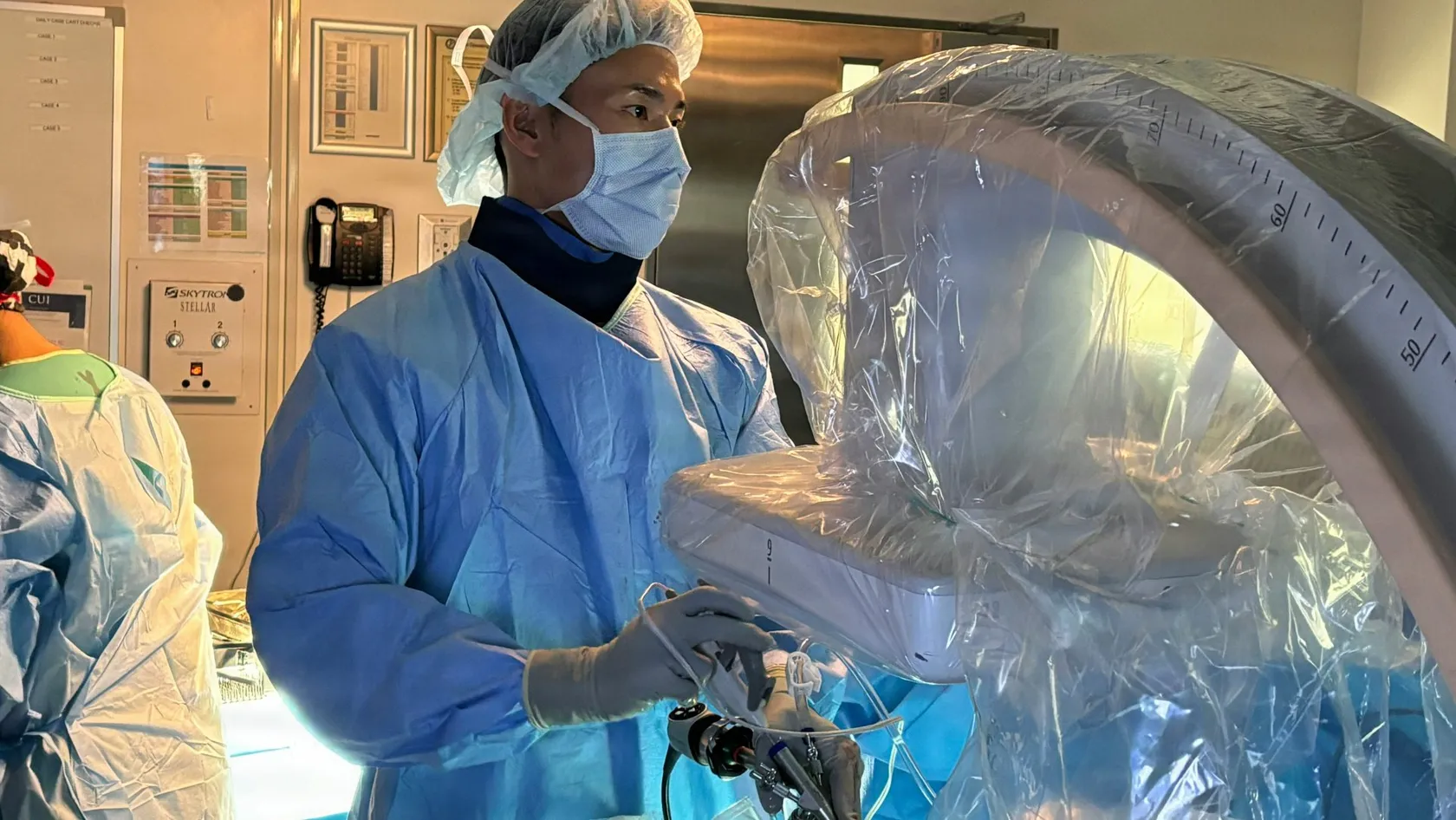
Minimally Invasive Spine Surgery - Keyhole Spine Surgery
Keyhole technique changes how a surgeon reaches your spine and leaves the operation at the end of that route almost unchanged. The randomized evidence shows less bleeding, shorter stays and earlier walking, then outcomes that match the open approach by the one year mark. This page sets out where the advantage is real, what it costs in radiation and surgeon experience, and which cases still belong to open surgery.
About This Department
A smaller door into the spine. The same room on the other side.
Keyhole technique changes how a surgeon reaches your spine and leaves the actual operation largely unchanged. This page sets out what the randomized trials measured, where the advantage is real, where it disappears by the one year mark, and which cases still belong to open surgery.
What keyhole spine surgery means
Traditional spine surgery reaches the spine by peeling the back muscles off the bone and holding them apart with a retractor for the length of the operation. Those muscles take a beating from that, and a good part of the pain and stiffness people report afterward comes from the approach and not from the work done at the end of it.
Keyhole technique attacks that problem and nothing else.
A narrow tube or an endoscope is passed between the muscle fibers instead of across them, widening a natural gap rather than cutting one, and the surgeon then works down that tube under a microscope or a camera. Incisions shrink accordingly, from several inches to something closer to a centimeter for a fully endoscopic case or two openings of roughly seven millimeters for a two portal one. When the tube comes out at the end, the muscle closes back over the path it took. That is the whole mechanism. Everything claimed for these techniques follows from it or does not follow at all. Nothing about the smaller opening makes the disc fragment come out differently, changes which nerve is being decompressed, or alters what a fusion has to achieve to count as a fusion, and keeping that distinction clear is the single most useful thing a patient can do while reading about this subject.
The corridor changes, the operation does not
Advertising in this field tends to blur two separate things, the route in and the work done at the end of it. Separating them turns a confusing set of claims into a short and answerable question. Does the smaller route deliver something you can feel, and for how long?
Two conclusions follow, and patients are usually sold only the first.
Both halves belong in the consultation. Ask for the second one. A patient who books a flight expecting a better spine at one year has bought the wrong thing, and a patient who dismisses the technique because the one year numbers match has thrown away a real advantage in the first month.
Three families of technique
One phrase, minimally invasive, covers three quite different setups, and hospitals use it loosely enough that a patient can book one and receive another. Ask which family is being proposed. The word alone tells you nothing.
Tube, one camera, or two
The tubular approach is the oldest and the commonest. A series of dilators spreads the muscle, a tube of roughly two centimeters holds the path open, and the surgeon works down it with a microscope and ordinary instruments. Uniportal endoscopic surgery goes narrower still, using a single rod endoscope with a working channel through which the instruments pass, with continuous saline irrigation keeping the view clear, and the incision falls to around a centimeter. Biportal endoscopic surgery splits the job across two small openings, one for the camera and one for the instruments, which restores some of the freedom of movement a single channel takes away, and each family has its own instruments, its own learning curve, and its own list of what it handles comfortably. None of them is a superior version of the others, and a surgeon who performs only one of them will describe that one as the best.
What actually gets spared
Muscles along the back of the spine are not passive padding. They hold you upright, and the paraspinal group in particular works constantly without your noticing.
Spread, never stripped
In an open approach those muscles are detached from the bone and held aside under tension, sometimes for hours, and the combination of detachment and sustained pressure leaves a measurable injury behind, whereas a tube spreads the same fibers apart and lets them fall back together afterward, so what was a wound becomes a temporary displacement. That difference explains the numbers in every comparative study. Blood comes from cut muscle, so less cutting means less bleeding. Early pain comes largely from the same source, so less cutting means an earlier discharge and an earlier first walk. The difference fades over the following months because muscle recovers, and by the time a year has passed the patient who had the bigger approach has repaired most of what was done to them, which is precisely the point at which the outcome curves meet.
Which operations suit it
Three jobs account for most keyhole spine surgery done anywhere in the world, and they sit in a clear order of how well the technique fits.
The ordering matters more than the list
Difficulty rises sharply down that list. Position three is a different sport. A discectomy through an endoscope is a short operation for a trained surgeon and one of the easiest cases to convert if it goes badly, while a single level fusion through tubes is a long technical exercise in which screws are placed without ever seeing the bone directly, and the margin for error narrows accordingly. Deformity correction over many levels sits outside the list altogether in most hands.
What the sciatica trial found
Most of what is written about keyhole spine surgery rests on single surgeon case series. One trial stands apart from that. Across four hospitals, 613 patients with at least six weeks of leg pain from a lumbar disc herniation were randomly assigned to endoscopic discectomy through a side approach or to conventional open microdiscectomy, then followed for twelve months with leg pain on a hundred point scale as the primary measure.
- Leg pain at twelve months. A median of 7 after the endoscopic operation against 16 after the open one, a difference of 7.1 points on that hundred point scale.
- Blood loss, admission and first walk. All three favored the endoscopic group, which is the finding that matches every other study in this field.
- Function, back pain and quality of life. Every secondary measure leaned the same way, which is reassuring because it means the primary result was no accident.
- Repeat surgery within the year. Nine patients of 179 in the endoscopic group and 14 of 309 in the open group, so roughly one in twenty either way.
- The authors' own caveat. They wrote that the differences were small and might not reach clinical relevance, and that sentence belongs in every discussion of this trial.
Read that caveat again. Small is not the same word as none. A seven point gap on a hundred point pain scale is a real finding and a modest one, and the correct summary is that the endoscopic route is a proper alternative to the open one rather than a leap past it. The companion economic analysis reached the same shape of answer from a different angle, finding the operation itself more expensive and the total cost to society lower, mostly through shorter stays and faster returns to work.
The learning curve inside that trial
Here is the detail almost nobody quotes, and it is the most useful thing in the whole study for somebody choosing a hospital. The investigators knew their surgeons had never performed the endoscopic operation before, so they built the inexperience into the design.
A trial that budgeted for its own beginnersA predetermined block of 125 endoscopic cases was designated as the learning curve, performed by surgeons who had not done the procedure before the trial opened, and those patients were excluded from the primary analysis. Sensitivity analyses that put them back in produced similar results. So the headline figures describe surgeons past their first twenty five cases, and the trial quietly documents that a hospital adopting this technique spends its first hundred or so operations getting good at it.
That is the practical lesson for anybody flying somewhere for keyhole surgery. The published advantages belong to experienced operators, and the same technique in inexperienced hands carries longer operating times, more conversions to an open approach and more complications while the surgeon climbs, which specialist bodies say more politely when they note that these techniques are technically harder and carry a longer learning curve despite producing equivalent outcomes once mastered. So the question to ask is not whether a department offers endoscopic spine surgery. It is how many of these a year the named surgeon performs, and how many they have done in total.
Fusion through a small corridor
Fusion is the hardest thing done this way and the most studied. The evidence is correspondingly thick. Several pooled analyses have compared the keyhole and open versions of the commonest lumbar fusion, and the pattern they produce is consistent enough to summarize in a table.
This table scrolls sideways on a narrow screen. Swipe or drag to see every column.
| Measure | Which way it goes | How solid the finding is |
|---|---|---|
| Blood loss | Lower with the keyhole approach | Consistent across every analysis |
| Hospital stay | Shorter with the keyhole approach | Consistent across every analysis |
| Radiation during surgery | Higher with the keyhole approach | Consistent, and rarely mentioned to patients |
| Operating time | Equal in one analysis, longer in another | Disputed, and probably a function of experience |
| Fusion rate and complications | No significant difference either way | Consistent, with complications 11.3 against 14.2 percent |
| Pain and disability at final follow up | No significant difference in the larger review | One smaller analysis favored the keyhole approach |
Where the analyses disagree
The review covering 32 studies found no significant difference in pain or disability scores at final follow up. A smaller pooled analysis limited to 394 patients with a single slipped vertebra found better long term function with the keyhole approach and more operating time to pay for it, so the two reviews disagree. Both cannot be right, and the fair reading is that the long term difference, if one exists, stays small enough that study selection changes the answer. A department that quotes only the favorable analysis has told you which papers it reads.
What does not improve
A fair page has to list the things a smaller incision leaves exactly where it found them, and some of these surprise people.
- The chance that your leg pain goes away. That depends on the nerve, the compression and how long it has been compressed, and the door makes no difference to any of the three.
- Whether a fusion actually fuses. Pooled fusion rates come out the same, since bone healing answers to biology and fixation and not to incision length.
- The odds of needing surgery again. Repeat surgery ran at roughly one in twenty in both arms of the randomized sciatica trial.
- Radiation. Keyhole fusion uses significantly more live imaging than the open version, because screws go in without the bone being visible.
- Operating time. It is the same or longer, so a smaller scar does not mean less time under anesthetic.
The radiation point deserves a sentence of its own
For a patient having one operation, the extra dose from a single case is small and carries little weight against the benefits. For the surgeon and the scrub team standing beside that machine several times a week for thirty years, it is a genuine occupational issue, and it is the main reason spine departments invest in navigation systems that cut the imaging back down. If a center offers keyhole fusion, asking how they manage radiation is a fair question and a revealing one.
What equivalence actually meansWhen a study reports no significant difference in outcome, it is not saying the two operations are identical. It is saying that across the patients studied, neither approach produced a better result at the end point measured, which leaves every other difference between them standing. Shorter stay is still shorter. More radiation is still more radiation. Equivalence is a statement about the destination, and everything on this page is a statement about the journey.
When open surgery is the better choice
Small incisions are a preference and not a principle, and some situations argue plainly against them.
The cases we would still open
Several levels needing work at once turns the narrow corridor into a disadvantage, since a tube that reaches one level beautifully has to be repositioned for every other one. Repositioning costs time and accuracy. Deformity that has to be corrected across a curve needs the whole spine exposed and controlled. Revision surgery through old scar tissue removes the tissue planes the technique depends on, so a tube arrives in a place where the landmarks have gone. Tumor and infection often need a wider exposure to get the whole thing out or to wash the field properly. And anatomy that is simply unusual, a very high body mass or a narrow working angle at a particular level, sometimes makes the keyhole route longer and riskier than a straightforward open one. A surgeon who names one of these and recommends an open operation has just handed you evidence of their judgment, and it is the good kind.
What happens on the day
You go to sleep under a general anesthetic and are turned face down on a frame that lets the abdomen hang free, which reduces bleeding from the veins around the spine, and then a live X-ray image finds the correct level before anything is cut, with that image checked again at the end. The incision goes in over the target, the dilators pass between the muscle fibers, the tube goes over them, and the camera or microscope comes in.
From there it is ordinary spine surgery
Bone is trimmed to expose the nerve, the nerve is protected and moved a few millimeters, and the disc fragment or the thickened ligament comes out from underneath it, while for a fusion the disc is cleared out, a cage packed with bone graft goes into the space, and screws are placed through separate stab incisions using the live imaging to aim them. A discectomy of this kind runs under an hour in practiced hands. A single level fusion takes two to four. The tube comes out, the muscle closes over itself, and the skin needs a few stitches or sometimes a single one. Most discectomy patients go home the same day or after one night, and most single level fusions after one or two, against three to five nights for the open version of the same operation.
What it does not fix
Every limit of the underlying operation survives the change of technique intact. That sentence covers most of the disappointment in this field.
Back pain without nerve compression rarely answers a discectomy through any door. A patient whose main complaint is an aching back with mild leg symptoms is a poor candidate no matter how small the incision, and the smaller incision arguably makes that mismatch more likely, because a low impact operation is easier to agree to than a high impact one. Numbness and weakness that a nerve has carried for a year recover slowly and sometimes partially, since the operation relieves pressure and cannot repair what pressure already did. Degeneration continues in the levels above and below a fusion at the same rate it would have anyway. Smoking still impairs bone healing and still doubles the trouble a fusion can give. And none of these techniques removes the need for the work afterward, which is the part patients consistently underestimate, because a spine that has been decompressed still belongs to somebody whose muscles have been guarding it for two years and who needs a physiotherapist to talk them out of that habit.
Risks and complications
Nothing exotic happens through a tube. Overall complication rates in the pooled fusion data came out at 11.3 percent for the keyhole approach against 14.2 percent for the open one, a gap that did not reach statistical significance, and the complications themselves are the familiar list from spine surgery, with two of them behaving differently through a tube.
The two that change character
A tear in the lining around the nerves is the commonest single complication of any lumbar decompression, and it is harder to repair down a narrow tube than through an open wound, since a stitch needs room for a needle holder. Experienced surgeons manage it with sealants and a short period lying flat, and occasionally by widening the exposure, which is an acceptable outcome and not a failure. Wrong level surgery is the second. Working without a broad view of the anatomy makes the live imaging the only thing standing between a correct operation and a wrong one, which is why the level is confirmed twice and why the images are kept. Beyond those two, the list is standard. Bleeding, infection, a nerve that is bruised by retraction and takes weeks to settle, a disc that herniates again at the same level, and a fusion that fails to unite. None of them is more common through a smaller door, and none of them is abolished by one either. That last clause is the one to hold on to, because the marketing around keyhole technique leans hard on the idea that a small opening is a small risk, and the pooled numbers simply do not support the leap from one to the other.
Recovery and going home
Two clocks run after this operation. Recovery after a keyhole decompression is quick and can mislead people into doing too much in week two. Recovery after a keyhole fusion is quick at the surface and slow underneath, since bone takes months to knit whatever the skin is doing.
Two different clocks
After a discectomy you walk the same day, the wound needs almost nothing, and leg pain has gone before you leave the building, after which desk work comes back in one to two weeks and physical work in four to six, with a physiotherapist teaching you how to bend and lift for the rest of it. Week two is the trap. The leg feels normal, the scar is a line, and somebody who has been in pain for a year decides to test what they have got back, which is how a proportion of the repeat operations in every series begin. After a fusion the picture splits in two. Comfort improves in weeks, because the muscle was spared and the nerve was freed, and that improvement is genuine. The fusion itself takes several months to become solid, and the restrictions during that period exist to protect a construct you cannot feel working. Patients who mistake early comfort for early healing are the ones who cause themselves trouble, and the single sentence worth carrying out of the hospital is that feeling well and being healed are separate events that arrive months apart.
Cost and having surgery in Istanbul
We print no price on this page, since the figure depends on which operation is being done and on how many levels, and a number written today would be wrong by the time you read it. What we can set out is what a written quote should separate. In this field the package price and the operation being priced are frequently two different things.
This table scrolls sideways on a narrow screen. Swipe or drag to see every column.
| Line | What to look for | Why it matters |
|---|---|---|
| The technique | Tubular, uniportal endoscopic or biportal endoscopic, named | All three are sold under the same phrase |
| The levels | Exactly which levels, and the price of adding one | Level counts change during planning more often than patients expect |
| The implants | Cage and screws included or billed separately | The largest single line in any fusion quote |
| Conversion | What happens to the price if the case converts to open | Conversion is a legitimate surgical decision and should not be a financial one |
| Physiotherapy | Sessions here, and a written program for home | The part that decides your result and the part most often omitted |
Send the MRI itself in its original form, along with plain standing X-rays if a fusion is being discussed, since a lying down scan hides instability that shows up only under load, and add a plain account of your symptoms, how far you can walk before the leg gives out, and what has already been tried. A spine surgeon reviews it and answers in writing which operation is indicated, whether the keyhole route suits your anatomy, which technique would be used, how many nights you would be here and what the physiotherapy plan looks like once you are home. Where an open operation is the better answer, the letter says so. We would rather lose the booking.
Staff in the international patients office work in English, Arabic, French, Russian, Serbian, Romanian and Spanish, with interpreting for other languages arranged before arrival. One coordinator handles your case from the first message to discharge and remains reachable on WhatsApp once you are back home, which matters after spine surgery because most of the questions arrive in week three, long after the flight, when somebody at home has started to wonder whether a particular ache belongs to the healing or to something else. Rooms have a companion bed, hotel and transfers are arranged around the surgical dates, a female physician is available on request, and the invitation letter for a visa goes out ten days before travel. Halal, vegetarian and diabetic meals are routine, and a prayer room is open on site.
Plan on a week in the country for a decompression and ten to fourteen nights for a fusion, which covers the assessment, the operation, the ward stay, the first physiotherapy sessions and the wound check before you fly. The fusion number surprises people who were told the operation was small. The operation is small. The healing underneath it runs on its own schedule, and a construct that has to knit for several months is best started under supervision rather than in an airport.
Send the scan. Ask how many the surgeon did last year.
Keyhole spine surgery FAQ
The questions below arrive in most first messages from abroad.
Is keyhole spine surgery better than open surgery?
How big is the scar?
Does a smaller incision mean a smaller operation?
Can my case be converted to open during the operation?
How experienced does the surgeon need to be?
Will I still need physiotherapy?
How soon can I fly home?
References
- Gadjradj PS, Rubinstein SM, Peul WC, Depauw PR, Vleggeert-Lankamp CL, Seiger A, et al. Full endoscopic versus open discectomy for sciatica. Randomised controlled non-inferiority trial. BMJ. 2022;376:e065846.
- Gadjradj PS, Broulikova HM, van Dongen JM, Rubinstein SM, Depauw PR, Vleggeert C, et al. Cost-effectiveness of full endoscopic versus open discectomy for sciatica. British Journal of Sports Medicine. 2022;56(18):1018-1025.
- Hammad A, Wirries A, Ardeshiri A, Nikiforov O, Geiger F. Open versus minimally invasive TLIF. Literature review and meta-analysis. Journal of Orthopaedic Surgery and Research. 2019;14(1):229.
- Qin R, Liu B, Zhou P, Yao Y, Hao J, Yang K, et al. Minimally invasive versus traditional open transforaminal lumbar interbody fusion for the treatment of single-level spondylolisthesis grades 1 and 2. A systematic review and meta-analysis. World Neurosurgery. 2018;122:180-189.
- Wang Q, Chang S, Dong JF, Fang X, Chen Y, Zhuo C. Comparing the efficacy and complications of unilateral biportal endoscopic fusion versus minimally invasive fusion for lumbar degenerative diseases. A systematic review and meta-analysis. European Spine Journal. 2023;32(4):1345-1357.
Editor's note
Written by the Biruni Hospital medical editorial team. Reviewed by Assistant Professor Fikret BAŞKAN, Neurosurgery.
Medically reviewed by

Assistant Professor Fikret BAŞKAN
Neurosurgery
Related Treatments
View All
ALIF - Anterior Lumbar Interbody Fusion Surgery
Coming in from the front restores the curve of the lower back better than any posterior route and leaves the back muscles untouched. It also carries one risk most pages will not name, and this page names it.

Brain AVM Surgery - Arteriovenous Malformation Surgery
An unruptured brain AVM bleeds at roughly 2.2 percent a year, and surgery spends its whole risk on a single morning. This page sets those two shapes of risk side by side, explains what the ARUBA trial does and does not say about your case, and shows how a Spetzler-Martin grade changes the answer.
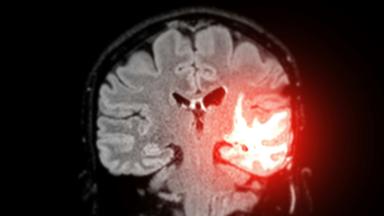
Brain Tumor Surgery - Brain Tumor Removal
Brain surgery is one trade repeated all day, how much tumor comes out against what the brain around it still does. This page puts the published numbers on both sides of that trade.
Cervical Microdiscectomy - Minimally Invasive Neck Disc Surgery
Neck disc surgery is done from the front, through the space between your windpipe and your carotid artery, and almost everything that goes wrong that is not the disc happens in that corridor. What has been measured in it.

Chiari Malformation Surgery
A Chiari malformation is measured in millimeters and treated according to symptoms, and those two things come apart more often than patients are told. Most people with the finding never need an operation. This page sets out who does, what posterior fossa decompression removes, why surgeons still argue over opening the dura, and what the pooled studies say about both sides of that argument.