
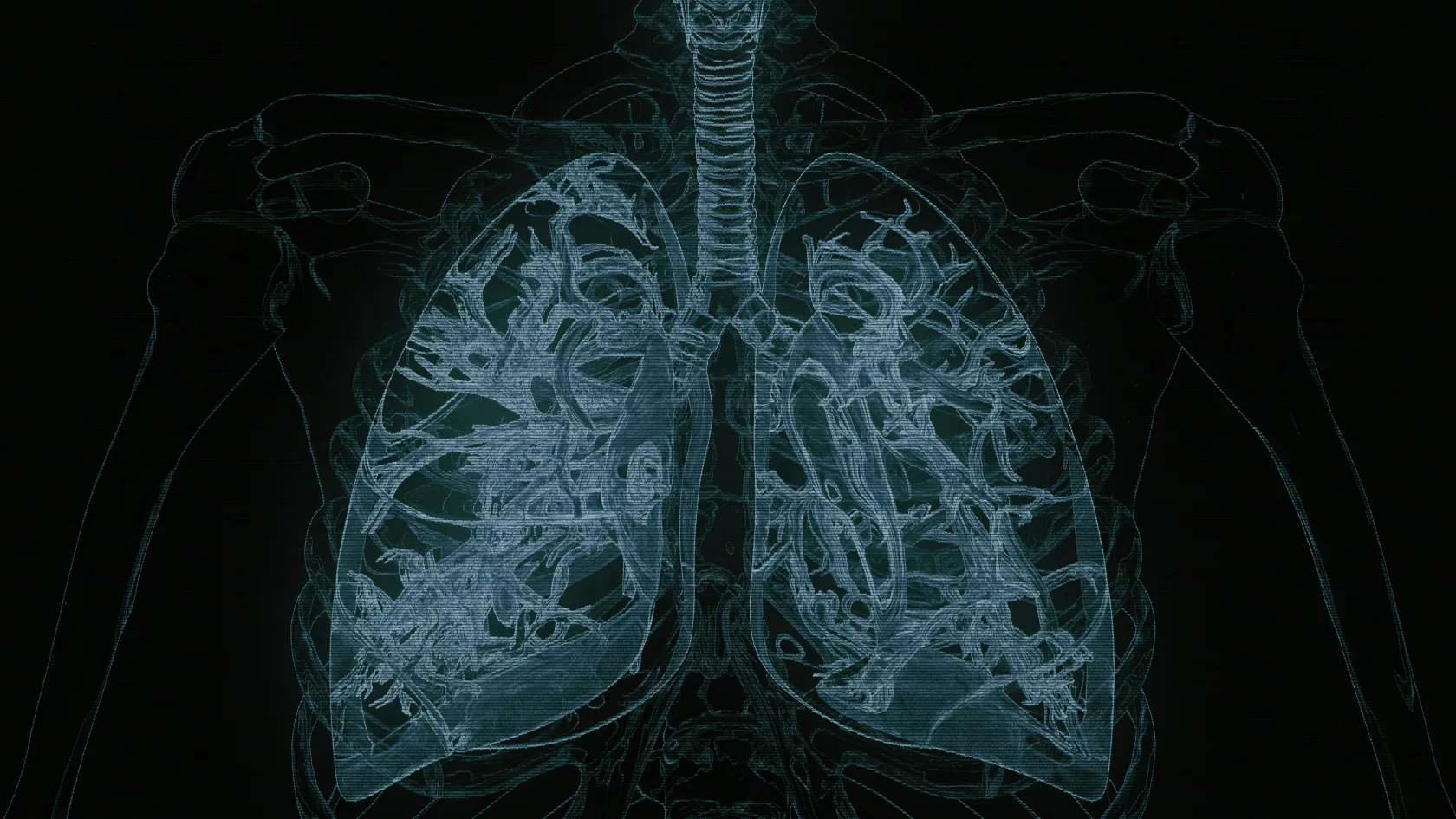
Lung Cancer Radiation Therapy
More dose sounds like more treatment. A trial that pushed stage III lung cancer from 60 to 74 grays found the opposite and lost eight months of median survival.
About This Department
Raising the tumor dose from 60 to 74 grays did not help. Survival fell by eight months.
RTOG 0617 randomized 544 patients with stage III lung cancer between 60 grays and 74 grays, with the same chemotherapy alongside both. Median survival came out at 28.7 months on the standard dose and 20.3 months on the higher one, the trial crossed its own futility boundary, and severe esophagitis tripled. The tumor was not the only structure receiving the extra dose.
The tumor dose is not the only number that decides the outcome
Radiation therapy for lung cancer gets explained to patients as a dose and a number of sessions. Sixty grays in thirty visits. Fifty-four grays in three. Those numbers are real and they matter, and taken alone they leave out the thing that separates a good plan from a bad one, which is where the rest of the dose lands on its way in and out.
A trial designed to prove that more dose meant better survival proved the reverse, and it did so clearly enough to be stopped for futility. That result is the single most useful thing a patient can know before reading anything else about this treatment.
RTOG 0617 randomized 544 people with unresectable stage III non-small cell lung cancer between 60 grays and 74 grays, both given in two-gray daily fractions with the same weekly carboplatin and paclitaxel. Median overall survival was 28.7 months in the standard-dose group and 20.3 months in the high-dose group, a hazard ratio of 1.38 with a confidence interval from 1.09 to 1.76. Severe esophagitis rose from 7 percent to 21 percent. Grade 3 or worse toxicity overall did not differ between the dose groups, which is part of what makes the survival gap so instructive, because the harm was not showing up in the places anyone was counting. A later analysis of the same trial found that the volume of heart receiving 40 grays was significantly associated with survival, and that patients treated with intensity-modulated technique had lower heart doses and less than half the rate of severe pneumonitis at 3.5 percent against 7.9 percent.
So the question at the start of treatment is never simply how much dose you are getting. Ask instead what your heart and esophagus receive for each gray delivered to the tumor, because the plan sets that ratio and the machine does not.
Four different treatments share the same name
One phrase covers four situations that have almost nothing in common beyond the equipment used to deliver them. Confusing them is the most common way a patient ends up comparing the wrong things.
Drag the table sideways on a narrow screen.
| Situation | What the radiation is doing | Typical shape of the course |
|---|---|---|
| Early stage, operation not possible or declined | Ablating a single small tumor with a very high dose per session | Three to eight sessions, delivered over one to two weeks |
| Stage III, disease in the chest and lymph nodes | Treating tumor and involved nodes together, with chemotherapy given at the same time | Around thirty daily sessions over six weeks, followed by immunotherapy in most cases |
| Small cell lung cancer, limited stage | Treating chest disease alongside chemotherapy on a compressed schedule | Thirty sessions given twice a day over about nineteen days, or once-daily over six weeks |
| Symptom relief at any stage | Shrinking a tumor enough to stop bleeding, pain, cough or airway obstruction | One to ten sessions, sometimes a single visit |
Why the distinction decides everything downstream
Being told you need radiation therapy conveys very little until you know which of these four is meant. The first replaces an operation. The second delivers curative treatment over six weeks and needs chemotherapy running through it. The third follows its own rules. The fourth makes no attempt to cure anything and should never be described as though it did.
Early stage disease, and where stereotactic treatment earned its place
A small peripheral tumor with no nodal involvement is still an operation first, whenever the patient can have one. When they cannot, or will not, the question becomes which kind of radiation.
That question had a real answer only in 2019.
The CHISEL trial enrolled 101 patients with biopsy-confirmed stage 1 peripheral disease who were medically inoperable or had refused surgery, and randomized them two to one between stereotactic ablative radiotherapy and standard fractionated radiotherapy. Stereotactic treatment meant 54 grays in three sessions, or 48 grays in four where the tumor sat close to the chest wall. Standard treatment meant 66 grays in 33 daily sessions, or 50 grays in 20. Local failure occurred in 14 percent of the stereotactic group and 31 percent of the standard group, a hazard ratio of 0.32 with a confidence interval from 0.13 to 0.77. Serious toxicity did not rise, with one grade 4 event and seven grade 3 events in the stereotactic arm against two grade 3 events in the standard arm, and the trial took five and a half years to enroll its hundred patients across fourteen hospitals in Australia and New Zealand, which says something about how hard the comparison was to run and why nobody had managed it sooner.
Three sessions beat thirty-three, in other words, on the outcome that matters most for a single small tumor.
That central-tumor exception carries real weight and never reads as a technicality. Walk away from any program offering stereotactic treatment for every tumor position.
Stage III, where the treatment has three parts
Disease that has reached the lymph nodes in the chest without spreading beyond it gets radiation and chemotherapy together, and since 2017 immunotherapy afterwards, so the treatment has three parts rather than one and each of the three rests on its own randomized evidence. Getting one part wrong costs you the others.
What consolidation immunotherapy added
The PACIFIC trial randomized 713 patients two to one between durvalumab and placebo after concurrent chemoradiotherapy. At five years, median overall survival was 47.5 months with durvalumab against 29.1 months with placebo, a hazard ratio of 0.72, with estimated five-year survival at 42.9 percent against 33.4 percent and five-year progression-free survival at 33.1 percent against 19.0 percent. A third of the treated group was alive and free of progression five years on. In this disease that is a large number.
That last figure changes how the six weeks of radiation should be understood. The radiation is not the whole treatment and it is not the last step, so a plan that damages the lung badly enough to make immunotherapy unsafe has cost the patient the part of the treatment with the largest effect. Radiation oncologists plan stage III cases differently now than they did before 2017, keeping lung dose lower than the old constraints demanded, precisely because of what has to follow. So the plan you are shown should have been built with the consolidation phase in mind, and that is a fair thing to ask about directly.
The three parts, in order
- Radiation to 60 grays in two-gray daily fractions, covering the primary tumor and the involved nodes. Higher is not better, as RTOG 0617 established at some cost.
- Chemotherapy given at the same time, never before or after. The two treatments potentiate each other and the sequence changes the result.
- Consolidation immunotherapy for patients whose disease has not progressed when the chemoradiotherapy finishes, which is where the largest survival gain in this setting has come from.
Small cell lung cancer follows different rules
Small cell disease behaves differently and is treated differently, and the radiation schedule is the clearest example.
For limited-stage disease, the long-standing standard has been 45 grays delivered twice a day over about nineteen days, alongside cisplatin and etoposide. That schedule is hard on patients and hard on departments, so the CONVERT trial set out to show that a more convenient once-daily course of 66 grays over six weeks was better. It enrolled 547 patients across 73 centers in eight countries. Median survival came out at 30 months on the twice-daily schedule and 25 months on the once-daily one, with a hazard ratio of 1.18 whose confidence interval crossed one. Two-year survival was 56 percent against 51 percent. Severe esophagitis and pneumonitis came out no different between the arms, and both ran lower than the trial had expected. Severe neutropenia was the one place the twice-daily schedule paid a price, at 49 percent against 38 percent, which is a manageable difference in a treated population and not one that changes the choice.
The trial was designed to show that once-daily treatment was superior and it did not. Because it was never powered to prove the two schedules equivalent, the conclusion was that twice-daily treatment stays the standard of care.
What the schedule means for a patient
Schedule matters practically here as well as clinically. Twice-daily treatment means two visits a day with a gap of at least six hours between them for nineteen days, which is a different logistical problem from one visit a day for six weeks. Anyone traveling for this treatment should know which schedule is being proposed before booking accommodation.
What planning is, and why it takes a week
The gap between the consultation and the first session looks like administrative delay. It is the opposite, because every decision that shapes the treatment, from how the target is drawn to which organ gets protected at the expense of which other one, gets made inside that week.
- Simulation. A planning CT scan in the exact position you will be treated in, with the immobilization device that will hold you there, so the plan and the delivery match.
- Motion assessment. A four-dimensional CT that records the tumor through the breathing cycle, because a lung tumor moves and a target drawn on a still image is a target drawn in the wrong place.
- Contouring. The radiation oncologist outlines the tumor, the nodes and every organ the beam will cross. This is the step where experience shows and where software cannot substitute.
- Optimization. The physicist and dosimetrist build a beam arrangement that meets the tumor dose while keeping heart, lung, esophagus and cord under their limits, which is an argument between competing constraints rather than a calculation with one answer.
- Verification. The plan is checked on the machine before a single fraction is delivered, and imaging at each session confirms the target is where the plan says it is.
The numbers to ask for
Get told your heart and lung dose numbers. Any department planning properly holds them, uses them, and can explain the trade-off it chose between the tumor dose it wanted and the organ doses it was willing to accept in order to deliver it.
The organs the beam has to cross
Three structures that set the limits
Scroll the table sideways if your screen is narrow.
| Structure | What it limits | When problems appear |
|---|---|---|
| Lung | How much healthy lung can receive a moderate dose. The volume receiving 20 grays was associated with severe pneumonitis risk in the RTOG 0617 analysis. | Weeks to a few months after treatment, as cough and breathlessness |
| Esophagus | How much dose the swallowing tube takes, which is the constraint patients feel most during treatment. High-dose radiotherapy tripled severe esophagitis in RTOG 0617. | During weeks three to six, and for some weeks afterwards |
| Heart | The volume receiving higher doses. Heart volume at 40 grays was significantly associated with overall survival in the same trial. | Months to years later, which is why it was missed for so long |
| Spinal cord and airways | Absolute limits that are not negotiable, and the reason some tumor positions cannot receive an ablative dose at all | Rare, late and serious, so the limits are treated as hard |
One finding about the heart reorganized the specialty. For decades the lung was treated as the organ to protect and the heart was a structure the beam happened to pass through, and the survival deficit in the high-dose arm of RTOG 0617 is now widely read as a cardiac signal that nobody was looking for. Planning practice changed in response. Intensity-modulated delivery became standard for locally advanced disease, and a plan reporting no heart dose figures should prompt a question.
What the six weeks are actually like
Daily treatment sounds worse than it is and the middle weeks are worse than the first.
Each session takes ten to twenty minutes, most of which is positioning and imaging. The delivery itself lasts a couple of minutes. Nothing is felt during it.
Weight loss during chemoradiotherapy is a clinical problem and not a cosmetic one, because a patient who has stopped eating tolerates the rest of the course badly and is less likely to be fit for the immunotherapy that follows. Nutritional support, pain relief that makes swallowing possible, and honest reporting of how bad it has become are the three things that keep a course on schedule. Treatment breaks sometimes become unavoidable and they cost something, since the overall time taken to complete a course affects how well it works, so the aim throughout is to manage the symptom instead of pausing the treatment. Say how bad the swallowing has become before you stop eating rather than afterwards, because the measures that help, from local anesthetic preparations to stronger analgesia to a feeding tube in the small number of cases that need one, all work better started early than started in the last week.
Radiation given to relieve a symptom
Much of the lung radiotherapy given anywhere in the world is not aimed at cure, and saying so plainly serves patients better than blurring it does.
When a tumor is bleeding, pressing on an airway, causing pain in a bone it has spread to, or pressing on the spinal cord, a short course of radiation can relieve that specific problem, often within days, and it can do so at a fraction of the burden a curative course would impose. One to ten sessions. Sometimes one.
What a short course can and cannot do
Spinal cord compression is worth naming separately. Weakness in the legs, numbness, or new difficulty passing urine in someone with known cancer needs imaging the same day, because the function you keep is largely the function you still have when treatment starts.
What to be skeptical of
Five claims that do not survive contact with the evidence
Each one sounds reassuring and none of them holds
One more, which applies to every stage. Anyone who will not say what the treatment is trying to achieve, in plain words, before it starts, has left the most important part of consent undone.
Questions worth asking before you agree to a plan
Seven things to have in writing. Each answer tells you something no brochure can.
The seven, and what each answer reveals
Drag the table sideways on a narrow screen.
| What to ask for | What the answer tells you |
|---|---|
| Which of the four situations applies to you, and whether the aim is cure or relief | Whether you and the department are working from the same understanding of the treatment. This is the answer most often assumed and least often spoken. |
| The total dose, the number of sessions, and the reason for that schedule given your tumor position | Whether the schedule was chosen for your anatomy or taken off a shelf. |
| Your lung, heart, esophagus and cord doses, and which constraint was hardest to meet | Whether a plan exists in any meaningful sense, and which trade-off the planner accepted. |
| Whether chemotherapy runs concurrently, and what happens to the plan if you cannot tolerate it | Whether there is a fallback, which matters because a proportion of patients cannot complete the concurrent drug. |
| Whether consolidation immunotherapy is intended, and whether the plan protects that possibility | Whether the largest survival gain in stage III disease has been designed into your course. |
| What is being done about swallowing pain and weight loss before they begin | Whether supportive care is planned or improvised. Improvised is what ends courses early. |
| Which symptoms after treatment should bring you back the same day, and to whom | Whether anyone has told you how to recognize pneumonitis, which is treatable early and dangerous late. |
Answers to all seven, without hesitation, tell you your case has been planned. Treating them as unusual questions tells you something too.
Arranging a course of radiotherapy away from home
Radiotherapy fits a planned stay well and a short trip badly, and the schedule makes the difference.
What the stay looks like
Three shapes of stay exist and they are very different from one another. Stereotactic treatment for early-stage disease means simulation, a planning gap of several days, and then three to eight sessions over one to two weeks, so a stay of around two to three weeks covers the whole thing. A full chemoradiotherapy course for stage III disease means six weeks of daily treatment plus the planning week and the recovery that follows, which is closer to two months away from home, and it comes with the possibility of a treatment break that extends the stay. Twice-daily treatment for small cell disease compresses the radiation into about nineteen days while requiring two visits a day. Anyone deciding where to have this treatment should get the intended schedule in writing before committing to anything, because these three shapes are not interchangeable and the accommodation, the visa duration and the companion arrangements all follow from which one applies to you.
Flying is a separate question from the treatment and gets its own assessment. Cabin pressure lowers the effective oxygen available, so anyone with reduced lung function, a recent pneumothorax, an air leak or significant breathlessness at rest needs clearance before booking a flight, and that clearance rests on pulmonary function testing and sometimes on an oxygen assessment. Radiation itself imposes no waiting period before flying, and lung function after chest radiotherapy can be worse than it was before, so a patient who flew here comfortably should not assume the return journey is identical.
Follow-up after returning home is planned at the same time as the treatment. Surveillance imaging, the pneumonitis watch through the first three months, and the consolidation immunotherapy phase all continue after the radiation stops, so the plan states which of those happen here and which happen where you live, who receives your dose report and your imaging, and how a new cough at week eight reaches someone who knows your case once you are back home. Settle that before the first session and never at discharge.
What moves the cost of a course
No prices appear on this page, and any figure quoted before the scans have been reviewed amounts to a guess. What drives the total holds no mystery.
The variables that move the figure
Seven items, and what each one adds
On a narrow screen this table scrolls sideways.
| Variable | Why it moves the figure |
|---|---|
| Number of fractions | Three sessions and thirty-three sessions are different products. The number follows the clinical situation and is not a lever to pull. |
| Technique | Intensity-modulated delivery with daily image guidance costs more than simpler conformal treatment and is standard for locally advanced disease for the reasons set out above. |
| Planning complexity | Four-dimensional CT, motion management and a plan with tight competing constraints take more physics time than a simple palliative field. |
| Concurrent chemotherapy | Drug costs, day-unit time and the monitoring around them are separate from the radiation itself. |
| Consolidation immunotherapy | A twelve-month phase that follows chemoradiotherapy in stage III disease, priced separately and often the largest single item. |
| Length of stay | Six weeks of daily treatment carries six weeks of accommodation and living costs, which for a traveling patient is frequently underestimated. |
| Supportive care | Nutrition support, pain management and the treatment of pneumonitis if it occurs. |
Request a quotation that separates radiation planning and delivery, chemotherapy, immunotherapy, imaging and living costs. A single combined figure cannot be compared with anything, and in this treatment it usually hides whether the immunotherapy phase is included at all.
Lung cancer radiation therapy FAQ
Is radiation therapy as good as surgery for early lung cancer?
Surgery remains the first option for anyone who can have an operation. Where that is not possible, stereotactic radiotherapy carries a real evidence base of its own, and it beat standard fractionated radiotherapy on local control in a randomized trial. Comparisons with surgery in operable patients have been attempted repeatedly and have struggled to recruit, so anyone claiming the question is settled is ahead of the evidence.
Will I lose my hair or be radioactive?
No to both. External beam radiotherapy leaves nothing behind in you, so there is no restriction on being around children or family at any point, and hair on your head is unaffected because it is not in the treatment field.
How many sessions will I need?
Anywhere from one to thirty-three, and the number is determined by what the treatment is for. Three to eight for a small peripheral tumor treated ablatively. Around thirty over six weeks for stage III disease with chemotherapy running alongside. Thirty given twice daily across nineteen days for limited-stage small cell disease, which is the one schedule that surprises people. Between one and ten for symptom relief.
Can I have a higher dose to be safe?
This was tested directly and the answer was no. Patients randomized to 74 grays lived a median of 20.3 months against 28.7 months at 60 grays, and severe esophagitis tripled. Dose escalation in lung cancer is not a way of trying harder.
What is pneumonitis and how worried should I be?
Inflammation of the lung in the treated area, appearing typically six to twelve weeks after treatment as cough, breathlessness and sometimes fever. Severe cases affected under 8 percent of patients in the large stage III trial and fewer than 4 percent with modern intensity-modulated planning. Steroids work on it when it is caught early and work less well once it has been left for weeks, so a new cough or new breathlessness inside three months of finishing treatment is a reason to telephone the department the same day instead of waiting for the next scheduled appointment. Do not wait for the scan.
Do I need chemotherapy at the same time?
Stage III disease, yes, unless you are unfit for it, because concurrent treatment outperforms giving the two sequentially. A small early tumor treated with stereotactic radiotherapy, no.
What happens after the last session?
Symptoms worsen for a week or two, then improve over roughly a month. Imaging follows at intervals, and for stage III disease the consolidation immunotherapy phase begins once you have recovered enough, which is where the largest survival gain in this setting comes from. Leaving after the radiation and skipping that phase discards the part of the treatment with the strongest evidence behind it.
References
- Bradley JD, Paulus R, Komaki R, Masters G, Blumenschein G, Schild S, et al. Standard-dose versus high-dose conformal radiotherapy with concurrent and consolidation carboplatin plus paclitaxel with or without cetuximab for patients with stage IIIA or IIIB non-small-cell lung cancer (RTOG 0617). A randomised, two-by-two factorial phase 3 study. Lancet Oncology. 2015;16(2):187-199.
- Ball D, Mai GT, Vinod S, Babington S, Ruben J, Kron T, et al. Stereotactic ablative radiotherapy versus standard radiotherapy in stage 1 non-small-cell lung cancer (TROG 09.02 CHISEL). A phase 3, open-label, randomised controlled trial. Lancet Oncology. 2019;20(4):494-503.
- Spigel DR, Faivre-Finn C, Gray JE, Vicente D, Planchard D, Paz-Ares L, et al. Five-year survival outcomes from the PACIFIC trial. Durvalumab after chemoradiotherapy in stage III non-small-cell lung cancer. Journal of Clinical Oncology. 2022;40(12):1301-1311.
- Faivre-Finn C, Snee M, Ashcroft L, Appel W, Barlesi F, Bhatnagar A, et al. Concurrent once-daily versus twice-daily chemoradiotherapy in patients with limited-stage small-cell lung cancer (CONVERT). An open-label, phase 3, randomised, superiority trial. Lancet Oncology. 2017;18(8):1116-1125.
- Chun SG, Hu C, Choy H, Komaki RU, Timmerman RD, Schild SE, et al. Impact of intensity-modulated radiation therapy technique for locally advanced non-small-cell lung cancer. A secondary analysis of the NRG Oncology RTOG 0617 randomized clinical trial. Journal of Clinical Oncology. 2017;35(1):56-62.
Editor's note
Written by the Biruni Hospital medical editorial team. Reviewed by Prof. Dr. Metin GÜDEN, Radiation Oncology.
Medically reviewed by

Prof. Dr. Metin GÜDEN
Radiation Oncology
Related Treatments
View All
Brachytherapy - Internal Radiation Therapy
A beam from outside has to cross healthy tissue to reach a tumor. Brachytherapy avoids that by placing a rice-sized radioactive source inside the tumor for a few minutes, then taking it out again. It is an essential part of curing cervical cancer and a tested option for womb, prostate and early breast cancer.
Brain Tumor Radiation Therapy
The plan for a brain tumor starts with what must be protected, the optic nerves, the brainstem, the hippocampus, and then shapes the dose around them. Radiosurgery in one to five sessions now treats most metastases, and six weeks of radiotherapy with temozolomide remains the standard after surgery for glioblastoma.

Breast Cancer Radiation Therapy
Ten times the local recurrence without radiotherapy. The same survival at ten years. Both figures come from one trial, and together they say what this treatment is actually for.

Cervical Cancer Radiation Therapy
More than a third of women given radiation for cervical cancer never receive the brachytherapy part. Four year survival was twelve points lower in that group.

Chemoradiation Therapy - Concurrent Chemoradiotherapy
Blood test on Monday, a drip on Tuesday, radiotherapy every weekday, and the same again for six or seven weeks. Chemoradiation asks more of a patient than either treatment alone and, for several cancers, cures more. See the survival gains trial by trial, the side effects they came with, who is fit for it and how a long stay is organized.