
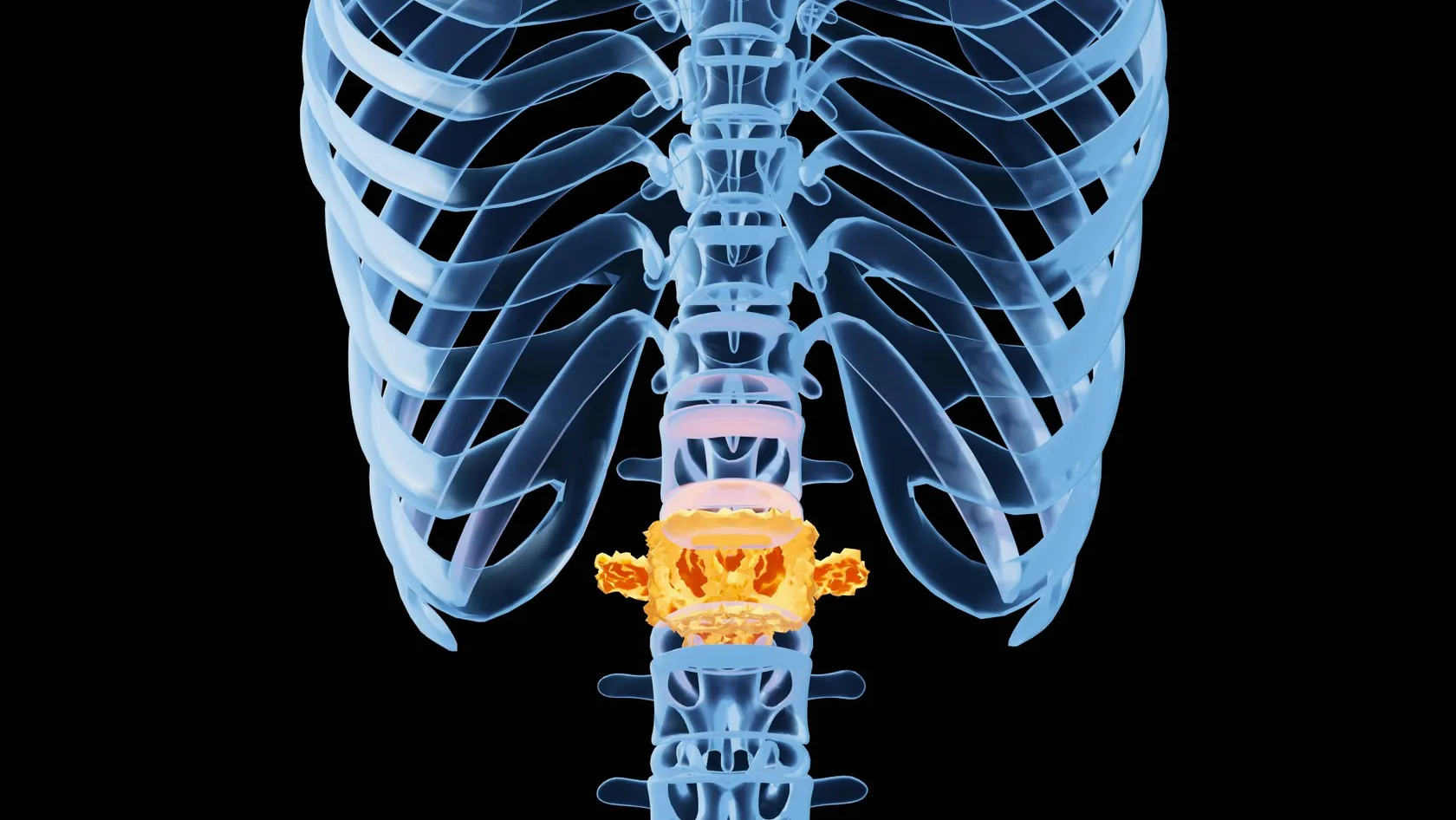
Lumbar Disc Surgery
Surgery for a herniated disc relieves leg pain much faster than waiting does, and by one to two years the operated and the non-operated end up in much the same place. What that means for your decision.
About This Department
A Dutch trial randomized 283 people with severe sciatica either to surgery within a fortnight or to six more months of waiting. At one year both groups had a 95 percent chance of saying they had recovered. The surgical group got there far sooner, and that is the whole finding, because the operation for a herniated lumbar disc buys you speed and not a different destination. Everything else on this page follows from that sentence, including the situations where waiting is genuinely unsafe. Speed is worth buying, and a page that pretends the operation offers more than that is setting you up to be disappointed in eighteen months when the leg pain has gone and the back still aches. The evidence on this condition is unusually good and unusually widely misdescribed, in both directions.
Free consultation
Send your scan and find out whether an operation would actually change anything
Send your magnetic resonance scan as image files and not only as a report, a note of how long the leg pain has been going on and where exactly it runs, whether you have any weakness in the foot or leg, whether bladder or bowel control has changed at all, what painkillers and injections have been tried, and any physiotherapy records. A spine surgeon reviews the file and tells you whether the scan matches your symptoms, whether the evidence supports operating in your particular case, and what would happen if you waited. No fee, no obligation, and a coordinator replies in your own language, usually within the same working day.
Five things first
Most of what follows is detail. These five points carry the argument, and if you read nothing else they are the ones that change decisions.
- Surgery works, and it mainly works faster. Randomized trials consistently show quicker relief of leg pain after surgery and convergence with conservative treatment somewhere between six months and two years. That is a real benefit and it is not the benefit most people think they are being offered.
- Trials everyone quotes are not what they seem. In the American trial, half the people assigned to surgery had not had surgery at three months and nearly a third of those assigned to no surgery had. Its own authors wrote that conclusions about superiority or equivalence are not warranted from that analysis. Anyone telling you the trials showed surgery makes no difference has not read them. Nor has anyone telling you the trials proved surgery superior, since those crossovers cut both ways and no trial here compared an operated group against a genuinely unoperated one for more than a few months.
- The scan finding is common in people with no pain at all. Pooling 33 studies of 3,110 people with no symptoms whatsoever, 29 percent of twenty-year-olds had a disc protrusion and 30 percent had a disc bulge. A herniation on your scan is evidence, and it is not by itself a diagnosis.
- There are situations where waiting is genuinely dangerous, and they are rare and specific. Loss of bladder control, numbness in the saddle area and progressive weakness are emergencies. Severe leg pain, however severe, is not one.
- One person in six has a second lumbar operation within ten years. That figure comes from a national database of 1,856 people followed for a decade, and it is considerably higher than most consent conversations imply.
What the trials found
Three randomized trials dominate this field, spread across forty years and three countries, and they agree with each other more closely than the arguments about them would suggest.
Wide table. Swipe or drag it sideways on a narrow screen, because it scrolls instead of shrinking.
| Trial | What it found | What has to be said with it |
|---|---|---|
| Norway, 1983, 280 patients | Surgery was significantly better at one year. By four years the advantage was no longer statistically significant, and little changed between four and ten. | Only 126 of the 280 were randomized, and only those whose surgical indication was uncertain. It answers a narrower question than it is usually credited with. |
| Netherlands, 2007, 283 patients | Leg pain resolved faster with early surgery, with a hazard ratio for perceived recovery of 1.97 and a confidence interval of 1.72 to 2.22. At one year both groups had a 95 percent probability of recovery. | The comparator was not no surgery. It was six months of waiting followed by surgery if still needed, and 39 percent of that group had an operation within the year. |
| The same trial at two years | No difference in disability. The early leg-pain advantage stopped being significant by six months and narrowed further after that. | By two years 44 percent of the conservative group had been operated on, and by five years 46 percent had. |
| United States, 2006, 501 patients | Differences between the assigned groups were described by the investigators as small and not statistically significant. No effect sizes were published in the abstract. | Half the surgical group had not had surgery by three months and 30 percent of the other group had. See the next section. |
| The American cohort who chose | Among 743 people who declined randomization and picked their own treatment, surgery was ahead by 14.8 points of bodily pain at three months and by 10.2 points at two years. | This group chose, so the comparison is not randomized and the authors say it must be interpreted cautiously. |
| An independent review of all of it | Found five trials in total, judged only two of them at low risk of bias, and declined to combine them at all. | Its stated reason was clinical heterogeneity and poor reporting of data. That is how thin this evidence base actually is. |
The crossover problem
If you have read that trials showed surgery to be no better than conservative treatment, you have read a claim these trials cannot support, and the reason is worth understanding because it recurs everywhere in surgical research. When patients are randomized to an operation but the pain becomes intolerable, they get the operation anyway. When they are randomized to wait but cannot bear it, they get operated too. Neither is a protocol violation so much as a fact of ordinary care, and both dilute the comparison until it measures something much narrower than it appears to.
American investigators produced the clearest case. At three months only half of those assigned to surgery had actually had it, and 30 percent of those assigned to conservative care had already been operated on. By eight years, 148 of 245 people assigned to surgery had been operated, which is 60 percent, and 122 of 256 assigned to no surgery had been operated, which is 48 percent. An analysis by assigned group is therefore comparing a group that was 60 percent operated against a group that was 48 percent operated, which is a twelve point difference in exposure to the thing being tested, and no analysis of that comparison can tell you whether surgery works. The investigators said so themselves, writing that because of the large numbers of patients who crossed over in both directions, conclusions about the superiority or equivalence of the treatments are not warranted based on the intention-to-treat analysis.
Dutch investigators handled this more cleanly by being honest about the comparator from the start. It did not compare surgery against no surgery. It compared surgery at two weeks against six months of continued conservative care with surgery afterward if still required, and 39 percent of that second group took the surgery within a year. Its authors describe the comparator in exactly those terms, and read that way the trial says something precise and useful, which is that two strategies for arriving at the same place produce the same one-year outcome and differ in how long you suffer along the way. Nobody in that trial was assigned to go without an operation forever, and nobody in this literature ever has been. That is a limit on what any of these trials can tell you, and it is a limit imposed by ethics rather than by carelessness, since a research committee will not approve withholding an available operation indefinitely from someone in severe pain.
This matters for you rather than for statisticians. The question these trials answer is not whether to have the operation. It is whether to have it now or later, and the honest answer they give is that later is a defensible choice with a known cost measured in weeks or months of pain.
What it is actually for
The operation treats the leg, not the back
Discectomy removes the fragment of disc pressing on a nerve root. What that relieves is the pain traveling down the leg, the numbness and the weakness that go with it. Back pain is a different problem with different causes, and it is not what this operation is designed to fix. Anyone whose main complaint is a sore lower back with little or no leg pain should be extremely cautious about being offered a discectomy, because the evidence that it helps is not there and the evidence that back pain persists afterward is. That distinction is the most useful single thing a patient can be told about this operation, and it is routinely left out of consultations because the scan shows a disc problem and a disc problem sounds like an explanation for a sore back.
How often back pain continues
A systematic review of 90 studies covering 21,180 patients, combined with a prospective series of its own, put recurrent low back pain at two years in the range of 15 to 25 percent, depending on how much pain counts as clinically important. In that same prospective series, 22 percent of patients at one year and 26 percent at two years were worse on back pain or disability than they had been at their own three month assessment. That is not a failure rate, since three months is usually the best anyone feels, and it is a realistic picture of how the years after a successful operation actually go. The distinction between failing to fix something and fixing the thing you set out to fix while a different problem continues underneath is the distinction this entire section rests on, and getting it clear beforehand prevents a good result from being experienced as a bad one.
What a good candidate looks like
Leg pain worse than back pain, following a recognizable nerve path, matching a herniation on the scan at the corresponding level and side, present for at least six weeks, and not settling. Every one of those conditions matters and the third is the one most often waved through. A scan showing a bulge at one level in someone whose pain follows a nerve from a different level is a scan that has found something irrelevant, and operating on it will not help. The six-week threshold is not arbitrary either, since it is the entry criterion the randomized trials used, and operating earlier than that puts you outside the population in which any of this evidence was collected.
Scans of people with no pain
Researchers pooled 33 studies covering 3,110 people who had no back pain, no sciatica and no symptoms of any kind, and scanned them anyway. The results explain a great deal about why spine care goes wrong.
Another wide one. Swipe or drag it sideways on a narrow screen, because it scrolls instead of shrinking.
| Finding on the scan | At age 20 | At age 80 |
|---|---|---|
| Disc degeneration | 37 percent | 96 percent. By eighty a degenerate disc is close to universal and therefore tells a doctor almost nothing. |
| Disc bulge | 30 percent | 84 percent. A bulge is a shape, not usually a herniation, and it is the finding most likely to alarm a patient unnecessarily. |
| Disc protrusion | 29 percent | 43 percent. This is the flattest curve in the table and the most instructive one. |
| Annular fissure | 19 percent | 29 percent. A tear in the outer ring of the disc, present in nearly one pain-free twenty-year-old in five. |
| What the reviewers concluded | Present in high proportions | That many of these features are likely part of normal aging and unassociated with pain, and must be read in the context of the patient's clinical condition. |
| The word to watch | Protrusion and bulge | The review reported protrusions and bulges, not herniations. The three words describe different things and reports use them loosely. |
When waiting is unsafe
Cauda equina, in numbers
That syndrome has a name and an incidence, and both are worth knowing precisely, because it is simultaneously the thing that justifies urgent scanning and a condition most people with sciatica will never develop.
Across a whole population of 5.4 million people in Scotland over one year, 149 cases were identified, giving an incidence of 2.7 per 100,000 people per year with a confidence interval of 2.3 to 3.2. That is roughly one person in thirty-seven thousand annually. Among women aged thirty to thirty-nine, the group at highest risk, it was 7.2 per 100,000. Of everyone given a hospital diagnostic code for the condition, 55 percent turned out on review of the notes not to have it.
On timing, a review of fifteen cohort studies covering 26,627 adults reported that the meaningful threshold appears to be around forty-eight hours from the onset of symptoms rather than the twenty-four or six hours that circulate as folklore, and that operating within twenty-four hours did not consistently outperform operating between twenty-four and forty-eight. Timing mattered most in people still passing urine voluntarily and showed no effect in those already in retention. By twelve months the timing differences faded and bladder function before the operation became the dominant predictor. Every study in that review was a cohort study rather than a randomized comparison, and the people operated fastest are the ones who arrived in the worst state, so confounding runs deep and irreducibly through all of it. No randomized trial of operating sooner against operating later in this condition exists, and given what would have to be randomized, none is ever going to.
What happens afterward is the uncomfortable half of this picture. Pooling 22 studies of 852 patients at a mean of 39 months after decompression, persistent bladder dysfunction affected 43.3 percent, sensory deficit 53.3 percent, sexual dysfunction 40.1 percent, motor weakness 38.4 percent and bowel dysfunction 31.1 percent. Every one of those pooled figures carries a confidence interval more than twenty points wide, so round them hard and read them as rough proportions. The honest summary is that surgery for cauda equina syndrome limits the damage more reliably than it reverses it, which is precisely why the symptoms above are worth reporting the same day.
Does waiting harm you
What the data actually show
An analysis of 1,192 patients from the American study split them by how long their symptoms had lasted before treatment, 927 with six months or less and 265 with more. Those with longer symptoms did worse, and they did worse whichever treatment they had. In the surgical group, four-year improvement in bodily pain was 48.3 points for the shorter-duration patients and 41.9 for the longer, and in the non-operative group it was 31.8 against 21.4. The difference in the benefit of surgery over conservative care did not change with duration at all. Read carefully, that says long-standing sciatica predicts a worse result from everything, and it does not say that delay ruins the operation. The distinction matters because the first version is a fact about who you are and the second is a threat about what you must do next, and one of those is used to push people toward decisions the evidence does not require them to make quickly.
The penalty was larger for waiting
Something in those numbers cuts against the folk claim. The gap between short and long duration was about 6.4 points of bodily pain among the operated patients and about 10.4 points among the non-operated. If anything, having had symptoms a long time hurt the people who did not have surgery more than it hurt the people who did, which is the opposite of the usual warning that delay closes a surgical window. That comparison is my arithmetic from the published means rather than a figure the authors stated, so treat it as a reading of their data instead of a finding of theirs.
What nobody has tested
The only randomized evidence about waiting concerns a short wait. The Dutch trial assigned 142 people to continued conservative care and those who crossed over did so at an average of about four months, which is the longest deliberate delay anyone has ever randomized someone to in this condition. No trial has randomized anyone to wait a year, and no trial has randomized anyone to wait indefinitely. So the honest position is that four months of waiting has been tested and is safe, that longer waits are associated with worse outcomes from all treatments, and that whether the waiting causes the worse outcome or simply identifies people who were always going to do badly is an open question. Both explanations fit the data equally well, and the second is at least as plausible as the first, because someone whose sciatica has already lasted a year has sciatica that did not behave like most sciatica.
If you do nothing
Questions to take with you
Take these to any consultation where an operation is being discussed. Each is phrased as something to ask for rather than something to wonder about.
- Ask which level and which side the herniation is on, and whether that matches your symptoms. Have the surgeon trace the path of your pain and then point at the scan. If those two things do not line up, nothing else in the conversation matters.
- Say out loud what proportion of your pain is leg and what proportion is back. Say the split out loud as a percentage. The operation is for the leg component, and a patient whose pain is mostly in the back is being offered the wrong treatment.
- Have them describe what would probably happen over the next three months without surgery. A surgeon who cannot describe the natural history of your condition in specific terms is not in a position to tell you what surgery adds to it.
- Request their own reoperation rate instead of the published one. Around one in six patients nationally has a second lumbar operation within ten years. A surgeon who audits their own results will have a figure and a surgeon who does not will say it is rare.
- Ask whether anything is planned beyond removing the fragment. Fusion, screws or a cage turn a small operation into a large one. For an uncomplicated first-time herniation the evidence does not support adding them, and the reason for adding them should be specific to you.
- Find out what happens if the leg pain comes back. The answer tells you whether you are being offered a plan or a procedure, and it is a fair question given that recurrence is the commonest reason for a second operation.
Does the technique matter
Considerable marketing effort goes into distinguishing microdiscectomy from tubular discectomy from endoscopic discectomy. The evidence comparing them is unusually clear and unusually boring.
Wide again. Drag the table sideways on a narrow screen, because it scrolls instead of shrinking.
| Comparison | Finding | Evidence behind it |
|---|---|---|
| Microscopic against open | Twelve minutes longer and a scar 24 millimeters shorter. No clinical difference demonstrated. | A review of 16 studies, only 4 at low risk of bias, whose authors called the differences clinically insignificant. |
| Tubular against conventional | Tubular was slightly worse on disability, leg pain and back pain at one year, and 69 percent against 79 percent reported good recovery. | A double-blind randomized trial of 328 patients. Every difference was too small for a patient to notice. |
| The same at five years | No significant difference on anything. Complete or near-complete recovery in 77 and 74 percent. | The same trial followed to five years, the longest follow-up published for this comparison. |
| Endoscopic against open | No difference in pain, disability, satisfaction, complications, recurrence or reoperation. More residual disc left behind with the endoscopic route. | Nine studies and 1,585 patients, but only two of the nine were randomized. |
| Removing the fragment only | No difference against clearing the disc space in reherniation, reoperation or complications. | A pooled analysis of 16 studies and 2,009 patients, of which only one was a randomized trial. |
| Minimally invasive against standard | Differences in leg pain under 0.5 points on a ten point scale, below any threshold for a change a patient would feel. | A Cochrane review of 11 studies and 1,172 participants, 7 of them at high risk of bias. |
The keyhole trial
One comparison deserves singling out because it is the rare case of a minimally invasive technique being tested properly against the standard one, with both patients and assessors blinded to which they had received.
Across 328 patients in seven Dutch hospitals, tubular discectomy produced slightly worse disability scores at one year, a leg pain difference of 4.2 millimeters on a hundred millimeter scale and a back pain difference of 3.5 millimeters, all favoring the conventional operation. Good recovery was reported by 69 percent after the tubular approach and 79 percent after the conventional one. The authors concluded that tubular discectomy resulted in less favorable results for self-reported leg pain, back pain and recovery.
Three of those results sat almost exactly on the boundary of statistical significance, which is worth saying because it means the trial did not decisively prove the keyhole approach inferior. What it decisively failed to do was show it better. Five years later the same patients were reassessed and no significant difference remained on any measure, with complete or near-complete recovery in 77 percent after conventional surgery and 74 percent after tubular. The practical conclusion is the one the technique reviews reach independently, which is that the approach matters far less than anyone selling you an approach will suggest, and that the differences which do exist are measured in millimeters and minutes.
Complications complicate that tidy picture in one direction and confirms it in another. Pooling six randomized trials, overall complications occurred in 5.5 percent of endoscopic operations against 10.4 percent of open ones, a risk ratio of 0.55 whose upper confidence bound was 0.98 and therefore barely significant. Pooling thirteen observational studies instead, overall complications did not differ, while three separate signals ran against the endoscopic route, with more transient nerve irritation, more residual disc left behind at a risk ratio of 5.29, and more revision surgery. Which half you read determines which conclusion you reach, and a page that quotes only the flattering half is not describing the evidence. The randomized half is the more trustworthy half, and the observational half contains far more patients, so the honest summary is that endoscopic surgery is a reasonable option with a plausible advantage on overall complications and a plausible disadvantage on completeness of decompression.
Complications
Second operations
Why they happen
Disc material herniating again at the same level is the commonest reason. Removing a fragment does not repair the tear it came through, and the remaining disc is under the same loads it was before. A systematic review of 90 studies and 21,180 patients concluded that same-level herniation requiring a further operation occurred in about 6 percent of patients, which is the single most defensible figure in that literature because the raw study-to-study range is so wide as to be meaningless.
Whether taking out more disc helps
Surgeons have argued for decades about whether to remove only the loose fragment or to clear out the disc space more thoroughly, on the theory that leaving less behind means less to herniate again. Pooling sixteen studies and 2,009 patients, the two approaches produced no difference in reherniation, no difference in reoperation and no difference in complications. That analysis had only one randomized trial in it and several of its other findings are reported in a way that makes their direction impossible to verify, so the three null results are the part worth carrying forward and the rest is not.
How often it happens in a randomized setting
In the Dutch technique trial followed for five years, reoperation occurred in 18 percent of the tubular group and 13 percent of the conventional group, a difference that did not approach statistical significance. Those are the only reoperation figures available from a double-blind randomized trial with five years of follow-up, and taken together they say that roughly one patient in seven had a further operation within five years of their first. That number is considerably higher than the impression most consent conversations leave behind, and it is not a sign that anything went wrong. Discs recur because the tear the fragment came through is still there and the disc is still carrying the same loads, and no operation currently available repairs either of those things, which is a limitation of the procedure and not a failure of the surgeon.
Reoperation over ten years
One national insurance database followed 1,856 people from their first lumbar disc operation for eight to ten years, using a method that correctly accounts for people who die before they can be reoperated. The curve it produced is the most useful single piece of information on this page.
This table is wide too. Swipe it sideways on a narrow screen, because it scrolls instead of shrinking.
| Time since the first operation | Chance of a second one by then | Reading it |
|---|---|---|
| One year | 4 percent | Close to the 6.8 percent reported independently in a 148-patient registry at one year. |
| Two years | 6 percent | The steepest part of the curve is over. Most recurrences that happen, happen early. |
| Three years | 8 percent | Roughly one patient in twelve by this point. |
| Five years | 11 percent | Consistent with the 13 and 18 percent seen in the randomized technique trial at the same timepoint. |
| Ten years | 16 percent | About one person in six. This is the number to carry into a consent conversation. |
| By first operation type | No difference | Open discectomy, laminectomy, endoscopic surgery and fusion did not differ. The technique does not buy you a lower chance of coming back. |
The day itself
What to send us
Whether an operation would help you is largely answerable from documents, and the whole question turns on whether one specific thing lines up with another specific thing.
- Your magnetic resonance scan as image files. Send the images and not only the report. The report tells you what one radiologist saw, and the images let a surgeon check the level, the side, the size of the fragment and whether it has migrated. If the scan is more than six months old, say so, because herniations change.
- Exactly where the pain goes. Draw it on a picture of a leg if that is easier. Down the back of the thigh to the sole of the foot is a different nerve from down the side of the calf to the top of the foot, and the difference decides which level is responsible.
- How long it has been going on, and whether it is changing. Six weeks is the usual threshold for considering surgery in the trials, and pain that has been slowly improving over the last fortnight is an argument for waiting a little longer.
- Any weakness, and whether it is getting worse. Say whether you can walk on your heels and on your toes. This is the single most useful thing a non-specialist can test and describe.
- Everything already tried. Painkillers with doses, physiotherapy, injections with dates and what happened after each. A patient who has had two injections that worked briefly is in a different position from one who has had none.
Recovery, week by week
Injections and fusion
Epidural steroid injections
The evidence here is genuinely contested and the field is unusually partisan about it. A review of 39 randomized trials, written explicitly as a rebuttal to an earlier assessment that had found injections ineffective, reported no pooled effect estimate of any kind for any outcome. Its most interesting finding cuts against its own authors, since across seven studies local anesthetic alone performed no worse than local anesthetic combined with steroid at three months and at twelve. On that review's own data the steroid component was not what was working. A reasonable position is that an injection may buy some weeks of relief, that it has not been shown to change whether you eventually need surgery, and that anyone presenting it as a settled treatment is overstating a live argument. It is also a low-risk thing to try while waiting, which is a perfectly good reason to have one even in the absence of strong evidence that it alters the course of anything.
Fusion for a simple herniation
No randomized trial comparing discectomy alone against discectomy plus fusion for a first-time uncomplicated herniation was located for this page, which is itself informative. In the national database of 1,856 patients, fusion as the first operation did not produce a lower reoperation rate than any other technique, and the authors reported no difference between the techniques at all. Fusion is a much larger operation with a much longer recovery, and for an ordinary disc herniation the evidence does not support it. If it is proposed to you, the reason should be a specific instability or deformity that is visible on your own imaging and can be pointed at. A general statement about stabilizing the segment or preventing future problems is not a reason, and it is the phrasing to be most careful about, because it is unfalsifiable and it doubles the size of the operation you are consenting to.
What actually helps in the meantime
Staying as active as the pain allows, adequate pain relief taken regularly rather than heroically, and time. The Dutch trial's conservative arm received nothing more exotic than that, and at one year it reached the same 95 percent probability of recovery as the surgical arm. Bed rest is not part of it and has not been for decades. If you are choosing to wait, the plan should include a specific point at which the decision gets revisited, because waiting without a review date is how people end up two years into something they never decided on. Set the date before you leave the consultation and write it down, since the alternative is a decision made by drift rather than by anybody.
Coming to Istanbul
Length of stay and the flight home
A single-level discectomy usually means one or two nights in hospital and a total stay in Istanbul of five to seven days, which allows a day beforehand for assessment and imaging review and several days afterward for a wound check before flying. Sitting for a long flight is uncomfortable in the first week, so book an aisle seat, get up regularly and expect the journey to be the least pleasant part of the whole episode. Anyone who has had a tear in the lining repaired during the operation may be asked to stay longer, and that decision is made on the day rather than in advance. Building two or three spare days into the trip costs less than changing a flight from a hospital bed, and it removes the pressure to leave before somebody has looked at the wound. Anyone whose journey home involves more than about four hours in a seat should say so during the consultation, because it occasionally changes the advice about when to fly and it is far easier to plan for beforehand than to negotiate on the day of discharge.
Follow up after you return home
You leave with the operative note describing exactly which level was operated on and what was removed, the postoperative imaging if any was done, a named contact here, and a written physiotherapy plan your own therapist can follow. Ask for all of it before you go, because assembling it from another country afterward is far harder. The symptoms that should prompt contact rather than waiting are the sudden return of the original leg pain, any change in bladder control, spreading redness or discharge at the wound, and fever.
A word about traveling for this particular operation
Lumbar discectomy is a good operation to travel for in one respect and an awkward one in another. The technical part is short, standardized and highly reproducible, so the quality gap between competent centers is small. What travel makes harder is the follow up, and since roughly one patient in six has a further operation within ten years, having a surgeon in your own country who knows what was done to your spine has real value. Send the documents home to your own doctor rather than filing them, and treat that as part of the operation instead of paperwork.
Lumbar disc surgery FAQ
Will I be worse off if I wait?
What does surgery actually give me?
Will it fix my back pain?
Does a herniated disc on my scan mean I need surgery?
Can the disc heal by itself?
When is it an emergency?
Is keyhole surgery better?
How likely am I to need another operation?
References
- Peul WC, van Houwelingen HC, van den Hout WB, Brand R, Eekhof JAH, Tans JTJ, Thomeer RTWM, Koes BW. Surgery versus prolonged conservative treatment for sciatica. The New England Journal of Medicine. 2007;356(22):2245-2256.
- Peul WC, van den Hout WB, Brand R, Thomeer RTWM, Koes BW. Prolonged conservative care versus early surgery in patients with sciatica caused by lumbar disc herniation, two year results of a randomised controlled trial. BMJ. 2008;336(7657):1355-1358.
- Lequin MB, Verbaan D, Jacobs WCH, Brand R, Bouma GJ, Vandertop WP, Peul WC. Surgery versus prolonged conservative treatment for sciatica, 5-year results of a randomised controlled trial. BMJ Open. 2013;3(5).
- Weinstein JN, Tosteson TD, Lurie JD, Tosteson ANA, Hanscom B, Skinner JS, Abdu WA, Hilibrand AS, Boden SD, Deyo RA. Surgical vs nonoperative treatment for lumbar disk herniation, the Spine Patient Outcomes Research Trial (SPORT), a randomized trial. JAMA. 2006;296(20):2441-2450.
- Weinstein JN, Lurie JD, Tosteson TD, Skinner JS, Hanscom B, Tosteson ANA, Herkowitz H, Fischgrund J, Cammisa FP, Albert T, Deyo RA. Surgical vs nonoperative treatment for lumbar disk herniation, the Spine Patient Outcomes Research Trial (SPORT) observational cohort. JAMA. 2006;296(20):2451-2459.
- Kerr D, Zhao W, Lurie JD. What are long-term predictors of outcomes for lumbar disc herniation, a randomized and observational study. Clinical Orthopaedics and Related Research. 2015;473(6):1920-1930.
- Weber H. Lumbar disc herniation, a controlled, prospective study with ten years of observation. Spine. 1983;8(2):131-140.
- Jacobs WCH, van Tulder M, Arts M, Rubinstein SM, van Middelkoop M, Ostelo R, Verhagen A, Koes B, Peul WC. Surgery versus conservative management of sciatica due to a lumbar herniated disc, a systematic review. European Spine Journal. 2011;20(4):513-522.
- Zhong M, Liu JT, Jiang H, Mo W, Yu PF, Li XC, Xue RR. Incidence of spontaneous resorption of lumbar disc herniation, a meta-analysis. Pain Physician. 2017;20(1):E45-E52.
- Rasouli MR, Rahimi-Movaghar V, Shokraneh F, Moradi-Lakeh M, Chou R. Minimally invasive discectomy versus microdiscectomy or open discectomy for symptomatic lumbar disc herniation. Cochrane Database of Systematic Reviews. 2014;2014(9):CD010328.
- Parker SL, Mendenhall SK, Godil SS, Sivasubramanian P, Cahill K, Ziewacz J, McGirt MJ. Incidence of low back pain after lumbar discectomy for herniated disc and its effect on patient-reported outcomes. Clinical Orthopaedics and Related Research. 2015;473(6):1988-1999.
- Woodfield J, Lammy S, Jamjoom AAB, Fadelalla MAG, Copley PC, Arora M, Glasmacher SA, Abdelsadg M, Scicluna G, Poon MTC, Pronin S, Leung AHC, Darwish S, Demetriades AK, Brown J, Eames N, Statham PFX, Hoeritzauer I. Demographics of cauda equina syndrome, a population-based incidence study. Neuroepidemiology. 2022;56(6):460-468.
- Najjar E, Egu C, Akil H, Najjar S, AlAchkar M, Muscogliati R, Daquino D, Komaitis S, Grevitt M. Reassessing the clock in cauda equina syndrome, a systematic review and meta-analysis of surgical timing and outcomes. The Spine Journal. 2026;26(9):1653-1670.
- Kumar V, Baburaj V, Rajnish RK, Dhatt SS. Outcomes of cauda equina syndrome due to lumbar disc herniation after surgical management and the factors affecting it, a systematic review and meta-analysis of 22 studies with 852 cases. European Spine Journal. 2022;31(2):353-363.
- Rihn JA, Hilibrand AS, Radcliff K, Kurd M, Lurie J, Blood E, Albert TJ, Weinstein JN. Duration of symptoms resulting from lumbar disc herniation, effect on treatment outcomes, analysis of the Spine Patient Outcomes Research Trial (SPORT). The Journal of Bone and Joint Surgery, American Volume. 2011;93(20):1906-1914.
- Arts MP, Brand R, van den Akker ME, Koes BW, Bartels RHMA, Peul WC. Tubular diskectomy vs conventional microdiskectomy for sciatica, a randomized controlled trial. JAMA. 2009;302(2):149-158.
- Overdevest GM, Peul WC, Brand R, Koes BW, Bartels RHMA, Tan WF, Arts MP. Tubular discectomy versus conventional microdiscectomy for the treatment of lumbar disc herniation, long-term results of a randomised controlled trial. Journal of Neurology, Neurosurgery and Psychiatry. 2017;88(12):1008-1016.
- Jacobs WCH, Arts MP, van Tulder MW, Rubinstein SM, van Middelkoop M, Ostelo RW, Verhagen AP, Koes BW, Peul WC. Surgical techniques for sciatica due to herniated disc, a systematic review. European Spine Journal. 2012;21(11):2232-2251.
- Qin R, Liu B, Hao J, Zhou P, Yao Y, Zhang F, Chen X. Percutaneous endoscopic lumbar discectomy versus posterior open lumbar microdiscectomy for the treatment of symptomatic lumbar disc herniation, a systemic review and meta-analysis. World Neurosurgery. 2018;120:352-362.
- Ambrosio L, Vadala G, Russo F, Papalia R, Denaro V. Discectomy versus sequestrectomy in the treatment of lumbar disc herniation, a systematic review and meta-analysis. The Spine Journal. 2025;25(2):211-226.
- Yang CC, Chen CM, Lin MHC, Lee MH, Hsieh PH, Cheng WY. Complications of full-endoscopic lumbar discectomy versus open lumbar microdiscectomy, a systematic review and meta-analysis. World Neurosurgery. 2022;168:333-348.
- Desai A, Ball PA, Bekelis K, Lurie JD, Mirza SK, Tosteson TD, Weinstein JN. Outcomes after incidental durotomy during first-time lumbar discectomy. Journal of Neurosurgery: Spine. 2011;14(5):647-653.
- Kim CH, Chung CK, Choi Y, Kim MJ, Kim MJ, Yang SH, Hwang SH, Lee CH, Park SB, Kim DH. The long-term reoperation rate following surgery for lumbar herniated intervertebral disc disease, a nationwide sample cohort study with a 10-year follow-up. Spine. 2019;44(19):1382-1389.
- Mummaneni PV, Whitmore RG, Curran JN, Ziewacz JE, Wadhwa R, Shaffrey CI, Asher AL, Heary RF, Cheng JS, Hurlbert RJ, Douglas AF, Smith JS. Cost-effectiveness of lumbar discectomy and single-level fusion for spondylolisthesis, experience with the NeuroPoint-SD registry. Neurosurgical Focus. 2014;36(6):E3.
- Manchikanti L, Knezevic NN, Boswell MV, Kaye AD, Hirsch JA. Epidural injections for lumbar radiculopathy and spinal stenosis, a comparative systematic review and meta-analysis. Pain Physician. 2016;19(3):E365-E410.
- Brinjikji W, Luetmer PH, Comstock B, Bresnahan BW, Chen LE, Deyo RA, Halabi S, Turner JA, Avins AL, James K, Wald JT, Kallmes DF, Jarvik JG. Systematic literature review of imaging features of spinal degeneration in asymptomatic populations. American Journal of Neuroradiology. 2015;36(4):811-816.
Editor's note
Written by the Biruni Hospital medical editorial team. Reviewed by Assoc. Prof. Dr. Melih ÜÇER, Neurosurgery.
Medically reviewed by

Assoc. Prof. Dr. Melih ÜÇER
Neurosurgery
Related Treatments
View All
ALIF - Anterior Lumbar Interbody Fusion Surgery
Coming in from the front restores the curve of the lower back better than any posterior route and leaves the back muscles untouched. It also carries one risk most pages will not name, and this page names it.

Brain AVM Surgery - Arteriovenous Malformation Surgery
An unruptured brain AVM bleeds at roughly 2.2 percent a year, and surgery spends its whole risk on a single morning. This page sets those two shapes of risk side by side, explains what the ARUBA trial does and does not say about your case, and shows how a Spetzler-Martin grade changes the answer.
Brain Tumor Surgery - Brain Tumor Removal
Brain surgery is one trade repeated all day, how much tumor comes out against what the brain around it still does. This page puts the published numbers on both sides of that trade.
Cervical Microdiscectomy - Minimally Invasive Neck Disc Surgery
Neck disc surgery is done from the front, through the space between your windpipe and your carotid artery, and almost everything that goes wrong that is not the disc happens in that corridor. What has been measured in it.

Chiari Malformation Surgery
A Chiari malformation is measured in millimeters and treated according to symptoms, and those two things come apart more often than patients are told. Most people with the finding never need an operation. This page sets out who does, what posterior fossa decompression removes, why surgeons still argue over opening the dura, and what the pooled studies say about both sides of that argument.