Most herniated discs heal without an operation, so knowing which symptoms genuinely call for surgery matters more than knowing the name of the procedure.
About This Department
A herniated disc in the lower back presses on a nerve root and sends pain radiating down the leg as well as through the back. Most people improve with rest, medication and physiotherapy within a couple of months. This article covers what happens when that does not happen, what lumbar disc surgery actually involves, and what an international patient needs to plan for before, during and after the operation.
1 to 3 nights
Typical hospital stay after a microdiscectomy
2 to 4 weeks
Before most people are back at a desk
3 to 10 in 100
Chance the same disc herniates again
Loss of bladder or bowel control
The one symptom that means a hospital tonight
Free consultation
Send your MRI before you decide anything
This review costs nothing and does not commit you to anything. Send the MRI or CT report describing your lumbar disc herniation and a note on how long the leg pain has lasted, and a spine specialist will tell you plainly whether surgery is likely to help, which technique fits your case, and what would need to happen before you travelled.
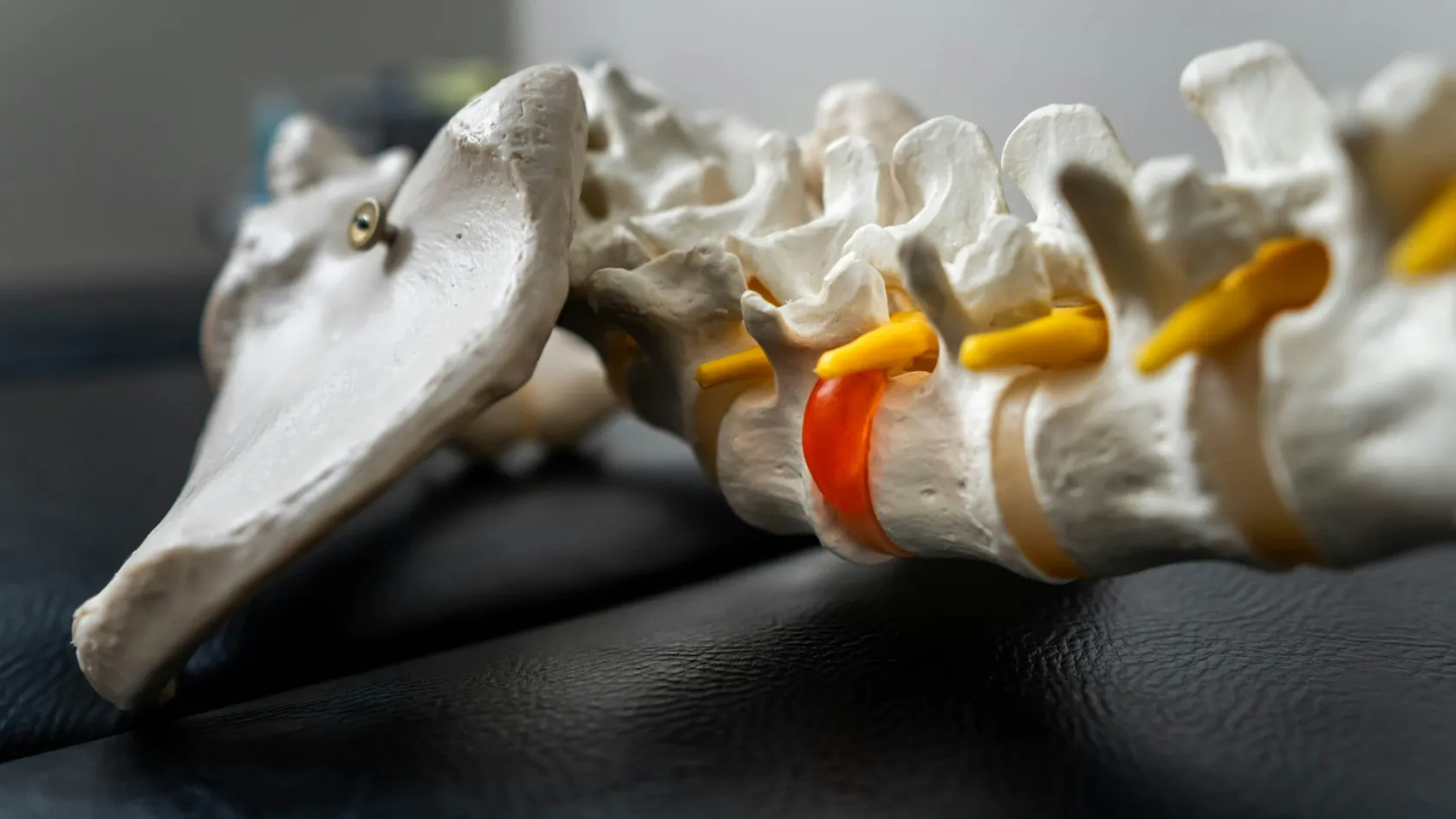
The lumbar spine carries five vertebrae, numbered L1 to L5, and each one sits on a disc that works as a shock absorber. A disc herniates when its soft inner core pushes through a crack in the tougher ring around it. In the lower back, that displaced material most often lands against one of the nerve roots travelling down into the leg, and the result is sciatica, a pattern of pain rather than a disease in itself, running from the buttock down the back or side of the leg and sometimes into the foot. Lower back disc surgery, in turn, is not one operation. It usually means a discectomy, the removal of the fragment pressing on the nerve, carried out through an open incision, through a smaller incision under a surgical microscope (microdiscectomy), or through a tube the width of a pencil guided by an endoscope. Laminectomy, spinal fusion and artificial disc replacement solve different problems and get folded into the same search term more often than they should. A patient reading about back surgery for the first time has no way to know which one, if any, applies to their own scan.
Roughly one in every hundred adults develops a symptomatic lumbar disc herniation in a given year, according to PubMed research comparing surgical techniques for the condition (Apostolakis et al, 2026). Most never reach a surgeon.
Are you a candidate for surgery?
Most disc herniations settle without an operation. Leg pain from a lumbar disc herniation generally eases within eight to twelve weeks of rest, anti-inflammatory medication and physiotherapy, and a large share of patients never need surgery at all.
Surgery moves from an option to a genuine recommendation in a narrower set of situations. Severe, disabling leg pain that persists after six to eight weeks of proper conservative treatment is the most common reason. Progressive weakness in the foot or leg, a numb patch that keeps spreading rather than settling, and pain that dominates over the back ache itself all make the decision more urgent.
Occasionally a patient arrives with loss of bladder or bowel control, numbness across the saddle area, or sudden major leg weakness. For them the decision is not really elective. That combination is called cauda equina syndrome. It needs surgery within a day, before the compressed nerves suffer permanent damage, and it is covered again near the end of this article because nobody reading about elective back surgery should mistake it for something that can wait.
Candidacy also depends on imaging that matches the symptoms described above.
A scan showing a bulging or mildly degenerated disc with no matching nerve pain is not an operative finding, whatever the radiology report says about it. The clinical picture and the MRI have to agree before an operation makes sense, which is exactly what a remote review of your reports before travel is for.
What the operation involves
Microdiscectomy surgery is built around removing as little tissue as possible while still reaching the nerve. General anaesthesia is standard. The surgeon works through an incision one and a half to two inches long, using a microscope or magnifying loupes to see the nerve root and the offending fragment clearly enough to take it out without disturbing the healthy tissue around it. The operation itself takes under an hour in the operating room.
1
Confirming the level
An imaging system confirms the exact disc level before anything is cut. Operating one level too high or too low is a rare but real error, and this step exists to rule it out before the incision is made.
2
Reaching the nerve
Muscle stays attached to the bone as the surgeon works past it, opening a small window in the ligament behind the disc and gently retracting the nerve root to expose the herniated fragment underneath.
3
Removing the fragment and closing
Disc material causing the compression comes out, the nerve root is checked for free movement, and the incision closes in layers under the skin.
Full endoscopic discectomy takes the same goal further. A working channel about the width of a pencil replaces the open incision, and the surgeon operates through a camera and instruments passed down that channel under continuous saline irrigation. According to PubMed, a 2026 meta-analysis of seventeen randomised trials covering 2238 patients found comparable pain and disability outcomes between full endoscopic and microscopic discectomy, with less blood loss, a faster return to work, and lower rates of wound infection, poor wound healing and haematoma for the endoscopic group, offset by greater radiation exposure from the fluoroscopy the technique depends on (Patel et al, 2026).
Neither approach is universally better. The right one depends on where the fragment sits, how it moved after herniating, whether it is free or still attached to the disc space, and how much scar tissue a previous operation at the same level has already left behind. That judgement is exactly what a surgeon reviewing your actual imaging is for, and it is not something a general description of two techniques can settle for you in the abstract.
Comparing the surgical options
Five names turn up under almost every search for lower back disc surgery, and they are not interchangeable.
This table scrolls sideways on a narrow screen. Swipe or drag to see every column.
What each option involves and where it fits
Procedure
What it involves
Where it fits
Microdiscectomy
Removal of the herniated fragment through a small incision under microscope magnification
The most established option, with the longest track record of the group
Full endoscopic discectomy
Same goal reached through a pencil-width tube and a camera under saline irrigation
Less soft tissue disruption, a shorter incision, more dependence on fluoroscopy
Laminectomy
Removal of part of the bony arch over the spinal canal to free room for the nerves
Used mainly when the canal itself has narrowed, a different problem from a single disc fragment
Spinal fusion
Discectomy followed by fixing two vertebrae together with screws and a cage
Reserved for cases where the spine itself has become unstable
Artificial disc replacement
The damaged disc is removed and replaced with a mobile implant
An alternative to fusion, considered only at carefully selected levels
Fusion and disc replacement both solve a stability problem rather than a nerve compression problem, which is why a straightforward herniated disc almost never needs either one. A surgeon who recommends fusion for a first herniation with no instability on the scan is answering a question the patient did not ask. Ask why before agreeing to it.
The honest risks
No operation on the spine is without risk. A patient deciding whether to travel for one deserves real numbers, stated plainly.
Five of them cover most of what actually happens.
Recurrent disc herniation
Between three and ten in every hundred patients develop a new herniation at the same level, sometimes months or years later. A 2025 meta-analysis of minimally invasive techniques put the figure at 3.7 in 100 after microendoscopic discectomy against 6.1 in 100 after a percutaneous transforaminal endoscopic approach, according to PubMed (Liu et al, 2025). Roughly one in ten of those recurrences ends up needing a second operation.
Dural tear
A small tear in the membrane covering the spinal nerves happens in a minority of cases, and it is repaired during the same operation, without lasting consequence.
Infection and wound problems
Pooled data from randomised trials, according to PubMed, put overall complication rates, wound infection included, at around 5.5 in 100 for full endoscopic discectomy against 10.4 in 100 for open microdiscectomy (Yang et al, 2022). The smaller incision used in endoscopic and microscopic techniques is the main reason the wound-related numbers favour them over an open approach.
Nerve root injury
Genuine nerve damage caused by the surgery itself is rare. When it happens, it can leave numbness, weakness or pain that is worse than the symptoms the patient had before the operation, which is why the retraction step relies on magnified vision throughout.
Persistent pain despite a technically successful operation
A nerve root that has been compressed for months does not always recover fully once the pressure is removed. Some patients are left with residual numbness or ache even though the surgery achieved exactly what it set out to do. It is worth knowing this before the operation.
General anaesthesia carries its own separate risks, unrelated to the spine itself, and an anaesthetist reviews your medical history before surgery as standard practice for this operation.
Recovery week by week
Leg pain often improves within hours of waking up from a microdiscectomy, because the pressure on the nerve is gone the moment the fragment is removed. Numbness and weakness are slower. The nerve root itself needs time to heal, and that can take weeks or, in a minority of cases, months, independent of how well the operation went.
Pain and healing do not move at the same speed.
Walking starts on the day of surgery or the morning after, and is actively encouraged. Sitting for long periods is the main early restriction, because a flexed spine loads the healing disc space more than standing or lying down does. Most patients manage light daily activity within the first one to two weeks and are back at a desk job within two to four weeks. Physical work involving lifting, twisting or prolonged standing generally waits six to eight weeks. A formal physiotherapy programme over that period does more for the long-term result than rest alone.
Full functional recovery, meaning the point at which the operated disc space has settled and the surrounding muscles have regained their normal strength, spans three to six months. That timeline holds whether the underlying procedure was open, microscopic or endoscopic. What differs between the techniques is mainly the first two to three weeks, where a smaller incision means less wound pain and a faster return to sitting comfortably.
How long you need to stay, and when you can fly
General medical explanations of discectomy never answer this question, because it depends on travelling at all, and a reader on a hospital's own back-pain page is rarely doing that.
Packages built for international patients having lumbar disc surgery in Turkey plan for ten to fourteen days in the country from arrival to departure. Inside that window, one to two days go to blood tests, imaging review and the neurosurgical consultation before surgery. The hospital stay itself runs one to three nights for an open or microscopic discectomy, and some endoscopic cases go home after a single night of monitoring. The remainder of the stay, often seven to ten days, covers wound checks and early mobilisation in a hotel near the hospital, since a ward has little extra to offer at that stage that a supervised hotel stay cannot. Flight clearance is a separate decision from discharge, and it is more conservative. Sitting for a long-haul flight loads the lumbar spine more than most people expect. Immobility during any flight also raises the risk of a blood clot in the leg, a risk surgery has already increased slightly on its own. Most spine surgeons ask for at least two to three weeks before a short flight and longer for one exceeding four hours. The final decision rests on how the wound looks and how the patient is moving at the pre-flight check. Airlines themselves sometimes ask for a doctor's letter confirming fitness to fly within six weeks of any spinal operation, so it is worth requesting that letter from the surgical team before leaving the hospital.
What actually drives the cost
Two patients having what sounds like the same operation can receive very different quotes. This is rarely the hospital padding the bill. Lumbar disc surgery is not one fixed procedure with one fixed price.
Technique choice changes the equipment involved. An endoscopic case needs the disposable working channel and camera system. An open case with instability needs screws, rods and a cage that a straightforward microdiscectomy never touches. How many levels are affected matters as much as which technique is used, since a two-level herniation takes longer and needs more implants than a single level. Whether the case is a first operation or a revision on a level operated on before changes both the operating time and the complexity of working around existing scar tissue. Patient factors move the number just as much. Age, weight, diabetes, osteoporosis, blood thinning medication and previous spine surgery at the same or a neighbouring level all affect how straightforward the case is and how much aftercare it is likely to need, and a patient on blood thinners needs those managed carefully before and after surgery, which adds coordination time even when the operation itself is routine.
No two quotes should look identical.
Packages aimed at international spine patients include the surgeon and anaesthetist fees, the hospital stay, pre-operative MRI and blood work, airport transfers, and a set number of nights in a partner hotel for the post-discharge monitoring period. Flights, travel insurance, any extension of the hospital stay beyond what was planned, and the cost of treating an unplanned complication sit outside that list by default. Reading a quote against that list is what tells you whether it is genuinely comparable to another one. The total figure alone tells you very little.
Trustworthy quotes come from a surgeon who has actually read your MRI. A price list matched only to a diagnosis code is not enough. Before accepting one, ask which technique it assumes, whether the implant or device is named specifically, how many physiotherapy sessions are included, what happens financially if you need an extra night on the ward, and whether the pre-operative scans are already covered inside the figure or billed separately. Sending your reports for a free review, through the contact details on this page, is how that figure gets built specifically around your case.
What the trip looks like in practice
Clinical care around a discectomy is well understood everywhere. The travel side is where patients from abroad have real, unanswered questions, and where most hospital pages go quiet.
Reviewing your MRI and clinical history remotely normally comes first, so you know before booking anything whether surgery is a reasonable recommendation for your case. Once a plan is agreed, an invitation letter supporting a medical visa is prepared for the countries that require one. Airport transfer to the hospital or partner hotel is arranged directly, so arrival does not depend on navigating an unfamiliar city on the day you land.
Travelling with a companion is normal for this kind of surgery, since walking unaided in the first days after the operation is limited and having someone present for the pre-operative consultation helps information land properly. What that companion's stay actually includes, in terms of accommodation and meals, varies by hospital and by package tier. Confirm it directly before booking anything.
After you fly home
Surgery does not end the relationship with the surgical team, and a hospital that treats it that way is one to be cautious of. Wound healing and early rehabilitation continue for weeks after the flight home, well past the point where daily contact with the hospital is practical.
Your discharge summary, written in a language your home doctor can act on, should travel with you along with the operative report and any imaging taken during the stay. Follow-up itself follows a structured pattern built around a remote check-in, by video call or messaging, at set points over the following weeks, with wound photographs reviewed remotely rather than requiring a return flight for a two-minute look at a healing incision.
Your local doctor at home should still be the first call for anything urgent, because an in-person examination is something no remote consultation can replace. What the surgical team abroad can offer is continuity, meaning someone who already knows exactly what was done and why, available to advise your local doctor directly if a complication needs interpreting against the details of the original operation. Establish that line of contact before you leave the hospital, before a problem starts at home and a phone number has to be searched for under pressure.
When to act immediately
Everything above describes a decision made over weeks, with time to get a second opinion, compare a quote against the questions in this article, and plan a trip properly. One combination of symptoms removes that time entirely.
Loss of control over the bladder or bowel, numbness spreading across the inner thighs and groin in a saddle-shaped pattern, and rapidly worsening weakness in both legs together point to cauda equina syndrome, a compression of the nerve bundle at the base of the spinal cord severe enough to cause permanent damage if it is not decompressed within twenty four to forty eight hours.
That means an emergency room visit tonight, in whichever country you happen to be in. Everything else in this article, including every question about technique, cost and travel timing, can wait for a proper conversation. This cannot.
Frequently asked questions
How long do I need to stay in the country before I can fly home?
Most international patients plan for ten to fourteen days total, covering pre-operative assessment, the operation, one to three nights in hospital, and a period of monitored recovery before a fitness-to-fly check. The flight itself is usually cleared separately, at least two to three weeks after surgery for a short trip and longer for a flight over four hours, based on how the wound and mobility look at that point rather than a fixed date set in advance.
Can a family member travel with me and stay during my recovery?
Yes, and it is common for this kind of surgery, since the first days afterwards involve limited independent walking. Confirm directly what the companion's own accommodation and meals involve, since this varies between packages.
Do I need microdiscectomy, endoscopic surgery, or something bigger like fusion?
For a single herniated disc with no instability on imaging, microdiscectomy or endoscopic discectomy are the usual choices, and the decision between the two comes down to where the fragment sits and how much scar tissue, if any, is already present. Fusion answers a different question, spinal instability, and a first-time herniation with a stable spine rarely needs it.
What happens if the disc herniates again after surgery?
Recurrence affects roughly three to ten patients in every hundred, sometimes within months and sometimes years later. Most recurrences are managed with the same conservative measures used the first time, rest, medication and physiotherapy, and only around one in ten eventually needs a second operation.
Is endoscopic surgery better than microdiscectomy?
Neither is categorically better. Endoscopic discectomy tends to mean less blood loss, a smaller wound and a faster return to work, while microdiscectomy has the longer track record and does not depend on the fluoroscopy exposure endoscopic techniques require. Pain relief and disability outcomes are broadly comparable between the two once healing is complete.
What should I do if something goes wrong after I am back home?
See a local doctor in person first, since an in-person examination cannot be replaced by a remote consultation. Keep the operative report and discharge summary from the surgery so your local doctor has the full picture, and use the follow-up contact arranged before you left so the original surgical team can advise directly if the complication needs interpreting against what was actually done.
References
Patel S, Nischal SA, Kale KM, et al. Full Endoscopic versus Microscopic Lumbar Discectomy for Lumbar Disc Herniation. A Meta-analysis of Randomized-controlled Trials. Spine (Phila Pa 1976). 2026. Published online ahead of print.
Yong JH, Wang E, Chin BZ, Hey HWD. Full-endoscopic versus microscopic lumbar discectomy for lumbar disc herniation. A systematic review and meta-analysis of 4186 cases. Spine J. 2026;26(5):981-995.
Yang CC, Chen CM, Lin MH, et al. Complications of Full-Endoscopic Lumbar Discectomy versus Open Lumbar Microdiscectomy. A Systematic Review and Meta-Analysis. World Neurosurg. 2022;168:333-348.
Liu S, Zhang X, Xiong Y, He H. Minimally invasive surgery for lumbar disc herniation. A meta-analysis of efficacy and safety. Int J Surg. 2025;111(8):5623-5636.
Apostolakis S, Haliasos N, Stavrinou LC, Stavrinou P. Sequesterectomy versus standard micro or open discectomy for lumbar disc herniation. A systematic review and meta-analysis. Neurosurg Rev. 2026;49(1).
Editor's note
Written by the Biruni Hospital medical editorial team. Reviewed by Assistant Professor Şafak SAYAR, Orthopedics and Traumatology.