
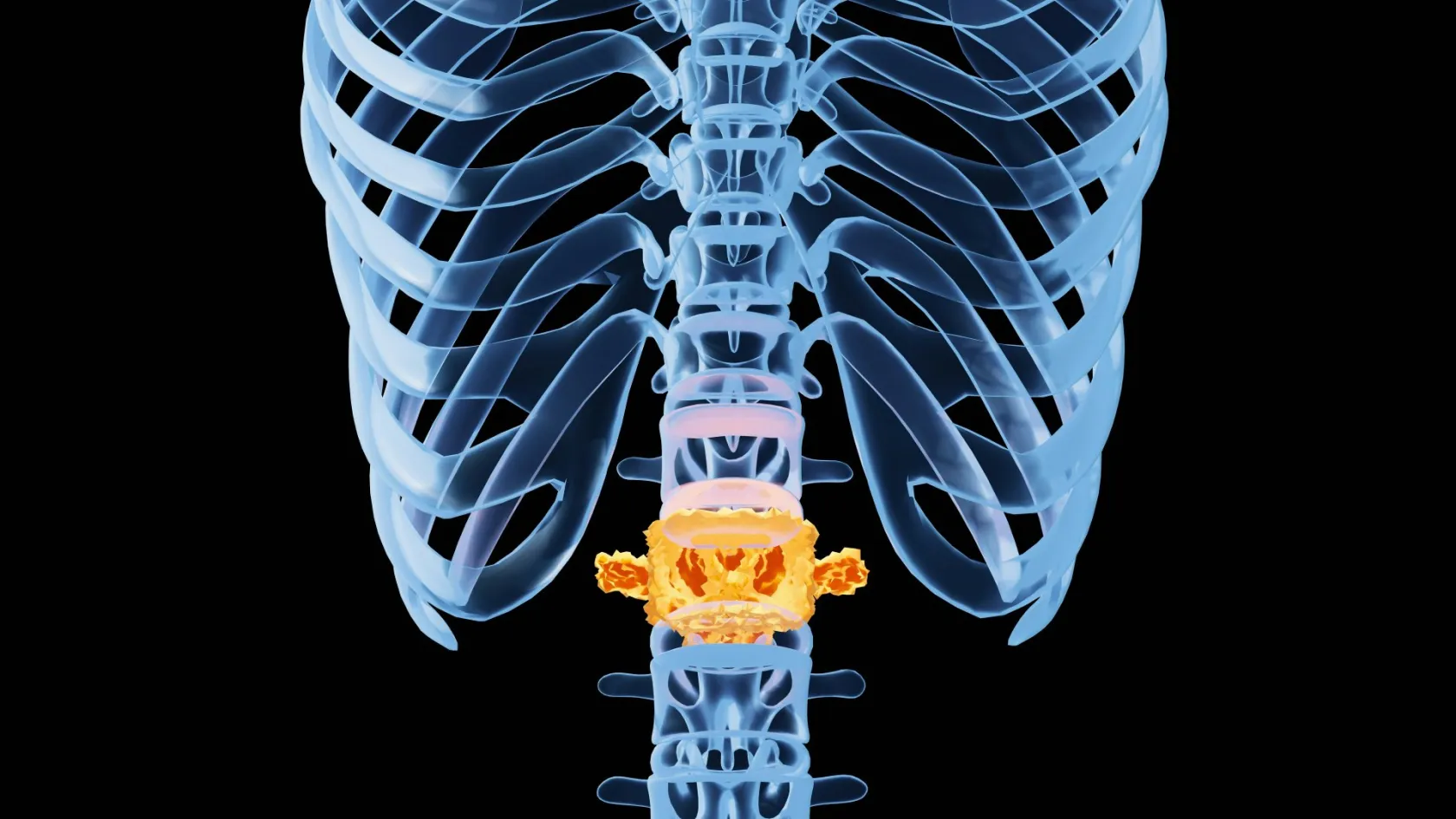
Herniated Disc - Slipped Disc Surgery
The MRI showing a large herniation is not what decides the operation. The leg is. Two herniations in three disappear from the scan without anybody touching them.
About This Department
Sciatica down one leg, an MRI report using words like extrusion and nerve root compression, and a surgeon who has offered to operate. Most readers of this page are standing there right now. What follows covers when a herniated disc genuinely needs an operation, what microdiscectomy does, how the endoscopic and open techniques compare in the trials, how recovery runs week by week, and what the trip involves for a patient arranging it from another country.
Free consultation
Send the MRI and find out whether this disc needs operating on at all
The review costs nothing and commits you to nothing. Send the lumbar MRI, ideally the images and the radiologist's report, a note of when the leg pain started and whether it has been getting better or worse, a list of the painkillers and injections you have already tried, and a description of any weakness, numbness or bladder change. A spine surgeon reads it and tells you whether an operation is warranted now, whether waiting is the better plan, and which technique would suit the herniation on your scan.
Two in three shrink on their own
A herniated disc is not a permanent injury. The soft centre of a disc pushes through a tear in its outer ring, the displaced fragment presses on a nerve root, and the body then treats that fragment as foreign tissue and starts breaking it down. Immune cells move in. The fragment loses water, shrinks and is reabsorbed. A meta-analysis in Pain Physician pooling eleven cohort studies put the overall rate of spontaneous resorption at 66.7 percent, which means two herniations in three disappear from the scan without anybody operating on them, and the reader who understands this fact reads every surgical recommendation differently afterwards.
The pain follows the same curve. Sciatica from a fresh herniation improves without surgery in the large majority of people over six to twelve weeks. No responsible surgeon operates on a leg that started hurting last Tuesday.
Two randomised trials define what surgery buys. In 2007 the New England Journal of Medicine published a Dutch trial of 283 patients who had endured severe sciatica for six to twelve weeks, randomised to early microdiscectomy or to prolonged conservative care with surgery held in reserve. Leg pain settled significantly faster in the surgical group, and perceived recovery came faster too, with a hazard ratio of 1.97. At one year the probability of recovery was 95 percent in both arms. Thirty-nine percent of the conservative group had crossed over and been operated on by then, at an average of nineteen weeks. Read those numbers carefully and the trade becomes clear. Early surgery does not change where you end up at twelve months. It changes how much of that year you spend in pain, and for somebody who cannot work, cannot sleep and cannot sit through a meal, several months of severe sciatica is not a small thing to hand back.
SPORT, the American trial published in JAMA in 2006, enrolled 501 patients and ran into the same honest difficulty. Half the surgical arm and nearly a third of the non-operative arm crossed over, so the intention-to-treat comparison could not settle superiority either way. Both groups improved substantially over two years.
Both trials settled on six weeks. What those six weeks are supposed to contain gets far less attention, and a great many patients arrive at a surgical clinic having spent them doing nothing at all. Proper conservative treatment for sciatica means analgesia strong enough that the patient sleeps and moves, which frequently means more than paracetamol and a warning about addiction. It means physiotherapy from somebody who has treated radicular pain before, working on movement and load instead of massage. It means staying active within the pain, since bed rest makes sciatica worse and has done in every trial that has tested it. And for a patient in severe pain it often means a nerve root injection of steroid, which settles the inflammation around the compressed root and buys the disc time to resorb. Somebody who has had all four of those and still hurts at twelve weeks has genuinely failed conservative treatment. Somebody handed a prescription for ibuprofen and told to rest has not. Operating on the second person treats an absence of care instead of a disc.
So the operation stays elective for the great majority. Time does the work instead, and it works.
What the MRI does not decide
Patients arrive convinced by their scan, and the vocabulary of the report does most of that persuading. Extrusion, sequestration, severe foraminal narrowing. Every one of those phrases sounds like a sentence handed down rather than a description of soft tissue that the body has already started dismantling. Radiologists write for surgeons, in a register built for precision, and never for reassurance, and a patient reading that language at midnight with no clinician beside them will reliably conclude that their spine is falling apart. It is not. The same report on the same disc, read aloud by a surgeon who then examines the leg and explains which of those findings has anything to do with the symptoms, turns into a far smaller problem in about four minutes, and the gap between the written report and the clinical picture is where a great deal of unnecessary anxiety and a certain amount of unnecessary surgery lives.
Scans and symptoms agree less than patients expect. Disc bulges show up on the MRIs of people with no back pain at all, in proportions that climb steadily with age, and a surgeon operating on an image rather than on a patient will occasionally remove a disc fragment that was never the problem. What decides the operation is the leg. Where the pain runs, which muscles have weakened, which reflex has gone, and whether the level of the herniation on the scan matches the nerve that the examination says is in trouble.
Ask any surgeon proposing an operation to name the nerve root and to explain how your symptoms map onto it.
Back pain on its own is the other trap. Discectomy is an operation for leg pain, and it treats sciatica far better than it treats a sore back, which patients discover afterwards when the leg is fine and the lumbar ache they also mentioned has barely shifted. Anybody whose dominant complaint is central low back pain without a clear radiating pattern deserves a conversation about why a discectomy might disappoint them before anybody books a theatre slot.
Four situations that make surgery the right call
Set against the two thirds that resolve, four groups of patients do better in theatre than out of it, and in those four the operation is a good one with a high rate of relief.
Cauda equina syndrome. One very large central herniation compresses the whole bundle of nerves at the bottom of the spinal canal. Disc surgery has one true emergency, and it runs on a clock measured in hours.
Progressive weakness. A foot that has started to drop, a calf that cannot lift the body onto its toes, a quadriceps giving way on stairs. Weakness that is getting worse week by week is a nerve losing the argument, and surgery here is booked in days rather than debated for months, because motor recovery after a long compression is slower and less complete than motor recovery after a short one.
Sciatica that has not budged in six to twelve weeks. Persistent sciatica puts more people on an operating list than every other indication combined, and the Dutch trial studied exactly this situation. Six weeks of proper conservative treatment means real physiotherapy, adequate analgesia and, in severe cases, a nerve root injection. Six weeks of hoping does not count. When that has been done and the leg still hurts enough to run the patient's life, microdiscectomy shortens the remaining misery substantially. A caveat worth saying out loud, because clinics chasing surgical volume rarely mention it. Patients who reach twelve months without surgery do just as well in the end, so anybody who feels the pain easing month by month has every reason to keep waiting.
A recurrent herniation at the same level. Patients who have already had one attack settle, then herniate again at the same disc, tend to be offered surgery earlier the second time.
Microdiscectomy from start to finish
Microdiscectomy removes the fragment pressing on the nerve and leaves the rest of the disc where it is. Nothing is fused, nothing is replaced, and the spine keeps every bit of its movement. Understanding that one sentence removes most of the fear patients bring to this operation, because the word spine surgery conjures rods and screws and a year of rehabilitation, and this is a different order of intervention entirely.
Here is what happens. The patient goes to sleep under general anaesthesia and is turned face down. A two to three centimetre incision opens over the affected level, muscle is retracted instead of cut, and a small window of bone at the edge of the lamina is removed to expose the nerve root. The surgeon works down an operating microscope from this point on, which is where the micro in the name comes from. The nerve root is gently lifted aside, the herniated fragment underneath it is taken out, the surgeon checks that the root now moves freely, and the wound closes in layers over a nerve that has stopped being squashed for the first time in months. One to two hours from first cut to last stitch.
Patients walk the same day.
Two things about that description are worth pinning down, because patients hear spine surgery and picture something else entirely. The first is that nothing is removed except the loose fragment and a small amount of disc material immediately behind it, so the disc keeps doing its job as a spacer and the joint keeps moving. The second is that the small window of bone taken from the edge of the lamina does not weaken the spine in any way a patient will ever notice, and it is removed to give the surgeon room to work around the nerve rather than to alter the mechanics of the segment. Nothing gets fixed to anything. No metal goes in. A patient who has read about fusion, cages and screws while waiting for their appointment can put all of that to one side, since none of it belongs to this operation.
Leg pain frequently goes the moment the anaesthetic wears off, which is the most striking thing about this operation and the reason satisfaction after a well-selected discectomy runs so high. The back around the incision aches for a week or two. That soreness comes from muscle.
Published Turkish packages put the ward stay at one to two nights for microdiscectomy, with some quoting three or four when the case is more involved.
Endoscopic against open
Endoscopic discectomy reaches the same fragment through a tube around eight millimetres across, guided by a camera, frequently under local anaesthetic with sedation. Marketing around it is loud. The evidence reads quieter, and more interesting.
Fourteen studies pooled in Spine in 2021 compared percutaneous transforaminal endoscopic discectomy against open microdiscectomy and found moderate quality evidence of no difference in leg pain at three to six months or at twelve, and no difference in functional status at those same points. Both operations get the fragment out and both relieve the nerve.
Complications are where the two techniques separate, and the picture cuts both ways. A 2022 meta-analysis in World Neurosurgery pooling six randomised trials reported overall complication rates of 5.5 percent for full-endoscopic discectomy against 10.4 percent for open discectomy or microdiscectomy, a risk ratio of 0.55. Dural injury, meaning a tear in the membrane around the nerves, was significantly less frequent endoscopically. The cohort data in the same paper pointed the other way on three counts, with transient dysesthesia, an unpleasant burning numbness in the leg, running nearly four times higher after endoscopic surgery, residual fragments left behind more than five times as frequently, and revision surgery around one and a half times more common.
This table scrolls sideways on a narrow screen. Swipe or drag to see every column.
| Measure | Open microdiscectomy | Full-endoscopic discectomy |
|---|---|---|
| Leg pain at 12 months | No difference between the two | No difference between the two |
| Overall complications in pooled trials | 10.4 percent | 5.5 percent |
| Tear in the dura | Higher | Roughly half as frequent |
| Fragment left behind | Uncommon | Over five times more frequent in cohort data |
| Burning numbness in the leg afterwards | Lower | Close to four times higher in cohort data |
| Return to theatre | Lower | Around 1.5 times higher in cohort data |
How do you judge whether a surgeon is on the right end of that learning curve? Ask directly, and ask in numbers. How many endoscopic discectomies has this surgeon performed. How many in the last twelve months, since a technique learned in 2016 and used twice a year since is not a technique anybody has retained. What proportion of their disc cases are done endoscopically, because a surgeon who converts to open in half of them is telling you something useful. And what happens if the fragment cannot be reached through the tube, since the answer is a conversion to an open microdiscectomy under the same anaesthetic, and a surgeon who says that plainly is a surgeon who has planned for it. None of those questions is rude. Every unit that does a lot of this work answers them without hesitating, and hesitation is itself an answer.
Position on this, since somebody has to take one. Both operations work. The technique matters far less than which surgeon is holding it, endoscopic surgery has a long learning curve and the residual fragment figures show what happens on the wrong end of it, and a patient choosing between a highly experienced open surgeon and an occasional endoscopic one should take the experience every time.
The six weeks that matter
Recovery here is fast by the standards of spinal surgery, and the risk is the opposite of the one people expect. Patients feel so much better so quickly that they do too much in week two and set themselves back.
Days one to seven
Walking starts within hours of waking. The physiotherapist covers getting in and out of bed without twisting, and covers stairs. Painkillers step down from the strong ones inside a few days. Sitting is the movement to ration during this first week, because a seated lumbar spine loads the operated disc more than standing or lying does, and twenty minutes at a time is the working limit.
Weeks two to six
Bending, lifting and twisting stay off the list for six weeks while the tear in the outer ring of the disc seals itself, and that tear is precisely why an early recurrence happens to people who lifted a suitcase in week three. Walking distance builds from a few hundred metres to a few kilometres. Desk work restarts between week two and week four for many patients, part time at first, with a chair that supports the lumbar curve and a rule about standing up every half hour. Physiotherapy proper begins around the fourth week and works on the deep abdominal and spinal muscles that have switched off during months of pain. Driving comes back once an emergency stop can be performed without hesitation and no sedating painkiller is on board, which lands most people between week two and week four for an automatic car and later for a manual. Flying, sitting through a cinema, long car journeys and anything else that pins the lumbar spine into flexion for hours all belong in the same category as sitting, and they are managed the same way, by breaking them up.
Six weeks to three months
Restrictions lift in stages. Swimming, cycling and the gym return with a physiotherapist's guidance, heavy manual work waits until around the third month, and contact sport waits longer.
This table scrolls sideways on a narrow screen. Swipe or drag to see every column.
| When | What happens | Still off limits |
|---|---|---|
| Day of surgery | Walking within hours, leg pain frequently gone on waking | Prolonged sitting |
| Week 1 | Discharge, short walks several times a day, strong painkillers stepped down | Bending, lifting, twisting, sitting beyond 20 minutes |
| Weeks 2 to 4 | Desk work part time, driving once an emergency stop is possible, physiotherapy begins | Bending, lifting, twisting |
| Weeks 4 to 6 | Walking distance up to a few kilometres, core rehabilitation under supervision | Heavy lifting, sport |
| 6 weeks to 3 months | Swimming, cycling and gym work return with guidance | Heavy manual work, contact sport |
Numbness that outlasts everything else
Altered sensation in the foot or the outer calf persists for months after the pain has gone, and it is the last thing to recover because a compressed nerve regenerates its outer fibres slowly. Weakness follows the same slow clock. A dropped foot that has been weak for three months before surgery may take a year to come back, and it may not come back completely, which is the strongest argument in this entire article for not sitting on progressive weakness while waiting for a scan appointment.
Risks, recurrence and a second operation
Pooled randomised data puts overall complications at 10.4 percent for open microdiscectomy and 5.5 percent for the full-endoscopic technique, and the great majority of what sits inside those figures is minor and temporary.
Recurrence matters more to patients than any other number here. Some of the disc stays in place after any discectomy, the tear in its outer ring stays a weak point for months, and a fresh fragment comes through the same hole in a minority of people, which is the single mechanical reason behind every restriction in the six weeks after surgery. It announces itself the same way the first one did, with leg pain returning down the same path, and it happens most frequently in the first year. A second microdiscectomy is a straightforward operation with good results. Repeated recurrences at the same level are what push a surgeon towards fusion, and that is a much bigger decision than the one this article started with.
Tears in the dura, the watertight membrane holding the spinal fluid, get repaired during the same operation and add a day or two flat in bed. Infection of the wound is uncommon and treated with antibiotics. Deep disc space infection is rare and serious, and it shows up as escalating back pain a week or two after an operation that had gone well.
Nerve root injury during surgery is rare in experienced hands.
Scar tissue around the nerve root deserves a paragraph of its own, since it explains a pattern that frightens people at the nine month mark. Every operated nerve heals with some fibrous tissue around it, and in a small number of patients that tissue tethers the root enough to reproduce a dull version of the original leg pain, months after a recovery that had gone perfectly. On a scan it looks nothing like a recurrent herniation, and it behaves nothing like one either, since it comes on gradually where a recurrence arrives overnight. Further surgery makes scar tissue worse rather than better, so the treatment runs through physiotherapy, nerve pain medication and time. Knowing this in advance turns a frightening development into an explicable one, and it stops a patient booking a second operation that would leave them further behind than when they started.
Blood clots deserve a separate mention for anybody flying home. The combination of a recent operation, several days of reduced walking and then a long flight in a fixed seat is exactly the set of conditions that produces a deep vein thrombosis, and the risk is small enough that it barely registers in a domestic patient's consent conversation while being large enough that a cross-border patient should take it seriously. Compression stockings for the journey, whatever clot prevention the surgeon prescribes, water rather than alcohol on the plane, and standing every half hour cover it. Calf pain with swelling on one side, or breathlessness with chest pain, means an emergency department at the destination airport rather than a taxi home to wait and see.
Then there is the outcome nobody counts as a complication, which is an operation that goes perfectly and leaves the patient no better. It happens when the pain was never coming from that nerve root, and it is prevented in clinic rather than in theatre, by matching the symptoms to the scan before agreeing to operate.
Staying, flying, and getting home
Plan seven to ten days in the country. One or two days go on assessment, blood tests and the anaesthetic review, one to two nights on the ward follow the operation, and the rest sits in a hotel nearby until a surgeon has checked the wound and cleared you to travel.
Flying home is the part that needs planning, because a plane seat is the single worst posture for a freshly operated lumbar disc. An aisle seat lets you stand every half hour, and standing every half hour is an instruction, and it is not a suggestion. Request the extra legroom row when you book. Compression stockings and whatever clot prevention has been prescribed matter as much on this flight as they would after any operation, and a flight longer than four hours goes better broken with a stopover where the ticket allows it. Book the seat before you book anything else, because the difference between an aisle seat you can leave every half hour and a window seat behind a reclined passenger on a six hour flight is the difference between arriving home sore and arriving home having undone a week of healing, and airlines release the good seats early. Pack a small cushion for the lumbar curve. Keep the painkillers in hand luggage with the prescription beside them, since some of them attract questions at customs and a printed list in English settles those questions in thirty seconds. Request airline assistance for boarding when you book. It costs nothing, and dragging a suitcase through a terminal in week one undoes a fortnight of care.
Nobody should carry their own luggage home from this operation.
How the remote assessment runs
Hospitals in Turkey handling international patients start the same way. A coordinator receives the MRI and reports, passes them to the spine unit, and a surgeon reads them. Back should come a written opinion naming the level and the nerve root, a recommended technique, and a costed estimate broken into lines, in a language you read, before anything is booked. Most Turkish hospitals charge nothing for that review.
Once you are back home
Leave with the discharge summary, the operation note naming the level operated on, and the post-operative instructions, all in English, and get the out-of-hours contact route in writing. Remote follow-up after a discectomy is undemanding. A photograph of the wound at two weeks, a note on walking distance and on whether the leg pain has stayed away, and a report from a local physiotherapist give the surgical team everything they need. Arrange the physiotherapy at home before you fly out rather than after you land back, because the fourth week is when it should start and finding a physiotherapist takes longer than that in many places.
See a local doctor the same day for returning leg pain that is severe, any new weakness, a wound that opens or leaks, fever, or the bladder symptoms described earlier.
Why two quotes never match
Five things move the number on a disc surgery quote. The planned technique comes first, since endoscopic sets and disposables cost differently from a microscope-based procedure. Level count matters. Two herniations at two levels stops being one operation. Whether the plan is a simple discectomy or a discectomy plus fusion, which changes the figure by a large multiple. The number of nights on the ward. And whether the case is a first operation or a revision through scar tissue, which takes longer and carries more risk.
Patient factors move it as well, in particular weight, diabetes, previous spinal surgery and any condition that needs a specialist review before anaesthesia.
Something else changes the total, and clinics rarely put it in writing. A quote assumes the operation the surgeon expects to perform after reading the MRI, and spines occasionally disagree with their scans. A fragment turns out to have migrated behind the vertebral body above. Scar tissue from an old operation takes an hour to work through. A second herniation at the level below, small on the scan and clearly symptomatic once the nerve is exposed, needs dealing with while the patient is already asleep. None of that is common, and all of it is normal enough that a serious hospital has a written answer ready for what happens to the invoice when it occurs. Get that answer in writing before you travel. Asking afterwards makes for a conversation nobody enjoys.
Published Turkish packages for disc surgery cover the operation itself, the nights on the ward, pre-operative tests, medications, a corset where one is used, airport transfers, an interpreter and the follow-up appointments before departure. Some include neuromonitoring. Outside the package sit the flights, travel insurance, extra hospital nights, and the treatment of any complication.
Four questions turn a headline into a real quote. Which technique does this assume. At how many levels. Does it include a fusion or exclude one. What happens financially if the surgeon finds a second herniation once inside.
One figure means something, and it comes from a surgeon who has read your MRI.
Frequently asked questions
Does a herniated disc always need surgery?
How long does recovery from a microdiscectomy take?
Is endoscopic disc surgery better than microdiscectomy?
How long do I stay in the country and when can I fly?
References
- Peul WC, van Houwelingen HC, van den Hout WB, Brand R, Eekhof JAH, Tans JTJ, Thomeer RTWM, Koes BW. Surgery versus prolonged conservative treatment for sciatica. The New England Journal of Medicine. 2007;356(22):2245-2256. doi:10.1056/NEJMoa064039
- Weinstein JN, Tosteson TD, Lurie JD, Tosteson ANA, Hanscom B, Skinner JS, Abdu WA, Hilibrand AS, Boden SD, Deyo RA. Surgical vs nonoperative treatment for lumbar disk herniation. The Spine Patient Outcomes Research Trial, a randomized trial. JAMA. 2006;296(20):2441-2450. doi:10.1001/jama.296.20.2441
- Zhong M, Liu JT, Jiang H, Mo W, Yu PF, Li XC, Xue RR. Incidence of spontaneous resorption of lumbar disc herniation. A meta-analysis. Pain Physician. 2017;20(1):E45-E52.
- Gadjradj PS, Harhangi BS, Amelink J, van Susante J, Kamper S, van Tulder M, Peul WC, Vleggeert-Lankamp C, Rubinstein SM. Percutaneous transforaminal endoscopic discectomy versus open microdiscectomy for lumbar disc herniation. A systematic review and meta-analysis. Spine. 2021;46(8):538-549. doi:10.1097/BRS.0000000000003843
- Yang CC, Chen CM, Lin MH, Huang WC, Lee MH, Kim JS, Chen KT. Complications of full-endoscopic lumbar discectomy versus open lumbar microdiscectomy. A systematic review and meta-analysis. World Neurosurgery. 2022;168:333-348. doi:10.1016/j.wneu.2022.06.023
Editor's note
Written by the Biruni Hospital medical editorial team. Reviewed by Assoc. Prof. Dr. Suat BATAR, Orthopedics and Traumatology.
Medically reviewed by

Assoc. Prof. Dr. Suat BATAR
Orthopedics and Traumatology
Related Treatments
View All-
Achilles Tendon Repair
Achilles tendon repair stitches a torn tendon back together and cuts the risk of a second rupture, while a boot with early movement gives the same function at one year in trials. This guide covers the signs of a tear, surgery or a boot, open and minimally invasive repair, rehabilitation week by week and the stay.
-
Bone Tumor Resection
Most people arrive expecting to lose the limb. For the large majority of bone tumours today the limb is saved, the bone is rebuilt with an implant or a graft, and survival is no worse for it. What decides the answer is the margin, and the margin is planned from an MRI of the whole bone before anything is cut.
-
Chondrosarcoma Surgery and Bone Tumor Resection
Chemotherapy and radiation barely touch this tumor, which sounds like the worst news on the page and is the reason a single operation cures it outright. For a grade 1 chondrosarcoma in an arm or a leg the bone is scraped clean from the inside and the natural joint stays where it is.
-
Complex Knee Revision Surgery
Infection now causes more failed knee replacements than any other single reason, 21.6 percent across registries in seven countries, and it can turn a revision into two operations with weeks of antibiotics between them. This page explains how the cause is found before surgery, when cones or a hinge are needed, and how a two-stage revision fits around travel.
-
Complex Trauma Reconstruction
A fracture that has not healed after a year, healed crooked or became infected can still be repaired, and the treatment often runs for months in an external frame. This page explains nonunion, malunion and bone loss repair, the choice between bone transport and the Masquelet technique, and how a long treatment fits around travel to Istanbul.