
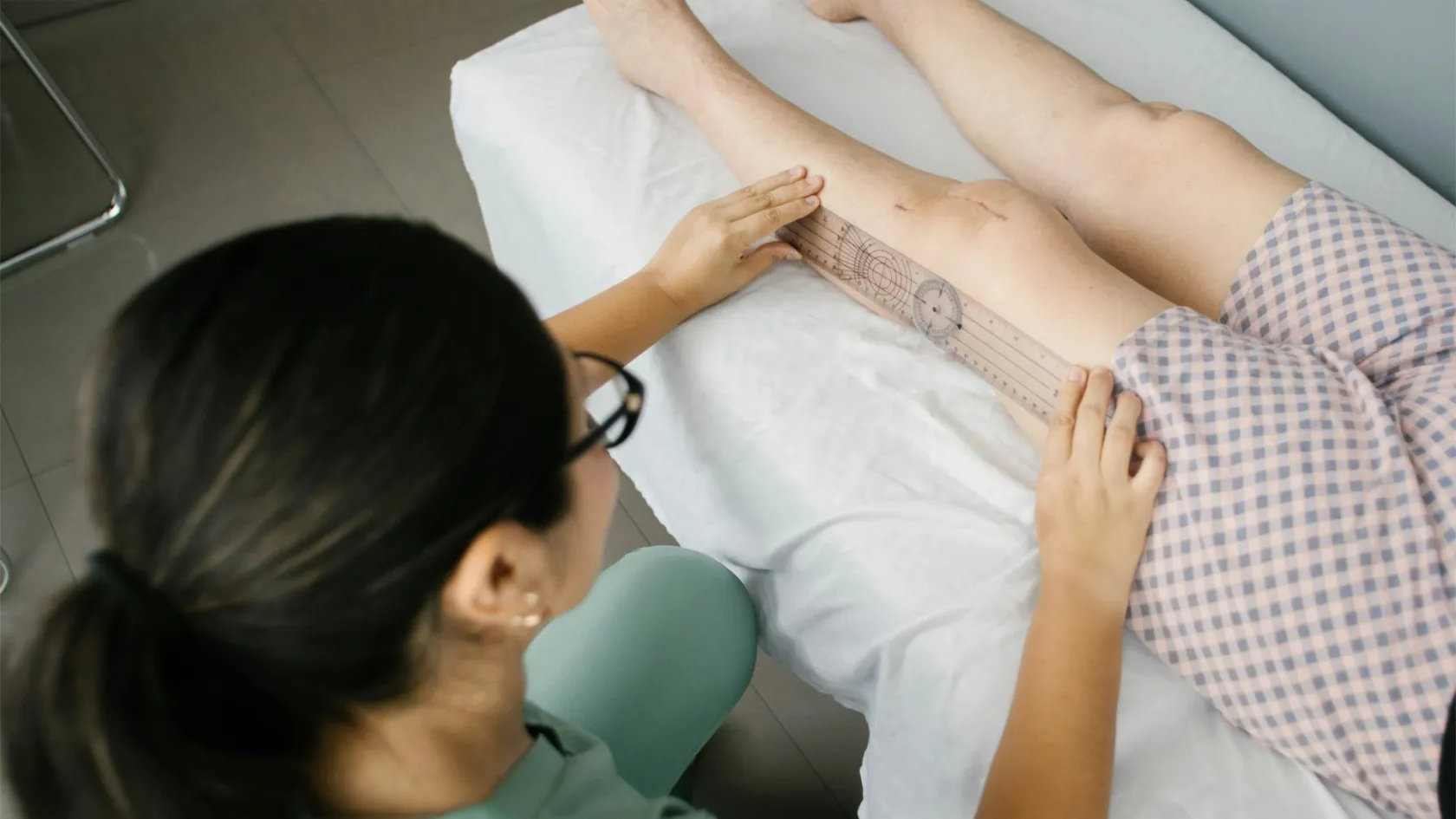
Limb Lengthening Surgery
Bone grows about a millimetre a day and then needs two to three times as long again to harden. That arithmetic, and not the operation, is what turns five centimetres of new leg into a project of seven to nine months.
About This Department
Nobody stretches the bone. Nobody could. Most people have that wrong about limb lengthening surgery, and correcting it explains everything else. The surgeon divides the bone and then a device pulls the two ends apart by about a millimetre a day, which is slow enough that the body treats the widening gap as a fracture it is still repairing and keeps laying down new bone into it. You grow the leg yourself. Slowly. The operation only makes room, and the months that follow are where the work actually happens.
Free consultation
Send standing full length leg X rays, and not a photograph
Planning a lengthening needs a standing X ray that shows both legs from hip to ankle on one film, because the question is never only how much length is missing but where the length is missing from and what the alignment is doing about it. Send that, with any previous operation notes, and what comes back is an opinion on how much can safely be gained, in which bone, with which device, and over how many months. The review costs nothing and carries no obligation.
How a bone is made longer
Surgeons call the technique distraction osteogenesis, and it runs in three phases, which a patient should be able to name before consenting to anything.
- Latency. About a week of nothing, while the body starts the repair it would start after any fracture.
- Distraction. The gap opens by roughly a millimetre a day until the planned length is reached.
- Consolidation. The waiting, while soft new bone hardens into something that carries your weight. Longer than the other two put together.
On the day itself the surgeon cuts the bone through a small incision, disturbing the periosteum and the blood supply as little as possible, and fixes the device that will do the pulling. Nothing gets lengthened that day. Not a millimetre. Distraction begins a week later, and it is the phase people picture when they think of the operation, and picturing it does not prepare anybody for how ordinary it feels to turn a dial four times a day for two months. The gap opens by one millimetre a day, split into three or four small movements so the tissue is never pulled hard at any single moment, and inside that gap a column of soft new bone forms and gets stretched along with everything else around it. Muscle, nerve, skin and blood vessel all lengthen at the same time, which is why the rate matters and why going faster does not work. Then comes the phase nobody warns you about.
Consolidation means waiting while that soft column hardens into bone strong enough to carry your weight without the device, and it takes substantially longer than the distraction did. In children the consolidation phase runs to about twice the length of the distraction phase, and in adults three to four times. Five centimetres take fifty days to distract and then several months to become a leg you can run on, and that ratio is the single most misunderstood fact about this operation.
Who has this done
Two quite different groups of people end up having the same operation. A page that blurs them helps neither. One group has a leg that is genuinely shorter, for a reason that can be named.
This table scrolls sideways on a narrow screen. Swipe or drag to see every column.
| Cause | What it looks like | What it changes about the plan |
|---|---|---|
| Congenital shortening | A femur or tibia that has been short since birth, frequently with the hip or the knee malformed alongside it. | The joint above and below has to be stabilised first, and lengthening is often staged across childhood. |
| Growth plate injury | A fracture or an infection in childhood that stopped one growth plate working while the other side kept growing. | The gap widens until the child stops growing, so timing the operation matters as much as doing it. |
| After trauma | Bone lost in an accident, or a fracture that healed short or crooked. | Deformity is corrected in the same treatment, and old scarred tissue lengthens less willingly. |
| After tumour surgery | A growth plate removed with a bone sarcoma in childhood, leaving the limb progressively shorter. | Previous reconstruction constrains the choice of device, and oncological follow up continues alongside. |
| Short stature, both legs | Two legs of equal length in a healthy adult who wants both made longer. | Everything is doubled, nothing is being corrected, and the assessment includes questions the others do not need. |
Differences under two centimetres are generally managed with a shoe raise and no surgery at all, and saying so is not a way of turning patients away. Below that threshold the operation asks for a great deal and gives back very little.
In children there is a second route that adults do not have, which is to slow the longer leg instead of lengthening the short one. A small plate placed across the growth plate of the good leg lets the shorter side catch up, and it is a far smaller undertaking than distraction. Timing it needs a growth prediction and it only works while the child is still growing.
The number that governs the calendar
Surgeons measure lengthening with one figure called the bone healing index, which is simply the number of days of treatment divided by the centimetres gained. It folds the distraction phase and the consolidation phase into a single number, and once you know it you can work out your own calendar without asking anybody.
What the published figures actually are
Researchers comparing 50 children having femoral lengthening at a single unit reported a healing index of 53.2 days per centimetre with an external fixator against 40.2 days per centimetre with a magnetic intramedullary nail, a difference that reached statistical significance. A separate series lengthening femurs after childhood bone sarcoma surgery, where the bone had already been operated on and grafted, recorded a mean of 41 days per centimetre with a range from 24 to 69. Multiply whichever figure applies to you by the centimetres you want and you have the honest length of the project.
Five centimetres at 45 days per centimetre is 225 days. Seven and a half months. From the operation to the day the device comes out, and that is before the strength work is finished.
Several things push the index up. Previous surgery or infection in the same bone, smoking, older age, a tibia in place of a femur, and irradiated or grafted bone all slow consolidation, and so does going faster than a millimetre a day, which produces a thin regenerate that then takes longer to harden. Nothing pushes the index down very much. Hold onto that asymmetry when somebody quotes you an unusually short timeline.
Frames, nails and the choice between them
Three families of device do this work and they ask very different things of the patient.
Rings or a bar outside the leg, connected to the bone by wires and pins that pass through the skin. It corrects deformity in several planes at once, it can be adjusted after the operation without going back to theatre, and it works in bone too damaged or too infected for anything at all to be placed inside it, which is a combination no internal device has yet matched. It also stays visible, it hurts, the pin sites need cleaning every day, and it remains on the leg for the whole of consolidation.
Something of a hybrid, and a useful one. The frame does the distraction and a nail inside the bone then holds the length while consolidation happens, so the fixator comes off months earlier than it otherwise would. It shortens the visible part of the treatment and adds a second operation to lock the nail.
Here a telescopic nail sits entirely inside the bone, driven a fraction of a millimetre at a time by an external magnetic controller the patient holds against the thigh several times a day. Nothing crosses the skin, so there are no pin sites and no daily cleaning to do, and the limitation is that it cannot correct much deformity and it needs a bone wide enough and straight enough to accept it.
Where a nail can be used, the evidence favours it, and that comparison of 50 children is the clearest statement of why. The nails hit the target length more accurately, healed faster at 40.2 days per centimetre against 53.2, produced significantly fewer complications, and cut the hospital stay from a mean of 9.2 days to 4.2. Coronal alignment at the end came out no different between the two. Frames have not been made obsolete by that. A leg that needs its alignment corrected in two planes as well as lengthened, a bone previously infected, a segment too short for a nail to grip, and a child whose growth plates must not be crossed are all reasons a good surgeon reaches for a fixator, and being offered one is not a sign of an out of date unit.
Why the device question is a real one
Internal nails are not all the same, and one of them taught the field an expensive lesson that patients deserve to hear about in advance.
Manufacturers introduced a weight bearing lengthening nail with the promise that patients could walk on the operated leg during treatment instead of using crutches for months, which is an enormous practical difference. Surgeons at the Royal National Orthopaedic Hospital then examined ten of these nails after removal from six patients, all of which had achieved their intended length and consolidated. Every nail showed corrosion at the telescoping junction. Five were graded severe, with chromium rich deposits on the surface. On plain X rays, six of those patients had cortical thickening and bone loss around exactly that junction. The device was withdrawn from the market.
One small retrieval study. The authors say plainly that more are needed before anybody understands the association.
None of that makes internal nails dangerous, because the non weight bearing version of the same family has a good record and sits behind most of the favourable numbers on this page. What it does show is that this field moves quickly, that a device can be marketed on a genuine advantage and later withdrawn, and that the questions to ask are which specific implant is being proposed, how long it has been on the market, and whether the surgeon will be following the manufacturer's weight bearing instructions or somebody's marketing copy.
How much length is realistic
Roughly five to eight centimetres from a femur in one treatment, and five to six from a tibia, are the figures a limb reconstruction surgeon works to. Those are not hard limits so much as the point beyond which the soft tissues start objecting faster than the bone does, because muscle, nerve and skin do not stretch as willingly as a regenerate forms. The tibia gives more trouble, and understanding why matters before choosing it. There are two bones in the lower leg rather than one, so the fibula has to be dealt with as well. The peroneal nerve wraps around the fibular neck where it is vulnerable to traction. The calf muscle group pulls the foot into equinus as it is stretched, which is the commonest problem in the whole field. And the compartments of the lower leg are tight, which makes pressure a genuine concern in the first days.
Femurs forgive more. A patient choosing between the two segments for stature should hear that the femur is the safer bone and gives more length per treatment. They should hear it early.
Where more length is needed than one bone will safely give, it is taken in stages, either by lengthening the femur and the tibia in separate treatments or by repeating a femoral lengthening after everything has consolidated and the soft tissues have recovered. Across eleven studies covering 795 patients, the largest review of stature lengthening put the mean gain at 6.7 centimetres with a range from 1.5 to 13, and the upper end of that range represents staged treatment across years, never anything achieved in one go.
Proportion sets its own limit, separately from safety. Lengthening only the femurs makes the thighs long relative to the shins, lengthening only the tibias does the reverse, and past a certain gain the result stops looking like a taller version of the same person. A surgeon who raises this without being asked is doing the job properly.
Physiotherapy is the treatment
Most surgical pages mention physiotherapy at the end as something that helps. Here it forms half of the treatment, and the patients who do badly are overwhelmingly the ones who skipped it.
The mechanism is simple enough, and grasping it is what turns a chore into something a patient will actually do. Every day the bone gets a millimetre longer, the muscles and tendons crossing it get a millimetre tighter, and a tight muscle held short for weeks turns into a contracture that no amount of later effort fully undoes. In the femur the hip flexors and the iliotibial band pull. In the tibia the calf pulls the ankle down into equinus, which is the single commonest problem reported in the stature lengthening literature and the reason some patients need a tendon released as a second operation. So the daily routine during distraction is stretching, joint range work, and time spent in positions that oppose the pull, supervised at first and then continued at home. Knee extension and ankle dorsiflexion are guarded jealously, because losing either of them costs more to recover than it ever costs to protect, and a patient who understands that will do the stretch on the bad days as well as the good ones. Splints are worn at night, every night. Walking with crutches is part of it and no substitute for it, and swimming and cycling come in as soon as the wound allows.
Ask how many physiotherapy sessions are included, and ask who supervises them once you fly home, because a programme that was going well under daily supervision can unravel in a fortnight when nobody is checking the ankle. A programme that stops when the patient leaves the country is no programme at all.
What goes wrong, and how often
Limb lengthening has a high rate of things going wrong and a low rate of them ending badly, which is an unusual combination and needs explaining properly. Surgeons in this field sort events into three grades, being problems that resolve without an operation, obstacles that need a further procedure, and true complications that leave a permanent deficit. Among 489 patients in a meta-analysis of lengthening for height, external fixation produced problems in 56 percent, obstacles in 48 percent and complications in 10 percent, while intramedullary nailing produced problems in 37 percent and obstacles in 42 percent with no significant complications recorded. Procedure related mortality across every study was zero.
Read those percentages as a description of the journey and not of the destination. Most patients in these series met at least one obstacle along the way and finished with the length they came for.
Lengthening for height, honestly
Healthy adults with two legs the same length who want both made longer are having an elective operation, and the honest way to write about it is to give that reader the same numbers as anybody else. Published outcomes come out better than the reputation suggests. Across 795 patients in eleven studies the mean gain was 6.7 centimetres, the mean follow up was almost five years, major complications averaged 0.15 per patient, and satisfaction reported in the external fixation studies reached as high as 95 percent. A separate meta-analysis of 489 patients recorded no deaths at all. Set against that, the burden is real and it lands entirely on somebody who was not ill. Months on crutches. Physiotherapy that hurts, daily. A body that will not do what it used to for the better part of a year, in somebody who walked into the hospital perfectly well and who has to keep choosing this every morning for eight months without a disease to point at as the reason. Both authors' groups above end on the same recommendation, which is that this treatment belongs alongside psychological support and that clear indications and guidelines for it are still lacking, and that second half of the sentence is the part commercial pages leave out.
Some people should not have this operation, and a unit that never says so has stopped assessing and started selling.
Anybody who cannot commit to daily physiotherapy for a year will have a bad time whatever the surgery does. The same goes for anybody with nobody at home to help through months of reduced mobility. That second group is larger than people admit at the point of booking, because the help sounds easy to arrange in advance and turns out to be a person giving up half a year. Expecting height to fix something else is the other one. That something might be a relationship, a career, or how a person feels about themselves, and in each case it measures success against a thing surgery cannot deliver. Active mental health difficulty, and body dysmorphic disorder in particular, is a reason to treat that first rather than to operate. Smoking materially slows consolidation and lengthens every phase. And an unrealistic target, meaning someone asking for twelve centimetres in one treatment, needs a conversation about staging rather than a booking.
Proper assessment includes a psychological consultation. Ask whether one is part of the pathway, and treat its absence as information about the unit.
The year, month by month
Taking five centimetres in a femur with an internal nail as the worked example, the shape of the year looks like this and the dates move with the healing index rather than with a calendar somebody printed.
Week one holds the operation and the latency period, with two to four nights in hospital, crutches from the day after surgery and no lengthening yet. Weeks two to nine are distraction, one millimetre a day in small increments, physiotherapy every day, an X ray roughly every two weeks and a clinic review to check the rate against what the bone is producing. That stretch is the demanding part, and also the part where the length actually appears.
This table scrolls sideways on a narrow screen. Swipe or drag to see every column.
| When | What is happening | What you are doing |
|---|---|---|
| Week 1 | Operation and latency. Two to four nights in hospital. | Crutches from the day after surgery. No lengthening yet. |
| Weeks 2 to 9 | Distraction. One millimetre a day, an X ray every fortnight, the length appearing. | Turning the controller several times a day and doing physiotherapy every single day. |
| Months 3 to 7 | Consolidation. The regenerate fills in on monthly films and nothing visible changes. | Weight going gradually through the leg. Strength work replaces stretching. |
| Months 7 to 9 | The bone will take full load and the crutches go. | Walking unaided. Gym and pool work building the leg back. |
| Year 1 to 2 | Running comes back for those who want it, and the nail can be removed. | A small separate operation for removal, planned well in advance. |
Then the device stops moving. Nothing visible happens for months, and this is the stretch in which patients who were doing well start telephoning to ask whether something has gone wrong, because a leg that is quietly turning cartilage into bone gives back no signal at all that it is working.
Consolidation runs from the third month to somewhere between the seventh and the ninth, weight going gradually through the leg as the X rays show the regenerate filling in, crutches abandoned when the surgeon says the bone will take it and not before. Strength work replaces stretching. Most patients walk unaided somewhere around six to nine months and get back to running, if they get back to running at all, at twelve to eighteen months, and the gap between those two figures is where a lot of quiet disappointment lives for people who were told about the first and not the second. Removing the nail, where that is planned, is a small separate operation usually done after a year or more.
Frames change that picture. They stay visible and they stay on through consolidation, which is exactly what the lengthening over a nail technique exists to avoid.
Staying, flying and coming back
Limb lengthening is measured in months, so nobody stays for all of it. Design the arrangement around that from the start, because improvising it in week six goes badly.
Assessment takes two to three days. That covers the standing long leg X rays, a CT where alignment or bone width is in question, the consultation and, for stature lengthening, the psychological assessment. The surgical block itself needs six to ten weeks in the country. That covers the operation, the hospital stay, the whole distraction phase under supervision, the physiotherapy that has to be learned properly before anyone leaves, and the first consolidation X rays.
Six to ten weeks. Longer than any other trip on this site.
Distraction under remote supervision is possible. It is also the riskier arrangement. The rate needs adjusting against what the X rays show, and a nerve symptom or a regenerate forming badly is a decision to make in days rather than at the next video call, so a unit that offers to run the whole distraction phase by message is trading convenience against the thing most likely to go wrong. Flying home at the end of distraction is routine, given a healed wound, no fever and a clot prevention plan. Take an aisle seat, keep the leg elevated where you can, walk or exercise the ankle hourly and carry the prescribed injections in hand luggage with a letter. Frames go through airport security more easily with documentation, so ask for a letter naming the implant.
Then plan the returns. The treatment continues once you are home. A consolidation review at three months, another when the device is due to come out, and a local doctor at home willing to take the interval X rays and send them across. Book those flights at the same time as the first one, since the alternative is discovering in month four that the review you need falls in a week you cannot travel and that the bone does not care about your calendar.
What drives the cost
Any single figure for limb lengthening describes one particular version of a treatment that varies more than almost anything else in orthopaedics. One bone or two, one stage or two, a frame or a motorised nail, eight weeks of supervised physiotherapy or two, and a second operation to remove the implant or none, are all live variables before anybody has examined you.
Seven things move the total. One of them is the operation.
The device family, first and by a distance, since a motorised internal nail is the most expensive component in this operation and an external fixator is not. How many bones, since bilateral treatment doubles the implants and nearly doubles the theatre time. How many segments, given that a femur and a tibia in the same programme mean separate operations on separate days. Whether deformity is being corrected alongside the length, which changes the device and the planning. The weeks of supervised physiotherapy included, which for this treatment is a major line rather than a footnote. Whether implant removal is inside the quotation or a separate future cost. And the accommodation weeks, since the supervised phase runs long enough that where you stay stops being a detail. Your own situation moves it too. Age, smoking, previous surgery or infection in the same bone, and any condition that slows bone healing all lengthen the programme, and a longer programme costs more in accommodation and supervision even when the surgical fee has not changed at all.
Packages published in this market ordinarily include the transfers, the tests before admission, the surgeon and anaesthetist, the implants, a stated number of ward nights, a stated block of physiotherapy sessions, interpreting, a block of accommodation and the reviews before departure. Left outside are the flights, the insurance, extra weeks of accommodation, treatment of a complication, and the later operation to remove the implant. In limb lengthening those last two are the lines that catch people out, because both are common enough to plan for and too common to hope against. Six questions turn a headline into something comparable. Which device is this, by name, and how long has it been in use. What length does the figure assume, and what happens if the plan changes to staged treatment. What physiotherapy is included, and over how many weeks. Is implant removal inside the figure. Are the return visits for consolidation reviews counted. And who carries the cost of treating an obstacle such as a contracture needing release.
No number means anything until a surgeon has seen standing long leg X rays and named the device and the plan. That review costs nothing, and the contact details at the top of this page are where it starts.
Frequently asked questions about limb lengthening surgery
How long does the whole thing take?
How much height can actually be gained?
Is an internal nail better than an external frame?
How much of it hurts, and how often is there a complication?
How long do I need to stay in Turkey, and can I do the lengthening at home?
Who should not have lengthening for height?
References
- Marwan Y, Cohen D, Alotaibi M, Addar A, Bernstein M, Hamdy R. Cosmetic stature lengthening, systematic review of outcomes and complications. Bone and Joint Research. 2020;9(7):341-350.
- Bulut H, Altin O, Salduz I, Salduz A. Meta-analysis of complications and functional outcomes in cosmetic limb lengthening. Journal of Orthopaedics. 2025;65:41-45.
- Hafez M, Nicolaou N, Offiah A, Giles SN, Madan SS, Fernandes JA. Femoral lengthening in children, a comparison between magnetic intramedullary lengthening nails and external fixators. Journal of Pediatric Orthopedics. 2022;42(3):e290-e294.
- Hothi H, Bergiers S, Henckel J, et al. Analysis of retrieved STRYDE nails. Bone and Joint Open. 2021;2(8):599-610.
- Alpan B, Eralp L, Sungur M, Valiyev N, Ozger H. Femoral discrepancy after childhood bone sarcoma surgery can be treated with magnetic intramedullary nails. Orthopedics. 2023;46(1):27-34.
Editor's note
Written by the Biruni Hospital medical editorial team. Reviewed by Assoc. Prof. Dr. Suat BATAR, Orthopedics and Traumatology.
Medically reviewed by

Assoc. Prof. Dr. Suat BATAR
Orthopedics and Traumatology
Related Treatments
View All-
Achilles Tendon Repair
Achilles tendon repair stitches a torn tendon back together and cuts the risk of a second rupture, while a boot with early movement gives the same function at one year in trials. This guide covers the signs of a tear, surgery or a boot, open and minimally invasive repair, rehabilitation week by week and the stay.
-
Bone Tumor Resection
Most people arrive expecting to lose the limb. For the large majority of bone tumours today the limb is saved, the bone is rebuilt with an implant or a graft, and survival is no worse for it. What decides the answer is the margin, and the margin is planned from an MRI of the whole bone before anything is cut.
-
Chondrosarcoma Surgery and Bone Tumor Resection
Chemotherapy and radiation barely touch this tumor, which sounds like the worst news on the page and is the reason a single operation cures it outright. For a grade 1 chondrosarcoma in an arm or a leg the bone is scraped clean from the inside and the natural joint stays where it is.
-
Complex Knee Revision Surgery
Infection now causes more failed knee replacements than any other single reason, 21.6 percent across registries in seven countries, and it can turn a revision into two operations with weeks of antibiotics between them. This page explains how the cause is found before surgery, when cones or a hinge are needed, and how a two-stage revision fits around travel.
-
Complex Trauma Reconstruction
A fracture that has not healed after a year, healed crooked or became infected can still be repaired, and the treatment often runs for months in an external frame. This page explains nonunion, malunion and bone loss repair, the choice between bone transport and the Masquelet technique, and how a long treatment fits around travel to Istanbul.