
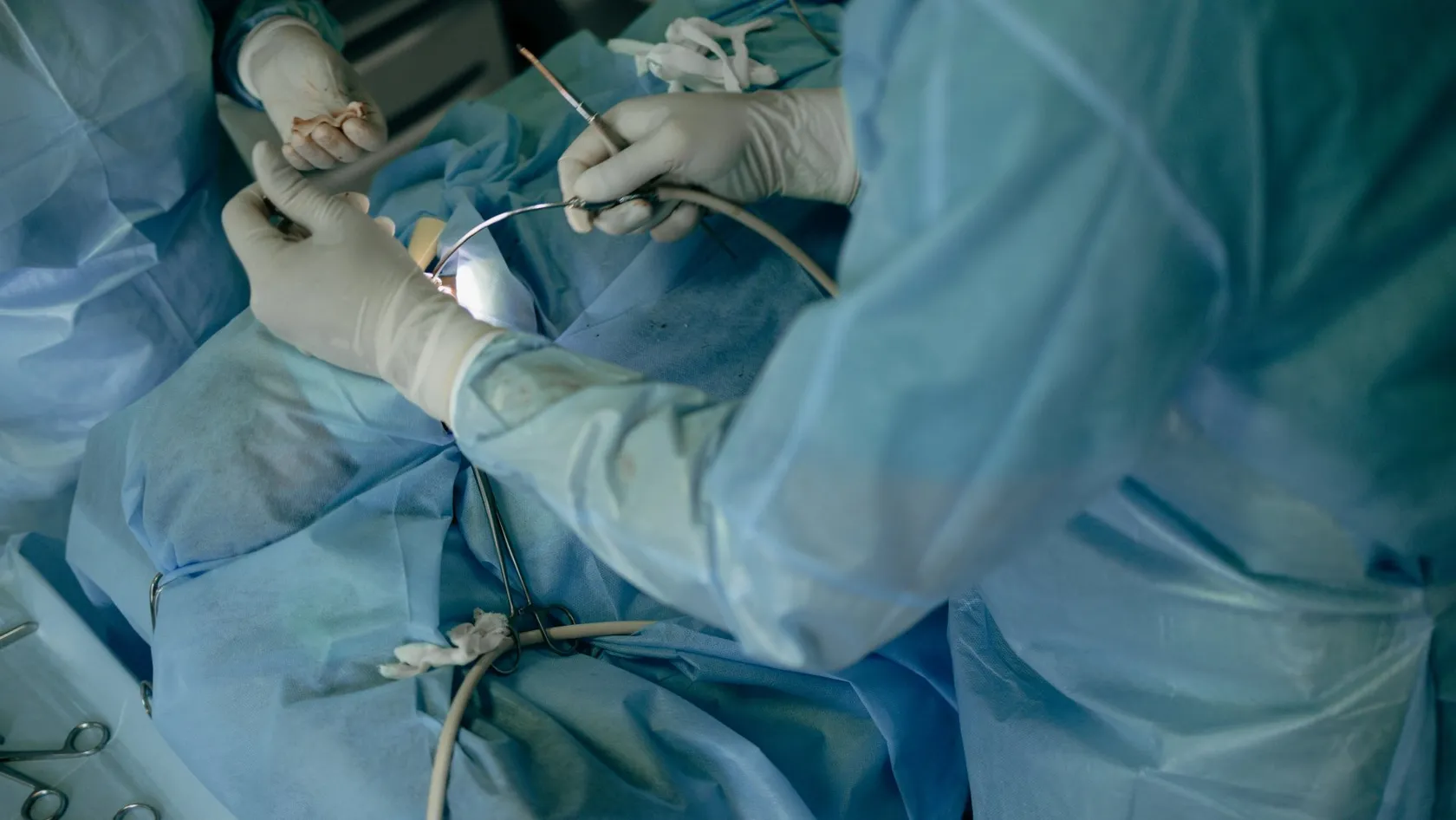
Laparoscopic Prostatectomy
Keyhole removal of the prostate inflates your abdomen with carbon dioxide, tips you head down for hours and works through straight rods that cannot bend at the tip. This page covers what each of those three does to your body, which route through the abdomen suits you, how to read the continence figure a clinic quotes, and where the randomized trials favor a robot instead.
About This Department
Small wounds are what gets advertised. Gas, tilt and rigid instruments are what it is.
Keyhole removal of the prostate inflates your abdomen with carbon dioxide, tips you head down for several hours and works through straight instruments that cannot bend at the tip. Each of those three shapes your week, your anesthetic assessment and your surgeon's difficulty. This page covers all three, and it reports honestly where the randomized evidence favors a robot instead.
The keyhole version, described plainly
Five or six small cuts take the instruments in, ranging from five to twelve millimeters, and carbon dioxide inflates the space so the surgeon has somewhere to work. A camera on a rod supplies the picture. The instruments are straight metal rods with jaws at the end, passed through valved tubes in the abdominal wall, and each one pivots at the point where it enters you, so the handle moves one way and the tip moves the other. Surgeons learn to reverse that instinct and never quite stop noticing it. The operation performed inside is the same one described on our radical prostatectomy page, with the same gland removed and the same join made between bladder and urethra afterward. What differs is the route in, the view, the physiology of lying inflated and tipped for several hours, and the difficulty of sewing that join through rods that cannot bend at the tip.
The surgeon stands at the table throughout, holding those rods, watching a screen above your knees.
What actually defines this approach
The missing wristA straight laparoscopic instrument can go in and out, swing in two directions around the port, roll along its own axis and open its jaws. A robotic instrument adds a hinged wrist behind the jaws, which gives two more directions of movement inside the body. That difference sounds small and it decides how hard one particular task becomes, namely sewing a circular join between bladder and urethra deep in the pelvis with the needle approaching at whatever angle the port allows. Everything else in the operation transfers between the two. Suturing at depth is where the wrist earns its money, and a surgeon who has spent years sewing that join with rigid rods has acquired a skill most of his younger colleagues will never need.
How to use this page
Sections one to six describe what the approach does to your body and which patients it suits poorly. Sections seven to nine cover the evidence comparing it with a robot and how to read the numbers a clinic quotes you. The rest is practical.
Three features, three consequences
Each of the three has a downstream effect that shows up somewhere in your care, and none of them appears in the brochure photograph of four small dressings.
This table scrolls sideways on a narrow screen. Drag or swipe to see every column.
| Feature | Open | Keyhole | Robotic |
|---|---|---|---|
| Gas in the abdomen | None | Yes, for the whole operation | Yes, for the whole operation |
| Head down tilt | Slight | Steep, sustained | Steep, sustained |
| Wrist at the instrument tip | The surgeon's own | None | Mechanical, inside the body |
| Where the surgeon stands | At the table, hands inside you | At the table, holding rods | At a console across the room |
| Wounds you go home with | One incision, hand span or shorter | Five or six, five to twelve millimeters | Five or six, five to twelve millimeters |
Through the abdomen or behind it
Two routes reach the prostate through small ports and this choice exists only in keyhole surgery. The transperitoneal route enters the abdominal cavity proper, moves bowel aside and comes down onto the bladder from above, giving a wide working space and a familiar layout, while the extraperitoneal route inflates the layer of fat and connective tissue in front of the bladder without ever opening the cavity, so the bowel stays where it is and the space stays small, dark and immediate. Surgeons have preferences that are close to religious on this point, and the published comparisons are calmer than the surgeons are. Two practical differences hold up. Staying outside the abdominal cavity keeps bowel out of the field and confines any leak from the join to a small pocket away from the intestines, and opening the cavity gives room for a long node dissection and a view that most trainees learned the anatomy on.
What the pooled comparisons found
Thirteen studies covering 1,674 men who had keyhole prostatectomy were pooled, split almost evenly between the two routes at 850 and 824, and operating time came out the same across them, as did blood loss, transfusion rate, complications during the operation and the chance of converting to open surgery. One difference reached significance. Complications after the operation were more frequent in the transperitoneal group, with an odds ratio of 1.69 and a confidence interval running from 1.23 to 2.32.
And the same question in robotic series
Sixteen studies covering 3,897 robotic operations asked it again and found the same direction with sharper numbers. Going behind the peritoneum instead of through it saved around fourteen minutes of operating time, sent men home most of a day sooner, and cut two specific problems by roughly four fifths, namely a sluggish bowel afterward and a groin hernia appearing later. Total complications, blood loss, margin status and continence at six months all matched. Neither route is better at removing the prostate. One of them disturbs less on the way past. The hernia figure deserves its own line, since a groin hernia showing up a year after prostate surgery gets put down to bad luck by the man it happens to and traced back to the operative route by anybody reading the pooled numbers, and a difference of that size in something requiring a second operation to repair belongs inside a consent conversation.
The gas
Carbon dioxide gets chosen because it dissolves readily in blood and will not burn, and it runs at a pressure somewhere between twelve and fifteen millimeters of mercury in most units. That pressure does three things at once. It lifts the abdominal wall away from the organs and creates the working space, it presses on the veins returning blood to the heart, and it pushes the diaphragm upward so the lungs have less room to expand, and all the while the gas is being absorbed steadily through the lining of your abdomen into the bloodstream, where it turns into acid that the ventilator has to blow off by breathing you harder than normal. None of this is dangerous in a healthy man and all of it matters in a man whose lungs or heart are already working at their limit.
Ask what pressure the unit works at. Fifteen is common, twelve is kinder to the circulation, and units that have thought about it will have an opinion ready.
The tilt
Reaching the prostate with instruments that come from above requires the bowel to fall away from the pelvis, gravity does that job when the table tips your head down by twenty five or thirty degrees, and you stay there for the whole operation, strapped and padded so that you do not slide. Blood pools in your head and chest. Pressure rises inside your skull and inside your eyes, your face and eyelids swell, and your lungs get squeezed from below by the gas and from above by nothing at all. Every one of those effects reverses when the table is levelled, which is the single most reassuring fact in this section and the reason the position is used so widely.
Somebody measured the eye part properly. In 59 men without glaucoma, eye pressure was recorded at six points through the operation. Anesthesia alone dropped it by 6.5 millimeters of mercury, an hour of gas and tilt raised it by 7.3, and by the end of the tilt it had climbed 10.2 above the starting value. Levelling the table brought it back, with the reading after return to flat sitting at 20.1 against 20.0 before anything began, and men whose operation ran beyond four hours finished with higher pressures than men whose operation ran under four. No eye complications occurred in any of them.
Length of the operation is therefore an eye variable as well as a surgical one.
A separate randomized trial of 66 men found that the anesthetic drug changes the size of the rise. Thirty minutes into the tilt, men maintained on a gas anesthetic had eye pressures averaging 23.5 while men maintained on intravenous propofol averaged 19.9, and the climb from baseline was 6.0 against 2.1. Nobody in either group came to harm, so this is no reason for alarm, and it is a reason for any man with glaucoma or raised eye pressure to make sure the anesthetist knows well before the day, since a drug choice that costs nothing removes most of the rise.
Who the keyhole route suits poorly
Almost nobody gets refused outright, and several conditions change the plan enough that they have to be declared before a date is booked. Glaucoma and any history of raised eye pressure belong at the top of that list, along with previous retinal surgery, and severe emphysema or chronic bronchitis belongs just under them, because the ventilator has to clear absorbed carbon dioxide on top of your normal load and a pair of lungs already working at capacity has nothing left to give. Heart failure that is poorly controlled reacts badly to both the pressure on the returning veins and the volume shift from the tilt. Raised pressure inside the skull, a shunt, or recent brain surgery rules the steep position out until a neurosurgeon says otherwise. Carrying a lot of weight belongs here too, in a quieter way. A heavy abdomen presses harder on the diaphragm once the gas goes in and the table tips, so the ventilator runs at higher pressures and the anesthetist watches more closely, and a man with untreated sleep apnea on top of that deserves a proper assessment before any date gets offered, since a reassuring email is no substitute for one.
Three more belong on the list for surgical rather than medical reasons.
Extensive previous abdominal surgery makes the transperitoneal route slow and pushes us behind the peritoneum, and prior pelvic radiotherapy scars every plane the operation depends on and turns a keyhole case into a genuinely difficult one, so a man who has had it belongs with the most experienced surgeon in the building. A very large prostate reduces the space in an already small pelvis, and while size alone stops nothing, it lengthens the operation, which by the previous section is also an eye and lung variable. Send us your height and weight, your medication list and your eye history with the rest of your documents, since these are the things that change our answer rather than your PSA.
Converting to open surgery
Occasionally a keyhole operation becomes an open one partway through. Bleeding that will not settle under gas pressure, adhesions that refuse to release, a view that has gone, an injury that needs repairing directly, or equipment that fails. Rates in published keyhole series are low and the pooled comparison of the two access routes found no difference between them, with the confidence interval on that comparison running so wide that the plain statement is simply that conversions are too uncommon to compare reliably. Conversion itself is undramatic from the inside. The ports come out, a lower abdominal incision goes in, the same operation carries on under direct vision, and the surgeon finishes with his hands where his instruments had been.
Treat conversion as a decision and not as an accident. A surgeon who converts when the view is poor has chosen your safety over his statistics, and a surgeon who has never converted in his career is either extraordinary or selecting his patients very carefully.
Consent forms should mention it. Ours does.
Keyhole against robotic
Robotic surgery has replaced conventional keyhole surgery across most of the wealthy world, at substantially higher cost, and the justification offered was better functional results from finer dissection of the nerve bundles. Two things made that claim hard to test properly. Randomizing a man between a machine he has read about for years and a technique he has never heard of takes a consent conversation most units would sooner avoid, and a surgeon equally skilled at both approaches is rare enough that trials kept running short of them. Five teams managed it anyway across two decades, and somebody finally pooled what they produced. Five randomized trials were identified, three teams supplied individual patient data, one contributed published figures, and the fifth had closed early for poor recruitment, leaving 1,205 randomized men in the analysis.
- Continence at twelve months showed no significant difference between the two approaches, with an odds ratio of 1.95 and a confidence interval running from 0.67 all the way to 5.62, a span that comfortably includes no effect at all.
- At three months and at six months the robot was ahead, significantly, so men who had robotic surgery got dry sooner and ended up in the same place.
- Potency told a different story. Among men who were potent beforehand and had a nerve sparing operation, the odds of being potent at twelve months were four times higher after robotic surgery, with a confidence interval from 1.63 to 10.09.
- Cancer control measures, margins and further treatment showed nothing separating the two approaches.
How to read a continence figure
Every clinic quotes a continence percentage and almost none of them state which definition produced it. Three definitions are in common use, namely no pads at all, no pads or one thin safety pad worn for reassurance, and no more than one pad of any kind, and those three applied to the very same group of men produce numbers that differ by more than any surgical technique ever has. Picture a hundred men a year after surgery. Sixty of them use nothing. Twenty keep a thin pad in a pocket for reassurance and rarely use it, and twenty wear one every day. The strict definition calls that sixty percent continent. The safety pad definition calls it eighty. The loosest definition calls it a hundred.
Investigators on a randomized multicenter trial took 718 men and tested each definition against the one thing that ought to settle it, which is whether the man himself answers yes when asked if he suffers from incontinence. At three months the safety pad definition matched his own view best, at six months and at twelve the strict no pad definition matched best, and the loosest definition agreed poorly at every single time point. The authors recommended that everybody report the zero pad figure and stop mixing definitions.
The practical use of that findingWhen a clinic sends you a continence figure, reply with one sentence asking which definition it uses and at what time point. A unit quoting 95 percent on the loosest definition at twelve months and a unit quoting 80 percent on the strict definition at twelve months may well be describing identical results, and only one of them has told you anything. The number to compare across units is the share of men using no pad at all at twelve months. Anything else is a different question wearing the same percentage sign.
The day and the week after
Fasting from midnight, a morning list where possible, and a general anesthetic with a breathing tube. Two to four hours inside. You wake with four or five dressings the size of a coin, a catheter, occasionally a drain, and a sore throat from the tube. Nurses will have you upright the same evening, which shifts trapped gas and lowers the clot risk at the same time. Most men eat a light meal the next day and leave on the second or third. Before any of that, the surgeon marks where the ports will go, following the shape of your abdomen and any scar already sitting on it, and a dose of antibiotic runs in as the anesthetic starts. A drain stays for a day where the join needed extra work or the node dissection was extended, coming out once the fluid through it turns clear and small in volume. The sore throat from the breathing tube fades inside a day and takes more men by surprise than the wounds do.
The wounds and the bloating
Port wounds need very little. Keep them dry for two days, then shower normally and pat them dry, and expect a little bruising that spreads downward under gravity and looks worse on day four than on day two. The twelve millimeter sites carry a stitch in the deeper layer, which is what stops a hernia forming there later on, and those two ache longest and feel tight for a week or so afterward. Bloating and the pressure of gas take three or four days to settle, and walking clears it faster than any medicine. Shoulder tip pain surprises men who were warned about their abdomen and nothing else.
The catheter and the return to ordinary life
The catheter stays seven to fourteen days regardless of the approach, since the join inside heals on its own timetable and takes no notice of how the surgeon reached it, and lifting stays off the list for six weeks so that the deep stitches at the port sites hold while they do their work. Desk work resumes at two weeks and physical work at six. Driving waits until an emergency stop produces no hesitation, which for most men falls in the third week. Leakage after the catheter comes out follows exactly the pattern described on our radical prostatectomy page, since the reconstruction is identical.
Choosing a unit for this operation
Conventional keyhole prostatectomy rewards experience more steeply than the other two approaches, so the questions below aim at the surgeon rather than the hospital. Send them by message and read the replies against each other. Four questions cost you one message each and they sort units faster than any amount of website reading. Use identical wording for every unit you write to, since a question phrased a little differently comes back answered a little differently and the comparison then means nothing.
- How many laparoscopic radical prostatectomies has the named surgeon performed in his career, and how many in the last twelve months.
- Which route does he use for this operation, through the abdomen or behind it, and what specifically would make him change that plan in my case.
- What share of his own patients uses no pad at all at twelve months, counted by questionnaire and not by memory.
- How often does he convert to open surgery, and what were the reasons the last few times.
Wide table. Scroll sideways on a narrow screen to reach the last column.
| Question | A serious reply | A reply to be wary of |
|---|---|---|
| Case numbers | Two figures for one named surgeon on this approach | A hospital total covering every urological operation |
| Route | A preference with the reasons it would change | Whichever one the question implied you wanted |
| Continence | A percentage with its definition and its time point | A percentage on its own, or a word instead of a number |
| Conversion | A low rate and a willingness to describe the cases | Never happens here |
Cost, travel and flying home
Set aside eleven to fifteen nights. Two go on arrival, bloods, anesthetic review and an eye pressure check where your history calls for one, two or three on the hospital, and the remainder on the stretch between discharge and catheter removal, ending with a review the day before you leave.
Clearance to board comes when you walk without difficulty, run no fever, have no wound discharge and are passing urine after the catheter comes out, which most men reach between day eight and day twelve, and gas trapped in the abdomen expands slightly in a cabin, so an early flight while still bloated is uncomfortable and not dangerous, with the extra days of waiting proving easier than explaining a miserable journey afterward. Clot risk stays above normal for several weeks after pelvic surgery, so we supply stockings, prescribe injections where a node dissection was done, and ask you to walk the cabin every hour. Going home with the catheter still in place works cleanly when a doctor at your end has agreed in writing to remove it, and we forward the operation note, the removal instructions and our direct line before you fly.
Four things move what this operation costs. The route and whether a lymph node dissection is included, the number of hospital nights, whether pathology on the whole specimen sits inside the quoted figure, and whether the follow up visits before departure are counted separately. Ask for all four in writing.
Send us the biopsy report with the grade group and the positive core count, the prostate MRI report together with the images on a disc or a link, your PSA history with dates, any bone or PSMA scan, a full medication list, your height and weight, and a note of every previous operation on your abdomen, groin or eyes. A urologist reads all of it and writes back at no charge, including the replies that say the keyhole route suits you poorly or that surgery suits you poorly. One coordinator then stays with you from that first message until you are home, reachable on WhatsApp afterward for as long as you need her. English, Arabic, French, Russian, Serbian, Romanian and Spanish are spoken in the building, anything else gets interpreted on request, your companion sleeps in the room, hotel and airport transfers are booked around the operating date, halal, vegetarian and diabetic meals are ordinary here, a prayer room sits on the ground floor, and the visa invitation letter goes out roughly ten days ahead. Once you are home, send the six week PSA and every result after it and a urologist here will read them without a fee.
No prices appear on this page. Any figure offered before a urologist has read your scan was picked to win an inquiry.
Laparoscopic prostatectomy FAQ
Seven questions reach us every week from men weighing this against a robot.
Is keyhole surgery worse than robotic surgery?
Why does my shoulder hurt after abdominal surgery?
I have glaucoma. Can I still have this operation?
Which route is better, through the abdomen or behind it?
What happens if it has to be converted to open surgery?
Will the small wounds mean less leakage afterward?
How long will we need to stay in Istanbul?
References
- Haney CM, Kowalewski KF, Westhoff N, Holze S, Checcuci E, Neuberger M, et al. Robot-assisted versus conventional laparoscopic radical prostatectomy, a systematic review and meta-analysis of randomised controlled trials. European Urology Focus. 2023;9(6):930-937.
- Holze S, Kuntze AS, Mende M, Neuhaus P, Truss MC, Do HM, et al. Assessment of different continence definitions in the context of the randomized multicenter prospective LAP-01 trial. European Journal of Medical Research. 2024;29(1):58.
- Wang K, Zhuang Q, Xu R, Lu H, Song G, Wang J, et al. Transperitoneal versus extraperitoneal approach in laparoscopic radical prostatectomy, a meta-analysis. Medicine. 2018;97(29):e11176.
- Uy M, Cassim R, Kim J, Hoogenes J, Shayegan B, Matsumoto ED. Extraperitoneal versus transperitoneal approach for robot-assisted radical prostatectomy, a contemporary systematic review and meta-analysis. Journal of Robotic Surgery. 2022;16(2):257-264.
- Shirono Y, Takizawa I, Kasahara T, Maruyama R, Yamana K, Tanikawa T, et al. Intraoperative intraocular pressure changes during robot-assisted radical prostatectomy, associations with perioperative and clinicopathological factors. BMC Urology. 2020;20(1):26.
- Yoo YC, Shin S, Choi EK, Kim CY, Choi YD, Bai SJ. Increase in intraocular pressure is less with propofol than with sevoflurane during laparoscopic surgery in the steep Trendelenburg position. Canadian Journal of Anesthesia. 2014;61(4):322-329.
Editor's note
Written by the Biruni Hospital medical editorial team. Reviewed by Assoc. Prof. Dr. Emre SALABAŞ, Urology.
Medically reviewed by

Assoc. Prof. Dr. Emre SALABAŞ
Urology
Related Treatments
View All
Bladder Cancer Surgery
Bladder cancer is treated by two operations that share almost nothing. One scrapes tumor off the inside wall through the urethra in twenty minutes. The other removes the bladder and rebuilds the route urine takes out of the body. The short one is treated everywhere as a minor procedure, and how well it is done decides the staging, the recurrence rate and whether the long one ever becomes necessary.
Fusion Biopsy Prostate - MRI-Guided Prostate Biopsy
Software builds a model of your prostate from the MRI and another from the live ultrasound, then deforms one onto the other so the lesion lands somewhere the needle can reach. Every step of that carries a few millimeters of error. This page covers where the error comes from, what the trials comparing the three targeting methods found, who draws the outline the needle aims at, and why good units still take cores from the rest of the gland.

Inflatable Penile Prosthesis
An inflatable penile prosthesis has three parts, and only one of them gets discussed. The reservoir sits inside the abdomen, decides where the operation gets difficult, and causes most of the reoperations men end up needing. This guide covers the hydraulics, the move from the space of Retzius to high submuscular placement, the evidence on palpability and auto inflation, the link between blood sugar control and infection, recovery week by week, and what the operation means in Istanbul.
Kidney Cancer Surgery - Renal Cancer Surgery
Kidney cancer surgery means two different operations, and the choice between them is made from a scan before anyone knows what the tumor is. The only randomized comparison found that sparing the kidney protected kidney function and did not extend life. This page works through that result, the clamp and the clock, biopsy before surgery, surveillance, and what changed when the disease has already spread.
Kidney Stone Surgery
Three measurements on a CT decide which kidney stone procedure suits you, and none of them is a brand name. The stone free rate a clinic advertises is a different kind of number, because it depends on how hard that clinic looked afterward. This page covers shockwaves, ureteroscopy and percutaneous surgery, what the randomized trials found, and why half of stone formers come back.