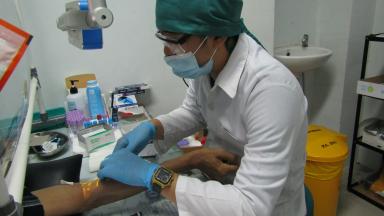
The international patient coordinator at Biruni Hospital in Istanbul is one named contact who stays with a patient from the first message through discharge and answers the same WhatsApp number afterward. Research shows nearly one in five patients has an adverse event after leaving a hospital, and a guide across the handover lowers readmissions. This page explains what the coordinator does, where the role stops, and what to put in a first message.
About This Department
International patient coordinator
Nearly one in five patients suffered an adverse event in the weeks after leaving the hospital. With a coach guiding the handover, readmissions within 30 days fell from 11.9 percent to 8.3 percent.
The riskiest moments in medical care are the handovers, when responsibility passes from one team, one building or one country to another. Researchers followed 400 patients discharged from a teaching hospital and found that 19 percent had an adverse event within about three weeks, two thirds of them related to medicines (Forster and colleagues, Annals of Internal Medicine, 2003). A randomized trial of 750 older patients then showed that a single guide who stayed with the patient across settings lowered readmissions (Coleman and colleagues, Archives of Internal Medicine, 2006). For someone traveling abroad for treatment, the international patient coordinator is that guide. This page explains what the coordinator at Biruni Hospital in Istanbul does, what falls outside the role, and how to get the most from it.
19
Percent of patients with an adverse event in the weeks after discharge
8.3
Percent readmitted within 30 days with a transition coach, against 11.9 without
7
Languages spoken in the international patients office, with interpreters for others
Free
Review of your reports by the relevant specialists
The international patients office assigns one coordinator with your first message, and that person stays with you through discharge. The same WhatsApp number keeps working once you are back home. The work falls into four periods.
1
Before you travel
Collects your reports, passes them to the right specialists, returns their written opinion, and sends the invitation letter that consulates request with a visa application.
2
Arrival
Arranges the airport transfer, accommodation near the hospital for relatives and daily transport, and confirms the schedule of first appointments.
3
During care
Books interpreters, keeps appointments in sequence, relays requests about meals, prayer and a female physician, and keeps the family informed with your permission.
4
Afterward
Makes sure you leave with the right documents, and remains the route for questions to the medical team once you are home.
Where the role stops
Coordinators organize and communicate. Knowing the limits of the role protects the patient.
1
No medical advice
Questions about diagnosis, doses, risks or symptoms go to the doctor. The coordinator carries the question and brings back the answer, in writing where it matters.
2
No consent on your behalf
Only you, or your legal representative, can agree to treatment, and only after the doctor has explained it to you through an interpreter.
3
No promises about results
Any outcome quoted to you should come from the treating doctor and refer to your own case.
Expect to hear "I will ask the doctor" often. It marks someone doing the job properly.
The handover nobody sees
Much of a coordinator's day is spent on joins. A scan booked for ten has to finish before the surgeon's clinic at eleven, the interpreter has to be in the room for both, the driver has to know that the patient cannot climb stairs, and the hotel has to hold the room two nights longer because the doctor wants one more blood test. Each of these is trivial alone. Together they decide whether a week abroad feels orderly or chaotic, and whether the patient arrives at each conversation rested enough to take it in. The same applies to information. Results come back from different departments at different hours, and somebody has to notice when one is missing before the consultation that depends on it. Patients at home do this work themselves, with a phone, a car and a lifetime of knowing how their own system behaves. Abroad they have none of those, and the coordinator stands in for all three.
Good coordination is mostly invisible. You notice it when it is absent.
Your first message
A complete first message saves days. Send it by WhatsApp or email and include the following.
Who you are. Name, age, country and the language you prefer.
What is wrong. The diagnosis if you have one, or the symptoms and how long they have lasted.
What has been done. Reports, scans, operations and current medicines with doses.
What you are asking. A second opinion, a specific treatment, or advice on options.
Practical limits. Dates you can travel, who will come with you, and whether an insurer or sponsor is involved.
Do my reports need to be translated first?
No. Send them as they are. The office works in English, Arabic, French, Russian, Serbian, Romanian and Spanish and arranges translation of other languages when the doctors need it.
Is my information kept private?
Medical files are shared only with the clinicians reviewing your case. Tell the coordinator if any relative should not receive information about you.
How soon will I hear back?
Timing depends on how complete the file is and how many specialists need to read it. Ask the coordinator for an expected date when you send it.
In reply you receive a written answer covering these points.
The medical opinion. What the specialists recommend and why.
The plan. Tests to repeat, expected nights in the hospital, and days to remain in Istanbul afterward.
The estimate. What is included, and how extras would be charged.
Why one contact matters
Of the 400 patients followed after discharge, 76 had an adverse event. Reviewers judged about a third of those events preventable and another third capable of being made less severe.
Most of the harm in that study came from medicines, from doses changed in the hospital and never explained, tablets continued that should have stopped, and side effects nobody had warned about. None of this is exotic. It happens whenever a patient leaves one system for another and the information does not follow, and crossing a border widens the gap. The Colorado trial tested a simple remedy. Patients were given a personal record, were coached to ask questions and to know their warning signs, and had one named person who stayed in touch across the move, and readmission at 30 days fell from 11.9 percent to 8.3 percent, with the benefit still visible at 90 days. Cancer care has used a similar figure for thirty years under the name patient navigator, and a review in CA, the journal of the American Cancer Society, found growing evidence that navigators improve uptake of screening and called for more research on their effect during treatment (Paskett and colleagues, 2011).
The evidence favors continuity. Through the coordinator, a hospital supplies it to someone from abroad.
Working together
1
Name one family spokesperson
Messages from five relatives produce five versions of the answer.
2
Put requests in writing
A short message leaves a record that the next shift can read.
Tell the coordinator what worries you most. Fear of needles, a relative arriving late or a meal you cannot eat can seem too small to mention, and small things are the easiest of all to fix.
3
Check the documents before you leave
Summary in English, medicines by generic name, operation note, pathology, images, and the letter confirming you are fit to fly.
4
Send an update in the first week at home
A line on how you are, and any question from your own doctor.
Keep the WhatsApp thread. It holds the dates, names and decisions of your whole treatment in one place.
When something goes wrong
Tell the coordinator first and tell them plainly. Delays, a misunderstanding with a member of staff, an unexpected charge or a symptom that worries you at the hotel all go through the same channel, and the coordinator either resolves the matter or takes it to the person who can. For anything medical and sudden, such as chest pain, heavy bleeding, breathlessness or a high fever, go straight to the emergency department and message the coordinator on the way. If a concern is not settled, ask for it to be passed to the head of the international patients office and ask for the reply in writing. Hospitals learn from complaints only when they are recorded.
Language and custom
Coordination means translating more than words. Families differ in who is told bad news first, in how decisions are shared, in whether a woman prefers a female doctor, in what may be eaten and when prayer falls, and a hospital that serves patients from many countries has to ask about these instead of assuming. At Biruni Hospital the kitchen prepares halal, vegetarian and diabetic meals, a prayer room is on site, and a request for a female physician goes to the department and is met wherever the rota allows. On the ward a companion bed lets one relative stay overnight. State your preferences at the start. Staff would much sooner be told than guess, and a preference stated on day one is far easier to honor than one discovered on day four. The coordinator passes it to everyone who needs to know, so you say it once.
Professional interpreters, and never relatives, should handle consent and discharge instructions.
Cost
Review of your reports costs nothing. The written estimate that follows lists what the treatment price includes.
Hospitals in this market build coordination into the care of international patients and charge separately for third-party services such as hotels and private transport. Confirm which applies to each item on your plan.
References
Forster AJ, Murff HJ, Peterson JF, Gandhi TK, Bates DW. The incidence and severity of adverse events affecting patients after discharge from the hospital. Ann Intern Med. 2003;138(3):161-167.
Coleman EA, Parry C, Chalmers S, Min SJ. The care transitions intervention: results of a randomized controlled trial. Arch Intern Med. 2006;166(17):1822-1828.
Paskett ED, Harrop JP, Wells KJ. Patient navigation: an update on the state of the science. CA Cancer J Clin. 2011;61(4):237-249.
Editor's note
Written by the Biruni Hospital medical editorial team. Reviewed by Assistant Professor İsmail YILDIZ, Anesthesia and Reanimation.