
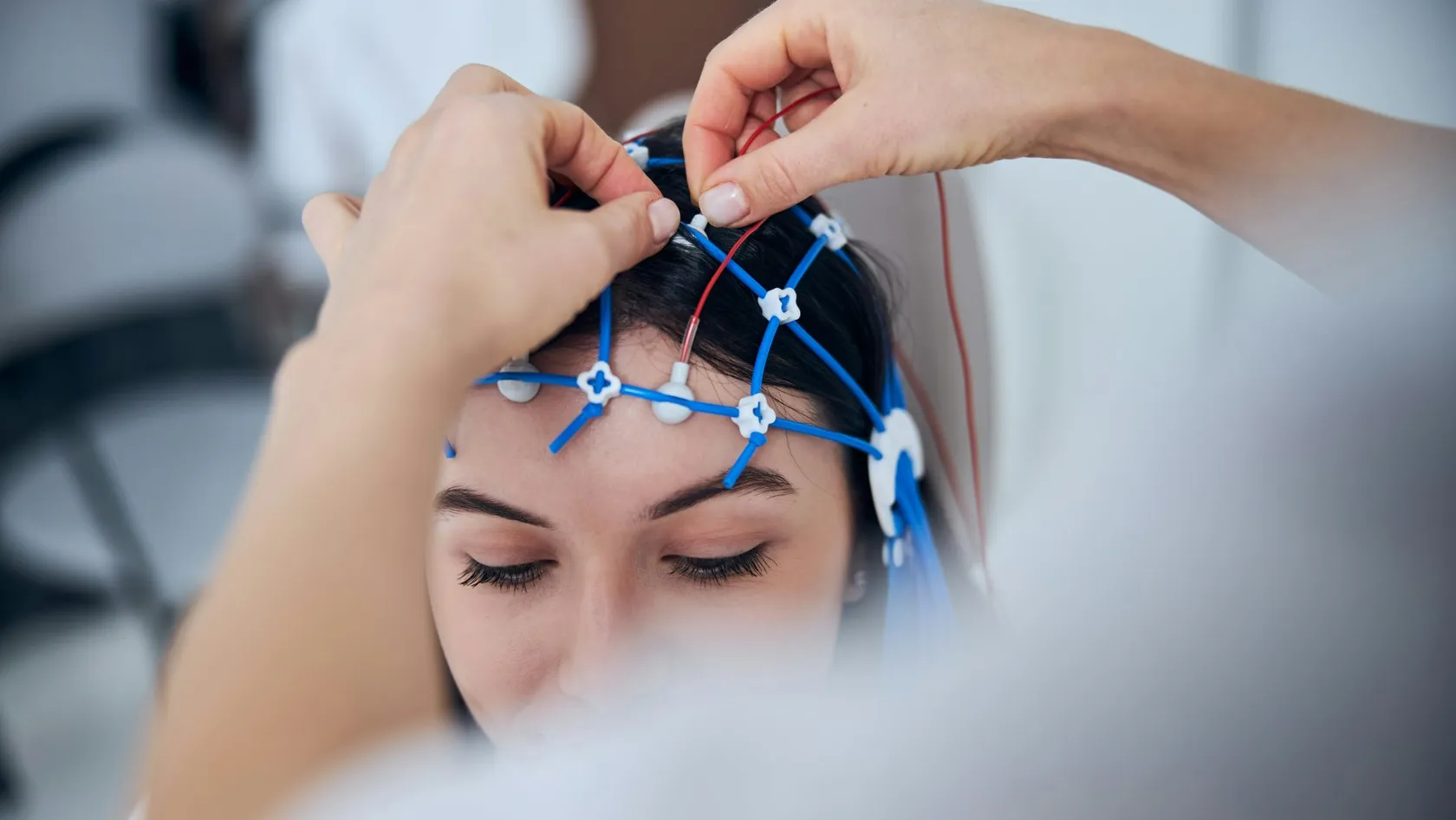
Deep Brain Stimulation Surgery - DBS Surgery
Stimulation does not slow Parkinson's disease down, and what it gives back is hours of the day when the medication is working without the writhing that used to come with them. This page sets out who qualifies, what the trials actually measured, how the two targets trade against each other, and what the hardware asks of you for the rest of your life.
About This Department
Deep brain stimulation does not slow Parkinson's down. What it gives back is hours.
Hours in the day when the medication is working, without the writhing that used to come with them. Knowing how many hours you stand to gain, and what you trade for them, is the entire decision.
What deep brain stimulation actually does
Two thin electrodes go into a target a few millimeters across, deep under the surface of the brain. A wire runs from each one under the scalp and down the side of the neck to a battery pack sitting below the collarbone. The battery sends a continuous pulse into that target, twenty four hours a day, for years.
Nothing comes out. Nothing gets destroyed.
A circuit that has started firing in the wrong pattern gets flooded with a signal that overrides the pattern, and the tremor or the stiffness or the writhing quiets down while the current is on. Switch the device off and everything comes back within minutes to hours. That reversibility explains why stimulation replaced the lesioning operations that came before it, and it explains why the treatment then demands a lifetime of maintenance that a one time operation never asks for.
Read the first sentence of this page again, since it is the sentence people arrive without. Parkinson's carries on progressing underneath the stimulation, at its own pace, indifferent to the hardware.
Who it is for
Candidates sit inside a narrow band. Neither the person diagnosed last month nor the person whose Parkinson's has stopped answering to medication altogether will be offered this operation, and both ends of that range get turned down, and being turned down at assessment is a real outcome that deserves saying out loud before you book a flight anywhere.
The shape of a good candidate
What teams look for is a patient whose medication still works well, and whose problem is that it stops working several times a day. The off periods arrive before the next dose is due, the on periods bring involuntary writhing movements called dyskinesia, and the day has broken into good hours and bad hours that no adjustment of the tablets seems able to smooth out. Thinking and memory need to be intact, since stimulation makes cognitive decline worse rather than better. Depression and any untreated psychiatric illness get addressed first.
Screening therefore runs wider than most people expect. A movement disorder neurologist confirms the diagnosis first, since several conditions imitate Parkinson's in its early years and none of the imitators respond to stimulation, and formal memory testing, a psychiatric assessment and an anesthetic review all sit between your first consultation and a surgical date.
Age alone rarely decides it. Frailty and cognition do.
The levodopa challenge, and what it predicts
One test does more work than every scan in your file. You come to clinic having skipped your medication overnight, get examined in that state, take a large dose of levodopa, and get examined again once it has taken hold. The two scores are compared.
Your best hour is the ceiling
Whatever separates those two examinations is roughly what stimulation can deliver. A patient who improves dramatically on levodopa has a great deal to gain, because DBS aims to hold you near your best medicated state for most of the day rather than for two hours after each tablet. A patient who barely improves has far less to gain, and a poor levodopa response stands as one of the commonest reasons a team declines to operate on somebody who has flown a long way to ask. Tremor breaks that rule, since a tremor that ignores medication frequently answers to stimulation anyway.
Nobody can promise you more than your own best hour, and any center that does is selling something, so get your levodopa response given to you as a number and then get somebody to say what that number means for the result you should expect.
What the first randomized trial measured
In 2006 a German group published the study that settled the argument for advanced disease. A total of 156 patients under 75 with severe motor complications were randomized in pairs to stimulation of the subthalamic nucleus plus medication, or to the best medical management their neurologists could arrange, and were compared at six months on quality of life and on motor severity measured off medication.
- Quality of life on the PDQ-39 questionnaire improved by a mean of 9.5 points more with stimulation, and motor severity off medication improved by 19.6 points more.
- The gains sat in the subscales patients care about, with improvements of 24 to 38 percent in mobility, daily activities, emotional wellbeing, stigma and bodily discomfort.
- Serious adverse events ran higher with surgery, 13 percent against 4 percent, and one patient died of a bleed inside the brain.
Read the last line with the others
One death belongs in the same paragraph as the 9.5 points, because both came out of the same 156 patients, and reading either figure on its own produces a distorted picture of what was actually measured. The overall count of adverse events ran higher in the medication group, 64 percent against 50 percent, which tells you that leaving advanced Parkinson's to tablets carries a bill of its own that simply arrives in smaller installments. Neither column sits empty. You are choosing which set of risks you would rather carry.
Doing it earlier than the field expected
For years DBS was held back as a last resort, offered to people who had exhausted everything else, by which point many were too frail or too cognitively affected to qualify. A trial published in 2013 tested whether that instinct was wrong. It enrolled 251 patients with a mean age of 52 and a mean disease duration of 7.5 years, all of them with motor complications that had only recently started, and followed them for two years. Quality of life improved by 7.8 points in the stimulation group and drifted 0.2 points worse in the medical group, a between group difference of 8.0 points, and motor disability, daily activities, drug induced complications and time spent moving well without dyskinesia all favored surgery as well. Those patients were roughly a decade younger than the ones in the 2006 study and had lived with the diagnosis for half as long, which is precisely what made the result uncomfortable for a field that had spent years telling people to wait.
Nothing was hidden in the cost column. Serious adverse events occurred in 54.8 percent of the stimulation group against 44.1 percent on medication, and 17.7 percent of patients had a serious event tied directly to the implant or the operation itself. A younger patient has more years to gain from those good hours and more years in which the hardware can fail. Both of those are true at once. Both belong in your consent conversation.
STN or GPi, and why the choice matters
Parkinson's uses two targets. The subthalamic nucleus, which everyone shortens to STN, and the internal globus pallidus, which everyone shortens to GPi. Clinics frequently describe that choice as technical and leave it there, which does patients no favors at all, because the two targets trade against each other in a way you can hold an informed opinion about.
On movement they tie
A multicenter randomized trial followed 89 GPi patients and 70 STN patients for three years. Motor scores off medication improved from 41.1 to 27.1 in the GPi group and from 42.5 to 29.7 in the STN group, and the difference between targets was not significant at any point across those 36 months. Quality of life rose in both groups at six months and then eased back as the underlying disease carried on regardless. On movement, in other words, the two targets tie.
The difference lives somewhere else.
So the question is what you are protecting
Somebody whose life is being wrecked by dyskinesia driven by a high levodopa dose, with sharp thinking, leans one way. Somebody already borderline on memory testing leans the other. Bring the target question to your consultation as a question, since it deserves a reasoned answer with your own test results in it.
What DBS does not fix
Symptoms that stopped answering to levodopa years ago will not start answering to stimulation. That single rule explains most of the disappointment that follows this operation.
The list nobody reads out
Freezing of gait that persists in your best medicated state tends to persist afterward. Balance and falling continue. Speech can get quieter or more slurred rather than clearer, and dysarthria sits among the commonest side effects reported across every one of these trials. Swallowing, blood pressure drops on standing, constipation, bladder urgency, sleep disturbance and low mood belong to the parts of Parkinson's that stimulation was never designed to reach. Memory does not improve, and at the STN target the measured trend runs the other way. Sleep may improve, and often does, because a night broken by stiffness and by the wearing off of a night time dose is a night stimulation can genuinely repair. None of that means the operation failed, and it means the operation was aimed at a different set of symptoms than the ones now bothering you, which is a distinction worth drawing before surgery because it becomes almost impossible to draw afterward.
Essential tremor
Parkinson's brings only part of the queue for this operation. Essential tremor counts as a separate condition entirely, it turns up far more frequently in the population, and it answers to stimulation of a thalamic target in a way that tends to impress everyone standing in the room.
Why tremor programming is the quick oneTremor answers within seconds of the current being adjusted, so the person doing the programming can see the effect of each change while making it. Parkinson's rigidity and dystonia take days or weeks to settle into a new setting, which is why those two need far more visits and far more patience. A tremor patient can be close to their final settings after a handful of sessions, while a dystonia patient may still be climbing toward the full benefit several months in.
Handwriting, a cup of tea, a spoon of soup. People measure it by those, and they measure it correctly.
Dystonia and the rest of the list
The trial that put pallidal stimulation on the mapForty patients with primary generalized or segmental dystonia had devices implanted, then were randomized so that half received real stimulation and half received none for three months, with assessors watching video and unaware of who was who. Movement scores fell by 15.8 points in the stimulated group and by 1.4 points in the sham group. Once everyone was switched on the sham group caught up, and the improvement in the first group held. Twenty two adverse events occurred in 19 patients, including four infections at the site of the stimulator and one electrode that moved out of position, and the commonest side effect was slurred speech.
Where the evidence thins out
Stimulation also treats severe obsessive compulsive disorder and some forms of epilepsy, and it remains under study for depression, addiction and Tourette syndrome, though every one of those uses sits on a far smaller body of evidence than Parkinson's, tremor and dystonia, carries stricter selection criteria, and in several countries requires approval from a committee before anyone operates. A center that offers you stimulation for a psychiatric condition as though it were routine has told you something useful about that center.
What the operation involves
Then the second stage
Generators go in under the skin below the collarbone, joined to the two wires by a connector that sits behind the ear. Some teams do this in the same sitting, others wait one to three weeks, and that second stage runs well under an hour, happens fully asleep, and sends many patients home the same day. Published figures put the electrode stage at four to six hours awake and rather less under general anesthetic, with one or two nights in hospital afterward.
Awake or asleep
Patients dread this part more than any other. Being awake here means being awake and talking, with no pain in it, because the brain carries no pain receptors of its own and the scalp gets numbed thoroughly before a single instrument comes near it, which is why the dread almost always runs worse than the thing itself. What you are asked to do is move an arm, count aloud, or say when something starts to feel strange.
The room is calmer than you are picturing
Drapes screen the working area, a nurse sits where you can see and hear them, and the parts that sound alarming turn out to be the parts you cannot feel at all. Most of the hours pass in quiet conversation broken by short bursts of testing.
Why anyone would choose to stay awake
Because the surgeon gets to watch your own rigidity melt as the current goes up, and gets to stop before the setting starts pulling at your face, which is a piece of information no scan can supply. Asleep surgery trades that live feedback for imaging accuracy and for a far more comfortable few hours, and both approaches sit in wide use with good published results behind them. Which one a center offers comes down to how that center is set up more than to any verdict on your particular case, so ask early if the answer matters to you.
Switching it on, and the months that follow
Nobody switches the device on in the operating room. Swelling around the electrodes produces a temporary improvement all by itself, sometimes a striking one that raises hopes it cannot keep, and programming through that would give a false reading, so most teams wait two to four weeks before the first session.
Programming makes a good result, or fails to make one, because the operation only places the electrode and everything that happens in the months afterward decides what that electrode actually does for you.
Ask who does it, and how often.
Risks specific to DBS
Bleeding along the track an electrode takes is the risk everyone thinks of first, and it produced the single death in the 2006 trial, at rates that every published series describes as low. Low never means zero.
Infection behaves differently here from the way it behaves after other brain surgery, because foreign material sits under the skin in three separate places and a hardware infection frequently ends with the whole system coming out, a course of antibiotics, and reimplantation months later. Four stimulator site infections turned up among the forty patients in the dystonia trial. Electrodes can shift, wires can break where they cross the neck, and skin can wear thin over the generator. Any of those means another operation, which is the reason a stimulator is described as a relationship with a hospital rather than as a single procedure. Then come the effects of the stimulation itself, a different category entirely, because slurred speech, tingling, pulling in the face or hand, blurred or double vision, unsteadiness, and changes in mood or impulse control all appear at particular settings and all disappear again when those settings change. That adjustability is why the programming months carry the weight they do.
Report a change in mood or spending or gambling the way you would report a fever.
Living with the hardware
The battery is a lifelong commitment
Every patient with a stimulator eventually needs the generator changed, and knowing which kind you are being offered belongs in the conversation while you can still choose. A rechargeable unit means a charging routine for the rest of your life and far fewer operations, while a non rechargeable one means nothing to remember and a small operation every few years. Neither choice is wrong. They are different bargains, and the right one turns on whether you would sooner manage a daily habit or a series of small operations spread across the coming decades.
This table scrolls sideways on a narrow screen. Swipe or drag to see every column.
| Type | How long it lasts | What it asks of you |
|---|---|---|
| Non rechargeable | Roughly three to five years, shorter at high settings | A replacement operation of thirty to sixty minutes each time it runs down |
| Rechargeable | Roughly ten to fifteen years | Charging through the skin on a regular schedule, and the discipline to keep it up |
| Both types | Electrodes in the brain normally stay for life | Only the generator is swapped, so the head is not reopened |
Daily life needs less adjustment than people fear. Airport security arches can trigger, so you carry an implant card and ask for a hand search, while household electronics, phones and induction hobs cause no trouble at a sensible distance, and MRI scanning remains possible under conditions the manufacturer sets out for your exact model, which means any future scan needs that model number in advance and diathermy during other surgery has to be avoided altogether. Never let a dentist or a surgeon proceed without knowing the device is there. Say it before they pick anything up. Keep that card in your wallet where it travels with you, because the moment you will need it is the moment nobody planned for, and a radiographer who cannot identify your model will cancel the scan sooner than guess at it.
Recovery, and when you can fly home
Recovery from the surgery itself is faster than most people expect, because the openings are small and no brain tissue has been removed, while recovery of your symptoms is the slow part, and confusing the two is what makes the first month after this operation feel like a mistake.
Bring somebody who can hold that timeline in their head while you cannot.
- Days one and two. One or two nights in hospital, a confirmation scan, headache and a sore scalp, and a device that is still switched off.
- The first two weeks. Ordinary daily activity comes back almost immediately, with no heavy lifting and no vigorous exercise. Stitches or clips come out around day ten to fourteen.
- Weeks two to four. The generator goes in if it was staged, and the first programming session happens once the swelling has settled and the wounds are clean.
- Weeks four to six. Full activity for most people, with settings still climbing and medication still coming down. Fatigue in this window is normal.
- Months three to six. Settings hold, the medication reaches a new steady dose, and what you have actually gained becomes clear enough to judge. Judge it then, and not before.
Clearance to fly normally comes at the wound review around day ten to fourteen, once the scalp is dry and no infection has appeared, and your surgeon writes a dated fitness to fly opinion for the airline and the insurer. Plan on two to three weeks in the country for the surgery and the wound check. Leaving at that point means leaving before your device has been programmed.
Cost, coordination, and having DBS in Istanbul
No price appears anywhere on this page, because a figure written today would be wrong by the time you read it. Where the money goes can be described, and for this operation the shape of it surprises people, since the implanted hardware forms the largest single line and the choice between a rechargeable and a non rechargeable generator moves the total further than the surgery itself does. Patients travel to Biruni Hospital for stimulation from Europe, the Gulf, North Africa and Central Asia, and the honest difficulty of doing this abroad has very little to do with the operation.
The difficulty lives in the year that follows.
This table scrolls sideways on a narrow screen. Swipe or drag to see every column.
| Line | Usually inside a package | Worth asking about by name |
|---|---|---|
| Hardware | Electrodes, extensions and the generator, named by brand and model | Rechargeable or not, and what the future replacement will cost |
| Hospital | Both operative stages, the nights, scans and medication | The per night rate if the stay runs long |
| Programming | The first session, and often the ones during your stay | Who does sessions two through six, and where |
| Travel | Hotel and transfers for you and one companion | Flights, visa costs and any return trip for programming |
Row three decides how this ends. A device that nobody adjusts stays set to whatever it was left on, and a patient flying home with an unprogrammed stimulator has bought hardware without buying the treatment, so before you travel, find out whether a neurologist near you programs stimulators and which brands they handle. Where no such clinic exists, the plan becomes a return visit at around three months, or remote sessions run with your local neurologist alongside, and either arrangement belongs in writing before surgery rather than being improvised afterward. Staff in the international patients office work in English, Arabic, French, Russian, Serbian, Romanian and Spanish, with interpreting arranged for other languages on request. One coordinator carries you from the first message through to discharge and stays reachable on WhatsApp once you are home, which is what makes a settings question at month four answerable. Rooms include a companion bed so one person stays every night, hotel and transfers are arranged either side of the admission, a female physician can be requested, an invitation letter for the visa goes out around ten days before travel, halal and vegetarian and diabetic meals are routine, and a prayer room is open on site.
Send your scans, your medication list with doses and timings, and a short video of yourself in an off period and an on period, because that package tells a functional neurosurgeon more than any referral letter ever manages to and it takes an afternoon with a phone to put together. The review costs nothing. A candid answer that you are not a candidate carries as much value as an offer of surgery.
DBS surgery FAQ
Does DBS cure Parkinson's disease?
Will I be awake during the operation?
Can I stop my Parkinson's medication afterward?
How long is the operation and the hospital stay?
When will I notice a difference?
Can I have an MRI scan afterward?
Who will adjust my settings once I am home?
Written by the Biruni Hospital medical editorial team. Reviewed by Dr Yunus Emre Yavuz, Neurosurgery.
References
- Deuschl G, Schade-Brittinger C, Krack P, Volkmann J, Schäfer H, Bötzel K, et al. A randomized trial of deep-brain stimulation for Parkinson's disease. New England Journal of Medicine. 2006;355(9):896-908.
- Schuepbach WMM, Rau J, Knudsen K, Volkmann J, Krack P, Timmermann L, et al. Neurostimulation for Parkinson's disease with early motor complications. New England Journal of Medicine. 2013;368(7):610-622.
- Weaver FM, Follett KA, Stern M, Luo P, Harris CL, Hur K, et al. Randomized trial of deep brain stimulation for Parkinson disease. Thirty-six-month outcomes. Neurology. 2012;79(1):55-65.
- Wang JW, Zhang YQ, Zhang XH, Wang YP, Li JP, Li YJ. Cognitive and psychiatric effects of STN versus GPi deep brain stimulation in Parkinson's disease. A meta-analysis of randomized controlled trials. PLoS One. 2016;11(6):e0156721.
- Kupsch A, Benecke R, Müller J, Trottenberg T, Schneider GH, Poewe W, et al. Pallidal deep-brain stimulation in primary generalized or segmental dystonia. New England Journal of Medicine. 2006;355(19):1978-1990.
Editor's note
Written by the Biruni Hospital medical editorial team. Reviewed by Assoc. Prof. Dr. Melih ÜÇER, Neurosurgery.
Medically reviewed by
Assoc. Prof. Dr. Melih ÜÇER
Neurosurgery
Related Treatments
View All
ALIF - Anterior Lumbar Interbody Fusion Surgery
Coming in from the front restores the curve of the lower back better than any posterior route and leaves the back muscles untouched. It also carries one risk most pages will not name, and this page names it.
Brain AVM Surgery - Arteriovenous Malformation Surgery
An unruptured brain AVM bleeds at roughly 2.2 percent a year, and surgery spends its whole risk on a single morning. This page sets those two shapes of risk side by side, explains what the ARUBA trial does and does not say about your case, and shows how a Spetzler-Martin grade changes the answer.
Brain Tumor Surgery - Brain Tumor Removal
Brain surgery is one trade repeated all day, how much tumor comes out against what the brain around it still does. This page puts the published numbers on both sides of that trade.
Cervical Microdiscectomy - Minimally Invasive Neck Disc Surgery
Neck disc surgery is done from the front, through the space between your windpipe and your carotid artery, and almost everything that goes wrong that is not the disc happens in that corridor. What has been measured in it.
Chiari Malformation Surgery
A Chiari malformation is measured in millimeters and treated according to symptoms, and those two things come apart more often than patients are told. Most people with the finding never need an operation. This page sets out who does, what posterior fossa decompression removes, why surgeons still argue over opening the dura, and what the pooled studies say about both sides of that argument.