The Radiation Oncology Center of Biruni Hospital Istanbul explains how long radiotherapy really takes, one week breast courses, side effects and costs.
Let us call you
Send us your contact information and we will call you as soon as possible.
About This Center
Roughly half of all people treated for cancer receive radiotherapy at some point, and it is the part of cancer care that looks hardest to move abroad, because the textbook version means a session every weekday for five, six or seven weeks. For several common cancers that picture is out of date. This page explains what the Radiation Oncology Center at Biruni Hospital in Istanbul treats, why the first days after arrival produce no visible treatment at all, and which published trials have compressed courses that once took a month into five visits or fewer.
Free consultation
Find out how many sessions your case actually needs before you book a flight
The remote file review is free and puts you under no obligation. Send your pathology report, your staging imaging (PET, CT or MRI reports), a summary of prior treatment, and the records of any earlier radiotherapy with the doses stated, and a radiation oncologist replies in writing with the proposed technique, the expected number of fractions and the total days you would spend in Istanbul.
What the Radiation Oncology Center treats, and where radiotherapy fits
Radiotherapy destroys cancer cells with precisely shaped high-energy beams while sparing the healthy tissue around them. The sparing works through two mechanisms. Geometry is the first: beams enter from many angles and overlap only inside the tumor, so the surrounding organs each receive a fraction of the dose the target does. Fractionation is the second, and it is the reason courses are split into daily sessions at all: normal cells repair radiation damage between sessions better than cancer cells do, so dividing the dose widens the gap between the harm done to the tumor and the harm done to you.
The Radiation Oncology Center at Biruni Hospital treats adults whose cancer plan includes radiation in any of its roles. Curative radiotherapy is given on its own for some tumors, combined with chemotherapy as chemoradiation for others, and after surgery to lower the risk of recurrence in cancers such as breast cancer. Palliative radiotherapy has a different goal: shrinking a tumor that causes pain, bleeding or pressure on a nerve or airway, in short courses designed around comfort rather than cure.
Modern radiation oncology works with a recognized toolkit. Intensity-modulated radiotherapy (IMRT) sculpts the dose around irregular shapes, image guidance (IGRT) checks the target position before each session, stereotactic radiosurgery (SRS) and stereotactic body radiotherapy (SBRT) deliver very high doses in one to five sessions with millimeter precision, and brachytherapy places a sealed radiation source directly inside or against the tumor. Which of these your case needs is a planning decision, and it drives both the fraction count and the price.
One boundary is worth drawing early: radiation delivered from a machine outside the body belongs to this center, while radiation given as an infusion, such as Lutetium-177 therapy, belongs to the hospital's Nuclear Medicine and Theranostics Center. The treatment decision itself is made in the hospital's multidisciplinary cancer pathway, where surgeons, medical oncologists and radiation oncologists agree on the sequence before anyone starts; this page covers the radiotherapy part of that plan. Children who need radiotherapy are treated within the hospital's pediatric pathway rather than through this adult service.
The department sits inside a university hospital of more than 600 beds, which matters in a specific way for radiotherapy patients: pathology review, PET imaging for treatment planning where it is indicated, chemotherapy for combined courses and intensive care all operate in the same building, so a plan that needs more than one specialty does not need more than one address.
The planning week between arrival and the first session
Between landing in Istanbul and lying under the machine for the first time there is a stretch of several days, sometimes a full week, in which nothing visibly happens to you. International patients regularly read this as lost time. It is the opposite: the planning phase is where the precision of the entire course is created, and every step in it exists to protect you.
1
Simulation CT
A CT scan taken in the exact position you will hold for every session. For head, neck or brain treatment a custom mask is molded to keep that position repeatable to the millimeter; for other sites a cushion or mold does the same job.
2
Contouring
The radiation oncologist outlines the tumor and every at-risk organ, slice by slice, on that scan, often merging in PET or MRI images. This is slow, expert work, and it defines exactly what gets treated and what gets protected.
3
Dose planning
Medical physicists compute the beam arrangement that puts the prescribed dose on the target while keeping each healthy organ under its safe limit, then refine it, sometimes through many versions.
4
Quality checks
Before the first beam, the plan is verified on the machine itself and the delivered dose is measured against the calculated one. Only after this does treatment begin.
Budget this week into your trip rather than resenting it. A short course of five fractions therefore usually means around two weeks in Istanbul in total, not five days.
And treat the planning phase as a quality signal when you compare centers. A clinic promising to start the beam on the day you land is not faster; it has skipped something.
How long does radiotherapy actually take? The trials that shortened it
A fraction is one radiotherapy session, one portion of the total dose. Historically most curative courses ran 25 to 35 fractions, one per weekday, which is where the six-week image of radiotherapy comes from. Over the past decade, large randomized trials have tested whether fewer, larger fractions control cancer just as well. For some of the most common cancers, they do, and that evidence has quietly rewritten the travel arithmetic for anyone considering radiotherapy abroad.
Breast cancer carries the strongest data. The FAST-Forward trial, published in The Lancet in 2020, randomized women to a five-fraction course delivered in one week against the standard three-week course, and at five years the one-week schedule was non-inferior for tumor control, with comparable late effects on normal tissue. A treatment that once anchored patients to a hospital for weeks can, for suitable patients, fit inside a single week of sessions.
Prostate cancer followed. In the PACE-B trial, reported in the New England Journal of Medicine in 2024, five fractions of stereotactic body radiotherapy proved non-inferior to conventionally fractionated or moderately hypofractionated courses for biochemical control of localized prostate cancer at five years. Five visits, spread over one to two weeks, against what used to be four to eight weeks of daily treatment.
For pain from bone metastases the compression goes further still. A systematic review of palliative radiotherapy trials by Chow and colleagues found that a single fraction relieves bone metastasis pain as effectively as a multi-fraction course. The honest caveat travels with the finding: patients treated with one fraction more often need retreatment later. For someone weighing a long trip against uncontrolled pain, one visit can genuinely be enough, with the understanding that a repeat may be needed.
Typical course lengths by situation. Your own number comes from the file review.
Situation
Typical course
What decides it
Breast, after surgery
1 to 3 weeks
Surgical and pathology details determine whether the one-week schedule fits
Localized prostate
5 fractions to several weeks
Risk group and the schedule chosen with your physician
Head and neck
6 to 7 weeks
Not compressible; shortening these courses lowers cure rates
Chemoradiation courses
5 to 7 weeks
Radiation and chemotherapy run together on a fixed weekly rhythm
Palliative pain relief
1 to 5 visits
A single fraction is often as effective for bone pain, with a higher chance of retreatment
Read the table honestly in both directions. Whether your treatment fits a short trip is a file-review question, and the answer is often better than patients fear, but not always. Head and neck courses stay long because the biology allows no shortcut, and anyone facing one of those, or a chemoradiation course, should plan to live in Istanbul for the duration rather than hoping a shorter schedule appears.
What a treatment day feels like, and the side effects to expect
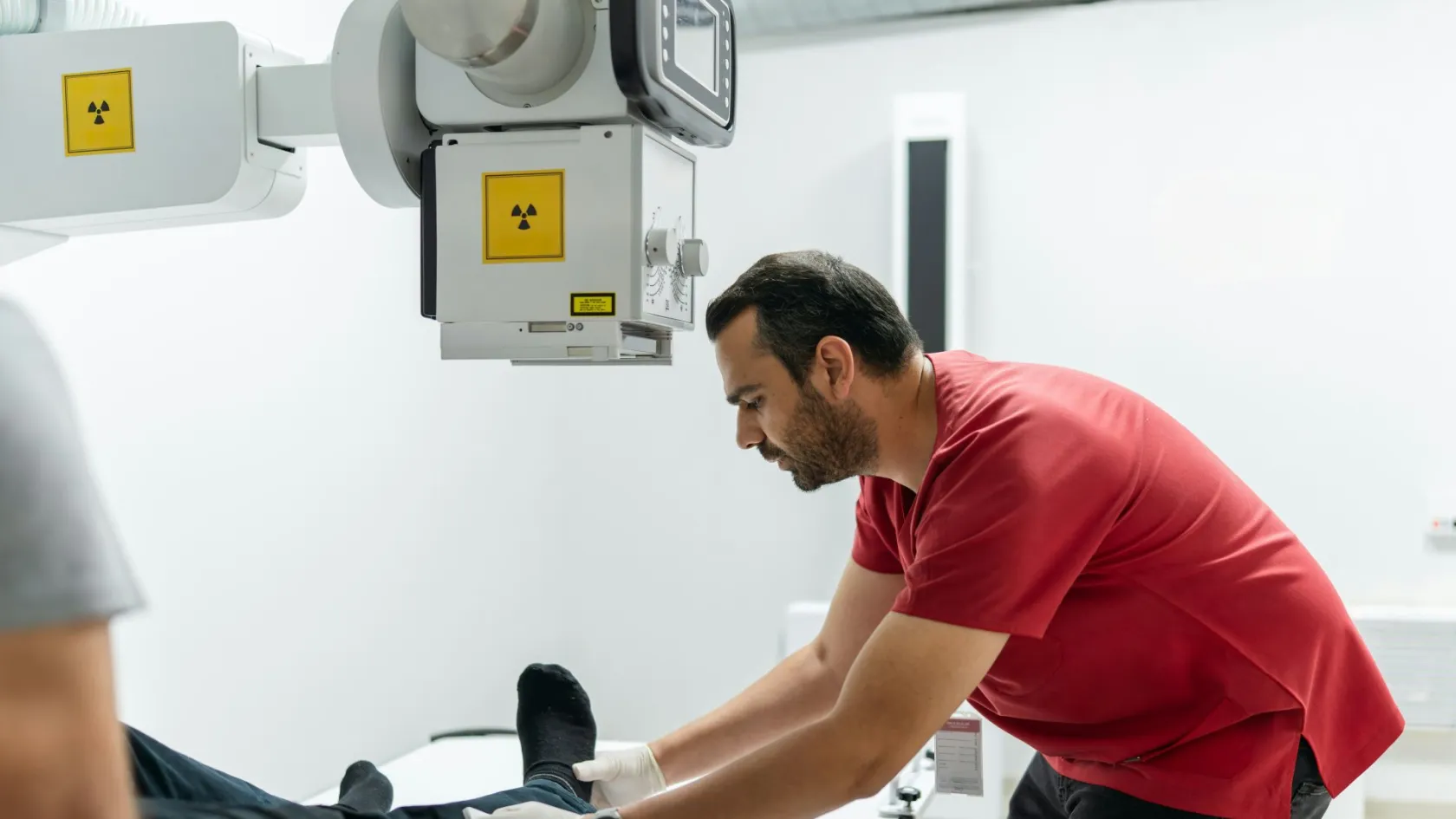
A radiotherapy session is shorter and stranger than most patients expect. You lie on the treatment table, the therapists position you against the marks or the mask made during simulation, imaging confirms the target, and the beam runs for a few minutes while the machine rotates around you. You see nothing and feel nothing during the beam. Positioning takes longer than the treatment itself, and most patients are in and out of the department within half an hour. External beam radiotherapy does not make you radioactive, so there are no restrictions around family, children or anyone else at any point in the course.
The rhythm is outpatient: one session per weekday, weekends off. Patients on multi-week courses build ordinary lives around the daily visit, and a fair number keep working remotely from their accommodation through the whole course.
Side effects build gradually rather than arriving at once, and they differ by treatment site.
Fatigue
Tiredness accumulates as the course goes on and tends to peak in the final week. It eases afterward. Feeling drained in week four does not mean the treatment is failing; it means the treatment is happening.
Skin changes
The skin over the treated area may redden, darken or peel late in the course, much like sunburn, and settles in the weeks after the sessions stop. Nurses teach skin care from day one.
Site-specific effects
Each treated region has its own pattern. Neck treatment can make swallowing sore, pelvic treatment can irritate the bowel or bladder, and your radiation oncologist goes through the exact list for your own plan before you consent. Most of these effects ease after the final fraction.
Late effects
A smaller group of changes can appear months or years later, such as tissue firmness or, rarely, damage to nearby organs. They are real, they are part of the consent discussion, and they are the reason follow-up continues long after the course.
Why missed sessions are not made up casually
Gaps in a curative radiotherapy course cost cure. Tumor cells that survive early fractions begin repopulating during unplanned breaks, and the published experience across cancer types shows that interrupted courses control disease less well than completed ones. The department protects the schedule accordingly, and you should too: do not book flights, excursions or family visits that touch a weekday during your course. The return ticket comes after the final fraction, not before.
The file review, and living in Istanbul during a course
Everything starts with documents, not travel. Five items let a radiation oncologist give you a real answer remotely: the pathology report that names your diagnosis, the reports of your staging scans (PET, CT or MRI), a summary of treatment so far including surgery notes and any chemotherapy, the technical records of any previous radiotherapy, and your current medication list.
One of those items outweighs the others if it applies to you. Records of earlier radiotherapy must include the dose details, meaning the region treated, the total dose and the fraction count, because normal tissues keep a lifelong memory of radiation and any decision about treating the same area again depends entirely on those numbers. A discharge letter that says only that radiotherapy was given at some point is not enough. Ask the original hospital for the technical treatment summary and send it with your file.
The written reply covers four things: whether radiotherapy is indicated at all in your situation, the technique proposed, the expected number of fractions, and the total time you would need in Istanbul including the planning phase, together with an itemized quote. If radiotherapy is not the right treatment for you, the reply says so, which costs you nothing to learn.
For the stay in Istanbul itself, the international patient office arranges airport transfer, provides interpreter support through consultations and treatment visits, and helps place patients on multi-week courses in long-stay accommodation near the hospital. Bring a companion if you can; a six-week course is easier with someone sharing the apartment, and the daily visit leaves most of each day free.
What you take home when the course ends
On the day of your last fraction you receive a completion summary recording the region treated, the total dose, the fraction count and the technique. Keep it for the rest of your life. It is the document a future physician anywhere in the world will need if the question of treating near that area ever arises, exactly the record this page asks you to obtain from any earlier course of your own.
Response to radiotherapy is not judged the week you fly home. Tumors continue shrinking for weeks to months after a course, so follow-up imaging is scheduled on a timeline your team sets and done back home, with the images or reports sent to Istanbul for remote review. Blood tests, where relevant, follow the same pattern.
Some symptoms after returning belong with a local doctor promptly rather than in a message thread: fever, bleeding, severe pain, difficulty swallowing that stops you drinking, or breathlessness. Seek care where you are first, then inform the team in Istanbul, and the completion summary in your hand lets any local physician understand instantly what was done.
What radiotherapy costs in Turkey
Published platform figures give a usable frame. The medical travel site Bi-maristan lists radiotherapy course totals in Turkey between 2,500 and 8,500 dollars with typical courses around 6,000 to 7,000 dollars, while EdhaCare lists a range of 3,500 to 9,500 dollars, conventional courses from about 2,980 dollars and advanced intensity-modulated courses up to about 7,000 dollars, figures those platforms present as roughly 78 percent below United States prices. Treat all of these as indicative listings compiled by booking sites, not as quotes.
Four factors move the real number: how many fractions your plan needs, the complexity of the technique (a stereotactic plan takes more physics work per fraction than a simple palliative field), the imaging wrapped around planning, and, for chemoradiation, the drug costs that run alongside. Accommodation scales with course length, so a week-long course and a seven-week course differ in living costs as much as in medical ones.
Here the evidence and the budget point the same way. A compressed, trial-backed schedule of five fractions can cost less in total, once flights and weeks of accommodation are counted, than a long conventional course quoted at a lower headline price. Whether your case qualifies for one is a question worth putting to any center you compare. Biruni Hospital states its own price only as a written itemized quote prepared after the free file review, because the honest number depends on the fraction count and technique your case needs.
Questions patients ask about radiotherapy in Istanbul
How many radiotherapy sessions will I need?
Anywhere from a single session to about thirty-five, depending on the cancer type, the goal of treatment and the technique. Breast radiotherapy after surgery can take five sessions in one week for suitable patients, selected localized prostate cancers can be treated in five stereotactic sessions, painful bone metastases sometimes need one visit, and head and neck cancers still require six to seven weeks of daily treatment. The number for your own case is set after a radiation oncologist reviews your pathology and imaging, and Biruni Hospital states it in writing before you travel.
Can breast radiotherapy really be completed in one week?
For many patients, yes. The FAST-Forward trial, published in The Lancet in 2020, showed that a five-fraction breast radiotherapy course delivered over one week was non-inferior to the standard three-week course for tumor control at five years, with comparable effects on normal tissue. Suitability depends on the details of your surgery and pathology, so the one-week schedule is confirmed only after your file has been reviewed, but it is an evidence-based standard, not a compromise.
Do I feel anything during a radiotherapy session?
No. The beam cannot be seen or felt, and the machine never touches you. A session consists mostly of careful positioning; the beam itself runs for only a few minutes. External beam radiotherapy also does not make you radioactive, so you can be around family, children and pregnant women normally throughout the course.
Can I fly home in the middle of a radiotherapy course and come back?
You should not plan to. Unplanned gaps in a radiotherapy course give surviving tumor cells time to regrow and are known to reduce the chance of cure, which is why treatment runs every weekday until the course is complete. Book the return flight for after the final session. On a course of several weeks the weekends are free, and many patients use them to rest or see Istanbul, but the weekday schedule itself is protected.
Can I have radiotherapy again after a previous course?
Sometimes, and the decision rests almost entirely on the records of the first course. Normal tissues keep a lifelong memory of dose, so a radiation oncologist can only judge whether re-irradiation is safe if the original records state the region treated, the total dose and the number of fractions. Ask the hospital that treated you for the full technical summary rather than a discharge letter, and send it with your file. Without those numbers, a safe remote answer is not possible.
What does a radiotherapy course cost in Turkey?
Medical travel platforms list full radiotherapy courses in Turkey at roughly 2,500 to 9,500 dollars depending on technique and fraction number, with typical totals around 6,000 to 7,000 dollars and advanced intensity-modulated courses toward the upper end. Those are indicative platform listings, not quotes. Biruni Hospital prepares a written itemized quote for your specific plan after the free file review, based on the technique and the number of fractions your case needs.
What should I send for the free file review?
Send your pathology report, the reports of your staging scans (PET, CT or MRI), a summary of treatment so far including surgery notes and chemotherapy, the technical records of any earlier radiotherapy with doses stated, and your current medication list. Photographed or scanned copies sent over WhatsApp are enough to start. The written reply states whether radiotherapy is indicated, the proposed technique, the expected number of fractions, the total days needed in Istanbul and the cost.
References
Murray Brunt A, Haviland JS, et al. Hypofractionated breast radiotherapy for 1 week versus 3 weeks (FAST-Forward): 5-year efficacy and late normal tissue effects results from a multicentre, non-inferiority, randomised, phase 3 trial. Lancet. 2020;395(10237):1613-1626.
van As N, Griffin C, et al. Phase 3 Trial of Stereotactic Body Radiotherapy in Localized Prostate Cancer. New England Journal of Medicine. 2024;391(15):1413-1425.
Chow E, Zeng L, et al. Update on the systematic review of palliative radiotherapy trials for bone metastases. Clinical Oncology (Royal College of Radiologists). 2012;24(2):112-124.
Editor's note
Written by the Biruni Hospital medical editorial team. Reviewed by Prof. Dr. Cemalettin ERTEKİN, General Surgery.