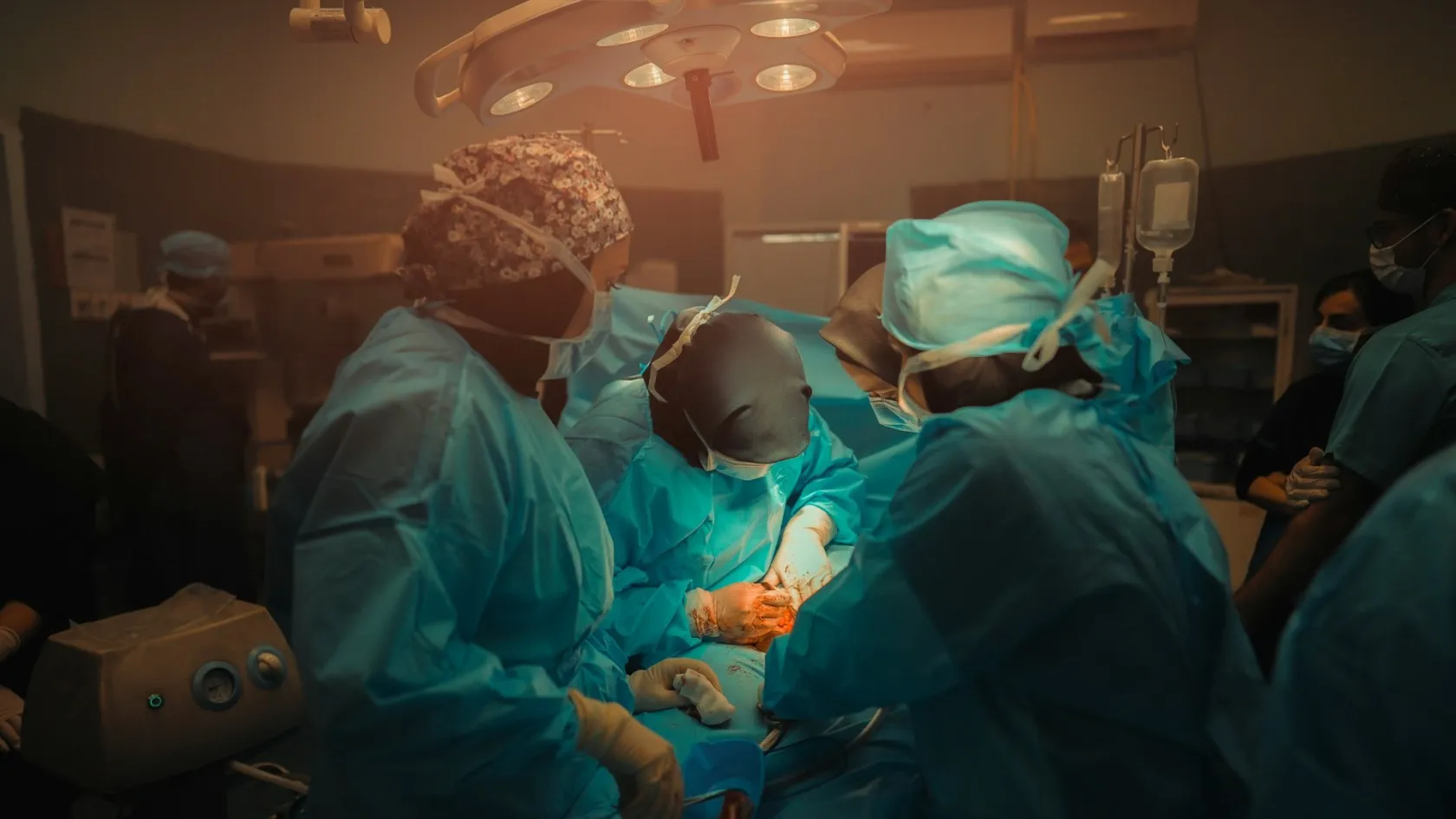
Pediatric surgery in Istanbul for hernia, undescended testis, hypospadias and circumcision, with timing evidence and a free review of your child's file.
Let us call you
Send us your contact information and we will call you as soon as possible.
About This Center
Your pediatrician has felt a bulge in your child's groin, noticed a testis that never came down, or told you that the opening of the urethra sits in the wrong place. None of this is rare. These are the common surgical conditions of childhood, almost all of them correctable in one planned operation, and this page explains how the Pediatric Surgery Center at Biruni Hospital in Istanbul handles them for traveling families: which operations are done, what the evidence says about the right age to do them, and how the whole trip fits into four to seven days.
Free consultation
A pediatric surgeon can plan your child's operation from the file, before any flight
The review is free and does not commit you to an operation. Send the ultrasound report, a clinical photo where the condition is visible, the notes from any earlier surgery, and your child's age, and a pediatric surgeon replies in writing with what the repair would involve and how many days to plan for.
What does the Pediatric Surgery Center operate on?
Inguinal hernia and hydrocele, umbilical hernia, undescended testis, hypospadias and circumcision make up most of the planned surgery of childhood, and they are the daily work of the Pediatric Surgery Center at Biruni Hospital in Istanbul. Pediatric surgeons perform every one of them inside a university hospital of more than 600 beds, which means the things a children's operation quietly depends on are already in the building: anesthesiologists of the Anesthesiology and Reanimation department who work with children, a Pediatric Intensive Care Unit for the rare case that needs it, and a Neonatology unit for surgery in the first weeks of life.
Hypospadias and the other pediatric urology repairs are planned jointly with the Urology department, so the operative strategy for a complex urethra rests on two specialties instead of one opinion. For the medical, non-surgical problems of childhood, the hospital's Children's Health and Diseases Center is the general front door. Childhood tumors are deliberately absent from this page: when imaging raises that suspicion, the case belongs to the Pediatric Hematology and Oncology Center, and any tumor surgery is planned inside that team.
When is the right age for a child's operation?
Surgery for an undescended testis should be performed between 6 and 12 months of age. That is the recommendation of the Nordic consensus published in Acta Paediatrica in 2007, and its reasoning concerns the future rather than the present: a testis left outside the scrotum through early childhood loses fertility potential that a timely operation would have protected (1).
Hypospadias carries a similar window. Weighing anesthesia risk, healing and the child's psychological development, the American Academy of Pediatrics placed elective genital surgery at roughly 6 to 12 months of age in its statement on timing (2). A boy operated on in infancy heals quickly and keeps no memory of the event.
This is the argument against postponing.
A parent who has noticed an empty scrotum or an unusual urethral opening should act during infancy, not at school age, because for these two conditions the calendar itself does part of the damage. The honest counterpart matters just as much: an older child is not too late. Both repairs are performed at every age, from infancy through adolescence, and no family should spend years comparing hospitals while the window closes. Come inside the window if you can. Come anyway if you could not.
Common conditions and when surgery is planned
Condition
Typical timing
Why then
Undescended testis
6 to 12 months
Earlier correction protects later fertility (1)
Hypospadias
Roughly 6 to 12 months
Balance of anesthesia safety, healing and development (2)
Inguinal hernia
Soon after diagnosis, at any age
A child's hernia does not close itself and can trap bowel
Hydrocele
After 12 to 18 months, if it persists
Many resolve on their own in the first year
Umbilical hernia
Around age 4 to 5, if still open
Most close without surgery in early childhood
Circumcision
Any age, under proper anesthesia
Timing is cultural or medical, not biological
How is each operation actually done?
Almost every operation in the table above takes less than an hour and, for most children, ends in discharge the same day or after one night. What differs is the anatomy each one corrects.
Groin and umbilicus
A child's inguinal hernia is not the muscle weakness seen in adults, and it is not repaired with mesh. A channel that should have sealed before birth has stayed open, and the operation closes that sac at its origin through an incision of a few centimeters, or laparoscopically. The danger is a loop of bowel slipping in and getting stuck. For that reason a child's hernia is repaired soon after it is found, not watched for years. A hydrocele, fluid collected around the testis, arises from the same channel and is corrected the same way once it is clear it will not resolve by itself. The umbilical hernia is the patient one of the group: most close on their own in early childhood, so surgery waits for the ones that persist toward school age or are unusually large.
Undescended testis
Orchidopexy brings the testis down into the scrotum and anchors it there, through a small groin incision when the testis can be felt, or laparoscopically when it cannot. The operation is a day case. Its value is invisible on the day and accumulates over decades, in fertility and in a testis that can be examined normally for the rest of the man's life.
Hypospadias and revision urology
Hypospadias repair moves the urethral opening to the tip of the penis and straightens any curvature, using the child's own tissue. Results depend on severity: an opening near the tip needs a smaller operation with reliably good outcomes in experienced hands, while a proximal opening near the base may need staged surgery. The complication worth knowing by name is fistula, a small leak along the reconstructed channel that shows itself as a second urinary stream. Fistulas occur in a minority of repairs, more after the severe forms, and each one is repairable in a further, shorter operation once the tissue has settled.
Revision hypospadias, redoing a repair that failed elsewhere, is a normal part of international pediatric urology practice. Planning starts with the operation notes from the earlier surgery, and no honest surgeon promises a one-stage fix before seeing the anatomy. Scarred tissue writes its own rules. The plan is stated after examination, not before it.
Circumcision
Circumcision at the center is done in an operating room, under anesthesia planned by an anesthesiologist for the child's age, with the same sterility and aftercare as any other procedure on this page. Families visiting Istanbul for other reasons regularly add it to their travel plans, which is entirely legitimate; the point is that it is treated as surgery, with an examined child and a controlled setting, wherever and whenever it is done.
Surgery in the newborn
Congenital anomalies that must be corrected in the first days of life, blockages of the esophagus or intestine and abdominal wall defects among them, are the most demanding work this specialty does. At Biruni Hospital these operations are carried out together with Neonatology, with intensive care before and after, and each case is planned individually rather than described in a paragraph.
Is anesthesia safe for a baby or small child?
Parents fear the anesthetic more than the operation itself, and that fear deserves a direct answer. Modern pediatric anesthesia, delivered by anesthesiologists in an equipped hospital, is safe enough that the guidelines quoted above deliberately place elective surgery in infancy (1,2); a profession worried about anesthetics in babies would have written those recommendations differently. Drugs, airway equipment and fasting rules are set by the child's age and weight, the anesthesiologist examines the child before the operation, and monitoring continues into a supervised wake-up with a parent nearby.
One planning question matters more for a traveling family than any other: whether two problems can be corrected under a single anesthetic. Frequently they can. A hernia and an undescended testis on the same side share an incision, and a circumcision can be added to another repair without extending the stay. Combining repairs this way is standard surgical planning, not a special offer, and it halves the number of trips a family has to make. Whether it fits your child is decided from the file, before travel, never on the operating table.
Why emergencies are not travel cases
Appendicitis is treated where the child is. A 2017 meta-analysis in Pediatrics found that antibiotic-only treatment of uncomplicated appendicitis works initially in many children but carries a real recurrence rate, and that appendectomy remains the standard (3). Whether your child's appendicitis is one of the cases where antibiotics are worth trying is a conversation to have with the surgical team in front of you, not across a border.
Testicular torsion is stricter still. A twisted testis survives for hours, roughly six of them, so sudden severe pain in the scrotum means the nearest capable hospital immediately, in any country. The travel described on this page is for planned, scheduled surgery only. An emergency has no itinerary.
How many days does the trip to Istanbul take?
Four to seven days covers nearly every operation on this page. The first day or two hold arrival, the surgeon's examination and the anesthesia assessment. The operation follows, with discharge the same evening or after one night for most of these procedures, and then come two or three quiet days near the hospital that end in a wound check clearing your child to fly.
Stitches in pediatric surgery are usually dissolvable, so nothing needs removing and no return visit exists just for a thread. Flying home a few days after a day-case operation is routine once the wound has been seen; a flight asks nothing of a healed groin or navel. Back home, follow-up runs on photographs: a picture of the wound sent over WhatsApp and reviewed by the operating surgeon, while your own pediatrician holds the written discharge summary. Interpreter support, airport transfer and help with accommodation are arranged through the international patient office.
What does pediatric surgery in Turkey cost?
Published figures from medical travel platforms sketch the market honestly enough. The Arabic-market platform Bi-Maristan lists hypospadias repair in Turkey at $3,700 to $4,500 including preoperative tests, with quoted averages reaching $5,500, and undescended testis surgery at $2,000 to $4,000, while Bookimed carries all-inclusive hypospadias packages around $15,000 with a four-day stay and family accommodation. The distance between those numbers is packaging, not surgery.
What moves an individual price is concrete: which procedure, whether two repairs share one anesthetic, a day case against an overnight stay, and whether this is a first operation or a revision of surgery done elsewhere, since revisions take longer and sometimes need stages. Biruni Hospital's own figure arrives as a written, itemized quote for your child after the file has been reviewed, issued before you book anything.
What should you send for the file review?
A groin or testis question needs the ultrasound report. Hypospadias assessment, in most international cases, starts from a clinical photograph taken by a parent and sent privately, because the anatomy tells a surgeon more than any description of it. Beyond those two, send the referral or clinic note, the operation notes if your child had earlier surgery, the child's age and weight, and the anesthesia history with any allergies. A complete file gets a concrete plan in reply. An incomplete one gets questions first.
Questions parents ask about children's surgery in Istanbul
Is my child too old for hypospadias repair?
No. The ideal window is roughly 6 to 12 months of age, but hypospadias repair is performed at every age, including in older boys and adolescents, with the same techniques. What changes with age is the conversation around the operation, not its feasibility. If the window has passed, the useful step is an assessment now, not further delay.
Is anesthesia safe for a baby?
Modern pediatric anesthesia in an equipped hospital is safe, which is why international guidance places elective surgery for undescended testis and hypospadias at 6 to 12 months of age. An anesthesiologist examines the baby beforehand, drugs and equipment are sized to age and weight, fasting instructions are set by age, and monitoring continues until the child is fully awake.
Can two problems be fixed in one operation?
Frequently, yes. A hernia and an undescended testis on the same side can share one anesthetic, and circumcision can be added to another planned repair. Combining them is standard surgical planning, and for a traveling family it means one trip instead of two. Whether it applies to your child is confirmed from the file before travel.
How many days do we need in Istanbul for a child's operation?
Plan for four to seven days. Arrival and the anesthesia assessment fill the first day or two, the operation itself is a day case or one night for most planned pediatric procedures, and a wound check a few days later clears the flight home. The exact count for your child's operation is put in writing before you travel.
When can my child fly home after surgery?
After the surgeon has checked the wound, which for a day-case procedure means two to four days after the operation. Stitches are usually dissolvable in children, so there is no removal appointment to wait for, and a flight places no strain on a healing groin or navel. Staged or revision repairs follow their own timeline, stated in the written plan.
What happens if appendicitis starts while we are abroad?
Go to the nearest capable hospital, wherever you are. Appendicitis and testicular torsion are emergencies treated where the child is, and torsion in particular is measured in hours. Traveling to Istanbul is for planned, scheduled operations, never for an acute abdomen or sudden scrotal pain.
How much does a child's operation in Turkey cost?
Published platform figures give the range: roughly $2,000 to $4,000 for undescended testis surgery and $3,700 to $5,500 for hypospadias repair on the platform Bi-Maristan, while all-inclusive packages on Bookimed reach about $15,000. The price for an individual child depends on the procedure, on whether repairs are combined under one anesthetic, and on whether it is a first operation or a revision. Biruni Hospital puts its own figure in writing for your child after the free file review.
References
Ritzen EM, Bergh A, et al. Nordic consensus on treatment of undescended testes. Acta Paediatrica. 2007;96(5):638-643.
American Academy of Pediatrics. Timing of elective surgery on the genitalia of male children with particular reference to the risks, benefits, and psychological effects of surgery and anesthesia. Pediatrics. 1996;97(4):590-594.
Georgiou R, Eaton S, et al. Efficacy and Safety of Nonoperative Treatment for Acute Appendicitis: A Meta-analysis. Pediatrics. 2017;139(3):e20163003.
Editor's note
Written by the Biruni Hospital medical editorial team. Reviewed by Prof. Dr. Burçak YILMAZ, Nuclear Medicine.