
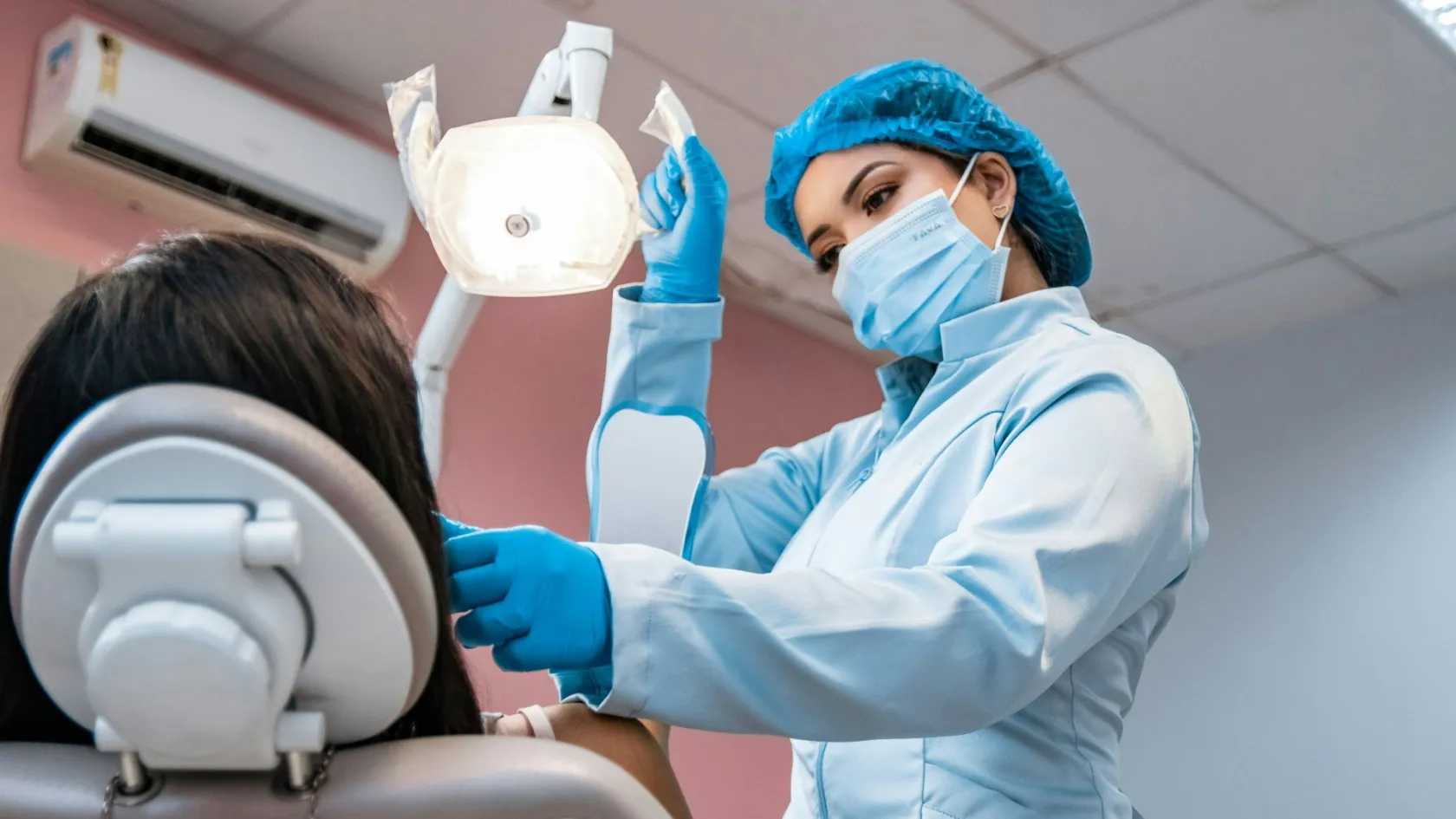
Oral & Dental Center
The difference between a dental clinic and a hospital dental center only matters on the days it matters completely. Treatment under general anesthesia for the patient who cannot face a chair awake, and a cardiologist down the corridor for the one on blood thinners.
Let us call you
Send us your contact information and we will call you as soon as possible.
About This Center
The chair is the same everywhere. What stands behind it is not.
An operating room and an anesthesiologist for the patient who cannot face treatment awake. A cardiologist down the corridor for the patient on blood thinners. The Oral and Dental Health Center covers implants, veneers, crowns, gum treatment, braces and jaw surgery, planned by one team that can read the rest of your medical file.
What Is Treated Here
Oral and dental health work divides into six areas here, and most patients need two or three of them at once rather than one on its own.
Children are seen here too. Fillings, extractions, space maintainers and preventive care, and for a very young child or one who cannot cooperate, the whole course of treatment fits into a single session under general anesthesia instead of being spread over a dozen frightening appointments.
When a Hospital Is the Right Place for Dental Work
Plenty of dentistry belongs in a clinic and there is nothing wrong with having it there. Four situations change that answer.
Severe Dental Anxiety, Treated in One Session
Patients Other Dentists Decline
Work That Crosses Specialties
Emergencies During a Stay
The single most useful thing in a first message is a photograph of your medication boxes. Anticoagulants, bisphosphonates, denosumab, immunosuppressants and steroids all change the surgical plan, and knowing them on day one prevents a cancelled appointment on day four. Send the list with the X-ray.
Implants, and the Two Trips They Usually Take
A dental implant is a titanium screw placed in the jawbone to replace the root of a missing tooth, the crown that goes on top of it comes later, and in between the two, bone has to grow onto the surface of that screw before it can carry a bite, which takes months and cannot be hurried by any technique or any material. Everything patients find confusing in implant timing follows from that one biological fact, so here it is at the start. The screw itself gives nobody any trouble. Deciding where it can safely go, how much bone stands between it and the sinus above or the nerve below, and whether the gum around it will stay healthy for twenty years is the difficult part, and all three of those are settled from a scan and an examination rather than from a photograph sent by message. That is why the first working day of an implant trip belongs to imaging.
Assessment and Imaging, One Working Day
Surgery and a Temporary Tooth, Five to Seven Days
Healing at Home, Three to Six Months
The Permanent Teeth, Three to Five Days
Some cases allow a temporary bridge to be fixed onto the implants immediately, which is what the marketing phrase teeth in a day describes, and while the technique is real it is not universal, because the condition that decides it is measured in the operating room and nowhere else. The international consensus on the All-on-4 protocol, published in the Journal of Clinical and Experimental Dentistry in 2017, states that an implant needs an insertion torque above 35 Ncm before it can be loaded immediately. If the bone that day does not give that grip, the honest thing is a removable temporary and a conventional healing period, and any center that promises fixed teeth in a day before it has seen your bone is promising something it cannot yet know. Where bone has been missing for years, it is rebuilt before or during the implant surgery, with a graft to widen a thin ridge or a sinus lift to gain height in the upper back jaw. That adds months to the timetable, and it is the most common reason a plan sent from a photograph turns out to be optimistic once a CBCT scan is read properly.
A plan drawn from your own X-ray, before you book a flight.
Send a panoramic X-ray taken within the last year, or a CBCT scan if you have one, three photographs of your smile in daylight, and your medication list. A dentist tells you which teeth can be saved, what fits into one trip, what needs a second, and how many working days you would need in Istanbul. The review carries no charge.
Veneers, Crowns, and What the Evidence Says About Materials
Survival runs high across all the ceramics. The difference between them shows up in complications, which is a better basis for choosing than a brand name in a brochure.
Ceramic laminate veneers last, and the numbers are better than most patients expect. A systematic review and meta-analysis published in the Journal of Esthetic and Restorative Dentistry in 2024 pooled 29 clinical studies and reported survival at a mean of just over ten years of 96.13 percent for feldspathic veneers, 93.70 percent for leucite-reinforced glass ceramic and 96.81 percent for lithium disilicate, with no significant difference between the materials in survival itself.
Complications Separate the Materials
Layered Ceramics Chip
Impressions here are taken with an intraoral scanner instead of a tray of impression material, the restorations are made from those digital files, and crowns and veneers are fitted before you fly home, with a trial fitting first for anything that changes the look of the front teeth, so the shape and the shade are approved by you while they can still be altered. That trial fitting matters more than patients expect, because a shade chosen from a chart under a surgery light behaves differently in daylight and against your own skin, and the only reliable test is to wear the shape for an hour and look at it in a mirror by a window. We keep the preparation minimal wherever the starting teeth allow it. Where a veneer would need heavy reduction to correct a position, alignment first and a thinner veneer afterwards is the plan that keeps the tooth, and that conversation happens before any tooth is touched rather than after.
Healthy teeth that are simply crooked or slightly discolored do not need to be ground down for crowns, since whitening, bonding and a few months of aligners often reach the same result while keeping the enamel, and enamel removed for a crown never grows back. A plan here starts from the least destructive option that achieves what you actually want. If that means we talk you out of twenty crowns, we will.
Gums Come First, and Here Is Why
Gum disease costs more adults their teeth than decay does, and it also explains why a beautiful crown fails three years after it was fitted. Bleeding when you brush is the early sign. Bone loss around the roots is the late one, and by then the tooth is loose because its foundation has gone, so treatment starts with cleaning beneath the gumline, moves to surgery only where deep pockets survive that, and continues as maintenance visits for the rest of your life. Implants get the same disease. Inflammation around an implant with bone loss is called peri-implantitis, and it is the main long-term threat to implant treatment, so two risk factors get discussed here before anyone books surgery.
Neither number is a refusal. Both give you a reason to bring your HbA1c into range before surgery instead of after it, and a reason to be told honestly what smoking does to the ten year outlook of the implants you are paying for. Maintenance carries the same weight as the surgery in this disease, so a cleaning appointment every three to six months around implants is part of the treatment and not an optional extra sold afterwards, and the schedule you leave with says exactly when each one falls due. Gum disease treated properly before implants go in also changes the surgery itself, since healthy tissue holds a suture and inflamed tissue does not, and a mouth cleaned up first heals faster afterwards. Patients who have lost teeth to gum disease once are the group most likely to lose implants to it later, which is not a reason to withhold implants from them, and it is a reason to build a maintenance plan into the quote from the beginning instead of discovering the need for one three years in.
Jaw Surgery, and Dentistry for Children
When Braces Alone Cannot Fix the Bite
An Impossible Year, or a Single Morning
Who This Suits, and Who It Does Not
- Dental fear has kept you out of a chair for years
- A medical condition or a medication makes other dentists hesitate
- Several problems at once need a sequence instead of separate appointments
- A child cannot be treated awake
- A jaw closes wrong and needs surgery as well as braces
- Teeth are missing and you want the bone assessed properly before anyone quotes
- A single filling your own dentist can do next week
- Crowns on healthy young teeth for appearance alone
- Implants in a mouth with untreated gum disease
- One short trip that ends with permanent implant crowns
- Any quote written before somebody has read a current X-ray of your jaws
Placing implants into an infected mouth means installing new hardware into an environment that is already losing bone, and a smile meant to look like a photograph of somebody else is a conversation before it is a treatment plan, because faces differ and teeth that suit one face look wrong in another. The same applies to a plan built around a single short trip when the bone will not allow it, since a promise made before the scan is read is a promise nobody can keep. Turning that down costs us a booking and saves a patient from a reconstruction that fails in the third year, which is a trade this department is happy to make every time. If you are told any of it, it costs you nothing and it has saved you from something.
Coming From Abroad, and Getting Home Again
A coordinator takes your oral and dental health file at the first message and stays with you through the last appointment.
The table below needs a sideways swipe on a narrow screen.
| Treatment | Trips | Working days in Istanbul |
|---|---|---|
| Whitening, cleaning, a filling | One | One to two |
| Veneers or crowns | One | Five to ten |
| Implants with permanent crowns | Two, separated by three to six months | Five to seven, then three to five |
| Implants needing a bone graft or sinus lift | Two, sometimes three | Decided after the CBCT scan is read |
Every treated tooth appears in standard tooth notation. The materials used, named, with the implant system and the component sizes, because a dentist anywhere needs those to service the work later. Before and after radiographs. A maintenance schedule saying when the next cleaning is due. A dentist in your own city can then handle a loose crown or a chipped veneer without guessing what was used.
Reading a Dental Quote Properly
Two quotes for the same number of crowns can describe completely different work. Five questions get you to the real comparison.
No figure appears on this page. A number printed here would be wrong for most people who read it and out of date within a season. Send the X-ray and what comes back is an itemized plan for your own mouth. Asking costs nothing.
Dental Treatment FAQ
Can I have all my dental work done in one trip?
I am terrified of the dentist. What can you offer?
I take blood thinners. Can a tooth still be taken out?
What should I send for a first opinion?
Will anyone speak my language?
What happens if something breaks after I get home?
Are dental implants safe if I have diabetes?
References
- Klein P, Spitznagel FA, Zembic A, Prott LS, Pieralli S, Bongaerts B, Metzendorf MI, Langner R, Gierthmuehlen PC. Survival and Complication Rates of Feldspathic, Leucite-Reinforced, Lithium Disilicate and Zirconia Ceramic Laminate Veneers. A Systematic Review and Meta-Analysis. J Esthet Restor Dent. 2025;37(3):601-619.
- Spitznagel FA, Balmer M, Wiedemeier DB, Jung RE, Gierthmuehlen PC. Clinical outcomes of all-ceramic single crowns and fixed dental prostheses supported by ceramic implants. A systematic review and meta-analyses. Clin Oral Implants Res. 2022;33(1):1-20.
- Li Y, Lu Z, Sun H. Impact of diabetes mellitus on the poor prognosis in patients with osseointegrated dental implants. A meta-analysis of observational studies. Biotechnol Genet Eng Rev. 2024;40(1):473-491.
- Penarrocha-Diago M, Penarrocha-Diago M, Zaragozi-Alonso R, Soto-Penaloza D. Consensus statements and clinical recommendations on treatment indications, surgical procedures, prosthetic protocols and complications following All-On-4 standard treatment. J Clin Exp Dent. 2017;9(5):e712-e715.
Start with an X-ray and a message
Send your panoramic X-ray, three photographs and your medication list. You will hear which teeth can be saved, what fits into one trip, whether a bone graft changes the timetable, and how many working days to book. Where your own dentist could do the job at home, you will hear that from us first.
Editor's note
Written by the Biruni Hospital medical editorial team. Reviewed by Assistant Professor Koray KOÇHAN, Gastroenterology.
Medically reviewed by
Assistant Professor Koray KOÇHAN
Gastroenterology
Other Medical Centers
View All-
Breast Health & Breast Cancer Center
Most people arrive having already decided which operation they want. The operation is rarely the first decision and never the one that decides most.
-
CAR-T Cell Therapy Center
CAR-T cell therapy in Istanbul for leukemia, lymphoma and myeloma. Eligibility, the five stage process, honest cost figures and how long you stay at Biruni.
-
Cellular Immunotherapy Center
Two entirely different industries use the words cell therapy. One has a regulator behind it. Four questions tell you which one you are talking to.
-
Check Up & Longevity Center
Biruni Hospital's Check-Up and Preventive Medicine Center in Istanbul plans risk based health screening by age, sex and history, with a free remote intake.
-

Children’s Health Center
The Children's Health and Diseases Center in Istanbul unites pediatric subspecialists at Biruni Hospital, with a free remote review of your child's file.