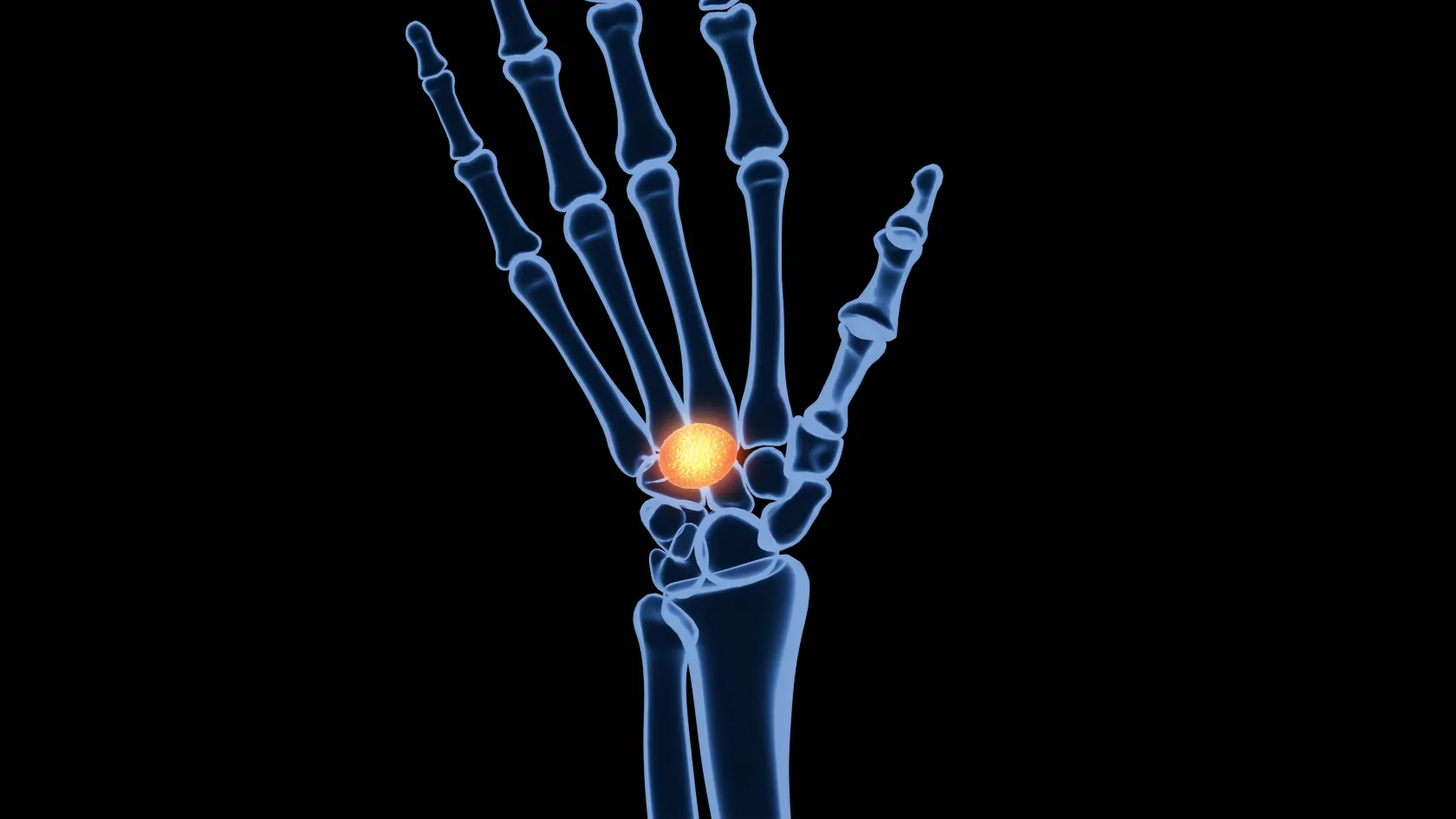
Wrist fusion surgery joins worn wrist bones so the joint stops hurting, either all of them in a total fusion or four of them in a partial fusion that keeps half the motion. This guide compares total fusion, four-corner fusion, proximal row carpectomy and wrist replacement, with results, recovery and the stay.
About This Department
Orthopedics
Wrist fusion stops the pain of a worn wrist for good. Partial fusion or carpectomy keeps some of the movement.
A total wrist fusion joins the forearm to the hand bones so the painful joint no longer moves, and a review of more than 800 fusions found it relieved pain more reliably than wrist replacement. Many wrists need less than that. Removing a row of small bones or fusing four of them keeps half the motion, and a review of 3,174 wrists compared the two. Send X-rays of both wrists and a note on your work and hobbies, and our orthopedic team will tell you which operation fits.
3,174
Wrists in the largest review of partial fusion and carpectomy
11% vs 5.2%
Later total fusion after four-corner fusion and after carpectomy
800+
Total wrist fusions in a review against wrist replacement
The wrist links the forearm to the hand through eight small carpal bones in two rows. When the cartilage between them wears out, every grip, push and twist hurts, and splints and injections lose their effect.
Comparison of outcomes showed that total wrist fusion provides more reliable relief than total wrist arthroplasty.
Systematic review of wrist fusion and wrist replacement in rheumatoid arthritis, Plastic and Reconstructive Surgery, 2008
What a wrist fusion is
The surgeon removes the remaining cartilage between the bones that hurt and holds them with a plate, screws or staples until they heal into solid bone over eight to twelve weeks. A total fusion joins the radius to the hand bones. A partial fusion joins only some of the carpal bones and leaves the rest of the wrist moving.
Five problems lead to wrist fusion.
Arthritis after an old ligament tear or a scaphoid fracture that never healed.
Rheumatoid arthritis that has destroyed the joint.
Kienböck disease, collapse of the lunate bone, in its late stage.
A wrist that failed earlier surgery, including a loose wrist replacement.
Paralysis or spasticity, where a fused wrist in the right position lets the fingers grip.
Life with a fused wrist
Forearm rotation, turning the palm up and down, comes from the joints near the elbow and the lower end of the forearm, so it stays. The fingers keep full movement and grip. What goes is bending and straightening at the wrist itself, and the hard tasks are pushing up from a low chair, reaching behind the back and working in tight spaces. Most patients adapt within months, and few who were in pain before want the movement back.
Total or partial fusion
Why keep some movement when you can
A wrist with half its normal motion handles nearly all daily tasks. When the arthritis leaves some joints in the wrist healthy, a partial fusion or a carpectomy keeps them working, and a total fusion stays available later if pain returns.
The main options
This table scrolls sideways on a narrow screen. Swipe or drag to see every column.
Wrist operations for arthritis
Operation
What happens
Motion kept
Best for
Total wrist fusion
Radius joined to the carpal and hand bones with a plate
None at the wrist, full forearm rotation
Arthritis throughout the wrist, heavy manual work, failed earlier surgery
Four-corner fusion
Scaphoid removed, four central carpal bones joined
Around half
Arthritis after an old injury with a damaged capitate head
Proximal row carpectomy
First row of three carpal bones removed
Around half
Arthritis after an old injury with a healthy capitate head
Radioscapholunate fusion
Radius joined to the first row
Around a third
Arthritis between radius and carpus after a fracture
Wrist replacement
Metal and plastic joint
Most
Low-demand patients, often with rheumatoid arthritis
Fusion against replacement
Cavaliere and Chung compared 18 studies of around 500 wrist replacements with 20 studies of more than 800 total fusions in rheumatoid arthritis. Fusion relieved pain more reliably, and complications and revisions ran higher after replacement. Satisfaction was high after both, and only three of 14 replacement studies reported an average arc of motion within the range used for daily tasks.
When we consider a wrist replacement
For a patient with rheumatoid arthritis in both wrists, or with stiff neighboring joints, keeping some motion in one wrist matters more. Wrist replacements loosen with heavy use, so we reserve them for low-demand hands and explain the revision risk plainly.
Arthritis after an old injury
A torn ligament between the scaphoid and lunate bones, or a scaphoid fracture that never healed, lets the carpal bones drift out of line. Over ten to twenty years, arthritis spreads in a predictable pattern, first between the scaphoid and the radius, then into the middle of the wrist. Surgeons call these SLAC and SNAC wrists, and they make up most partial fusions and carpectomies.
Call the team the same day
Fingers that turn pale, blue or numb in the cast, a cast that feels too tight as the hand swells, a wound that leaks or reddens, or a temperature of 38 degrees or more.
How a wrist fusion is done
Every wrist fusion goes through an incision on the back of the wrist under general anesthesia or a nerve block, and the surgeon checks the cartilage directly before committing to the final operation. Pooled data favor the carpectomy where it fits.
In the treatment of scapholunate advanced collapse and scaphoid nonunion advanced collapse wrists, PRC results in better outcomes and a lower complication rate compared to 4CF.
Meta-analysis of 3,174 wrists, Journal of Hand Surgery, 2024
Bone graft
Bone graft packed between the bones helps them join. In a four-corner fusion, the removed scaphoid supplies it. For a total fusion, the surgeon takes graft from the bone under the removed cartilage, or through a small incision over the pelvis when more is needed.
Total wrist fusion step by step
1
Exposure
The surgeon moves the tendons on the back of the wrist aside and protects them.
2
Preparing the joints
Cartilage comes off the radius, the carpal bones and the base of the third metacarpal.
3
Position and plate
Slight extension, the position of strongest grip, with a precontoured plate from the radius to the third metacarpal.
4
Splint
A splint for two weeks, then a removable brace until the bones have joined.
Four-corner fusion and carpectomy
1
Four-corner fusion
The surgeon removes the scaphoid and joins the lunate, capitate, hamate and triquetrum with screws, staples or a circular plate.
2
Proximal row carpectomy
The surgeon removes the scaphoid, lunate and triquetrum, and the capitate settles into the socket on the radius where the lunate sat. With no bones left to heal together, the hand returns to use within weeks rather than months.
Four-corner fusion or carpectomy
The head of the capitate decides most cases. In a carpectomy it becomes the new joint surface. Its cartilage has to be healthy. If it has worn, four-corner fusion avoids that surface entirely.
Age and work weigh in too. Younger patients in heavy manual work, builders, mechanics and farmers among them, lean toward four-corner fusion for the slightly stronger grip it gives in pooled studies, while older patients and those whose hands do lighter work gain more from the simpler recovery of a carpectomy, which needs no bones to heal together and lets the hand back into use weeks sooner. Both keep a total fusion in reserve.
What the studies show
Dozens of studies have compared the two motion-keeping operations, and the four largest reviews agree on direction while differing on how much it matters.
The 2024 review of 3,174 wrists
Hones and colleagues pooled 61 studies with a mean follow-up of five years. Carpectomy gave more extension and ulnar deviation and less pain. Grip strength did not differ. After four-corner fusion, 8.9 percent of the fusions failed to join, and 11 percent of wrists went on to total fusion, against 5.2 percent after carpectomy.
The numbers side by side
Movement, grip and complications
This table scrolls sideways on a narrow screen. Swipe or drag to see every column.
Four-corner fusion against carpectomy, 242 wrists
Measure
Four-corner fusion
Proximal row carpectomy
Flexion and extension arc
62 degrees
75 degrees
Radial deviation
14 degrees
10 degrees
Grip, share of the other hand
74 percent
67 percent
Overall complications
29 percent
14 percent
This table scrolls sideways on a narrow screen. Swipe or drag to see every column.
Long-term and pooled results
Finding
Four-corner fusion
Proximal row carpectomy
Conversion to total fusion, 3,174 wrists
11 percent
5.2 percent
Fusion failing to join
8.9 percent
Not applicable
Complications, 1,059 wrists over 5 to 18 years
Higher
Odds ratio 0.3
Reoperation, same review
Higher
Odds ratio 0.1
Small differences in practice
A third review of 311 patients found carpectomy gave 6.2 degrees more motion and slightly more grip, and its authors judged the gaps too small to matter clinically and the two operations equivalent. Long-term follow-up of up to 18 years found no difference in grip, pain or function scores.
How we read it
With healthy cartilage on the capitate, we favor carpectomy for its simpler recovery and lower complication rate. With a worn capitate, or a patient who needs maximum grip for heavy work, four-corner fusion.
Recovery and the stay in Istanbul
One or two nights in hospital, then five to seven days in Istanbul for the wound check and the change from splint to cast or brace. Fingers move from the first day to stop swelling and stiffness. Bones join over eight to twelve weeks after a fusion, and light use of the hand resumes after a carpectomy from the third week, with physiotherapy at home.
A companion, language and cost
Dressing and eating with one hand are hard for the first days, so a companion helps, and one person can sleep in your hospital room. Our coordinators speak English, Arabic, French, Russian, Serbian, Romanian and Spanish and arrange interpreters for other languages. The cost depends on the operation, the plate or staples and the nights in hospital, and the estimate after the free review lists them.
Before the flight home we hand over four things.
The operation note and X-rays.
A written plan for the brace and finger exercises.
A date for the X-ray at six to eight weeks near your home, which our surgeon reviews by WhatsApp.
The coordinator's number for follow-up after you return home, through to the final X-ray that confirms the bones have joined.
Wrist fusion surgery FAQ
Can I still use my hand after a wrist fusion?
Yes. The fingers move fully and you can still turn the palm up and down. Bending the wrist itself stops, and pain from it stops too.
Is a partial fusion better than a total one?
When healthy joints remain in the wrist, a partial fusion or carpectomy keeps around half the motion. A total fusion fits arthritis throughout the wrist or heavy manual work.
How long until I can work?
Desk work in two to four weeks. Heavy manual work waits for the bones to join, three months or more after a fusion.
How long will I stay in Istanbul?
Five to seven days, including the wound check before the flight.
Can my husband or wife stay with me?
Yes. One companion stays in your hospital room and in the hotel afterward, and the coordinator books both.
References
Hones KM, Hao KA, Rakauskas TR, et al. Four-corner fusion versus proximal row carpectomy for scapholunate advanced collapse and scaphoid nonunion advanced collapse wrist: a systematic review and meta-analysis. Journal of Hand Surgery (American Volume). 2024;49(7):633-638.
Chammas PE, Hadouiri N, Chammas M, et al. Proximal row carpectomy generates better mid- to long-term outcomes than four-corner arthrodesis for post-traumatic wrist arthritis: a meta-analysis. Orthopaedics and Traumatology, Surgery and Research. 2022;108(7):103373.
Saltzman BM, Frank JM, Slikker W, et al. Clinical outcomes of proximal row carpectomy versus four-corner arthrodesis for post-traumatic wrist arthropathy: a systematic review. Journal of Hand Surgery (European Volume). 2015;40(5):450-457.
Amer KM, Thomson JE, Vosbikian MM, Ahmed I. Four-corner arthrodesis versus proximal row carpectomy for scapholunate advanced collapse: a systematic literature review and meta-analysis. Annals of Plastic Surgery. 2020;85(6):699-703.
Cavaliere CM, Chung KC. A systematic review of total wrist arthroplasty compared with total wrist arthrodesis for rheumatoid arthritis. Plastic and Reconstructive Surgery. 2008;122(3):813-825.
Editor's note
Written by the Biruni Hospital medical editorial team. Reviewed by Assistant Professor Şafak SAYAR, Orthopedics and Traumatology.