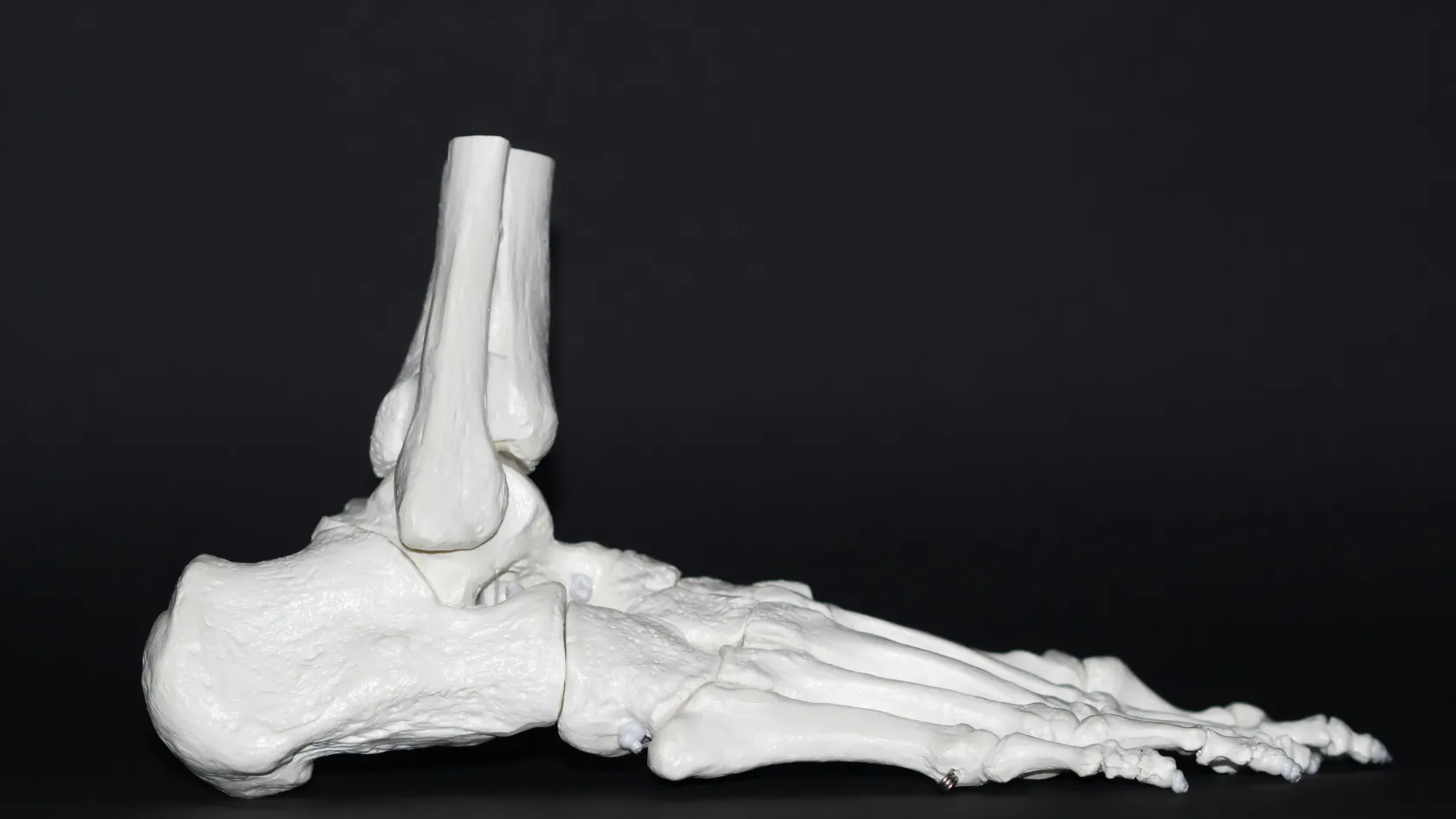
Deep pain with every step, a stiff ankle and X-rays showing worn cartilage, often years after an old fracture, can be relieved by replacing the joint surfaces with metal and plastic components that keep the ankle moving. This guide explains why ankles wear out, how replacement compares with fusion, how long implants last, who suits the operation, the risks, the recovery and how long to stay in Istanbul.
About This Department
Orthopedics
A new joint for a worn ankle. Less pain, movement kept.
In a meta-analysis of 7,942 modern ankle replacements, 89 percent were still in place ten years after surgery.
89%
Ankle replacements still in place at ten years in a meta-analysis
70%
Share of advanced ankle arthritis that follows an old injury
2 to 4 nights
Hospital stay in published Istanbul ankle replacement packages
Free
Review of your X-rays before you book
Free consultation
The review costs nothing and carries no obligation. Send weight-bearing X-rays of both ankles, any CT or MRI and a note on how far you can walk, and our foot and ankle team will tell you whether replacement or fusion suits your ankle, what to expect, and how long to plan for. A coordinator replies in your own language.
Every step hurts deep in the ankle, the joint has stiffened, walking on uneven ground or slopes has become hard, and X-rays show the cartilage worn away, often years after an old ankle fracture or sprain. Ankle replacement surgery removes the damaged joint surfaces and replaces them with metal and plastic components that glide on each other, relieving pain while keeping the ankle moving. Below you will find why ankles wear out, how a replacement compares with ankle fusion in the randomized trial and large cohort studies, how long the implants last, who suits the operation, how it is done, the risks, the recovery, how long to stay in Istanbul, and the follow-up at home.
Why ankles wear out
Injury, more than age.
Signs of advanced ankle arthritis include
deep pain with every step,
stiffness, especially in the morning,
swelling after walking,
and difficulty on slopes, stairs and uneven ground.
1
Weight-bearing X-rays
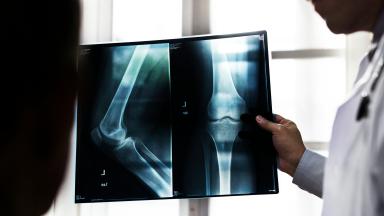
Standing films of both ankles and feet show the true joint space and alignment.
2
CT scan
Measures the bone, cysts and the joints below the ankle.
3
Test injection where needed
Numbing one joint confirms which one causes the pain.
Unlike the hip and knee, where arthritis usually comes with age, the ankle wears out mostly after injury. In a series of 639 patients with advanced ankle arthritis at an American university center, 70 percent of cases followed trauma, most often a rotational ankle fracture, while 12 percent came from rheumatoid arthritis and only 7 percent were primary osteoarthritis with no clear cause. That is why many patients are younger and still working when the ankle fails, a decade or more after the fracture that started it. Repeated sprains that left the ankle loose, infection, bleeding into the joint in hemophilia and a flatfoot or high-arched foot that loads the ankle unevenly are other causes. Pain is felt at the front of the ankle, stiffness grows, and swelling follows long walks. Shoes wear unevenly. Over time the foot may tilt inward or outward as one side of the joint collapses, and the gait shortens to protect the painful ankle, which in turn tires the knee, hip and back.
This table scrolls sideways on a narrow screen. Swipe or drag to see every column.
Causes of advanced ankle arthritis in 639 patients
Cause
Share of patients
Typical history
After injury
70 percent
An ankle fracture or repeated sprains years earlier
Rheumatoid arthritis
12 percent
Several joints affected, often both ankles
Primary osteoarthritis
7 percent
No earlier injury or disease
Treatments to try before surgery include
a rocker-soled shoe or an ankle brace,
weight loss and low-impact exercise such as cycling and swimming,
pain relief and, for flares, a steroid injection,
and, in early arthritis with a bone spur at the front, a keyhole clean-out.
What an ankle replacement is
Is it the same as a knee or hip replacement?
The idea is the same, but the ankle is smaller, carries more load per square centimeter and has thinner skin over it, so ankle implants and techniques are specific to the joint.
Three parts make up a modern ankle replacement, and the metal parts have a rough or coated surface into which bone grows, holding them without cement.
1
Tibial component
A metal plate fixed to the end of the shinbone.
2
Plastic insert
A durable polyethylene bearing between the two metal surfaces so they never touch.
3
Talar component
A metal cap over the talus.
Fixed or mobile bearing
In a fixed-bearing design the plastic insert locks into the upper plate. In a mobile-bearing design it can slide a little on both surfaces. Both are in wide use, and in a post hoc analysis of the British trial, fixed-bearing replacements did better than fusion. The surgeon chooses the design that fits your bone and alignment.
Designs differ in
whether the insert is fixed or mobile,
how much bone is removed,
and how the parts anchor to bone.
Pain relief with the ankle still moving.
Patient-specific guides
Some surgeons plan the operation on a CT scan and use cutting guides printed to fit the patient's own bones, which helps position the implants in deformed ankles.
Replacement or fusion
Fusion, which joins the shinbone and talus into one solid bone, has long been the alternative. The British TARVA trial randomized 303 patients aged 50 to 85 with end-stage ankle arthritis to replacement or fusion, and at one year walking and standing scores had improved in both groups, a little more after replacement, with a difference too small to be certain. The number of adverse events was similar, 109 against 104, but their nature differed.
Scroll sideways on small screens to see every column.
Ankle replacement and ankle fusion compared
Measure
Replacement
Fusion
Walking and standing at one year, TARVA
Improved, slightly more
Improved
Typical problems, TARVA
Wound healing and nerve injury
Blood clots and bone that fails to join, 7 percent
Ankle movement
Kept
Lost at the ankle, partly taken over by nearby joints
How surgeons weigh the choice
Replacement suits patients who value movement, have arthritis in the joints below the ankle, or already have a fused or stiff joint nearby. Fusion suits heavy manual work, high body weight, severe deformity, poor bone or an earlier infection.
Five years on
Why the cohort differs from the trial
Patients were not randomized, so surgeons chose fusion more often for younger smokers and people with diabetes, and replacement for those with inflammatory arthritis.
In Canada, a study of 388 ankles followed for a mean of 5.5 years found that pain and function scores improved by similar amounts after both operations once differences between the patients were taken into account, while reoperations and major complications were more frequent after replacement.
On a phone, slide the table sideways to see every column.
Canadian cohort at a mean of 5.5 years
Measure
Replacement
Fusion
Ankles studied
281
107
Revision
17 percent
7 percent
Major complications
19 percent
7 percent
How long it lasts
Ten-year view
Most failures happen slowly and show on X-rays before they cause trouble, which is why yearly checks matter.
Scroll sideways on small screens to see both columns.
Meta-analysis of 7,942 modern ankle replacements
Measure
Result
Implants in place at ten years
89 percent
Failure rate
1.2 percent per year
Ankle score out of 100
40 before, 80 at a mean of 8.2 years
Total ankle movement
23 degrees before, 34 after
Pooling 58 studies, a meta-analysis covering 7,942 modern ankle replacements found that 89 percent were still in place at ten years, a failure rate of 1.2 percent per year. Ankle scores rose from 40 to 80 out of 100 at a mean of 8.2 years, and total ankle movement improved from 23 to 34 degrees. Thin lines around the implants on X-rays appeared in up to 23 percent, which surgeons watch at follow-up. When a replacement does fail, it can be revised with new components or converted to a fusion.
Signs it may be time
End-stage ankle arthritis with good bone, a foot that can be aligned straight, a healthy weight, arthritis in neighboring joints, and a wish to keep ankle movement.
Talk to us first
Active or past infection in the ankle, severe deformity that cannot be corrected, poor blood supply or nerve damage in the foot, very heavy manual work, or dead bone in the talus.
How the operation is done
Swipe sideways on a narrow screen to see the whole table.
The hospital stay
When
What happens
Day before
Tests, final X-rays and meeting the anesthetist
Surgery day
Two to three hours in the operating room, leg raised in a splint afterward
Days one to three
Physiotherapist teaches crutches, wound checked, discharge to the hotel
1
Anesthesia
Spinal or general anesthesia with a nerve block that keeps the foot comfortable for the first day.
2
Approach
A cut of 10 to 12 centimeters at the front of the ankle.
3
Preparing the bone
Guides, and in some centers patient-specific guides made from a CT scan, direct thin cuts of the shinbone and talus.
4
Implants and balance
The components are fitted, the alignment and ligament balance are checked, and tendons or the heel bone are adjusted if the foot is tilted.
5
Closure
The wound is closed carefully and the leg rests in a padded splint.
Risks and how they are managed
Wound healing problems
The skin at the front of the ankle is thin. Careful handling, raising the leg and stopping smoking reduce delayed healing.
Nerve irritation
Numbness on the top of the foot from small skin nerves, fading over months in most patients.
Loosening or wear
Checked on X-rays at follow-up, and treated with revision or conversion to fusion if needed.
Infection and blood clots
Uncommon. Antibiotics at surgery and clot prevention while mobility is reduced.
The recovery
Both columns fit on a phone once you slide the table sideways.
Recovery milestones
Time
Milestone
Two weeks
Wound check and stitches removed
Six weeks
Walking boot set aside as the surgeon allows
Three months
Normal shoes for most patients
Six to twelve months
Swelling settles
Expect a slow first six weeks. The leg stays in a splint and then a walking boot, kept raised above the heart as much as possible for the first two weeks while the thin skin at the front of the ankle heals, with crutches and partial weight in the early period on the surgeon's instructions. Physiotherapy then restores movement and strength. It matters. Calf stretches, balance work on one leg, cycling on a static bike and, later, walking on slopes rebuild the confidence that months of pain took away. Most patients walk in normal shoes by three months, and swelling can last six months to a year, so a compression stocking and an evening with the leg up remain useful long after the wound has healed. Driving returns once you can brake safely, around eight to ten weeks after a right ankle and sooner after a left ankle in an automatic car. Desk work resumes at four to six weeks, and standing work at three months or later.
How long to stay in Istanbul
Plan for two weeks.
Published Istanbul ankle replacement packages list two to four nights in hospital, with one offering ten days, and one platform's overview gives ten days in Turkey. Inclusions vary and can cover the implant, surgery and anesthesia, preoperative tests and imaging, medicines, transfers and an interpreter. The wound check at around two weeks allows a safe flight. Fitness to fly is confirmed at that visit, with the leg raised where possible, clot prevention and an aisle seat.
What decides the cost
The implant design, any correction of deformity, CT-based planning, nights in hospital, physiotherapy and imaging set most of the figure.
A quote you can compare names the implant and the stay, and that figure comes only after a foot and ankle surgeon reviews your weight-bearing X-rays and CT. The review costs nothing.
Arranging the trip
Weight-bearing X-rays of both ankles, any CT, and photos of how you stand, sent on WhatsApp, start the review, and the coordinator who answers stays with you through surgery and the recovery at home. Speak with the team in English, Arabic, French, Russian, Serbian, Romanian or Spanish, or through an interpreter. A companion sleeps on the companion bed in your room. Hotel nights, the visa invitation letter sent ten days before travel and the transfers are arranged by the international office, and halal, vegetarian and diabetic meals, a prayer room and a female physician on request are available.
Once you are back home
X-rays at six weeks, three months and then once a year check the implants, and you send the images through the coordinator for review in Istanbul. A local physiotherapist continues the program.
A red, hot or leaking wound, fever, a swollen and painful calf, sudden breathlessness, or new pain after a period of comfort. Each needs a doctor the same day.
Ankle replacement FAQ
How long does an ankle replacement last?
In a meta-analysis of 7,942 ankle replacements, 89 percent were still working at ten years.
Is ankle replacement better than fusion?
The TARVA trial found similar results at one year. Replacement keeps movement but needs more reoperations over time.
When can I walk normally?
Most patients walk in normal shoes by three months.
Am I too young for an ankle replacement?
Age matters less than activity, weight and bone quality, and the surgeon weighs them together with the state of the joints around the ankle and your own goals.
Can a failed replacement be fixed?
Yes, with new components or by converting to a fusion.
Can a family member stay with me?
Yes. A relative sleeps on the companion bed in your room, and a hotel nearby is booked for anyone else.
References
Saltzman CL, Salamon ML, Blanchard GM, et al. Epidemiology of ankle arthritis. Report of a consecutive series of 639 patients from a tertiary orthopaedic center. Iowa Orthop J. 2005;25:44-46.
Goldberg AJ, Chowdhury K, Bordea E, et al. Total ankle replacement versus arthrodesis for end-stage ankle osteoarthritis. A randomized controlled trial. Ann Intern Med. 2022;175(12):1648-1657.
Daniels TR, Younger ASE, Penner M, et al. Intermediate-term results of total ankle replacement and ankle arthrodesis. A COFAS multicenter study. J Bone Joint Surg Am. 2014;96(2):135-142.
Zaidi R, Cro S, Gurusamy K, et al. The outcome of total ankle replacement. A systematic review and meta-analysis. Bone Joint J. 2013;95-B(11):1500-1507.
Editor's note
Written by the Biruni Hospital medical editorial team. Reviewed by Assoc. Prof. Dr. Suat BATAR, Orthopedics and Traumatology.