
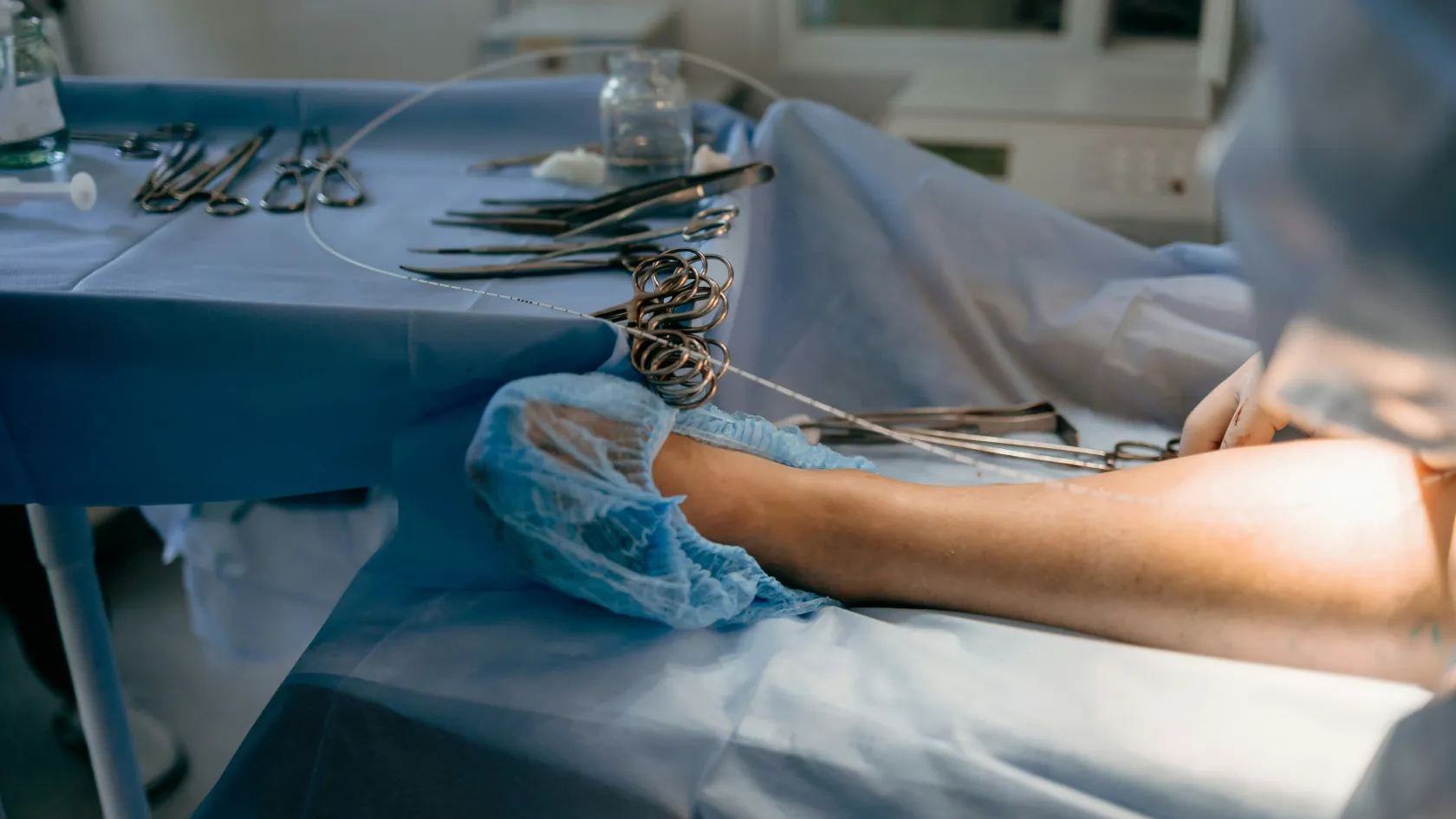
Varicose Vein Treatment
The bulging veins are the sign and the leaking trunk vein above them is the disease, so modern treatment closes that vein from the inside with heat, glue or foam under local anesthetic and the patient walks out within the hour. Five years on, laser ablation matched surgery for quality of life in a trial of 798 patients, and closing the vein early healed leg ulcers in 56 days against 82.
About This Department
Stripping under general anesthesia has given way to a catheter under local anesthetic. Five years on, the results of the two are the same.
Treatment closes the faulty vein that feeds the varicose veins. Today that happens from the inside, through a catheter threaded into the vein under ultrasound, with heat, glue or foam, and the patient walks out the same hour. In the CLASS trial, 798 patients in the United Kingdom were randomized to laser ablation, foam sclerotherapy or surgery, and five years later quality of life was equally good after laser and surgery and worse after foam. For leg ulcers, closing the vein within two weeks healed them in a median of 56 days against 82 with compression alone.
People who search for varicose vein treatment have usually lived with their veins for years. Somebody told them the operation was not worth it. That advice belongs to an earlier era, and this page sets out what the modern treatments do, what the randomized trials measured, who gains from them, and how a patient from abroad fits treatment of one or both legs into a single short trip to Istanbul.
What varicose veins are, and what the treatment closes
Blood in the leg veins has to climb back to the heart against gravity. One-way valves inside the veins stop it falling back between heartbeats. When the valves in the long superficial vein of the leg fail, the great saphenous vein on the inside of the thigh and calf or the small saphenous vein behind the knee, blood pools, the pressure in the branches below rises, and the branches stretch into the ropy, bulging veins seen under the skin. The bulging veins are the sign. The leaking vein above them is the disease.
Every effective treatment therefore closes the leaking trunk vein first and only then deals with the visible branches. Closing the trunk costs the leg nothing. The deep veins inside the muscle carry more than nine tenths of the blood and take over at once, and a duplex ultrasound before treatment maps which trunk leaks, where the leak starts, and whether those deep veins are healthy. Nobody should plan a treatment without that scan.
The scan takes twenty minutes and changes everything that follows.
Stockings relieve, and only closure treatsCompression stockings ease aching and swelling and are the first advice everywhere, and the CLASS trial and EVRA trial both used them as the comparison. They do nothing to the valve that has failed, and symptoms return the day the stocking comes off.
The four treatments
Four methods close a trunk vein. Three of them need no operating room.
Endovenous thermal ablation, by laser or radiofrequency
A thin catheter enters the vein through a needle puncture below the knee. It travels to the top of the vein under ultrasound and comes back slowly while its tip heats the vein wall, which shrinks and seals. Local anesthetic fluid goes in around the vein along its whole length beforehand, both to numb it and to protect the skin from the heat. Laser and radiofrequency differ in the energy source and in little else. Guidelines in Europe and the United States name thermal ablation as the first choice for a leaking trunk vein.
Cyanoacrylate glue
A medical adhesive goes in through a catheter in small amounts along the vein, which is pressed closed from outside and sticks shut. No heat. So the anesthetic injections around the vein fall away, and the leg needs no stocking afterward. A small share of patients develop a red, itchy reaction along the vein in the first weeks, and a few prove allergic to the adhesive, which is the one reason to prefer heat in someone with many allergies.
Foam sclerotherapy
A detergent drug mixed with air into a foam is injected under ultrasound into the vein, where it strips the lining and the vein scars closed. It needs no catheter and no anesthetic. It treats twisted veins that a catheter cannot pass, and it is the standard way to treat the visible branches after the trunk has been closed. As a treatment for the trunk itself it fails more often than heat, and in the trials it needed repeating more often.
Surgery
Ligation and stripping tie off the vein at the groin and pull it out through a second cut near the knee, under general or spinal anesthesia. The oldest treatment still works. Its results at five years matched laser ablation in the largest trial, which surprised many surgeons who had expected the catheter to win outright. Catheter methods displaced it for two reasons. Recovery takes hours in place of days. Bruising is lighter. It keeps a place for veins too twisted or too close to the skin for a catheter, and for patients whose thermal ablation has already failed. Whichever method closes the trunk, the bulging branches come out at the same session by phlebectomy, tiny hooks through two-millimeter nicks.
What the trials found
Laser, foam or surgery, five years later
Four treatments head to head at one year
Glue against radiofrequency, three months to five years
Leg ulcers heal faster when the vein is closed early
Who needs treatment, and who needs only stockings
Symptoms and skin damage earn treatment. The visible veins alone earn it only when the patient wants them gone.
- Aching, heaviness, itching, night cramps or swelling that ease with elevation and worsen by evening, in a leg where ultrasound shows a leaking trunk vein.
- Skin changes. Brown staining, hardening or eczema around the ankle mean pressure has been high for years and an ulcer is the next stage. These patients gain most and should not wait.
- A healed or open venous ulcer, where closing the vein speeds healing and halves the chance of the ulcer returning.
- Bleeding from a vein or a clot in a superficial vein, both of which are reasons to close the trunk once the acute episode has settled.
- Cosmetic concern, where the patient understands that spider veins are treated with fine injections after any trunk leak has been dealt with, and that new veins can appear over the years.
Some people should wait. Others should choose differently. A blocked deep vein on the ultrasound makes the superficial veins the only route home for the blood, and closing them would be wrong. Pregnancy postpones treatment, since many veins shrink after delivery. A current clot in the deep veins, an untreated cancer, and an inability to walk after the procedure each call for a different plan, while a patient on blood thinners is treated with the drug continued, because thermal ablation does not require stopping it.
The day of treatment
Risks and side effects
Serious harm rarely follows these procedures. Minor nuisance follows nearly all of them.
This table scrolls sideways on a narrow screen. Swipe or drag to see every column.
| Complication | How common | What is done |
|---|---|---|
| Bruising and tenderness along the treated vein | Most patients, for one to two weeks | Walking, paracetamol, the stocking |
| A tight cord under the skin as the vein scars | Common for several weeks | Settles by itself |
| Numb patches of skin from the nerve beside the vein | A few percent, more when the vein below the calf is treated | Usually recovers over months |
| Brown staining of the skin over treated branches | Common after foam, fades over a year in most | Time, sun protection |
| Clot in a deep vein or in the lung | Under 1 percent in the large trials | Walking from the first hour, a check ultrasound, blood thinners if it occurs |
| Reaction along the vein after glue | A minority, in the first weeks | Anti-inflammatory tablets, resolves |
| Visual disturbance or headache after foam | Rare and brief | Passes within minutes |
| Skin burn | Rare with correct anesthetic infiltration | Dressings |
| The vein reopening, or new veins appearing | 5 percent of trunks in the first year after heat, more after foam. New branches over the years in a share of patients | A further session of ablation or foam |
Days in Istanbul, cost and the trip
How long, and when to fly
Three to four days cover the length of stay. Day one holds the consultation and the mapping ultrasound, day two the treatment of both legs where needed, and two days later the surgeon checks the legs, scans the deep veins, and clears the flight. Airlines set no rule after a catheter procedure. The treated leg tolerates flying well, with the stocking on, an aisle seat and a walk every hour. Published programs in Istanbul quote the same three to four days, with same-day discharge.
What decides the cost, and the trip
The number of legs and trunk veins treated decides most of the cost. Radiofrequency and laser catheters are single-use devices, glue costs more per vein than heat, and foam costs least, and the extent of phlebectomy, sedation if requested, the stockings, and the duplex ultrasounds before and after make up the rest. Blood thinners and previous treatment change the plan. Published packages in Istanbul cover the consultation, the ultrasound, the procedure for one or both legs, the device, stockings, the follow-up check, an interpreter and transfers. Hotel and flights fall outside them. A quote follows the surgeon's review of your photographs and any ultrasound, which costs nothing. One coordinator handles the case in English, Arabic, French, Russian, Serbian, Romanian or Spanish, or through an interpreter, sends the appointment confirmation and an invitation letter naming the hospital and the treating doctor ten days before travel, and books the hotel and the transfers. The visit fits inside any short visa. Halal, vegetarian and diabetic meals, a prayer room and a female doctor on request are all available, and a companion is welcome, although few patients need one for a procedure done under local anesthetic.
After you fly home
The stocking stays on for one to two weeks after thermal ablation or foam, by day at least. Walking every day is the only exercise required. Once you are back home the discharge file hands your own doctor the ultrasound before and after, the procedure report with the method and the veins treated, and a letter in English, and a duplex ultrasound at six to twelve weeks, which any doctor at home can do, confirms the trunk has stayed closed. Small residual veins get foam or fine injections at that visit or later, in Istanbul or at home. The coordinator stays reachable on the same WhatsApp number. Clinical questions go to the treating surgeon. Weight control, walking and fewer hours standing lower the chance of new veins over the years, and a new leaking vein, if one appears, gets the same treatment.
Varicose Vein Treatment FAQ
Is laser or radiofrequency better than surgery for varicose veins?
Which is best, laser, radiofrequency, glue or foam?
Do varicose veins come back after treatment?
Can both legs be treated in one visit?
Is the treatment painful?
Should a leg ulcer be treated before or after closing the vein?
References
- Brittenden J, Cooper D, Dimitrova M, et al. Five-Year Outcomes of a Randomized Trial of Treatments for Varicose Veins. N Engl J Med. 2019;381(10):912-922.
- Rasmussen LH, Lawaetz M, Bjoern L, Vennits B, Blemings A, Eklof B. Randomized clinical trial comparing endovenous laser ablation, radiofrequency ablation, foam sclerotherapy and surgical stripping for great saphenous varicose veins. Br J Surg. 2011;98(8):1079-87.
- Morrison N, Gibson K, McEnroe S, et al. Randomized trial comparing cyanoacrylate embolization and radiofrequency ablation for incompetent great saphenous veins (VeClose). J Vasc Surg. 2015;61(4):985-94.
- Morrison N, Gibson K, Vasquez M, Weiss R, Jones A. Five-year extension study of patients from a randomized clinical trial (VeClose) comparing cyanoacrylate closure versus radiofrequency ablation for the treatment of incompetent great saphenous veins. J Vasc Surg Venous Lymphat Disord. 2020;8(6):978-989.
- Gohel MS, Heatley F, Liu X, et al. A Randomized Trial of Early Endovenous Ablation in Venous Ulceration. N Engl J Med. 2018;378(22):2105-2114.
Editor's note
Written by the Biruni Hospital medical editorial team. Reviewed by Prof. Dr. Bülent ACUNAŞ, Radiology.
Medically reviewed by

Prof. Dr. Bülent ACUNAŞ
Radiology
Related Treatments
View All
Biliary Stenting - Bile Duct Stent Placement
Draining the bile before a pancreatic cancer operation doubles the complication rate, metal stents beat plastic ones by months, and both sides of a blocked liver do no better than one. Each of those findings came from trials, and each overturned what doctors assumed. This guide gives them plainly, along with the routes, the risks and the days to plan.
Bone Marrow Biopsy
Collecting the marrow takes 10 to 30 minutes, while the genetic tests on it can take three weeks, and that wait decides how long a trip to Istanbul should last.
Cryoablation - Tumor Freezing Surgery
Cryoablation destroys a tumor with a ball of ice grown around it through needles the width of a pencil lead, with no incision and one night in hospital. For small kidney tumors it matched surgery in the Mayo Clinic series, and it treats lung metastases and painful bone metastases.
CT-Guided Biopsy - Computed Tomography Guided Biopsy
A CT-guided biopsy uses the scanner to steer a needle into a lung nodule, a deep abdominal mass, a bone lesion or a lymph node and remove cores of tissue for diagnosis and molecular testing, under local anesthetic in about twenty minutes. This page explains when CT guidance is chosen, why a core of tissue matters, what the day involves, the risks of lung biopsy and of other sites with figures from large studies, what the report means, and how patients from abroad arrange it in Istanbul.
Irreversible Electroporation - Nanoknife Surgery
Irreversible electroporation, known by the brand name NanoKnife, destroys a tumor with high-voltage electrical pulses between needle electrodes while sparing the blood vessels, bile ducts and nerves around it. It covers how it works, which pancreatic, liver, prostate and kidney tumors it treats, what the registry and trial data show and what they do not, the procedure, the risks, the follow-up, and how patients from abroad arrange it in Istanbul.