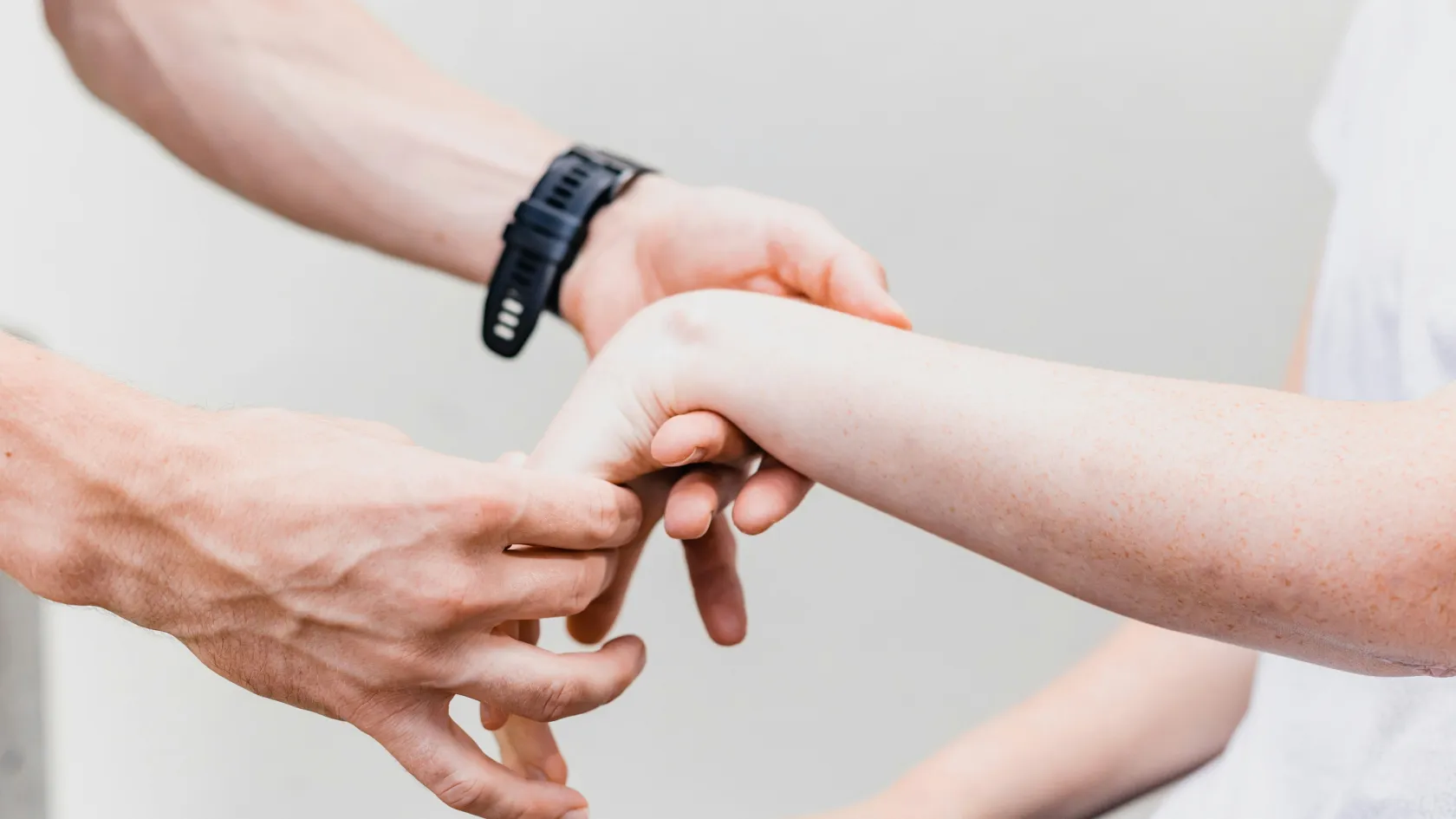
When a finger keeps clicking or locking after a splint and one or two steroid injections, trigger finger release divides the tight A1 pulley in a few minutes under local anesthetic, and you bend the finger on the table to confirm it glides freely.
About This Department
Orthopedics
A few minutes under local anesthetic. You bend the finger on the table to prove it works.
In a 2024 meta-analysis of eight randomized trials with 548 patients, open and needle release of the trigger finger gave the same rates of revision, complications and pain.
90 to 100%
Success of open A1 pulley release in published series
39%
Long-term relief from a second steroid injection
3 to 5 days
Usual stay in Istanbul for a release
Free
Review of your video before you book
Free consultation
The review costs nothing and carries no obligation. Send a short video of the finger bending and straightening, a list of injections you have had and any other hand problems, and a hand surgeon will tell you whether release is the right step and which technique fits. A coordinator replies in your own language.
A finger or thumb clicks when you bend it, sticks in the palm in the morning, or locks so that you have to straighten it with the other hand, and a splint or an injection has not ended it. Trigger finger release opens the tight band at the base of the finger, the A1 pulley, so the tendon glides freely again, and it takes minutes under local anesthesia with you awake. Below you will find how triggering is graded, what injections achieve, when release is the right step, how open and needle releases compare, what is different for children with a trigger thumb, the risks, the recovery, how long to stay in Istanbul, and the follow-up at home.
What a trigger finger is
The tendons that bend each finger run through a series of tunnels, called pulleys, which keep them close to the bone like the rings on a fishing rod. When the first of these, the A1 pulley at the base of the finger in the palm, thickens, or a nodule forms on the tendon, the tendon catches as it passes through, and the finger clicks, sticks or locks. Ring fingers and thumbs are hit most. People over forty, women and people with diabetes, rheumatoid arthritis or thyroid disease carry the highest risk, and several fingers can trigger at once or one after another. Morning stiffness and a tender lump in the palm at the base of the finger are typical, and some people feel the click in the middle joint of the finger even though the problem lies lower down in the palm. Hands that grip tools for hours, and hands of people who have had carpal tunnel surgery, trigger more often.
This table scrolls sideways on a narrow screen. Swipe or drag to see every column.
How triggering is graded and treated
Grade
What you notice
Usual treatment
1
Pain and a tender lump, no catching
Rest, splint, injection
2
Catching that you can straighten actively
Splint or injection
3
Locking that needs the other hand to straighten, or a finger that cannot fully bend
Injection, then release if it returns
4
A finger fixed bent and unable to straighten
Release, sometimes with treatment of the stiff joint
Conditions that travel with trigger finger include
diabetes,
rheumatoid arthritis,
underactive thyroid,
and carpal tunnel syndrome, which is often treated in the same sitting.
Splints and injections first
Three things make an injection less likely to last.
Diabetes.
Triggering for more than six months.
Several fingers affected at once.
A night splint that keeps the knuckle straight rests the tendon and helps early, mild triggering. A steroid injection into the tendon sheath settles many fingers for months or for good, and the effect is weaker in people with diabetes and in fingers that have triggered for a long time.
Repeat injections help fewer patients. Among 292 repeat injections studied in one clinic, a second injection gave long-term relief in 39 percent of fingers and a third in 39 percent as well, while half of patients had at least a year without symptoms, and most eventually chose release.
Two injections, then think about release.
When release is the right step
Signs it may be time
Triggering that returns after one or two injections, a finger that locks and needs the other hand to straighten, a finger stuck bent, triggering in several fingers, or diabetes, where injections work less well.
Talk to us first
A finger that clicks only now and then without pain, an injection given in the last few weeks, an active infection in the hand, or a stiff finger caused by arthritis rather than triggering.
Open or needle release
Both methods divide the same band.
In an open release the surgeon makes a cut of about one to two centimeters in the palm, sees the A1 pulley and divides it, then asks you to bend and straighten the finger to confirm that it glides freely before closing. A percutaneous release divides the pulley with a needle passed through the skin, without an incision. A 2024 meta-analysis of eight randomized trials with 548 patients found no difference between the two in revision surgery, complications or pain, so the choice depends on the finger, the surgeon's experience and your preference. Thumbs and little fingers, where nerves lie close to the pulley, are released open in most hands. Open release succeeds in 90 to 100 percent of published series.
1
Local anesthetic
A small injection numbs the palm. No fasting, no general anesthetic.
2
Release
The pulley is divided in a few minutes.
3
Check
You make a fist on the table to show the finger moves freely.
4
Dressing
A light dressing allows finger movement the same day.
One small cut, one tight band.
Trigger thumb in children
Children usually present with a thumb stuck bent at its tip.
Why children get a trigger thumb
It is not present at birth in most cases but appears in the first years of life, often noticed by parents as a thumb that will not straighten. A small nodule on the tendon can be felt at the base of the thumb, and it is rarely painful.
One prospective study of 93 trigger thumbs in young children followed for more than four years found that 32 percent resolved on their own within five years, while 43 percent went on to surgery, and thumbs bent more than 30 degrees at the start rarely resolved, only 2.5 percent. Observation for a time is reasonable, and release under a short general anesthetic is a quick operation when the thumb stays fixed.
Not the same as in adults
Injections are not used in children. Pediatric trigger fingers other than the thumb can be linked to other conditions and are assessed more carefully.
Watch first, operate if the thumb stays fixed.
Risks
Complications are uncommon and mostly minor.
Across 795 open releases in one review, minor complications occurred in 9.6 percent and major ones in 2.4 percent. Three habits keep them low.
Dividing only the A1 pulley.
Moving the finger from the first day.
Keeping the wound dry.
Tenderness and scar sensitivity
A tender palm for some weeks, eased by massage.
Stiffness
More likely in fingers that were locked for a long time. Exercises and sometimes therapy help.
Nerve injury
Rare. The thumb and index finger need the most care.
Bowstringing
The tendon lifting from the bone if too much of the pulley system is released, avoided by dividing only the A1 pulley.
The recovery
Move the finger the same day.
Light tasks such as eating, dressing and typing return within a few days, stitches come out at ten to fourteen days, either in Istanbul or with a nurse or family doctor at home, and heavy gripping waits two to three weeks. Swelling and stiffness at the middle joint can last a few weeks in fingers that triggered for months, and a hand therapist helps when it lingers. Fingers that were stuck bent for months before surgery may not straighten fully at once, because the middle joint has tightened while the finger was held flexed, and a night splint that holds the finger straight, worn for several weeks alongside daily stretching, gains most of the missing extension back. The tender lump in the palm softens over two to three months, and golf, racket sports and the gym resume as soon as gripping feels comfortable again. Within a month the finger is forgotten.
How long to stay in Istanbul
Plan for three to five days.
Published hand release packages in Istanbul list one night in hospital, though going home the same day is common, and include the consultation, medicines, nursing care, transfers, an interpreter and a companion's stay, with a check scheduled about a week after surgery. Several fingers can be released in one sitting, and the stitches can come out at home. Flying is fine within a day or two, with the hand raised on a cushion and the dressing kept dry.
What decides the cost
How many fingers are released, open or needle technique, a hospital night or day surgery, and any therapy sessions set most of the figure.
Published packages leave out flights and hotel nights. A quote you can compare names the fingers and the technique, and that figure comes only from a hand surgeon reviewing your symptoms and photos. The review costs nothing.
Arranging the trip
Your first WhatsApp message, with a short video of the finger clicking gives the best start, and the coordinator who replies stays with you until you are home and after. English, Arabic, French, Russian, Serbian, Romanian and Spanish are spoken, with an interpreter for other languages, a companion sleeps in your room on the companion bed, and the international office books a hotel, sends the visa invitation letter ten days before travel and arranges transfers, with halal, vegetarian and diabetic meals, a prayer room and a female physician on request.
Once you are back home
Keep the dressing dry for the first days and move the finger fully several times an hour. Send a short video of the finger bending at one and three weeks through the coordinator.
Spreading redness, fever, a wound that opens, numbness at the fingertip, or triggering that returns. Each needs a doctor soon.
Trigger finger release FAQ
Is trigger finger release painful?
The local anesthetic stings briefly, and most people need only simple painkillers afterward.
Can trigger finger come back after surgery?
Rarely after a complete release. Other fingers can start triggering later.
Is a needle release as good as open surgery?
A meta-analysis of eight randomized trials found no difference in revisions, complications or pain.
How many steroid injections should I try?
One or two. Repeat injections gave long-term relief in 39 percent of fingers in one study.
Does a child's trigger thumb need surgery?
About a third resolve on their own within five years. Thumbs bent more than 30 degrees rarely do.
Can a family member stay with me?
Yes. A relative or friend can sleep in your room on the companion bed, and the international office books a nearby hotel for anyone else traveling with you.
References
Dardas AZ, VandenBerg J, Shen T, Gelberman RH, Calfee RP. Long-term effectiveness of repeat corticosteroid injections for trigger finger. J Hand Surg Am. 2017;42(4):227-235.
Casey JC, Daher M, Dworkin M, et al. Open versus percutaneous fixation of trigger finger. Meta-analysis of clinical outcomes. J Hand Surg Am. 2024;49(6):570-575.
Elahi MA, et al. Tendon sheath incision for surgical treatment of trigger finger. JBJS Essent Surg Tech. 2023;13(1).
Hutchinson DT, Rane AA, Montanez A. The natural history of pediatric trigger thumb in the United States. J Hand Surg Am. 2021;46(5):424.e1-424.e7.
Editor's note
Written by the Biruni Hospital medical editorial team. Reviewed by Assoc. Prof. Dr. Suat BATAR, Orthopedics and Traumatology.