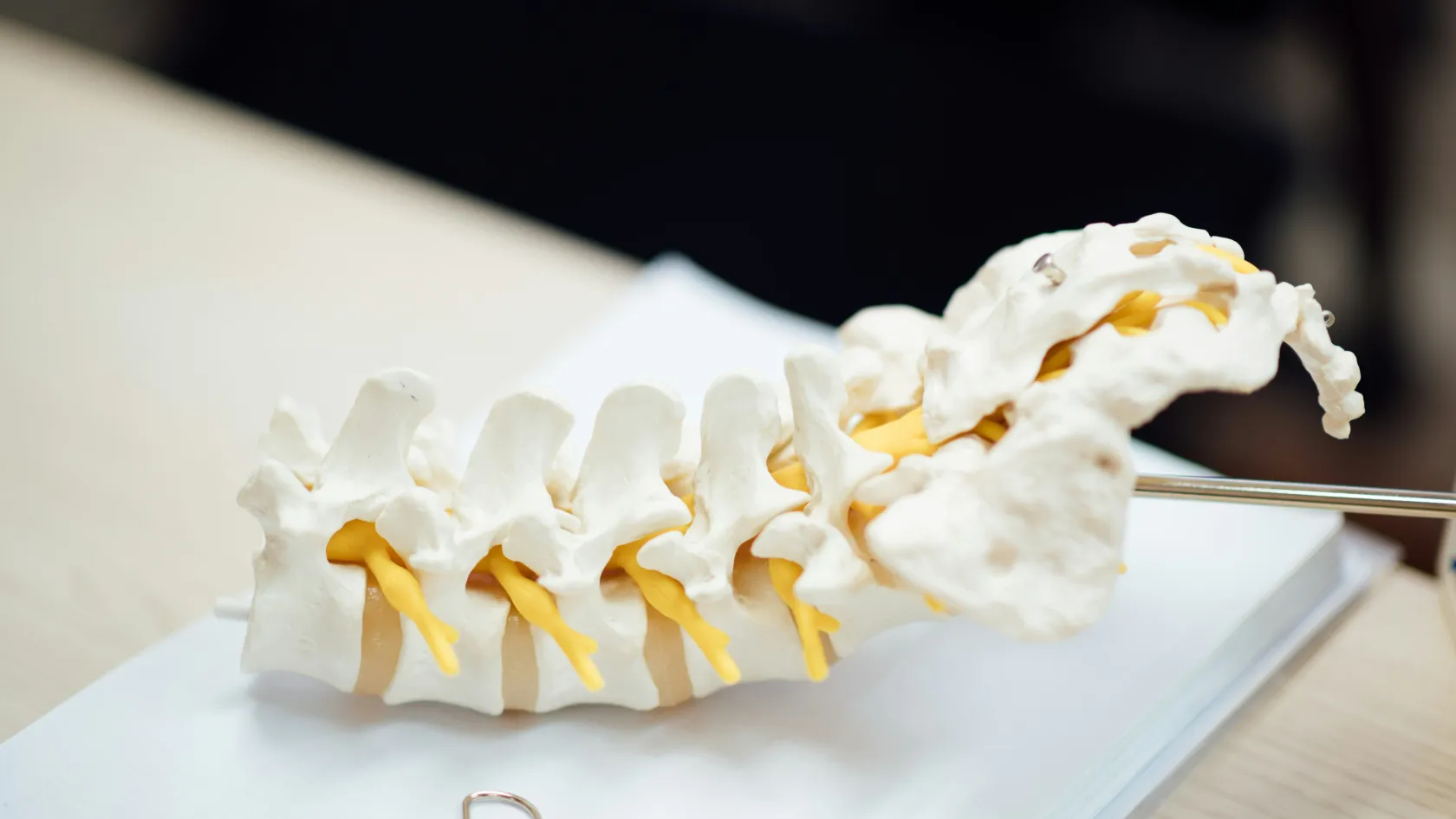
The approach comes from the front, through the abdomen, with a vascular surgeon moving the large blood vessels aside to reach the disc.
The front approach can injure a major vein or artery, and in men can damage the nerves that control ejaculation, leading to retrograde ejaculation in a small share. The implant can sink into the bone or shift. Revision through the same route years later carries a much higher risk than the first operation, so we only offer a disc replacement where we expect it to last.
What the trials show
Randomized trials compared disc replacement with fusion and with rehabilitation, with follow-up to five and eight years.
Disc replacement against fusion
Across the fusion trials, three findings held.
- Pain and disability improved to a similar degree after both operations, with the differences on pain scales falling below what patients notice.
- The replaced level keeps around six degrees of motion.
- Fewer patients need further surgery at the operated level, and the neighboring disc wears less on X-ray.
This table scrolls sideways on a narrow screen. Swipe or drag to see every column.
CHARITE disc against anterior fusion, five years
| Outcome |
Disc replacement |
Fusion |
| Overall success |
57.8 percent |
51.2 percent |
| Working full time |
65.6 percent |
46.5 percent |
| Long-term disability |
8.0 percent |
20.9 percent |
| Further surgery at the operated level |
7.7 percent |
16.3 percent |
| Motion at the operated level |
6.0 degrees |
1.0 degree |
The ProDisc-L trial
Zigler and colleagues randomized 236 patients with single-level disease to the ProDisc-L disc or a fusion front and back. At five years, new degenerative changes at the neighboring level appeared in 9.2 percent after disc replacement and 28.6 percent after fusion, though surgery at the neighboring level, 1.9 against 4.0 percent, did not differ significantly. Motion at the replaced level fell slightly, from 7.3 to 6.0 degrees.
Changes in ALD at 5 years were observed in 9.2% of TDR patients and 28.6% of fusion patients (p = 0.004).
ProDisc-L trial, 236 patients, Journal of Neurosurgery Spine, 2012
Eight years against rehabilitation
Both groups improved.
This table scrolls sideways on a narrow screen. Swipe or drag to see every column.
Disc replacement against rehabilitation, eight years, 173 patients
| Outcome |
Disc replacement |
Rehabilitation |
| Improvement in Oswestry disability score |
20.0 points |
14.4 points |
| Full recovery |
24 percent |
6 percent |
| Clinically important improvement |
70 percent |
50 percent |
| Later back surgery |
14 percent |
24 percent crossed over to surgery |
Reading the eight-year result
Both groups improved a great deal. The gap of 6.1 points favored surgery but stayed below the 10 points the trial was built to detect, and work, quality of life and drug use did not differ. One serious adverse event followed disc replacement.
The difference between groups is statistically significant in favor of surgery, but smaller than the prespecified clinically important difference of 10 ODI points that the study was designed to detect.
Furunes and colleagues, Spine Journal, 2017
Patients who gain most
A young adult with one or two worn discs, healthy facet joints, back pain far worse than leg pain and a full course of rehabilitation behind them. For that patient, disc replacement offers a real chance of full recovery, which came to 24 percent at eight years.
The Cochrane review
- Seven randomized trials, mostly with two years of follow-up.
- Disc replacement slightly better than fusion on back pain and disability, below clinically important thresholds.
- Prevention of neighboring disc disease not properly tested.
- A call for caution about wide use while late complications remain unknown.
Although statistically significant, the differences between disc replacement and conventional fusion surgery for degenerative disc disease were not beyond the generally accepted clinical important differences with respect to short-term pain relief, disability and Quality of Life.
Cochrane review, 2012
Our approach
How we use these results
We recommend a disc replacement only for patients who meet the trial criteria and have completed rehabilitation without enough relief. We tell every patient that intensive rehabilitation gets many people close to the same result, and that the operation carries risks a program of exercise does not.
This table scrolls sideways on a narrow screen. Swipe or drag to see every column.
Options for chronic disc-related back pain
| Option |
Suits |
Trade-off |
| Intensive rehabilitation |
Everyone, first |
Effort over weeks, no surgical risk |
| Total disc replacement |
Selected patients with one or two discs and healthy facet joints |
Keeps motion, front approach risks, difficult revision |
| Fusion |
Facet arthritis, instability, slipped vertebra |
Reliable, loses motion, more neighboring wear |
What to send for a review
A lumbar MRI less than six months old, standing and bending X-rays, any CT, a note on the share of pain in the back and in the legs, the treatments tried including any rehabilitation program, and your weight and bone density if known.
The stay in Istanbul
Plan on two weeks. Three to five nights in hospital, then seven to ten days in Istanbul for walking, the wound check and an X-ray before you fly. Fitness to fly follows that X-ray, with an aisle seat and a short walk every hour. A companion can sleep in your room, coordinators speaking English, Arabic, French, Russian, Serbian, Romanian and Spanish arrange the hotel and transfers, and follow-up after you return home runs through them with X-rays at three months and one year reviewed by our surgeon. The cost depends on the number of levels and the implant, and the estimate after the free review lists each.
Total disc replacement FAQ
Is disc replacement better than fusion?
For carefully selected patients, pain relief is similar, motion is kept and fewer need further surgery at that level. The differences in pain and disability stay small.
Should I try rehabilitation first?
Yes. An intensive exercise and cognitive behavioral program brought large improvements in the Norwegian trial, and surgery added only a modest further gain.
How long does an artificial lumbar disc last?
Trials have followed implants for five to eight years with low failure rates. Revision, if needed, carries higher risk than the first operation.
Can two levels be replaced?
Yes, when both discs meet the criteria. Most patients have one level.
How soon can I work?
Desk work from around six weeks, physical work from three months.
References
- Hellum C, Johnsen LG, Storheim K, et al. Surgery with disc prosthesis versus rehabilitation in patients with low back pain and degenerative disc: two year follow-up of randomised study. BMJ. 2011;342:d2786.
- Furunes H, Storheim K, Brox JI, et al. Total disc replacement versus multidisciplinary rehabilitation in patients with chronic low back pain and degenerative discs: 8-year follow-up of a randomized controlled multicenter trial. Spine Journal. 2017;17(10):1480-1488.
- Guyer RD, McAfee PC, Banco RJ, et al. Prospective, randomized, multicenter Food and Drug Administration investigational device exemption study of lumbar total disc replacement with the CHARITE artificial disc versus lumbar fusion: five-year follow-up. Spine Journal. 2009;9(5):374-386.
- Zigler JE, Glenn J, Delamarter RB. Five-year adjacent-level degenerative changes in patients with single-level disease treated using lumbar total disc replacement with ProDisc-L versus circumferential fusion. Journal of Neurosurgery: Spine. 2012;17(6):504-511.
- Jacobs W, Van der Gaag NA, Tuschel A, et al. Total disc replacement for chronic back pain in the presence of disc degeneration. Cochrane Database of Systematic Reviews. 2012;2012(9):CD008326.