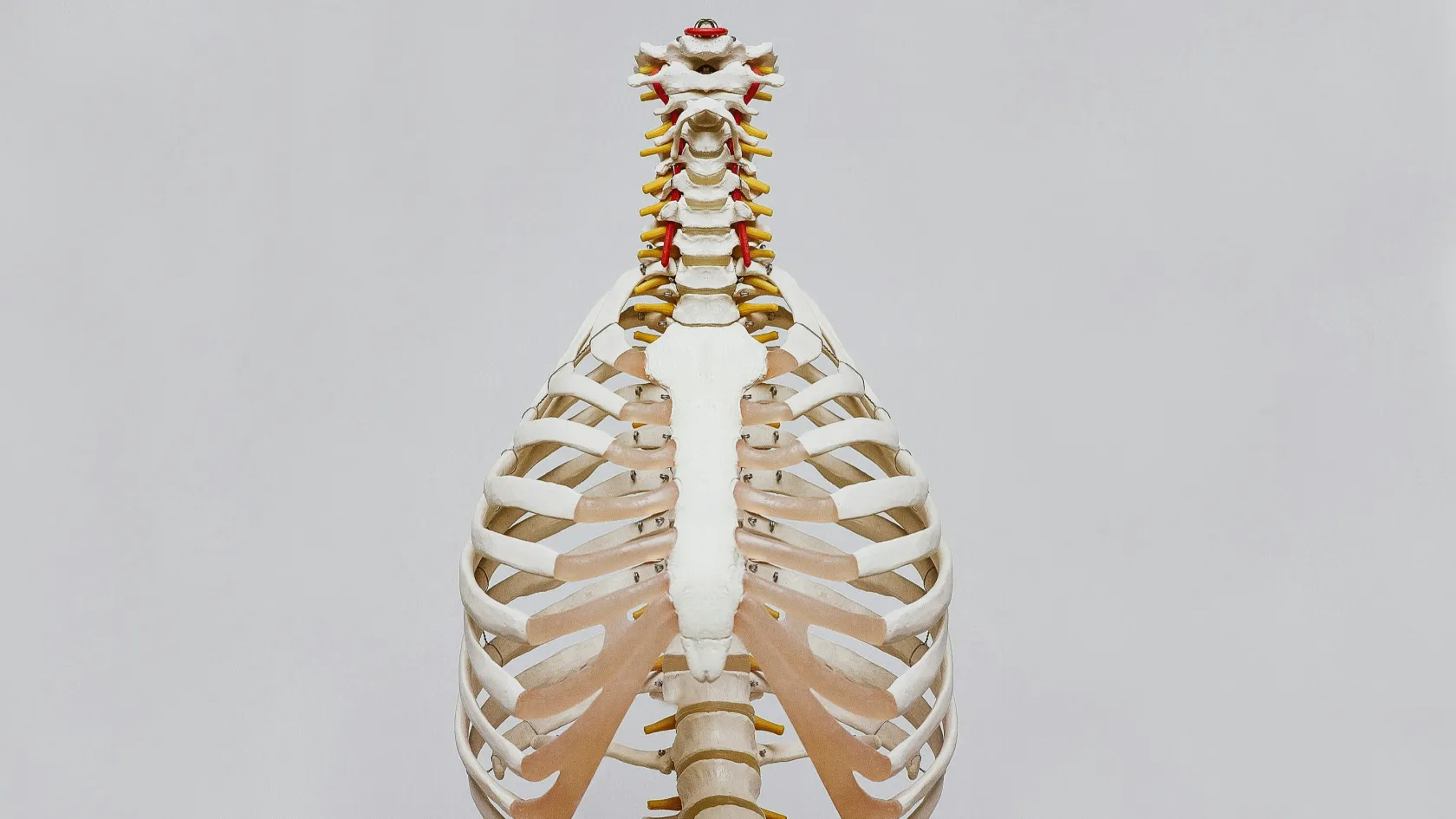
A head that falls forward of the pelvis predicts pain and disability better than the size of a sideways curve, so correcting adult spinal deformity starts with balance rather than with a straight X-ray.
About This Department
Orthopedics
The goal is a spine that holds you upright without effort. A straight X-ray comes second.
In a nine-center North American study of adults with lumbar scoliosis, 77.4 percent of patients treated with surgery reached a meaningful improvement in disability at two years, against 38.3 percent of those treated without it.
77.4%
Meaningful improvement in disability after surgery, ASLS study
38.3%
The same improvement without surgery
14 to 21 days
Published total stay in Istanbul for spinal correction
Free
Review of your standing X-rays before you book
Free consultation
The review costs nothing and carries no obligation. Send standing X-rays of the whole spine and pelvis, any MRI or CT, a bone density result and earlier operation notes, and a spine surgeon will tell you whether correction is likely to help, which operation fits, and what to prepare. A coordinator replies in your own language.
A curve or a forward lean of the spine has grown to the point where walking upright, standing at the sink or sleeping through the night has become hard, and a surgeon has raised the possibility of an operation. Spinal deformity correction realigns the spine with screws, rods and, where needed, wedges of bone removed, then fuses it in the corrected position so the head sits back over the pelvis and the nerves are freed. Below you will find why balance matters more than the size of the curve, what the best study comparing surgery with non-surgical care found, which operation suits which spine, how to prepare, the complication figures, the recovery, how long to stay in Istanbul, and what happens once you are home.
What spinal deformity correction treats
Adults come to deformity surgery by several routes. Degenerative scoliosis develops in a previously straight spine as the discs and joints wear unevenly, usually after fifty, and it often narrows the canals where the nerves run, causing leg pain on walking. Adolescent scoliosis that was never treated can progress slowly through adult life, kyphosis, a forward rounding, comes from Scheuermann disease, osteoporotic fractures, ankylosing spondylitis or earlier surgery, and flatback deformity follows long fusions done decades ago that removed the natural inward curve of the lower back. All of these share one mechanical problem when they become disabling, namely a trunk that tips forward or sideways so that muscles must work all day to hold the body upright, and that work produces the fatigue and pain patients describe. Neuromuscular curves in adults with conditions such as Parkinson disease or an earlier stroke form a smaller and harder group, because weak muscles struggle to hold any correction for long.
Signs that need a spine surgeon soon
Leg weakness, numbness that spreads, unsteady walking or a change in bladder control, because they can mean pressure on the nerves.
What imbalance feels like day to day
Standing at the kitchen sink for only a few minutes, leaning on a shopping trolley to walk through a supermarket, bending the knees to stand upright, aching thighs and buttocks by the afternoon, and needing to sit down or lean on something to rest the back.
Leaning forward hurts more than curving sideways.
Balance matters more than the curve
A multicenter study of 298 adults with scoliosis, published in Spine in 2005, compared every measurement on the standing X-ray with pain and function scores and found that positive sagittal balance, the head and trunk falling forward of the pelvis, predicted symptoms more reliably than any other measurement, including the size of the sideways curve. Thoracolumbar and lumbar curves caused more symptoms than curves in the chest.
The sideways curve mattered less.
The measurements a surgeon reads on a standing X-ray
Sagittal vertical axis, the horizontal distance between a plumb line dropped from the seventh neck vertebra and the back of the sacrum. Pelvic incidence, a fixed angle of each person's pelvis that sets how much inward curve the lower back needs. Lumbar lordosis, the inward curve actually present. Pelvic tilt, how far the pelvis has rotated backward to compensate. Together these numbers tell the surgeon how much correction the spine needs and where.
What the surgeon aims for
A plumb line from the base of the neck falling within about 5 cm of the sacrum, an inward curve of the lower back within about 10 degrees of the pelvic incidence, and a pelvis that no longer has to tilt backward to keep you upright.
The mismatch that predicts benefit
When the inward curve of the lower back falls far short of what the pelvis calls for, surgery helps more. In an analysis from the Adult Symptomatic Lumbar Scoliosis study, published in the Journal of Neurosurgery Spine in 2020, patients whose mismatch exceeded 11 degrees gained more from an operation, while those with a nearly normal match did no better with surgery than without it.
What did not matter
Body weight and mental health did not change that benefit.
Surgery or not, the ASLS study
The best evidence for adults comes from a North American study across nine centers of patients aged 40 to 80 with a lumbar curve of at least 30 degrees and real disability, published in the Journal of Bone and Joint Surgery in 2019. Some patients agreed to be randomly assigned, and others chose their own treatment and were followed alongside them.
This table scrolls sideways on a narrow screen. Swipe or drag to see every column.
Two-year results of the Adult Symptomatic Lumbar Scoliosis study
Measure
Surgery
Non-surgical care
Meaningful improvement in scoliosis scores
85.7 percent
38.7 percent
Meaningful improvement in disability scores
77.4 percent
38.3 percent
Further operations
34 revisions in 24 patients, 14 percent
Not applicable
Patients who changed their mind
Not applicable
64 percent of those randomized to non-surgical care later had surgery
The authors closed with advice for every patient. If you are satisfied with your spine as it is, non-surgical care is advised, with the understanding that improvement is unlikely. If you are not and you expect improvement, surgery is preferred.
Which operation for which spine
Four building blocks make up most corrections.
Decompression with a short fusion. For leg pain from narrowed nerve canals in a modest curve with good balance. Smaller, faster, and kinder to older patients.
Long posterior fusion. Screws from the lower chest or upper back to the sacrum and often the pelvis, with rods that restore the curve and balance.
Interbody cages. Spacers placed between vertebrae from the side, front or back that restore disc height and inward curve and give a large surface for fusion.
Osteotomies. Wedges of bone removed to bend a stiff spine, from small Ponte cuts to a pedicle subtraction osteotomy through a whole vertebra.
Some surgeons stage a large correction over two operations a few days apart to shorten each anesthetic, and minimally invasive techniques suit some patients with flexible curves and moderate imbalance, while severe rigid deformities still need an open operation.
Getting ready for surgery
1
Bone strength
A bone density scan. Osteoporosis treated, sometimes with bone-building injections for some months, before screws go in.
2
No smoking
Smoking slows fusion and raises infection risk. Stopping several weeks before surgery helps.
3
Nutrition and weight
Protein, vitamin D and, where possible, weight loss.
4
Heart, lungs and blood
A medical review, and blood thinners stopped or bridged on the surgeon's instructions.
5
Imaging
Standing X-rays of the whole spine and pelvis, CT and MRI, planned together into a target alignment.
Risks, with what is done about each
Risk is real. Adult deformity surgery carries more of it than most spine operations. In the ASLS study, 97 serious adverse events occurred among 173 operated patients, most often implant failure or a fusion that did not heal, in 25, and junctional kyphosis above the fusion, in 10, and patients who had one improved less than those who did not, yet still improved more than patients treated without surgery, at two and at four years.
Implant failure and nonunion
A broken rod or a fusion that has not healed. Extra rods across osteotomy sites, more interbody cages and bone-building medicine reduce it. A revision fixes it.
Junctional kyphosis
Collapse at the top of the fusion. Avoiding overcorrection, choosing the top vertebra carefully and strengthening weak bone reduce it.
Nerve injury
Usually a mild weakness that recovers. Spinal cord monitoring during correction warns the surgeon early.
Infection, blood loss and clots
Antibiotics, medicines that limit bleeding, blood salvage, early walking and clot prevention manage these.
The recovery
Expect a slow first month.
Patients stand with a physiotherapist on the first or second day, often after a night in intensive care, and walking distances grow daily on the ward while the drain and catheter come out. At home, walking remains the main exercise. Bending, lifting and twisting wait for the fusion, which takes six to twelve months to mature, and desk work becomes possible after six weeks to three months depending on the length of the fusion and on age. Some people feel worse for the first weeks than before the operation as the body adapts to a new posture, and improvement continues for up to two years. A fusion to the pelvis changes how you sit, put on socks and get into and out of a car. An occupational therapist teaches the new ways before discharge, and a long-handled reacher and a raised toilet seat make the first months at home much easier.
How long to stay in Istanbul
Plan for about three weeks.
Published Istanbul figures vary widely with the size of the operation, from three days in hospital at one center to eight to ten days at another, and recommendations for the whole trip run from fourteen to twenty-one days. A long fusion with osteotomies sits at the upper end, and flying waits for a dry wound, confident walking and a standing X-ray reviewed by the surgeon, and on a long flight an aisle seat and a walk every hour help.
What decides the cost
The number of levels fused, whether the fusion goes to the pelvis, the number of osteotomies and interbody cages, a staged operation, intensive care nights and blood products set most of the figure.
Revision surgery costs more than a first operation.
Bone-building medicine before surgery, a longer rehabilitation in Istanbul and your own medical conditions move it further. Your health moves it too.
Published packages for spinal correction in Istanbul list the operation and implants, the hospital stay with meals and nursing, medicines during the admission, a room for a companion, surgeon consultations and preoperative tests, and some add neuromonitoring, transfers and a hotel after discharge. Hotel nights, take-home medicines and extra hospital days sit outside several of them, so a quote you can compare names the levels, the implants and the osteotomies, and says whether monitoring and intensive care are included. That figure comes only from a spine surgeon reading your standing X-rays, CT and MRI. The review costs nothing.
Arranging the trip
A coordinator answers your first WhatsApp message, stays with you to discharge and keeps the same number afterward, and English, Arabic, French, Russian, Serbian, Romanian and Spanish are spoken by the team, with an interpreter for any other language. A companion bed lets one person stay in your room every night, and the international patients office books the hotel for the nights before and after, sends the invitation letter for a medical visa about ten days before travel and arranges transfers. Halal, vegetarian and diabetic meals come from the hospital kitchen, a prayer room sits on site, and a request for a female physician goes to the department with your first message.
Bring every earlier spine X-ray and operation note.
Once you are back home
Standing X-rays at three, six, twelve and twenty-four months follow the fusion and the junction above it, and a local surgeon can take them while the coordinator passes them to the surgeon in Istanbul. Osteoporosis treatment continues for years where it applies.
New leg weakness, loss of bladder control, a fever with a red wound, or a sudden pain or new forward lean at the top of the fusion. Each needs a doctor the same day.
Spinal deformity correction FAQ
Is adult scoliosis surgery worth it?
For patients who are unhappy with their spine and expect improvement, the ASLS study found meaningful improvement in disability in 77.4 percent after surgery against 38.3 percent without it.
What are the risks of spinal deformity surgery?
Serious adverse events are common, most often implant failure, a fusion that does not heal and collapse above the fusion. Even patients who had one improved more than those treated without surgery in the ASLS study.
How long is the hospital stay?
Three to ten days in published Istanbul figures, depending on the size of the operation, and fourteen to twenty-one days in Istanbul in total.
Will I be shorter or taller after surgery?
Many patients stand taller, because the spine is straightened and the trunk no longer leans forward.
When can I return to work?
Desk work after six weeks to three months. Heavy physical work waits for a solid fusion and may not be possible after a long fusion.
Can a family member stay with me?
Yes. One companion stays in your room on the companion bed, and the international patients office arranges the hotel.
References
Kelly MP, Lurie JD, Yanik EL, et al. Operative versus nonoperative treatment for adult symptomatic lumbar scoliosis. J Bone Joint Surg Am. 2019;101(4):338-352.
Yanik EL, Kelly MP, Lurie JD, et al. Effect modifiers for patient-reported outcomes in operatively and nonoperatively treated patients with adult symptomatic lumbar scoliosis: a combined analysis of randomized and observational cohorts. J Neurosurg Spine. 2020;33(1):17-26.
Smith JS, Shaffrey CI, Kelly MP, et al. Effect of serious adverse events on health-related quality of life measures following surgery for adult symptomatic lumbar scoliosis. Spine (Phila Pa 1976). 2019;44(17):1211-1219.
Glassman SD, Berven S, Bridwell K, Horton W, Dimar JR. Correlation of radiographic parameters and clinical symptoms in adult scoliosis. Spine (Phila Pa 1976). 2005;30(6):682-688.
Editor's note
Written by the Biruni Hospital medical editorial team. Reviewed by Assoc. Prof. Dr. Suat BATAR, Orthopedics and Traumatology.