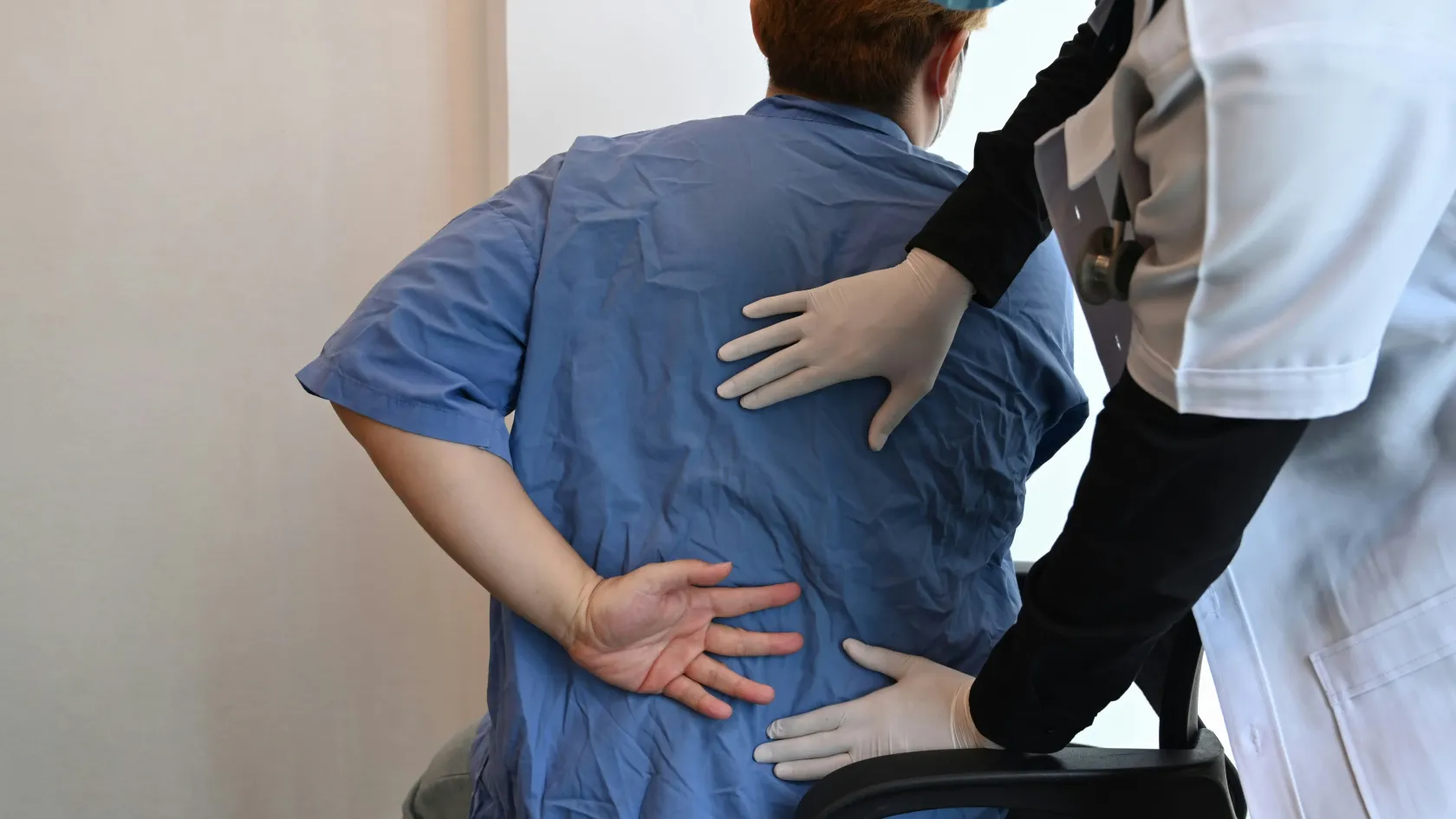
Spinal Decompression Surgery - Spinal Stenosis Surgery
Legs that ache, tingle or tire after a short walk and ease when you sit or lean forward are the typical sign of lumbar spinal stenosis. Decompression surgery removes the thickened ligament and bone pressing on the nerves. This guide explains what to try first, what the trials found for surgery against physiotherapy and for adding fusion, how the operation is done, the risks, the recovery and how long to stay in Istanbul.
About This Department
Orthopedics
Room for the nerves again. Further on your feet.
In two large randomized trials, decompression alone worked as well as decompression plus fusion for most patients, with a shorter hospital stay.
4.1 days
Hospital stay after decompression alone, against 7.4 with fusion, in a Swedish trial
71.4%
Clear improvement in disability after decompression alone in NORDSTEN-DS
3 days
Hospital stay in a published Istanbul lumbar decompression package
Free
Review of your MRI before you book
Free consultation
The review costs nothing and carries no obligation. Send your lumbar MRI, any standing X-rays and a note on how far you can walk before the legs give trouble, and our orthopedic spine team will tell you whether decompression fits, whether fusion is needed, and how long to plan for. A coordinator replies in your own language.
Walking has shrunk to a few hundred meters before the legs ache, tingle or grow heavy, sitting down or leaning on a shopping trolley brings relief, and an MRI shows that the spinal canal in the lower back has narrowed. Spinal decompression surgery for lumbar spinal stenosis removes the thickened ligament, bone spurs and overgrown joint edges pressing on the nerves, so they have room again, and in some patients the level is also stabilized with screws. Below you will find what causes the narrowing, what to try first, what the randomized trials found for surgery against physiotherapy and for adding fusion, how the operation is done, the risks, the recovery, how long to stay in Istanbul, and the follow-up at home.
What spinal stenosis is
Three changes narrow the canal together
discs that lose height and bulge,
facet joints that enlarge with arthritis,
and a ligament that thickens and folds inward.
Why bending forward helps
Stooping widens the canal a little, which is why leaning on a trolley or cycling is easier than walking upright.
Narrowing builds slowly. Over decades the discs in the lower back lose height, the facet joints at the back of the spine enlarge with arthritis, and the yellow ligament lining the canal thickens and folds inward, until the nerves that travel to the legs are squeezed, most often between the fourth and fifth lumbar vertebrae. Standing straight and walking narrow the canal a little more, while bending forward opens it, which explains the typical pattern doctors call neurogenic claudication. Pain, numbness or weakness in the buttocks and legs comes on with walking or standing and eases within minutes of sitting or stooping, as when leaning on a trolley in the supermarket or cycling, which many patients still manage comfortably. Back pain may be present. It is rarely the main complaint. When one vertebra has slipped forward on the one below, called degenerative spondylolisthesis, the narrowing is often worse at that level. Leg cramps from poor circulation can look similar, so pulses in the feet are checked and sometimes a vascular scan is added before blaming the spine.
This table scrolls sideways on a narrow screen. Swipe or drag to see every column.
Where the narrowing sits and what it causes
Type
Where
Typical symptoms
Central stenosis
The main canal
Both legs ache and tire with walking
Lateral recess stenosis
The side of the canal where the nerve turns
Pain in one leg in a nerve pattern
Foraminal stenosis
The opening where the nerve leaves the spine
One-sided leg pain, sometimes at rest
With spondylolisthesis
A level where one vertebra has slipped
Leg symptoms and back pain on standing
Typical signs include
leg pain or heaviness that comes on with walking,
relief within minutes of sitting or bending forward,
numbness or tingling in the legs or feet,
and a walking distance that shrinks over months.
Seek help at once
Numbness in the groin or saddle area, new difficulty passing urine or controlling the bowels, or rapidly increasing leg weakness. These point to severe compression of the nerves and need emergency assessment.
What to try before surgery
Many people with stenosis stay stable for years, and some improve. Nonsurgical care comes in stages.
1
Confirm the cause
An MRI and standing X-rays, with pulses in the feet and the hips checked, so that circulation or hip arthritis is not mistaken for stenosis.
2
Physiotherapy
Flexion exercises, core strength and walking or cycling, with pain relief and medicines for nerve pain.
3
Injection for flares
An epidural steroid injection can calm a flare of leg pain for weeks or months.
When surgery becomes the question
Walking distance that keeps shrinking, leg pain that limits daily life despite these steps for three months or more, or weakness that appears.
Surgery or physiotherapy
Physiotherapy first, surgery when walking keeps shrinking.
SPORT enrolled 654 patients with stenosis but no slipped vertebra at 13 American spine centers, 289 of them randomized. Many switched between treatments, so the randomized comparison showed a benefit only in bodily pain, while the combined analysis of what patients actually received favored surgery for pain and function from three months through two years. A Pittsburgh trial of 169 patients aged 50 or older randomized to decompression or a physical therapy program found similar improvement in physical function at two years, 22.4 against 19.2 points, though 57 percent of those assigned to physiotherapy crossed over to surgery.
Scroll sideways on small screens to see every column.
Randomized trials in lumbar spinal stenosis
Trial
Patients
Question and finding
SPORT, 2008
654
Surgery against usual nonsurgical care. Better pain and function with surgery in the as-treated analysis
Pittsburgh, 2015
169
Surgery against physical therapy. Similar function at two years, with 57 percent crossing to surgery
Swedish Spinal Stenosis Study, 2016
247
Adding fusion to decompression. No better results at two or five years
NORDSTEN-DS, 2021
262
Adding fusion for a slipped vertebra. Decompression alone was noninferior
1
Three months of physiotherapy
The starting point for most patients without weakness.
2
Review
Walking distance, leg symptoms and the MRI are reviewed together.
3
Decide on surgery
Decompression alone for most, with fusion kept for an unstable or deformed level.
Decompression alone or with fusion
What a slipped vertebra means
In degenerative spondylolisthesis one vertebra has slid forward a few millimeters on the one below, usually between the fourth and fifth lumbar vertebrae. It narrows the canal further and was long thought to need fusion in every case.
Fusion adds screws, rods and bone graft to hold a level still. In the Swedish Spinal Stenosis Study, 247 patients aged 50 to 80 with narrowing at one or two levels, more than half with a slipped vertebra, were randomized to decompression alone or decompression plus fusion. Disability scores at two years were 24 and 27, walking distance in six minutes was 405 and 397 meters, results at five years were similar, and the hospital stay was 4.1 against 7.4 days. NORDSTEN-DS then tested patients who all had a slipped vertebra of 3 millimeters or more, and 71.4 percent after decompression alone against 72.9 percent after fusion improved their disability score by at least 30 percent at two years. Reoperations were 12.5 and 9.1 percent.
When fusion still makes sense
A level that moves abnormally on standing X-rays, a large slip or curve, or a decompression that would leave the spine unstable.
Signs it may be time
Leg pain or numbness on walking that matches the MRI, walking distance that keeps shrinking, three months or more of physiotherapy and other treatment without enough relief, or weakness that is appearing.
Talk to us first
Back pain without leg symptoms, leg pain from poor circulation or hip arthritis, findings on MRI that do not match the symptoms, or a medical condition that makes anesthesia unsafe until it is treated.
How decompression is done
Open or through a tube
The surgeon reaches the canal from the back, under general anesthesia, through a cut of a few centimeters over the affected level, and under a microscope or endoscope removes the thickened ligament and the bone and joint edges pressing on the nerves. A laminectomy removes the back arch of the vertebra, while a laminotomy or a decompression through a tube removes only part of it, keeping more of the muscles and joints intact.
1
Positioning
You lie face down on a padded frame that keeps the abdomen free.
2
Level check
An X-ray marks the level.
3
Decompression
Ligament and bone spurs are removed until the nerves move freely.
4
Fusion if planned
Screws and rods are placed and bone graft laid over the level.
5
Closure
Stitches close the layers.
Risks and how they are managed
On a phone, slide the table sideways to see both columns.
What fusion added in the Swedish Spinal Stenosis Study
Measure
Fusion compared with decompression alone
Hospital stay
7.4 days against 4.1 days
Operating time and bleeding
Longer and greater with fusion
Further lumbar surgery over 6.5 years
22 percent against 21 percent
Tear of the nerve covering
A small tear in the dura leaks spinal fluid. It is repaired during surgery, and a day of bed rest may follow.
Infection
Antibiotics before surgery, careful wound care and good blood sugar control keep it low.
Symptoms that return
Narrowing can develop at the same or another level over the years, and some patients need another operation.
Blood clots
Early walking and clot prevention for those at higher risk.
The recovery
Pain goes first
Leg pain on walking eases soon after surgery. Numbness and tingling that were present for years fade more slowly, over months, and in some patients never disappear completely, which is worth knowing before surgery.
You stand and walk on the day of surgery or the morning after. Leg pain on walking eases quickly in many patients. After decompression alone, patients leave hospital after one to three days, while a fusion adds a few more. Desk work returns in two to four weeks after decompression and six to eight after fusion, and driving resumes once you can sit comfortably and brake hard. Walk every day. Add a little distance each week, starting with ten minutes several times a day and building toward half an hour or more by six weeks, and avoid heavy lifting, bending with a load and twisting for six weeks, while a physiotherapist adds core and hip strength from about the fourth week and teaches you how to lift, garden and get in and out of a car without straining the operated level. Sleep in whatever position is comfortable. Walking distance becomes the measure that patients notice most, and many keep a simple diary of it.
How long to stay in Istanbul
Plan for one week after decompression, and ten to fourteen days after fusion.
A published Istanbul package for lumbar decompression with screws and graft lists three days in hospital and includes surgery and anesthesia, preoperative MRI, CT and X-rays, an interpreter and transfers, with the hotel left out. A wound check and confident walking come before the flight. Fitness to fly is confirmed at the final visit, with an aisle seat, a lumbar cushion and regular walks in the aisle.
What decides the cost
Decompression alone or with fusion, the number of levels, screws and graft, open or tube technique, nights in hospital and imaging set most of the figure.
A quote you can compare names the levels, the technique and any implants, and that figure comes only after a spine surgeon reviews your MRI, standing X-rays and symptoms. The review costs nothing.
Arranging the trip
Send your lumbar MRI and a note on how far you can walk on WhatsApp, and a coordinator replies and stays with your case through surgery and after you fly home. The team speaks English, Arabic, French, Russian, Serbian, Romanian and Spanish, and interpreters cover the rest. A son, daughter or spouse can sleep in the room on the companion bed. The international office books a hotel, sends the visa invitation letter ten days before travel and arranges transfers, and meals come halal, vegetarian or diabetic, with a prayer room and a female physician on request.
Once you are back home
Video calls at six weeks and three months through the coordinator review walking distance and wound healing, and after a fusion, X-rays at three and twelve months check the bone.
Fever, a leaking or red wound, a severe headache on sitting up, new numbness in the saddle area, or trouble controlling the bladder. Each needs a doctor the same day.
Spinal stenosis surgery FAQ
Short answers to the questions patients ask most.
Is surgery for spinal stenosis worth it?
In SPORT, patients who had surgery improved more in pain and function than those treated without it, though physiotherapy alone helps many.
Do I need screws and fusion?
Not usually. Two large trials found decompression alone as effective as adding fusion for most patients, including many with a slipped vertebra.
How soon can I walk?
The same day or the next morning.
Will the narrowing come back?
It can, at the same or another level, over years, and some patients need another operation.
Am I too old for surgery?
Age alone does not rule it out. General health, heart and lung function and walking goals decide.
Can a family member stay with me?
Yes. One relative sleeps on the companion bed in your room, and the international office arranges a hotel for others in the party.
References
Weinstein JN, Tosteson TD, Lurie JD, et al. Surgical versus nonsurgical therapy for lumbar spinal stenosis. N Engl J Med. 2008;358(8):794-810.
Delitto A, Piva SR, Moore CG, et al. Surgery versus nonsurgical treatment of lumbar spinal stenosis. A randomized trial. Ann Intern Med. 2015;162(7):465-473.
Försth P, Ólafsson G, Carlsson T, et al. A randomized, controlled trial of fusion surgery for lumbar spinal stenosis. N Engl J Med. 2016;374(15):1413-1423.
Austevoll IM, Hermansen E, Fagerland MW, et al. Decompression with or without fusion in degenerative lumbar spondylolisthesis. N Engl J Med. 2021;385(6):526-538.
Editor's note
Written by the Biruni Hospital medical editorial team. Reviewed by Assistant Professor Şafak SAYAR, Orthopedics and Traumatology.