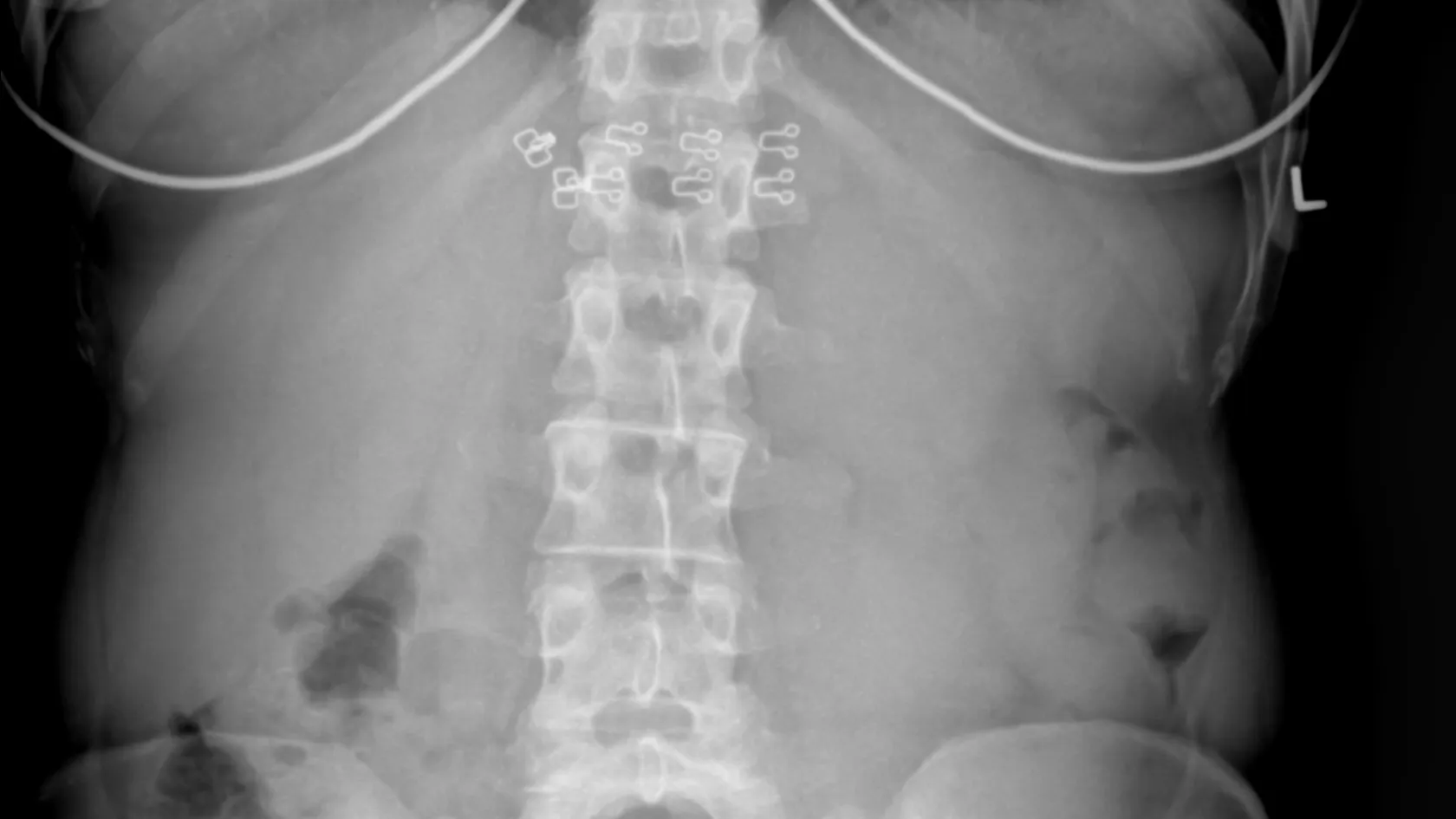
Bone cement for a broken vertebra fell out of favor after two sham-controlled trials in 2009, and later pooled data showed who still gains, patients whose fracture is under six weeks old with swelling on the MRI. This page compares vertebroplasty and kyphoplasty, explains cement leakage, the osteoporosis plan and open surgery for unstable fractures, and sets out how long to stay in Istanbul.
About This Department
Orthopedics
Most spinal compression fractures heal without an operation. Cement or screws are for the fractures that do not.
A spinal compression fracture happens when the front of a vertebra collapses, usually in bone thinned by osteoporosis, sometimes after a fall that seemed minor or a simple lift. Many heal with pain relief and time. For pain that does not settle, surgeons inject bone cement into the broken vertebra through a needle, with or without first restoring its height with a small balloon, and an unstable fracture may need screws. This page explains which fractures benefit, what the sham-controlled trials found, how vertebroplasty and kyphoplasty compare, what to do about the bones afterward, and what to send for a free review of your MRI.
6 weeks
Fractures treated within this window gained most from cement injection in pooled trials
3.4 times
Higher odds of a new fracture when cement leaks out of the vertebra
3 to 4 nights
In hospital after kyphoplasty in a published Istanbul package
Three causes account for nearly all compression fractures. Each leads to a different plan.
Osteoporosis
Thinned bone gives way under ordinary loads. The fracture follows a cough, a lift or a minor fall, and sometimes nothing the patient can recall at all, which leaves many people treating a sore back for weeks before anyone orders a scan. An MRI with a fluid-sensitive sequence shows whether a fracture is fresh, because a healing vertebra carries swelling inside the bone that an old collapse does not.
An old, healed fracture does not respond to cement. The MRI decides who is a candidate.
Cancer, injury and unstable fractures
Myeloma and cancer that has spread to the spine weaken a vertebra from inside, and a car accident or a fall from height can break a healthy one. Some of these fractures stay stable and are treated much like an osteoporotic collapse, with cement where the pain demands it. Others do not. A burst fracture that pushes bone into the spinal canal, a fracture with nerve symptoms, or a collapse that keeps progressing into a forward stoop needs open surgery, in which the surgeon frees the nerves and fixes the vertebrae above and below with screws and rods, with cement around the screws to hold them in soft bone. That operation means six to seven nights in hospital in published packages. Recovery is measured in months rather than days, the first weeks are spent walking short distances several times a day with a physiotherapist, and the flight home waits until the wound is checked and the standing X-ray confirms that the screws sit where they were placed. For a patient traveling from abroad, that difference in time away from home shapes the whole plan, so the first question in every review is whether the fracture is stable.
When a compression fracture is an emergency
New weakness or numbness in the legs
Trouble passing urine or controlling the bowels
Fever together with back pain
A fracture after a car accident or a fall from height
Any of these needs an emergency department today, in the country where you are, because it points to pressure on the nerves, an infection or an unstable fracture.
Cement or conservative care
Pain relief, a short rest, gentle walking and sometimes a brace let many osteoporotic fractures heal within weeks. Cement injection, called vertebroplasty, has been tested against that care and against a sham procedure, in which patients lie on the table and receive local anesthetic without the cement.
Cement helps most when the fracture is fresh, the pain is severe and the MRI shows swelling in the bone.
Across 20 randomized trials and 2,566 patients, cement relieved pain better than conservative care at every time point. Against a sham procedure, the difference was not significant at most time points. The patients who still gain are those treated within six weeks of the fracture.
This table scrolls sideways on a narrow screen. Swipe or drag to see every column.
Vertebroplasty for osteoporotic compression fractures, what pooled trials show
Comparison
Pain relief
Notes
Against conservative care
Better at every time point
20 trials, 2,566 patients
Against a sham procedure
No clear difference at most time points
Sham with numbing of the bone surface matched cement most closely
Fracture younger than 6 weeks
Better short-term pain relief and quality of life
Benefit concentrated in fresh fractures
Those results changed practice.
1
Studies without a control group
Reported quick pain relief, and the procedure spread before any sham-controlled trial existed.
2
Two sham-controlled trials in 2009
The sham group improved nearly as much.
3
A fall in use
Cement procedures in the American Medicare population fell by 38.3 percent over the next eight years.
4
Pooled trials since
The benefit concentrates in fresh fractures with severe pain and swelling on the MRI.
So the decision rests on three findings that any surgeon can read from your file, which are the age of the fracture, the swelling inside the bone on a fluid-sensitive MRI sequence, and how much the pain still limits standing and walking after a few weeks of ordinary care. The table below sets out how those findings translate into a plan.
On a phone, slide this table sideways to read all of its columns.
Who is a candidate for cement
Finding
Plan
Fresh fracture, swelling on MRI, severe pain
Cement considered
Old fracture with no swelling
Cement will not help
Pain settling with conservative care
Continue conservative care
Nerve symptoms or an unstable fracture
Open surgery with screws
Vertebroplasty and kyphoplasty compared
Both procedures go through the skin of the back under X-ray guidance, through openings smaller than a centimeter. Nothing stays behind but cement. A meta-analysis of comparative studies found less cement leakage and better restored height after kyphoplasty, with no difference in pain, disability or new fractures at neighboring levels, while kyphoplasty took longer and cost more. For most patients the choice comes down to the shape of the broken vertebra, and the surgeon explains it on the images.
Drag sideways on a narrow screen to see the whole table.
Vertebroplasty against kyphoplasty
Point
Vertebroplasty
Kyphoplasty
Balloon to lift the bone
No
Yes
Cement leakage
More frequent
Less frequent
Height restored
Less
More
Pain and disability
Similar
Similar
Time and cost
Shorter, lower
Longer, higher
How each procedure works
Vertebroplasty
The needle enters the broken vertebra on one or both sides. Liquid cement fills the cracks and sets within minutes. Walking starts the same day.
For a fresh, painful fracture, either procedure is reasonable.
Kyphoplasty
In kyphoplasty, a small balloon is inflated inside the vertebra first, to lift the collapsed bone and leave a cavity, and the cement then fills that cavity at lower pressure.
Kyphoplasty suits a fracture that has lost more height at the front, and the surgeon shows you why on the images.
New fractures and cement leakage
Two worries come up at almost every consultation.
Does cement cause the next fracture
Fourteen randomized trials with 1,413 patients, pooled together, found no increase in new vertebral fractures after vertebroplasty compared with control treatment, with a risk ratio of 1.05, and fewer serious adverse events, with a risk ratio of 0.53. Treatment within six weeks of the fracture was linked to fewer new fractures.
The next fracture comes mostly from the osteoporosis itself.
Cement leakage
Small amounts of cement can seep into the veins or the disc next to the vertebra. Most of these leaks cause no symptoms. Leakage still matters. Across 15 studies and 6,546 patients, it raised the odds of a new fracture 3.4 times, more than older age, female sex or the number of treated levels, so slow injection under continuous X-ray counts for more than the brand of cement. In cancer-related fractures, where most of seven randomized trials showed better pain relief than other treatments, leakage appeared in a quarter of procedures.
Our surgeons inject slowly under live X-ray.
Treating the bones as well as the fracture
A vertebral fracture from a minor strain means osteoporosis until proven otherwise. The risk of another fracture peaks in the first year, so the bone plan starts during the same visit.
1
Bone density scan
Measures the hip and spine and sets the baseline for treatment.
2
Blood tests
Vitamin D, calcium and the other causes of bone loss that can be corrected.
3
Medicine
A decision on osteoporosis treatment, made with you, before you fly.
4
Handover
A written plan for your doctor at home, who continues the treatment and repeats the scan.
Fixing the fracture while leaving the bone untreated leaves the patient waiting for the next one.
The stay and the flight home
One published kyphoplasty package in Istanbul lists three to four days in hospital, and six to seven when screws are added. Plan five to seven days in Istanbul after cement alone and two weeks after open fixation.
Day one, MRI, standing X-rays and a review with the surgeon
Day two, the procedure under local or general anesthesia, and walking the same evening
Days three to four, discharge once walking is comfortable
Before the flight, a check of the needle sites and the written bone plan
At home, a daily walk and no heavy lifting for six weeks
Many patients notice less pain within a day or two. Some feel it at once. Long flights raise the risk of clots, so walk the aisle every hour. Your coordinator is assigned from the first message. That person keeps the same WhatsApp number after you return home, answers in English, Arabic, French, Russian, Serbian, Romanian or Spanish, brings in an interpreter for any other language, and stays the single contact for the surgeon, the ward and the hotel from the first scan you send until the last check of the needle sites before your flight. One relative can sleep on a companion bed in the patient room. Hotel nights before and after the admission, airport transfers and every ride to the hospital are booked by the international patients office, so nobody in the family has to find a taxi with a sore back to look after. Meals from the hospital kitchen come halal, vegetarian or diabetic. There is a prayer room on site. Female surgeons can be requested and are assigned wherever the rota allows, and the invitation letter for the visa leaves ten days before travel.
Call the same day for leg weakness or numbness, fever, chest pain, breathlessness, or sharp new back pain.
What a quote should cover
Cost depends on the number of levels, on balloon kyphoplasty against simple vertebroplasty, and above all on whether screws are needed. The published package for this market includes the procedure, an MRI with a fluid-sensitive sequence, standing X-rays, a posture assessment, a rheumatology consultation and airport transfers. Flights, the hotel and screw fixation are extra.
A figure worth comparing comes after a surgeon has seen on your MRI whether the fracture is fresh, and that review is free.
Spinal compression fracture surgery FAQ
Do all compression fractures need surgery?
Many heal within weeks with pain relief and gentle activity. Cement is considered for a fresh fracture with severe pain that is not settling, and open surgery for an unstable fracture or nerve pressure.
Is kyphoplasty better than vertebroplasty?
Kyphoplasty leaks cement less frequently and restores more height, but pain relief and new fracture rates are similar, and it takes longer and costs more.
How soon can I fly after kyphoplasty?
Five to seven days after the procedure, once walking is comfortable. After open fixation, two weeks.
Will I need treatment for osteoporosis?
Yes, in almost every case of a fracture from a minor strain. The fracture itself is the strongest warning sign of the next one.
What should I send for a free review?
The MRI of the spine with a fluid-sensitive sequence, standing X-rays, the date the pain began, any bone density result, any history of cancer, and a list of medications. A spine surgeon replies with whether the fracture is fresh, which procedure fits, and the expected stay, at no charge and with no obligation to travel.
References
Li WS, Cai YF, Cong L. The effect of vertebral augmentation procedure on painful OVCFs: a meta-analysis of randomized controlled trials. Global Spine J. 2022;12(3):515-525.
Lainez Ramos-Bossini AJ, Lopez Zuniga D, Ruiz Santiago F. Percutaneous vertebroplasty versus conservative treatment and placebo in osteoporotic vertebral fractures: meta-analysis and critical review of the literature. Eur Radiol. 2021;31(11):8542-8553.
Manchikanti L, Sanapati J, Pampati V, et al. Utilization of vertebral augmentation procedures in the USA: a comparative analysis in Medicare fee-for-service population pre- and post-2009 trials. Curr Pain Headache Rep. 2020;24(5):22.
Daher M, Kreichati G, Kharrat K, Sebaaly A. Vertebroplasty versus kyphoplasty in the treatment of osteoporotic vertebral compression fractures: a meta-analysis. World Neurosurg. 2023;171:65-71.
Lainez Ramos-Bossini AJ, Jimenez Gutierrez PM, Moraleda Cabrera B, et al. Risk of new vertebral compression fractures and serious adverse effects after vertebroplasty: a systematic, critical review and meta-analysis of randomized controlled trials. Quant Imaging Med Surg. 2024;14(11):7848-7861.
Lian YS, Chen LP, Chen JY. Risk factors for new vertebral fracture after percutaneous vertebroplasty or kyphoplasty for osteoporotic vertebral compression fractures: an updated systematic review and meta-analysis. Eur Spine J. 2025;34(11):5116-5125.
Mattie R, Brar N, Tram JT, et al. Vertebral augmentation of cancer-related spinal compression fractures: a systematic review and meta-analysis. Spine. 2021;46(24):1729-1737.
Editor's note
Written by the Biruni Hospital medical editorial team. Reviewed by Assoc. Prof. Dr. Necdet DEMİR, Orthopedics and Traumatology.