Ear, Nose and Throat
Septoplasty straightens the wall between the nostrils so air can pass. Two randomized trials, in the Netherlands and the United Kingdom, found it clearly better than sprays for a blocked nose caused by a bent septum.
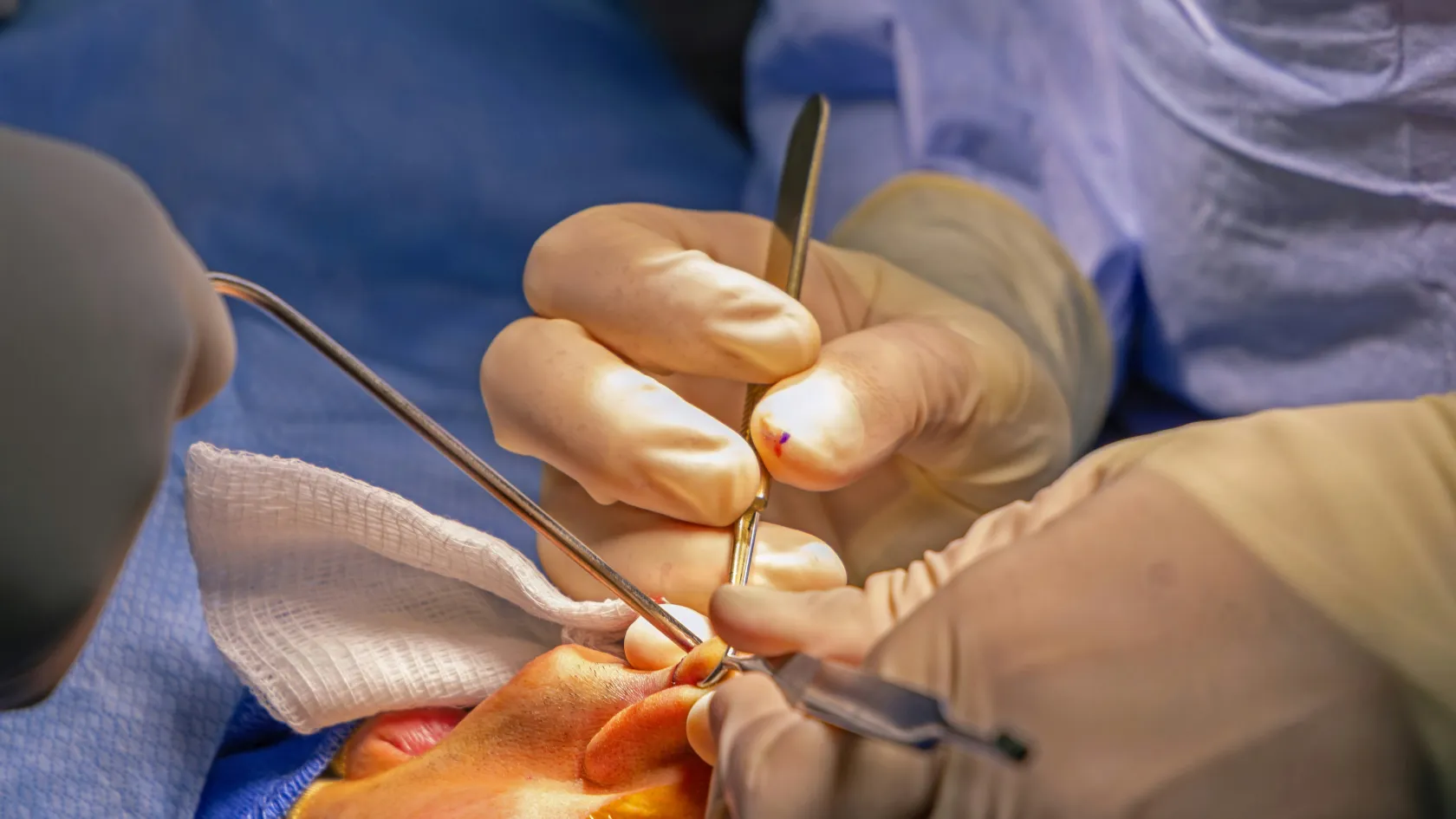
A deviated septum is common. Many people with one never notice it. When it blocks breathing through one or both sides, disturbs sleep or makes exercise hard, and steroid sprays have not helped, septoplasty is the operation that fixes the structure. Performed through the nostrils, without an outside cut, it takes an hour and the majority go home the same day or the next morning. Complications occurred in 3.42 percent of 5,639 operations in one large series, bleeding above all. Send us your symptoms, any nasal endoscopy or CT and the treatments you have tried, and an ENT surgeon will tell you whether septoplasty is likely to help and how long to plan.
19.9 vs 39.5
Symptom score at six months, surgery against sprays, lower is better
3.42%
Complications in 5,639 septoplasties
5 to 7 days
In Istanbul, including splint removal
Free
ENT surgeon's review of your file
Free consultation
Warning signs after surgery
Heavy bleeding that does not stop with gentle pressure and sitting upright, fever with increasing pain and swelling at the tip of the nose, which can mean a collection of blood or pus on the septum, and clear watery discharge after a head injury all need an ENT surgeon the same day.
Who benefits from septoplasty?
Selection decides the result.
- Blocked breathing through the nose on most days for at least three months, bad enough to notice at night and during exercise.
- A bend that matches the blocked side.
- No improvement after a proper trial of steroid and saline sprays.
- Symptoms that affect sleep, exercise, work or the use of a CPAP machine for sleep apnea.
Baseline severity predicts the degree of improvement in symptoms.
NAIROS trial of 378 adults, Health Technology Assessment, 2024
- A steroid nasal spray, used daily and correctly, for at least a month.
- Saline rinses to clear mucus and crusts.
- Treatment of allergy, which swells the lining and can mimic a septal problem.
- Stopping decongestant sprays used for more than a few days, which cause rebound swelling.
In patients with septal deformity, nasal septoplasty results in significant improvement in disease-specific quality of life, high patient satisfaction, and decreased medication use.
NOSE study, Otolaryngology Head and Neck Surgery, 2004
- Examination of the nose with an endoscope, before and after a decongestant spray.
- A CT scan of the sinuses when sinus disease is suspected.
- Allergy testing when symptoms are seasonal or come with sneezing and itching.
- A sleep study when snoring and daytime sleepiness suggest sleep apnea, since septoplasty alone rarely cures it.
Septoplasty, with or without turbinate reduction, is more effective than medical management with a nasal steroid and saline spray.
NAIROS trial, Health Technology Assessment, 2024
Meticulous attention to detail in identifying the appropriate anatomy and maintaining good visualization is the key to a safe and effective septoplasty, enabling for very low complication rate.
Series of 5,639 patients, European Archives of Oto-Rhino-Laryngology, 2018
Complications
In a series of 5,639 patients treated at one center between 2009 and 2017, complications occurred in 193, 3.42 percent. Excessive bleeding was the most frequent. When the turbinates were reduced in the same operation, a collection of blood on the septum, reduced sense of smell, slow healing from infection and scar bands inside the nose were more common than after septoplasty alone.
In the Dutch trial, one of 102 surgical patients developed a septal abscess and two a hole in the septum, a perforation that can whistle or crust. Numbness of the upper front teeth for a few weeks, and a change in the outside shape of the nose if too much support is removed, are recognized risks that careful technique keeps rare.
What the trials found
For decades septoplasty was the commonest nose operation in adults without a single randomized trial behind it. Two have now been published, in the Netherlands and the United Kingdom, and both favor surgery for the right patients.
This table scrolls sideways on a narrow screen. Swipe or drag to see every column.
Randomized and prospective studies of septoplasty
| Study |
Patients |
Result |
| Dutch randomized trial, The Lancet 2019 |
203 adults, septoplasty against sprays and watchful waiting |
Quality-of-life score 72.2 against 63.9 at 12 months, benefit sustained to 24 months |
| NAIROS, United Kingdom, Health Technology Assessment 2024 |
378 adults, septoplasty against steroid and saline spray |
Symptom score 19.9 against 39.5 at six months. More adverse events with surgery, 132 against 95 |
| NOSE study, United States, 2004 |
59 adults after failed medical treatment |
Obstruction score fell from 67.5 to 23.1 at three months and stayed there at six |
Snoring and sleep apnea deserve a word. A blocked nose makes both worse, and opening it helps many people tolerate a CPAP mask, or sleep more quietly. Septoplasty by itself cures sleep apnea only in a minority, because the main narrowing lies further back in the majority, in the throat, and a sleep study before surgery avoids a disappointing result. Children and teenagers are a separate case. Their noses are still growing, and surgeons operate on the septum before the late teens only when the blockage is severe, using techniques that preserve the growth centers.
Recovery
The nose feels blocked for the first week, as swelling and splints fill the passages, and breathing opens up as they settle. Mild pain responds to paracetamol. Saline sprays several times a day keep the lining moist. Blowing the nose, heavy lifting and hard exercise are avoided for two weeks, and contact sports for four to six. Desk work resumes within a week for the majority.
The full benefit appears over one to three months as the lining heals. In the NAIROS trial, patients with the worst symptoms before surgery improved the most, and an honest estimate of severity therefore matters when deciding.
How many days in Istanbul, and what decides the cost?
Septoplasty fits into a week.
This table scrolls sideways on a narrow screen. Swipe or drag to see every column.
A typical recovery
| Time after surgery |
What happens |
| Day of surgery |
One night in hospital or home the same evening |
| Days five to seven |
Splints removed in the clinic, first check with an endoscope |
| Weeks one and two |
Blocked feeling eases, no nose blowing or heavy lifting |
| Weeks four to six |
Contact sports and full exercise allowed |
| Three months |
Final result as the lining heals completely |
Depending on the selected perspective, cost-effectiveness threshold, and time horizon, septoplasty has the potential to be cost-effective.
Economic evaluation of the Dutch trial, BMC Medicine, 2020
Plan five to seven days in Istanbul. The first day covers the examination and tests, the operation follows the next day, and the splints come out on day five to seven, after which you can fly home with a written plan for rinses and a date for your check with your own ENT doctor, who receives the operation note and a description of any turbinate work done. Flying earlier risks bleeding. Cabin pressure changes, and the splints stay unchecked.
Cost covers the surgeon, anesthesia, the operating room, one night in hospital and the follow-up visits. Turbinate reduction or a combined septorhinoplasty adds to it. Your own figure follows the free review of your file.
One coordinator handles your visit. The team works in seven languages, with interpreters for the rest. Ten days before travel, an invitation letter naming the hospital and the surgeon goes out, and the international patients office books the transfer and a hotel for you and a companion. Halal, vegetarian and diabetic meals come on request, a prayer room is on site, and a request for a female doctor is passed to the department and met wherever the rota allows. Back home, the coordinator stays reachable on the same WhatsApp number, and a check with your own ENT doctor at six weeks completes the care.
Septoplasty FAQ
Does septoplasty change the shape of my nose?
No. It works inside the nose. A change in outside shape needs a septorhinoplasty, which corrects the septum and the outer nose together.
Is septoplasty better than nasal sprays?
In two randomized trials, yes, for people with a blocked nose from a bent septum. In the NAIROS trial the symptom score at six months was 19.9 after surgery against 39.5 with sprays.
How painful is recovery?
Patients describe a blocked, heavy feeling rather than pain for the first week, controlled with paracetamol.
What are the risks?
Complications occurred in 3.42 percent of 5,639 operations, bleeding most frequently. A hole in the septum, infection and reduced smell are rarer.
When can I fly after septoplasty?
After the splints are removed, five to seven days after surgery.
Can my family come with me?
Yes. The international patients office arranges a hotel for you and a companion.
References
- van Egmond MMHT, Rovers MM, Hannink G, Hendriks CTM, van Heerbeek N. Septoplasty with or without concurrent turbinate surgery versus non-surgical management for nasal obstruction in adults with a deviated septum: a pragmatic, randomised controlled trial. Lancet. 2019;394(10195):314-321.
- Carrie S, Fouweather T, Homer T, et al. Effectiveness of septoplasty compared to medical management in adults with obstruction associated with a deviated nasal septum: the NAIROS RCT. Health Technology Assessment. 2024;28(10):1-213.
- Stewart MG, Smith TL, Weaver EM, et al. Outcomes after nasal septoplasty: results from the Nasal Obstruction Septoplasty Effectiveness (NOSE) study. Otolaryngology Head and Neck Surgery. 2004;130(3):283-290.
- Dąbrowska-Bień J, Skarżyński PH, Gwizdalska I, Łazęcka K, Skarżyński H. Complications in septoplasty based on a large group of 5639 patients. European Archives of Oto-Rhino-Laryngology. 2018;275(7):1789-1794.
- van Egmond MMHT, Grutters JPC, Hannink G, van Heerbeek N, Rovers MM. Septoplasty versus non-surgical management for nasal obstruction in adults with a deviated septum: economic evaluation alongside a randomized controlled trial. BMC Medicine. 2020;18(1):101.