
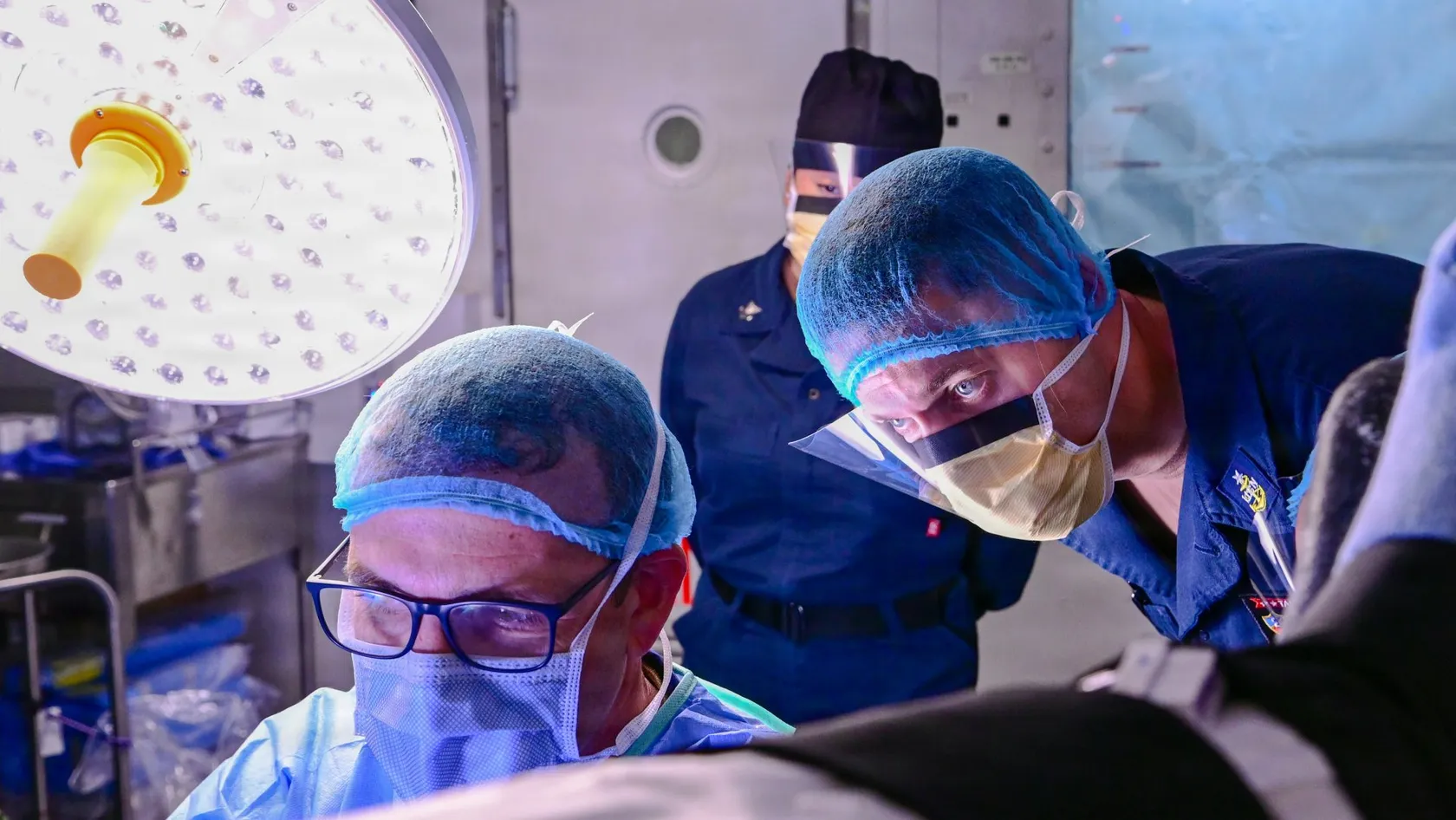
Radical Prostatectomy - Prostate Removal Surgery
Removing the prostate takes an hour and the result is decided in the last two centimeters, where the bladder neck, the nerve planes, the apex and the node dissection each buy one outcome by spending another. This page walks those four decisions in the order the surgeon meets them, gives the trial evidence behind each, and names what your own anatomy had settled before the first cut.
About This Department
Taking the gland out is the quick part. Your result is decided in the last centimeter.
This operation gets graded on three things at once, namely clean edges, urinary control and erections, and almost every technical choice that buys one of them spends another. This page walks through those choices in the order the surgeon meets them, gives the evidence behind each, and names what your own anatomy had already settled before anyone picked up an instrument.
What comes out and what goes back together
The prostate wraps around the urethra between the bladder above it and the muscular ring below it, and removing the gland therefore means cutting that tube in two places and joining the ends again afterward. Work begins at the top. The bladder neck gets divided, the seminal vesicles and the last stretch of each vas deferens come away with the specimen, the gland is lifted forward off the rectum behind it, and then the surgeon reaches the apex, the narrow tip where the prostate sits directly on the sphincter, and divides the urethra just below that. The specimen leaves the body whole. What remains is a bladder with an open neck, a short cuff of urethra and a gap between them that has to be closed in a way that holds urine and still lets it pass. Six to eight stitches do that, or a single running suture, depending on the surgeon. Everything that determines how you urinate for the rest of your life happens inside those last two centimeters of the operation, and the hour spent freeing the gland beforehand contributes very little to it.
The reconnection is the operation
A join between bladder and urethra has to be watertight enough to heal without leaking into the pelvis, loose enough to avoid scarring into a narrow ring, and placed without dragging on the sphincter it sits against. The catheter that stays in afterward is there as a splint while that seal forms, its removal date gets chosen by how the join looked when it was made, and surgeons who reconstruct the tissue behind the join before making it, a step borrowed from anatomical studies of how the sphincter is suspended, report faster early continence with no cost anywhere else.
Removal is easy to teach. The rebuild is not.
Every millimeter gets spent twice
Cancer sits inside a capsule that is thin, incomplete in places and glued to the structures a man needs afterward. Cutting wide of that capsule protects against leaving disease behind. Cutting close to it protects the sphincter, the nerve bundles and the bladder neck. Both instincts are correct and they point in opposite directions, so the operation is a sequence of small decisions about where exactly to spend the tissue, each one taken with incomplete information and no chance to revise it. A surgeon who always cuts wide will show excellent pathology reports and a clinic full of men in pads, and a surgeon who always cuts close will show fast continence figures alongside a steady trickle of PSA results that refuse to reach zero. Neither extreme is defensible, and the whole craft of this operation lies in reading each side of each gland separately and deciding separately.
Four decisions carry nearly all of that weight.
How the bladder neck is divided, how close the dissection runs to the nerve planes on each side, how wide the apex is taken, and how far the lymph node dissection extends. The rest of this page takes them one at a time, with the evidence behind each and an account of where it runs out.
The edge of the specimen
Pathologists paint the outside of the removed gland with ink before slicing it, so any cancer cell sitting against that ink was cut through rather than removed whole. Reports call this a positive surgical margin. Rates published across surgical series run from around 7 percent to well over 30 percent, which reflects how the series were assembled more than how the operations went, since a unit operating on advanced disease will have more of them than a unit operating on small tumors. The apex produces the largest share, because that is where the capsule thins to nothing and the sphincter begins.
What a positive margin changes for you
A positive margin raises the chance of the PSA returning. It does not mean the PSA will return, and a majority of men who have one never see it happen, since the cells at that edge were frequently killed by the cautery or removed with the tissue around them. Practically, a positive margin buys you closer PSA surveillance and moves radiotherapy from unlikely to possible. Nobody should be treated for a positive margin on its own, since the trigger for anything further is a PSA that starts climbing and the margin report simply tells your doctor how carefully to watch for it.
The bladder neck
Where the bladder funnels into the prostate, a collar of muscle closes during ejaculation and contributes something to holding urine as well, and preserving that collar means dissecting right down onto the prostate at the top of the gland and separating the two along the plane between them, which leaves a small neat opening that fits the urethra almost exactly. Dividing more generously leaves a wide bladder opening. That opening then has to be tailored down with a row of extra stitches, a step surgeons call the tennis racket closure from the shape it produces, and every additional stitch is another place the join can scar into a ring later on. Preservation shortens the time a man spends leaking after the catheter comes out, and every series reporting it finds the same thing. The collar itself also closes during climax, so preserving it changes nothing about ejaculation once the gland producing the fluid has gone.
What preservation costs at the baseA systematic review pulled together fifteen studies of bladder neck preservation, including two randomized trials, with sample sizes from 50 to 1,067 men and across open, laparoscopic and robotic surgery. Overall positive margin rates ranged from 7 to 36 percent and margins specifically at the base of the gland ranged from zero to 16.3 percent. Averaged across the studies, the base margin rate was 4.9 percent where the bladder neck had been preserved and 1.85 percent where it had not. The authors suggested changing the plan for the bladder neck when the preoperative MRI shows a lesion at the anterior base, which is exactly the kind of decision an MRI should be earning its place by informing.
Those two numbers are the whole argument in miniature. Faster dryness for most men, bought with a slightly higher chance of leaving disease at the top of the gland, and the trade only makes sense when the scan says the top of your gland is clear.
This table scrolls sideways on a narrow screen. Drag or swipe to see every column.
| Decision | Cutting closer buys | Cutting closer spends | What should settle it |
|---|---|---|---|
| Bladder neck | Earlier dryness and a neater join | Base margins of 4.9 percent against 1.85 percent | MRI appearance at the anterior base |
| Nerve planes | Erections, one to three years later | Margin risk on that side of the gland | Biopsy map and MRI, side by side |
| The apex | Urethral length and therefore control | The commonest site of a positive margin | Where the tumor sits on the scan |
| Node dissection | A shorter operation and fewer lymph collections | Accurate staging, and possibly more in high grade disease | Grade group and estimated nodal risk |
The nerve planes
Nerve sparing gets described to patients as a yes or a no, and surgeons think of it as a plane, since three layers of fascia wrap the back and sides of the prostate and the nerves carrying erectile signals run within and between those layers. Dissecting outside all of it sacrifices the nerves and gives the widest margin. Dissecting between the layers preserves most of the bundle. Dissecting directly on the capsule preserves nearly all of it and leaves the least tissue between the blade and any cancer reaching the edge. Surgeons grade what they did on a scale rather than a switch, and a good operation note says which grade was achieved on the left and which on the right, because the two sides are frequently different.
What settles it in the room
The biopsy map says which side and which region held cancer and at what grade. The MRI says whether the tumor touches or crosses the capsule and where. Those two documents get read together before the operation and a plan gets written for each side, and then the tissue itself has a vote, since a plane that separates cleanly is telling the surgeon something and a plane that drags is telling him something else. Some units send the freshly separated nerve plane for frozen section while the man is still asleep, so a suspicious result converts a spared side into a sacrificed one before the wound closes. That service requires a pathologist standing by and a unit willing to pay for the extra half hour.
What your body had already settled
Surgeons take credit for continence results and some of that credit belongs to anatomy nobody chose. The stretch of urethra running between the tip of the prostate and the point where it enters the penile bulb carries the sphincter, men differ a good deal in how long it is, and a long one gives the surgeon room to cut and still leave a working valve behind. A short one means every millimeter taken at the apex comes out of the mechanism itself. This measurement shows on the same MRI that was done to plan the biopsy, it takes a radiologist thirty seconds, and hardly anybody asks for it.
Age, weight and any previous prostate operation belong on the same list.
How far the node dissection goes
Prostate cancer that leaves the gland reaches the pelvic lymph nodes first, and surgeons disagree over how many of them to take. A limited dissection clears the obturator nodes alone. An extended dissection adds the external iliac, internal iliac, common iliac and presacral groups, doubles or triples the node count, adds operating time and raises the rate of lymph collections afterward, so Brazilian investigators randomized 300 men with intermediate or high risk disease to one or the other and powered the trial to detect a 15 point advantage in five year freedom from PSA recurrence. They found nothing of the sort. Median freedom from recurrence reached 61.4 months in the limited group and had not been reached in the extended group at the cutoff, a hazard ratio of 0.91 with a confidence interval running from 0.63 to 1.32. Freedom from metastasis showed the same pattern with wider limits. No man in either arm had died of prostate cancer.
One subgroup stood out. Men whose biopsy grade group was 3, 4 or 5 did better with the extended dissection, with a hazard ratio of 0.33 and a test for interaction at 0.007, which the authors were careful to call hypothesis generating. Extended dissection also found nodal disease that limited dissection missed, so it stages you more accurately whatever it does for you, and both facts belong in the conversation while a surgeon who offers extended dissection to everybody has skipped the first of them.
How many has he done
Somebody took 7,765 operations performed by 72 surgeons at four American academic centers and plotted cancer recurrence against how many prostatectomies each surgeon had completed before that particular man walked in. The curve was steep and it kept falling until around the two hundred and fiftieth case, with five year recurrence coming out at 17.9 percent for men operated on by a surgeon with ten previous cases and 10.7 percent for men operated on by a surgeon with 250, an absolute difference of 7.2 points. Same disease, same era, same adjustment for stage and grade. The only variable was how many times the surgeon had done it before.
The keyhole curve is longer
The same group repeated the analysis on 4,702 laparoscopic operations by 29 surgeons across seven institutions in Europe and North America, and five year recurrence fell from 17 percent at ten previous cases to 16 percent at 250 and 9 percent at 750, so the improvement was real and it accrued far more slowly than in open surgery. Then came the finding nobody wanted. Surgeons who had learned open prostatectomy first produced significantly worse results at the same laparoscopic case number than surgeons whose very first prostatectomy was laparoscopic, with a risk difference of 12.3 points. Skill at one version of this operation does not transfer cleanly to another version of it, and a distinguished open career is no guarantee on a console.
Why the answer arrives slowly
Units that count their results can answer all three questions in one message. Units that have never counted will respond with adjectives, with a photograph of equipment, or with a figure for the hospital as a whole. Treat the delay itself as information.
Open, laparoscopic and robotic
Three routes reach the same gland and the same four decisions. The differences between them live almost entirely in the first two weeks afterward, in blood loss, wound size and hospital nights, and the evidence on continence, erections and cancer control has repeatedly failed to separate them once surgeon experience is held constant.
- Open retropubic surgery reaches the prostate through a lower abdominal incision. Direct touch, the fastest learning curve, more blood loss and a longer stay in hospital afterward.
- Laparoscopic surgery works through small ports with long rigid instruments. Small wounds, a punishing learning curve, and the approach that most rewards starting young.
- Robot assisted surgery gives the same small ports with wristed instruments and a magnified three dimensional view. Least blood loss, shortest stay, highest equipment cost.
- Perineal surgery, through an incision between scrotum and anus, still exists and is rare, since it reaches the nodes poorly.
The sentence to hold on toThe approach changes your first two weeks and the surgeon changes your next decade. A busy open surgeon will give you a better result than an occasional robotic one, and a busy robotic surgeon will give you a better result than an occasional open one, and the two busy surgeons will give you results close enough that the difference between them has never been reliably measured. Choose the person. The equipment comes with him.
We use the approach our surgeons have the highest count on.
What to ask before you book
Three questions separate a unit that measures from a unit that markets.
Wide table. Scroll sideways on a narrow screen to reach the last column.
| You asked for | A serious answer looks like | A weak answer looks like |
|---|---|---|
| Pad free rate | A percentage, a questionnaire name and a denominator | Excellent results with our advanced technique |
| Positive margin rate | Two figures, one for confined disease and one for extended | One low number with no denominator attached |
| Nerve sparing plan | A grade for the left side, a grade for the right, and a reason | We always spare the nerves |
| Annual case number | A number for the named surgeon on the planned approach | A number for the hospital across all urology |
Send those three questions to every unit you are considering, including this one, and compare the replies rather than the websites. A unit that keeps a database answers within a day. The comparison costs you nothing and it filters more effectively than any amount of reading.
The operating day
You stop eating the night before and stop clear fluids a few hours ahead, then go to sleep under a general anesthetic with a breathing tube and, for the keyhole approaches, a steep head down tilt that the anesthetist watches carefully in anybody with heart or lung disease. Two to four hours in the room. A drain sometimes, a catheter always, and a recovery bay before you reach the ward. Blood transfusion is uncommon in keyhole surgery and occasional in open surgery. Standing up on the evening of the operation and walking the corridor the next morning cuts the clot risk more than any drug does, so the nurses will insist on it.
Two nights covers it for most men. Three for some.
Living with the catheter
Seven to fourteen days is the usual range, decided by how the join looked rather than by the calendar, and some units check it with a gentle contrast study before removal in men whose reconstruction was difficult. Bladder spasms surprise almost everybody. They feel like a sudden cramping urge with a little leakage around the tube, they respond to medication within a day, and they alarm men who had assumed a catheter would leave them with no sensation down there at all.
Removal takes about a minute and needs no anesthetic.
Getting dry again
Pelvic floor training gets recommended to everybody and the evidence behind it is more interesting than the recommendation. Eleven randomized trials covering 1,028 men were pulled together, with average age 64 and follow up between three and twelve months, and one trial of 300 men inside that set found the trained group reaching continence sooner at one month, at three months and again at six. Adding biofeedback made men more likely to be dry or free of continual leakage within the first one to two months, with a relative benefit increase of 1.54 and a confidence interval that just cleared 1. By three to four months that advantage had disappeared, and biofeedback performed no better than written or spoken instruction. Electrical stimulation and magnetic stimulation looked better than exercises early in a single trial and matched them from three months onward. The pattern across all of it is consistent. Training moves the date forward and leaves the destination where it was.
That is still a reason to do it properly, since the months between the catheter and dryness are the hardest part of this operation for most men and shortening them matters a great deal, so learn the movement from a physiotherapist before the operation rather than from a leaflet afterward, start the day the catheter leaves, and stop lifting for six weeks so the repair heals without being tested. Leakage that has stopped improving by twelve months rarely improves on its own after that, and surgical options exist for the small number of men who reach that point.
Erections and the report that follows
Nothing returns quickly here and men who expect it at six weeks lose faith early, because nerves that were handled gently still stop conducting for months while they recover, so the useful window runs from one year to three and the starting point is whatever function a man had before the operation. Ejaculation ends permanently, since the gland and the vesicles that produced the fluid have gone, while orgasm survives in nearly everybody and needs saying out loud because almost nobody is told. Tablets, vacuum devices and injections all work during the waiting period and none of them speeds the nerve recovery underneath.
The report card on your operation
Two to three weeks after surgery the pathologist finishes with the whole gland and issues a report that grades both your disease and your operation, giving the stage, the grade group across the entire specimen, the margin status with its location, and the node count with how many of them held disease. The first PSA at six weeks then tells you whether anything is still producing the protein. Read those two documents together and keep copies of both, because they answer every question that gets asked for the following twenty years and no other piece of paper does.
Cost, travel and flying home
Budget eleven to fifteen nights here. Arrival and workup take two, the hospital takes two or three, the rest is the stretch between discharge and catheter removal plus a review afterward, and men who want the catheter out before boarding should plan toward the longer end of that range.
Fitness to fly
Pelvic surgery raises the risk of a clot in the leg for several weeks and a long flight adds to it, so this is the part of the journey that deserves planning rather than the surgery itself. We fit compression stockings, we prescribe injections to cover the flight where the operation involved node dissection, and we ask every man to walk the aisle each hour and keep drinking, with clearance to board arriving for most men between day eight and day twelve. Traveling with the catheter still in place is entirely workable provided a doctor at the other end has agreed in writing to remove it, and we send that doctor the operation note and the removal instructions before you go.
What moves the cost
Four items account for most of the variation between quotes, namely whether the node dissection is limited or extended, which approach the surgeon uses, how many hospital nights are included, and whether the pathology on the whole specimen sits inside the figure or arrives as a separate invoice afterward. Get all four written down before you accept anything, and treat the fourth one as a test of how the quote was assembled.
- The biopsy report with grade group, the number of cores taken and the number that held cancer on each side.
- The prostate MRI report and the images themselves on a disc or a link, since a report alone cannot be re-read here by our own radiologist.
- Every PSA you have ever had, each with its date, and the name of the laboratory where possible.
- Any bone scan or PSMA scan, a list of your medications, and a note of any previous prostate or abdominal operation.
One of our urologists reads all of that and replies in writing at no charge, including the cases where the reply says your disease suits monitoring or radiation better than an operation. A single coordinator then carries you from that first message to the departure gate and stays on WhatsApp long after you land, and English, Arabic, French, Russian, Serbian, Romanian and Spanish are spoken inside the building while other languages get interpreted as soon as you ask for them. Your companion gets a bed in your room. Nobody sleeps in a corridor. We book the hotel and the airport transfers around your surgical dates, kitchen sends halal, vegetarian and diabetic meals as a matter of course, and a prayer room sits on the ground floor. Visa invitation letters leave roughly ten days before you travel. Once you are home, the six week PSA and everything that follows it gets read here without a fee, so keep sending them and keep sending the pad counts alongside, since the two together tell us far more than either one on its own.
We publish no prices. Any figure quoted before a urologist has read your MRI was chosen to win an inquiry.
Radical prostatectomy FAQ
Seven questions dominate the messages that reach us.
How long does the operation take?
Does the robot give a better result?
My report says positive margin. What now?
Can both nerve bundles always be spared?
When will I stop needing pads?
Do I need the lymph nodes taken out?
How long do we need to stay in Istanbul?
References
- Vickers AJ, Bianco FJ, Serio AM, Eastham JA, Schrag D, Klein EA, et al. The surgical learning curve for prostate cancer control after radical prostatectomy. Journal of the National Cancer Institute. 2007;99(15):1171-1177.
- Vickers AJ, Savage CJ, Hruza M, Tuerk I, Koenig P, Martinez-Pineiro L, et al. The surgical learning curve for laparoscopic radical prostatectomy, a retrospective cohort study. Lancet Oncology. 2009;10(5):475-480.
- Lestingi JFP, Guglielmetti GB, Trinh QD, Coelho RF, Pontes J, Bastos DA, et al. Extended versus limited pelvic lymph node dissection during radical prostatectomy for intermediate-risk and high-risk prostate cancer, early oncological outcomes from a randomized phase 3 trial. European Urology. 2021;79(5):595-604.
- Bellangino M, Verrill C, Leslie T, Bell RW, Hamdy FC, Lamb AD. Systematic review of studies reporting positive surgical margins after bladder neck sparing radical prostatectomy. Current Urology Reports. 2017;18(12):99.
- Boellaard TN, van Dijk-de Haan MC, Heijmink SWTPJ, Tillier CN, Veerman H, Mertens LS, et al. Membranous urethral length measurement on preoperative MRI to predict incontinence after radical prostatectomy, a literature review towards a proposal for measurement standardization. European Radiology. 2024;34(4):2621-2640.
- MacDonald R, Fink HA, Huckabay C, Monga M, Wilt TJ. Pelvic floor muscle training to improve urinary incontinence after radical prostatectomy, a systematic review of effectiveness. BJU International. 2007;100(1):76-81.
Editor's note
Written by the Biruni Hospital medical editorial team. Reviewed by Prof. Dr. Barış NUHOĞLU, Urology.
Medically reviewed by

Prof. Dr. Barış NUHOĞLU
Urology
Related Treatments
View All
Bladder Cancer Surgery
Bladder cancer is treated by two operations that share almost nothing. One scrapes tumor off the inside wall through the urethra in twenty minutes. The other removes the bladder and rebuilds the route urine takes out of the body. The short one is treated everywhere as a minor procedure, and how well it is done decides the staging, the recurrence rate and whether the long one ever becomes necessary.
Fusion Biopsy Prostate - MRI-Guided Prostate Biopsy
Software builds a model of your prostate from the MRI and another from the live ultrasound, then deforms one onto the other so the lesion lands somewhere the needle can reach. Every step of that carries a few millimeters of error. This page covers where the error comes from, what the trials comparing the three targeting methods found, who draws the outline the needle aims at, and why good units still take cores from the rest of the gland.

Inflatable Penile Prosthesis
An inflatable penile prosthesis has three parts, and only one of them gets discussed. The reservoir sits inside the abdomen, decides where the operation gets difficult, and causes most of the reoperations men end up needing. This guide covers the hydraulics, the move from the space of Retzius to high submuscular placement, the evidence on palpability and auto inflation, the link between blood sugar control and infection, recovery week by week, and what the operation means in Istanbul.
Kidney Cancer Surgery - Renal Cancer Surgery
Kidney cancer surgery means two different operations, and the choice between them is made from a scan before anyone knows what the tumor is. The only randomized comparison found that sparing the kidney protected kidney function and did not extend life. This page works through that result, the clamp and the clock, biopsy before surgery, surveillance, and what changed when the disease has already spread.
Kidney Stone Surgery
Three measurements on a CT decide which kidney stone procedure suits you, and none of them is a brand name. The stone free rate a clinic advertises is a different kind of number, because it depends on how hard that clinic looked afterward. This page covers shockwaves, ureteroscopy and percutaneous surgery, what the randomized trials found, and why half of stone formers come back.