
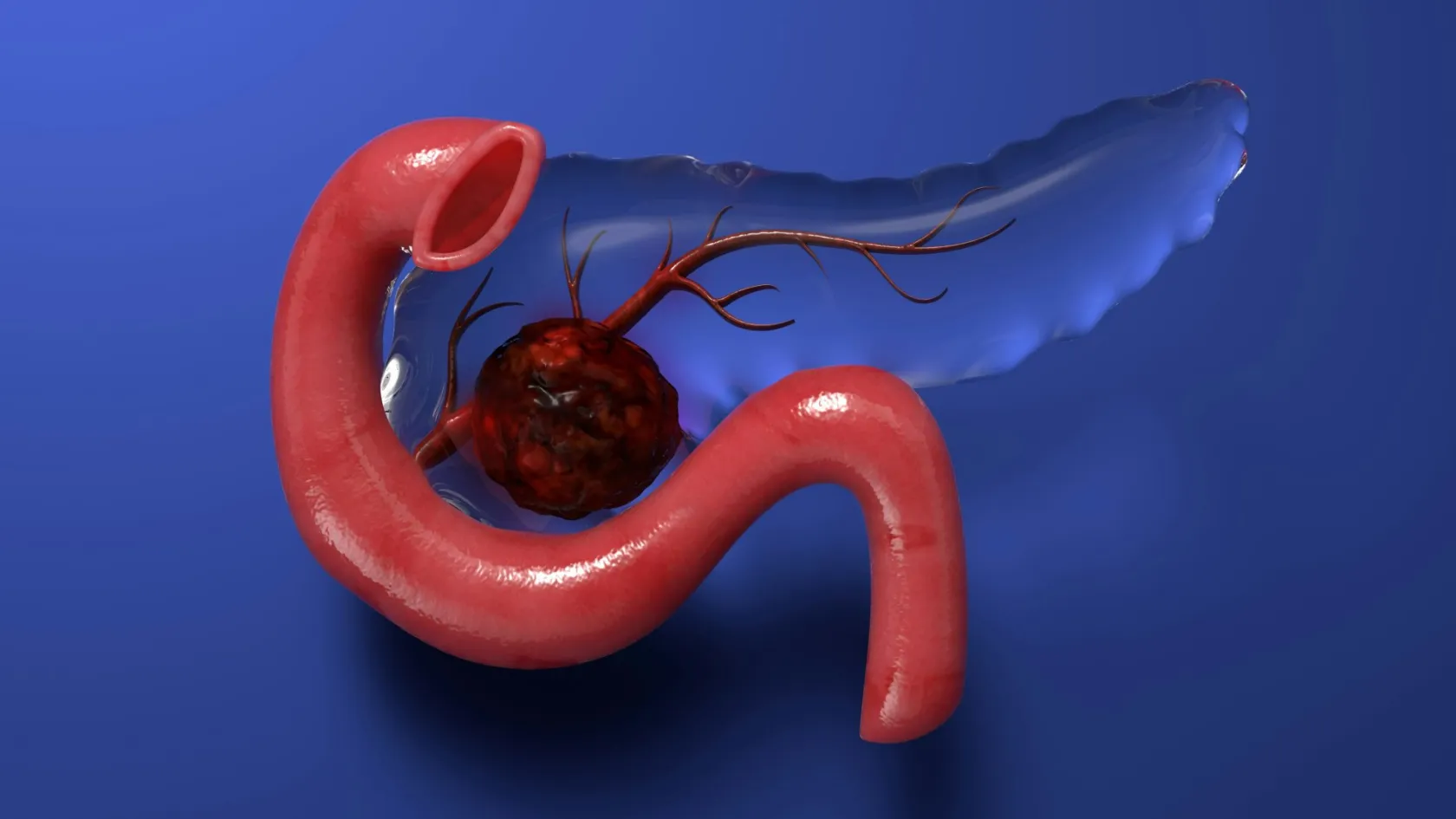
Pancreatic Cancer Surgery
Complications after pancreatic surgery happen at much the same rate everywhere. What differs between hospitals is whether you survive them, and surgeons have a name for that gap.
About This Department
Complications after pancreatic surgery happen at roughly the same rate everywhere. What differs between hospitals is what happens next. Whether the team notices the problem on day five instead of day eight, whether a radiologist is available that evening to place a drain, and whether somebody has seen this exact situation forty times before. Surgeons call the gap between those two outcomes failure to rescue, and it is the reason where you have this operation matters more than for any other cancer operation described anywhere on this site.
Free consultation
Send the pancreatic protocol CT as image files rather than as a report
Whether this tumour can be removed is decided by millimetres of contact between it and three named blood vessels, and no written report substitutes for a surgeon looking at the arterial and venous phases himself. Send the CT or MRI files, the endoscopic ultrasound and biopsy results, the CA 19-9 level, the bilirubin and whether a stent has been placed, and a note of your weight now against six months ago. What comes back is an opinion on resectability, on whether chemotherapy should come first, and on what the realistic sequence of the next year looks like. The review costs nothing and carries no obligation.
Resectable, borderline or not
Your pancreas sits draped over the vessels that supply the liver, the intestine and the spleen. Whether a tumour can be removed comes down to how far it has wrapped itself around three of them, measured in degrees of contact on a CT performed with a specific pancreatic protocol. That measurement, and not the size of the tumour, produces the word your report uses.
This table scrolls sideways on a narrow screen. Swipe or drag to see every column.
| Category | What it describes, and what happens next |
|---|---|
| Resectable | No contact with the arteries and no more than minimal contact with the veins. The tumour can be lifted off. Even here, most units now give chemotherapy before operating rather than after. |
| Borderline resectable | Contact with a vein that can be rebuilt, or limited contact with an artery. Removal is possible but the margin is at risk, so treatment comes first and the scan is repeated to see what it achieved. |
| Locally advanced | The tumour encircles an artery to a degree that makes clean removal unlikely, so chemotherapy is the treatment. A minority respond well enough that surgery gets revisited months later. |
| Metastatic | Spread beyond the pancreas, most often to the liver or the peritoneum. Surgery on the pancreas does not help here, and any clinic offering it should be questioned closely. |
Two things follow that patients are rarely told. These categories move. A tumour called borderline in January can become resectable in June, which is the entire rationale for the sequence described in the next section. And the words are read off images by a specialist, so a second opinion on resectability is a second opinion on the scan itself, which means sending the files and never the report.
The order has changed
For decades a resectable pancreatic cancer went straight to theatre and chemotherapy followed. That order has been reversed for most patients, and the trial that did it produced a result whose shape is easy to misread.
A difference of six weeks, and a difference of fourteen points
Dutch investigators across 16 centres randomised 246 patients with resectable or borderline resectable disease to chemoradiotherapy before surgery or to surgery first. At a median follow-up of 59 months, median overall survival was 15.7 months with treatment first and 14.3 months with surgery first, a difference of six weeks that on its own looks trivial. The five year survival figures tell a different story. Twenty and a half percent of the treatment-first group were alive at five years against 6.5 percent of the surgery-first group, a hazard ratio of 0.73, and the effect held across every prespecified subgroup, including the patients whose disease was fully resectable and who could perfectly reasonably have gone straight to theatre on the older understanding.
When a median barely moves alongside a five year rate that triples, it means the treatment is not stretching everybody's life by a few weeks. It moves a minority of people into a group that survives years, and the median is simply blind to that. Modern practice has largely moved beyond the gemcitabine-based regimen used in that trial to stronger combinations, and results with those are being reported now.
Chemotherapy afterwards matters as much and is better established. A French and Canadian trial randomised 493 patients who had already had their cancer removed to a modified four-drug regimen or to gemcitabine, and found median disease-free survival of 21.6 months against 12.8 and median overall survival of 54.4 months against 35.0. Toxicity was the price. Severe side effects occurred in 75.9 percent on the four-drug regimen against 52.9 percent on gemcitabine, so fitness after surgery decides who can take it.
That last sentence carries a practical consequence nobody states plainly. Recovering well from the operation is not merely pleasant, it is what buys you access to the treatment that produces those survival figures, and a patient who spends three months recovering from a complication frequently never receives it at all.
The operations by name
Which operation you have is decided entirely by which part of the pancreas the tumour occupies, and the three parts behave nothing alike.
Tumours in the head, and the Whipple
Around three quarters of pancreatic cancers sit in the head of the gland, and the head cannot be removed alone because it shares a blood supply with the duodenum. So a pancreatoduodenectomy, universally called a Whipple, takes the head of the pancreas, the duodenum, the gallbladder, the lower bile duct, the nearby lymph nodes and sometimes the lowest part of the stomach. Three separate joins are then made to reconnect what remains. The pancreas to small bowel, the bile duct to small bowel, and the stomach to small bowel. It ranks among the largest operations in general surgery, it takes five to eight hours, and the first of those three joins is the one everything later in this page comes back to, because a connection between a soft gland that produces digestive enzymes and a loop of bowel is the most unforgiving connection a general surgeon is ever asked to sew.
Tumours in the body and tail
Distal pancreatectomy removes the body and tail with the spleen attached, since the splenic artery and vein run along the back of the gland and cannot reliably be separated from a cancer. No joins are needed because nothing has to be reconnected, which makes it a shorter and less dangerous operation than a Whipple. Losing the spleen brings its own long-term consequence, meaning vaccination against three specific bacteria before or shortly after surgery and lifelong awareness of infection risk. Total pancreatectomy, removing the whole gland, is reserved for tumours spanning it or for particular hereditary situations, and it produces guaranteed diabetes and complete enzyme failure, so it is avoided wherever a lesser operation will do, and being offered one is a reason to ask what the smaller alternative would have cost you in terms of a clear margin, since occasionally it would have cost nothing at all.
The question that matters most
Ask how many pancreatic resections the unit performs each year. Every other question on this page is secondary to that one.
Why volume matters more here than anywhere else
Reviewers covering 44 published studies over twenty years found mortality after pancreatic resection consistently lower in high volume centres than in low volume ones, and identified the mechanism. Failure to rescue, meaning death in a patient who developed a complication that a different team would have brought them through, occurred more often in low volume centres. Length of stay was shorter in high volume centres as well. The complication itself is not what kills people after this operation. What kills them is a complication that nobody caught in time, in a hospital that had not built its week around the possibility. Everything else in this section follows from that one sentence.
What a high volume unit actually has is unglamorous, and naming it gives you something to check that is not the marketing. An interventional radiologist available at night to place a drain into a collection. Nurses who recognise that a patient is subtly wrong on day six before the observations change. A pathologist who reports pancreatic specimens weekly and not twice a year. An intensive care unit accustomed to this specific recovery. And a surgeon for whom a difficult reconstruction is a Tuesday rather than an event.
Countries define high volume differently and the thresholds argued over in the literature vary widely, so the number alone will not settle it. Ask the follow-up questions instead. How many of these did the unit do last year. Who covers interventional radiology out of hours. And what actually happens on a Sunday night when a patient starts to deteriorate.
Open, keyhole or robotic
Pancreatic surgery came to minimally invasive techniques late and cautiously, because the reconstruction is delicate and the consequences of getting it wrong are severe.
Pooling individual patient data from four randomised trials, covering 275 patients with pancreatic cancer having a Whipple, keyhole surgery matched open surgery on the two measures that decide the cancer outcome. Clear margins matched, and so did the lymph node harvest. Blood loss fell by around 91 millilitres and the hospital stay by 3.8 days, while the operation took roughly 98 minutes longer. Major complications and 90-day mortality did not differ.
Non-inferior, in other words, with a modest recovery advantage and a longer time under anaesthetic.
This table scrolls sideways on a narrow screen. Swipe or drag to see every column.
| Approach | What the evidence supports |
|---|---|
| Open Whipple | The reference operation, and the right one for vessel involvement, for reoperations, and for any unit whose own results with it are good. |
| Laparoscopic Whipple | Non-inferior on margins and node harvest across four randomised trials, with less blood loss and a shorter stay, at the cost of a longer operation. |
| Robotic Whipple | Adopted rapidly for the pancreatic join, where articulated instruments help most. The randomised evidence is younger than for laparoscopic surgery and is still accumulating. |
| Distal pancreatectomy | Moved to keyhole surgery earlier than the Whipple did, since nothing has to be reconnected afterwards. |
Any unit that answers "we do this open, and here are our results" is giving a legitimate answer and not a defensive one.
The operation, in order
Five to eight hours for a Whipple. A good deal of that time goes on deciding whether to continue at all.
Looking for a reason to stop
Surgeons inspect the abdomen, frequently by laparoscopy first, for deposits on the peritoneum or the liver surface too small for any scan. Finding one ends the operation there, which sounds like a defeat and is the opposite, since a Whipple in somebody with undetected spread costs months of recovery and buys nothing.
Testing whether the vessels are clear
Before anything is divided, the surgeon exposes the plane between the tumour and the artery behind it. This marks the point of no return in the operation and the reason the scan was studied so carefully beforehand. If the artery is genuinely involved, the operation stops here as well.
Taking the specimen out
Stomach or duodenum, bile duct, pancreas and small bowel are divided in sequence, and the whole block comes out as one piece with the surrounding lymph nodes and the tissue lying against the artery. That last edge is where a positive margin most often turns up, and where a specialist pathologist earns their reputation.
Rebuilding, and the join that decides everything
Three connections go to small bowel, and the pancreatic one gives the trouble because the gland is soft and holds stitches poorly. Surgeons sew the duct to the bowel lining, or the whole cut face into the bowel, and both techniques have their advocates. Drains stay beside that join for the first days, since here they earn their place.
Between a fifth and a third of patients booked for a Whipple do not have one, because step one or step two reveals disease that the scans missed. That possibility belongs in the conversation before you travel, alongside a plan for what happens next if it occurs.
The leak, and who gets it
Pancreatic juice digests protein, which is its purpose, and it does not distinguish between a meal and the tissue around a fresh surgical join. A leak from the pancreatic connection is therefore the complication that defines this operation, and it drives most of the deaths, most of the long stays and most of the readmissions.
Two features of your own anatomy predict it, and both can be discussed before the operation instead of discovered afterwards.
The two things that predict a leak, both known in advance
A soft gland leaks more than a hard one. A pancreas obstructed for months by a tumour becomes firm and fibrous, holds stitches well and heals reliably, while a soft healthy gland behaves like the organ it is. A narrow duct leaks more than a wide one. In a series of 150 Whipple patients where the leak rate was 22 percent, a duct measuring under 5 millimetres on the preoperative CT carried the heaviest weight in the risk score the authors built, ahead of soft gland texture, a low total serum protein and abdominal fat volume. Patients scoring in the low band and patients scoring in the high band were meaningfully different populations before anybody picked up a scalpel, so a surgeon who has looked at your duct on the scan can tell you something useful about your own risk rather than quoting an average drawn from a population you may not belong to.
The paradox needs stating plainly, because it upsets people. A patient whose tumour has blocked the duct for months, and who therefore looks worse on the scan, frequently has an easier recovery than somebody whose gland is soft and whose duct is normal.
Managing a leak means leaving the drains, giving antibiotics, resting the gut and waiting, and most of them settle. The dangerous version erodes into an artery and produces bleeding that arrives suddenly in the second or third week, which is the specific emergency behind the argument about interventional radiology cover made earlier on this page. Four things get reported the moment they appear.
- Any blood from a drain, in vomit, or in the stool, however small the amount.
- Drain fluid that turns cloudy, brown or smells, which is the earliest sign of a leak becoming infected.
- A fever, or a pulse that is climbing while everything else looks unchanged.
- Feeling unaccountably unwell on a day you were expected to be improving, which is the sign staff take most seriously and patients most often apologise for mentioning.
What else goes wrong
Delayed gastric emptying is the commonest problem after the leak and the one that lengthens ordinary recoveries. The stomach simply refuses to push food onward for days or sometimes weeks, producing fullness and vomiting, and it is managed with a tube, with patience, and sometimes with feeding delivered into the small bowel beyond the hold-up. It resolves in nearly everybody. Waiting is the hard part.
The rest of the list
Bile leak from the second join. Bleeding, early from a vessel and late from an eroded artery. Abscess in the space where the pancreas head used to be, wound infection, clots in the legs or lungs, and chest infection, since the incision sits high and breathing hurts enough to stop people coughing properly. Malnutrition, quiet and consequential, which the section below is about. Ask directly for the 90 day mortality after a Whipple, then interpret the answer carefully. In genuinely high volume units it is low, and the published range across all hospitals is considerably wider, which is the whole substance of the volume argument. A surgeon quoting you a figure of zero is quoting a run of good luck rather than a practice, and the honest units name a number and then explain how they arrived at it.
What the pancreas was doing for you
Two jobs belong to this gland, and losing part of it interferes with both, in ways that are entirely manageable and routinely mismanaged.
Enzymes, and why the dose is usually too low
Enzymes that break down fat, protein and starch come from the pancreas, and after a resection there are not enough of them. What that looks like is pale, greasy, foul-smelling stool that floats, wind, cramps and weight that keeps falling however much you eat, and it is frequently mistaken for the cancer progressing when it is a treatable deficiency. You take replacement capsules with every meal and every snack, swallowed at the start of eating and spread through a long meal, and the commonest error in the entire aftercare of this operation is a dose set too low and never reviewed. If the symptoms persist, the fix is almost always more capsules and not fewer, and a specialist should be adjusting them, which is a piece of aftercare that survives a plane journey badly and that somebody at home has to be told, explicitly and in writing, to take over from the day you land.
Insulin, and the diabetes question
Insulin comes from the same gland, so removing part of it reduces the supply, and how much that matters depends almost entirely on how the rest of the gland was working beforehand. After a Whipple most people with normal blood sugars beforehand do not become diabetic, and those already glucose intolerant frequently do. After a total pancreatectomy diabetes is universal and it is a particular kind, brittle and prone to lows, because the hormone that raises blood sugar is lost along with the one that lowers it. Anybody having a total pancreatectomy needs a diabetes specialist involved from the beginning, well before the first hypoglycaemic episode.
- Take the enzyme capsules with every meal and every snack, from the day you start eating, and never save them for large meals only.
- Report greasy or floating stool immediately, since it means the dose is wrong and not that you are eating badly.
- Weigh yourself weekly and write the number down, because a falling weight is the earliest sign that something needs adjusting.
- Eat small and often. Six or so times a day, with protein in each one.
- Have vitamin levels checked, particularly the fat-soluble ones, since the same enzyme failure blocks their absorption.
- Where the spleen was removed, complete the vaccinations and carry a card saying so.
Weight and strength return slowly. Fatigue lasts three to six months, driving returns at around four to six weeks depending on the approach, and physical work at three months. Losing ten percent of body weight is common and stabilising it matters more than regaining it quickly, because the chemotherapy that follows is given to people who are strong enough for it.
How long you stay
Four to six weeks in the country for a Whipple, and anybody quoting less has not planned for the complication that a fifth of patients have.
Assessment takes five to seven days, and it covers a pancreatic protocol CT read here and not merely reported elsewhere, endoscopic ultrasound with biopsy where tissue is needed, CA 19-9, liver function and clotting, a stent into the bile duct if you are jaundiced, nutritional assessment, and a hepatobiliary tumour board before any date is fixed. Where a stent is placed, two to four weeks are usually allowed for the jaundice to settle before operating, and that wait is not padding. Expect eight to fourteen days on the ward after an uncomplicated Whipple, with the drains and the return of eating deciding it, and considerably longer where a leak develops. Then a further two weeks nearby, which covers the drain removal, the pathology discussion that determines the chemotherapy, the enzyme dose being set properly and the confirmation that your weight has stopped falling rather than merely slowing, which is the single measurement that predicts whether you will be well enough for the chemotherapy that follows.
Flying gets cleared at around four weeks after an uncomplicated operation, with drains out, no fever, no undrained collection, a stable weight and an agreed plan for clot prevention on the flight. Nobody flies with a drain in. And because a leak can erode into an artery as late as the third week, the temptation to leave at day twelve on the grounds that you feel perfectly well is the one specific temptation this whole page exists to talk you out of.
What drives the cost
More than any operation on this site, the cost of pancreatic surgery is decided by what goes wrong and not by what is planned. Eight things move the total.
- Which resection is planned. A Whipple with three reconstructions is a wholly different operation from a distal pancreatectomy, which needs no reconstruction at all and costs accordingly.
- Whether a vein has to be resected and rebuilt, which adds vascular reconstruction to an already long operation.
- The approach, since robotic and laparoscopic platforms carry instrument costs per case that open surgery does not.
- Whether a biliary stent and an endoscopic ultrasound with biopsy are inside the assessment fee or billed separately.
- Intensive care, which after this operation is planned rather than exceptional.
- The ward days, which the pancreatic join ultimately decides and which nobody can promise in advance.
- Radiological drainage of a collection, which a fifth of patients need and which involves the radiology suite as well as the ward.
- Chemotherapy before and after, which is the largest item of all and sits outside almost every surgical package.
Enzyme replacement runs on quietly in the background. It continues for life, the dose is frequently higher than the starting prescription, and it should be checked against what is available where you live before you leave.
Your own condition moves the total as well. Jaundice, weight loss, low albumin, diabetes, heart and lung disease and previous abdominal surgery each raise the chance of a longer stay.
What a package here ordinarily buys is the transfers, the pre-admission workup, the operating fees, an agreed number of theatre and ward days, an interpreter, accommodation and the appointments before departure. Sitting outside it, almost always, are the flights, insurance, ward nights past the agreed count, critical care beyond what was planned, the management of a leak, and every form of drug treatment.
Six questions turn a headline into a quotation. Which resection does the figure assume, and what changes if the operation is abandoned at laparoscopy. What number of intensive care nights sits inside it. How many ward nights, and what an extra one costs. Is radiological drainage of a leak covered, and if not, what does it cost. Whether the endoscopic ultrasound and the biliary stent sit inside the assessment fee or arrive as separate invoices. And whether the specimen pathology with margin assessment is included.
No figure means anything until a surgeon has read your own scan. That review costs nothing.
Once you are home
Chemotherapy after surgery should start within eight to twelve weeks and the evidence for it is strong, so the single most useful thing your discharge paperwork can do is let an oncologist at home begin without repeating anything. That means the operative note, the full pathology with the margin status and node count, the imaging on disc, your discharge weight, the enzyme dose, and the name of somebody here who answers messages. Get it in English before you leave the building.
What the surveillance actually watches
Surveillance runs on clinical review, CA 19-9 and CT at three to six month intervals for the first two to three years, then less often. That marker is useful and imperfect, rising in some benign conditions and staying normal in a minority of cancers, so a single number is never acted on alone.
Contact the team here for a fever, worsening abdominal or back pain, vomiting that will not settle, yellowing of the eyes, blood in vomit or stool, or a weight that is still falling three months on. Between appointments a message answers most questions within hours. The enzyme dose in particular gets adjusted remotely without difficulty.
Frequently asked questions about pancreatic cancer surgery
What is the single most important thing to check about a hospital?
Why would I have chemotherapy before the operation?
What is a pancreatic leak and how likely am I to get one?
Will I become diabetic?
Will I need enzyme capsules forever?
How long do I need to stay abroad, and when can I fly?
References
- Versteijne E, van Dam JL, Suker M, et al. Neoadjuvant chemoradiotherapy versus upfront surgery for resectable and borderline resectable pancreatic cancer, long-term results of the Dutch randomized PREOPANC trial. Journal of Clinical Oncology. 2022;40(11):1220-1230.
- Conroy T, Hammel P, Hebbar M, et al. FOLFIRINOX or gemcitabine as adjuvant therapy for pancreatic cancer. The New England Journal of Medicine. 2018;379(25):2395-2406.
- Ahola R, Sand J, Laukkarinen J. Centralization of pancreatic surgery improves results, review. Scandinavian Journal of Surgery. 2020;109(1):4-10.
- Uijterwijk BA, Wei K, Kasai M, et al. Minimally invasive versus open pancreatoduodenectomy for pancreatic ductal adenocarcinoma, individual patient data meta-analysis of randomized trials. European Journal of Surgical Oncology. 2023;49(8):1351-1361.
- Akgul O, Merath K, Mehta R, et al. Postoperative pancreatic fistula following pancreaticoduodenectomy, stratification of patient risk. Journal of Gastrointestinal Surgery. 2019;23(9):1817-1824.
Editor's note
Written by the Biruni Hospital medical editorial team. Reviewed by Prof. Dr. Özcan YILDIZ, Medical Oncology.
Medically reviewed by

Prof. Dr. Özcan YILDIZ
Medical Oncology
Related Treatments
View All-
Bilateral Mastectomy
Whether you carry a BRCA mutation, have cancer in one breast or in both, bilateral mastectomy removes both breasts in one operation, and how much it helps depends on which of those three paths brought you to it.
-

Breast Conserving - Lumpectomy Surgery
Keeping the breast has never been the less thorough choice, and the largest recent studies now point the other way. This page explains who can have breast conserving surgery, what the margin report decides, and how long a woman traveling for it needs to stay.
-

Cytoreductive - Tumor Reduction Surgery
Patients cleared of every visible deposit lived 30 months in one gastric series. Those left with anything at all lived 7.3 months, however little remained.
-
Debulking - Ovarian Cancer Tumor Reduction
Two women with the same diagnosis on the same morning can get operations that share almost nothing. What decides it is who measured the disease first.
-
Debulking Surgery
Surgeons removed a median of 57 lymph nodes from women already cleared of visible disease. It bought no extra months, and tripled deaths within 60 days.