
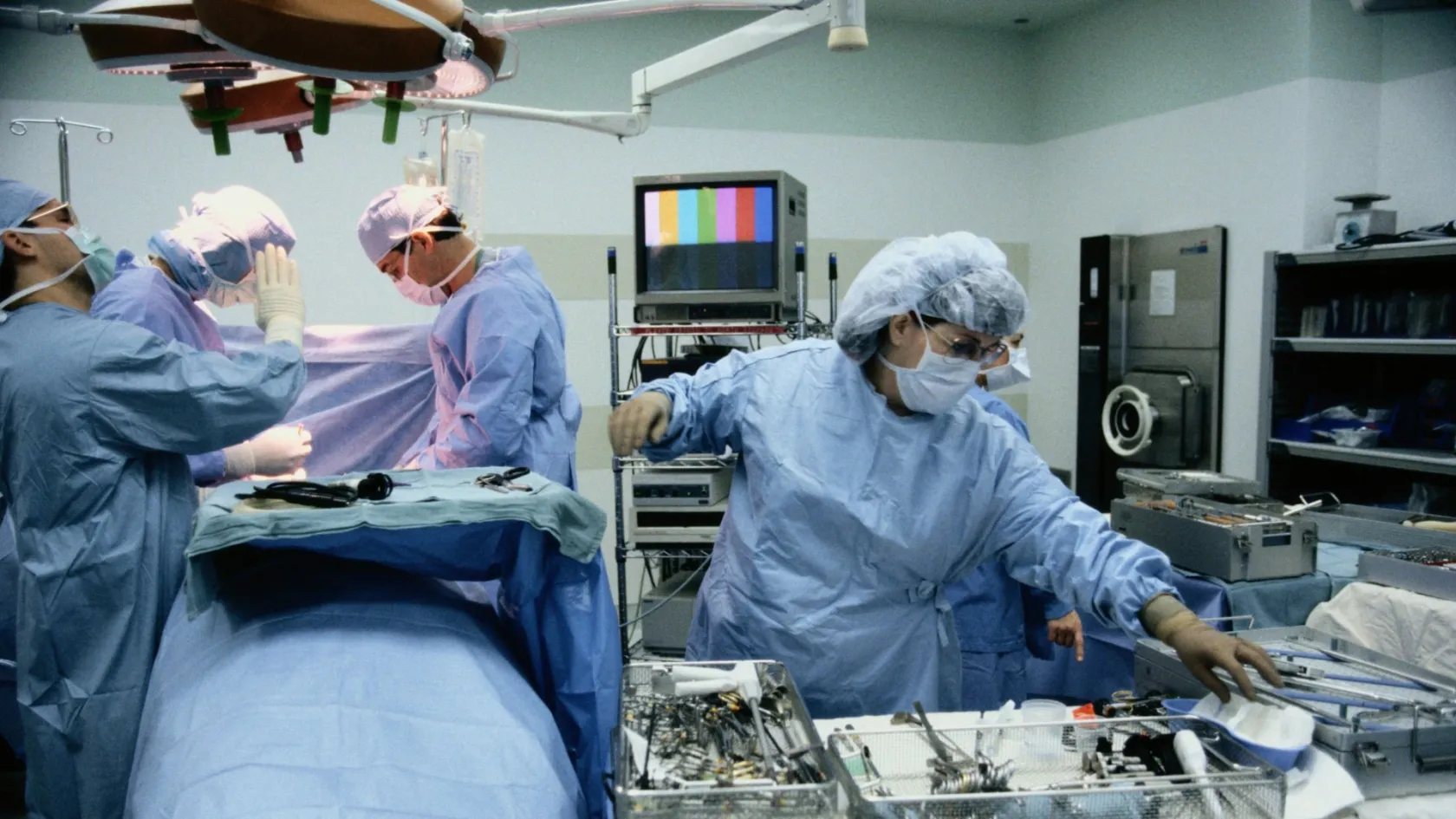
Debulking Surgery
Surgeons removed a median of 57 lymph nodes from women already cleared of visible disease. It bought no extra months, and tripled deaths within 60 days.
About This Department
Surgeons in one randomized trial removed a median of 57 lymph nodes from women whose ovarian cancer had already been cleared to nothing visible. Those women lived 65.5 months. The women whose nodes were left alone lived 69.2 months, and died within 60 days of surgery at a third of the rate. More surgery bought nothing and cost lives, which is the sort of finding that has reshaped debulking surgery over the past two decades, and this article sets out what the operation removes, whether chemotherapy should come before it or after, what the randomized trials actually found, and what recovery and travel involve.
Free consultation
Find out whether surgery or chemotherapy should come first in your case
The review costs nothing and commits you to nothing. Send the most recent CT of the chest, abdomen and pelvis with the actual images, your CA-125 results with their dates, the biopsy or cytology report if tissue has been sampled, and a note of any chemotherapy already given. A gynecologic oncologist will tell you what the imaging suggests about the extent of disease and whether removing all of it at one operation looks achievable.
The word, and what surgeons now aim for
Debulking entered the language when surgeons believed that reducing the quantity of cancer in the abdomen helped a patient whatever quantity stayed behind. Four decades of data took that belief apart.
The name survived it.
Today the operation gets graded by what remains at the end, on a scale every gynecologic oncology unit in the world records and reports. Three outcomes exist, and the distance between the first and the other two carries most of the survival difference in advanced ovarian cancer.
This table scrolls sideways on a narrow screen. Swipe or drag to see every column.
| Term on the report | What the surgeon saw at the end | What it carries |
|---|---|---|
| R0, complete | No cancer visible to the naked eye anywhere in the abdomen | The longest survival, and the target of every modern operation |
| Optimal, R1 | Deposits remain, none of them larger than one centimeter | Clearly worse than R0, clearly better than leaving bulk behind |
| Suboptimal, R2 | Disease larger than one centimeter still in place | The poorest outcome, and the one units plan hardest to avoid |
One consequence of that scale deserves a warning. Hospitals advertise their optimal debulking rate, and the word optimal sounds like the best possible result while covering everything up to a centimeter of residual cancer. A unit reporting a 90 percent optimal rate might be achieving R0 in half its patients.
When you ask about surgical results, request the R0 rate specifically, with the number of advanced cases behind it.
Debulking also gets used outside gynecology, for brain tumors and for bulky sarcomas, where reducing a mass genuinely relieves pressure or pain. Nearly all the published evidence, and nearly everyone searching for the term, concerns advanced ovarian, fallopian tube and primary peritoneal cancer, which is what the rest of this article describes.
What the operation removes
A debulking starts with the standard gynecological clearance and expands from there according to where the disease has settled. Both ovaries and the fallopian tubes come out, along with the uterus and the cervix in almost every case, and with the omentum, the fatty apron hanging from the stomach across the bowel, which is the single commonest site of spread. That much happens in nearly every advanced case. Beyond it, the operation follows the cancer, and it adds on in tiers.
Peritoneal stripping
The lining comes off the pelvic sidewalls, the diaphragm or the abdominal wall wherever deposits coat it. This is the commonest addition and it is what makes the operation long.
Bowel resection
A length of large bowel comes out when disease has grown into it, most often at the rectosigmoid junction where the ovarian mass sits directly against the bowel wall. The two cut ends are joined again in the same operation.
Splenectomy
The spleen goes when disease has wrapped its surface, which also changes what vaccinations you will need afterward.
Whatever else the disease dictates
Part of the liver capsule, the gallbladder, a portion of stomach wall, small bowel segments and the appendix all appear on operative notes from these cases, in the combinations the cancer has chosen rather than the ones a surgeon would prefer.
Nothing in that list is routine. Which of it applies to you comes from your scans and, more reliably, from what the surgeon finds once the abdomen is open, so the consent conversation should walk through each possibility before the day.
Waking with a stoma after consenting only to a hysterectomy means the consultation failed her.
Operate first, or give chemotherapy first
Sequence shapes everything else in this operation, and patients traveling abroad arrive with strong feelings about it. The instinct says operate now, get it out. Three randomized trials examined that instinct.
What the trials found
According to PubMed, a European trial randomized 670 women with stage IIIC or IV disease to surgery first or to three cycles of chemotherapy followed by interval surgery. Residual disease of a centimeter or less was achieved in 41.6 percent after primary surgery and 80.6 percent after interval surgery, and the hazard ratio for death came out at 0.98, meeting the criterion for non-inferiority (Vergote et al, 2010). Complete resection of all visible disease, whenever it was achieved, was the strongest single predictor of how long a woman lived.
Britain's CHORUS trial reached the same place by a different route. Among 550 eligible women, median overall survival ran to 22.6 months with surgery first and 24.1 months with chemotherapy first, with the hazard ratio of 0.87 pointing gently toward chemotherapy (Kehoe et al, 2015), also according to PubMed.
An Italian trial then narrowed the question to the women in whom it bites hardest, those with a heavy tumor load confirmed by laparoscopy. Among 171 patients, complete resection was achieved in 47.6 percent of the surgery-first arm and 77.0 percent of the chemotherapy-first arm, while major postoperative complications ran at 25.9 percent against 7.6 percent. Median overall survival came out at 41 and 43 months, a difference of no consequence (Fagotti et al, 2020).
This table scrolls sideways on a narrow screen. Swipe or drag to see every column.
| Trial | Women randomized | Clearance, surgery first | Clearance, chemotherapy first | Survival difference |
|---|---|---|---|---|
| Vergote, 2010 | 670 | 41.6 percent to within a centimeter | 80.6 percent to within a centimeter | None, hazard ratio 0.98 |
| Kehoe, 2015 | 550 | Not the primary measure | Not the primary measure | None, 22.6 against 24.1 months |
| Fagotti, 2020 | 171, all heavy tumor load | 47.6 percent to R0 | 77.0 percent to R0 | None, 41 against 43 months |
What that means in your case
Three trials, one conclusion.
Where the disease burden is heavy, operating first buys no extra months and imposes a heavier complication rate, because a surgeon working through extensive disease has to do more, take longer and accept more risk to reach the same endpoint. Chemotherapy shrinks the field first and the surgeon then reaches R0 more often, through a shorter operation.
None of that makes chemotherapy first the right answer for everyone. Where disease is limited enough that a complete clearance at one sitting looks realistic, surgery first remains standard, and it spares the delay. How much disease there is, and where it sits, decides the sequence.
How that decision gets made
Four steps stand between a scan and a date in theater, and a unit that skips the third one is guessing.
Cross-sectional imaging
CT of the chest, abdomen and pelvis maps the obvious disease and rules out spread beyond the abdomen. It underestimates small deposits on the bowel and the diaphragm, which is the limitation that drives everything that follows.
Tissue and tumor markers
Biopsy or fluid sampling confirms the cancer type before any treatment starts, since the plan for a high-grade serous tumor differs from the plan for a mucinous one. CA-125 gives a baseline the team will track for years afterward.
Laparoscopic assessment
Two or three small incisions admit a camera, scoring what it sees across the diaphragm, the bowel, the stomach and the mesentery. The score predicts whether a complete clearance is reachable, and the Italian trial above used it to select the patients it randomized.
The multidisciplinary meeting
Surgeon, medical oncologist, radiologist and pathologist agree the sequence together. A plan built by one surgeon alone, without that meeting, sits outside the standard that every international guideline now sets for advanced ovarian cancer.
For an international patient the third step carries a practical consequence worth planning around. Laparoscopic assessment and definitive surgery sometimes happen at one admission and sometimes as two procedures days apart, and the second arrangement stretches the time you spend in the country. Establish which model the unit uses before you book flights. Ask as well how the plan itself gets made. Here the gynecologic oncology multidisciplinary meeting reviews the scans and the biopsy before an operation is offered, and a patient traveling from abroad can have their case presented to it before they book anything, which means the answer to whether surgery comes first arrives before the flight rather than after it.
The lymph nodes surgeons stopped removing
Systematic removal of the pelvic and para-aortic lymph nodes formed part of a standard debulking for decades, on the reasoning that cancer travels through them and that clearing them must help. A trial published in 2019 tested the reasoning directly, in women who had already been cleared of all visible abdominal disease and whose nodes looked normal on imaging and to the surgeon's hand.
What the lymphadenectomy trial showed
Among 647 women randomized during surgery, a median of 57 nodes came out in the lymphadenectomy group. Median overall survival reached 65.5 months in that group and 69.2 months in the group left alone, with a hazard ratio of 1.06. Repeat laparotomy followed in 12.4 percent against 6.5 percent, and death within 60 days of surgery in 3.1 percent against 0.9 percent (Harter et al, 2019), according to PubMed.
Read those two mortality figures again. Removing 57 healthy lymph nodes tripled the chance of dying within two months of an operation and returned nothing measurable in exchange. Guidelines changed quickly afterward, and a surgeon who proposes systematic lymphadenectomy today should be able to say why your case falls outside the trial, most commonly because a node looks abnormal on imaging or feels abnormal during the operation.
Enlarged or suspicious nodes still come out. Healthy ones stay where they are.
Theater day and the first nights
The day runs in a fixed order, and every part of it exists for a reason worth knowing in advance.
The order of the day
A long incision, for a reason
A midline incision runs from the pubic bone toward the ribcage, long enough to let the surgeon reach the diaphragm. Disease sitting under the right dome cannot be handled through a small pelvic incision, so a short scar here would mean disease left behind.
Inspection before removal
Every surface gets examined and the plan formed from the scans gets confirmed or revised on the spot. Only then does the clearance proceed, most teams working from the pelvis upwards.
Four to eight hours, and a second surgeon when needed
That is the ordinary span for an advanced case, longer where bowel has to be resected and rejoined, shorter for interval surgery after chemotherapy has done part of the work. A gastrointestinal or hepatobiliary surgeon scrubs in alongside the gynecologic oncologist when the disease reaches their territory, and that gets planned before the day rather than arranged during it.
The first two nights
Waking happens in a high dependency bed after an extensive clearance. Drains, a urinary catheter and a patient-controlled pain pump are ordinary rather than ominous. Sitting out of bed on the first day and walking the corridor on the second sound trivial and are the two things that most reduce chest infections and clots, so the physiotherapy team will push, and being pushed is the treatment.
Recovery on the ward starts there. Eating restarts within a day or two where no bowel was joined, and more slowly where a join was made. Ward stay after an advanced debulking runs five to ten days, and a bowel resection adds to it.
Complications and the published rates
Major complications after primary debulking for heavy disease ran at 25.9 percent in the Italian randomized trial, against 7.6 percent after interval surgery. That gap is the strongest practical argument for getting the timing decision right, and any unit quoting a figure far below either number should be asked how it defines a major complication and over what period it counts. The specific complications sort into a fairly predictable order. Wound infection and a collection needing drainage sit at the common end. Surgeons watch hardest for a leak from a bowel join, which declares itself between the fifth and tenth day with fever, pain and a rising inflammatory marker, and clots in the leg or lung carry real risk after cancer surgery in the pelvis, so the blood-thinning injections continue for weeks beyond discharge. Lymphatic fluid collecting in the pelvis, chest fluid needing a drain after diaphragm work, and injury to the ureter or bladder complete the published list.
Stomas deserve naming outright. Where a length of bowel comes out and the surgeon judges an immediate join unsafe, a temporary ileostomy protects it, and that possibility belongs in the consent conversation for every advanced case.
Many such stomas get reversed after several months. Some stay.
Menopause, hormones and fertility
Removing both ovaries ends fertility and starts the menopause on the day of surgery, and for a woman who had not yet reached it the change arrives without the years of gradual transition that would otherwise cushion it. What follows is not trivial and it is not temporary.
- Hot flushes, disturbed sleep, vaginal dryness and mood changes, which begin within days for some women rather than over the months a natural menopause would take.
- Bone density falling faster from that point on, which is managed over decades with vitamin D and calcium and, where the team judges one useful, a baseline bone scan to measure from.
Whether hormone replacement can be used afterward depends on the tumor type and on the oncologist's reading of your case, and practice varies between units and countries. Raise it before surgery. A woman who first hears about surgical menopause in the recovery bay has been failed twice, once by the omission and once by the timing.
Fertility preservation applies to a small and specific group, chiefly younger women with early-stage disease confined to one ovary, where a conservative operation leaving the uterus and the other ovary is sometimes possible. Advanced disease of the kind this article describes rarely permits it. Anyone for whom the question is live should have the conversation before the first cycle of chemotherapy, since options narrow sharply once treatment begins.
Recovery, week by week
Discharge marks a beginning. Through the first fortnight the wound dominates everything, standing up straight feels wrong, and short frequent walks beat any attempt at a long one.
Between weeks two and six appetite returns unevenly and fatigue arrives in waves that catch women who felt fine the previous day, while the abdominal wound gains strength slowly and needs three months before it will tolerate lifting anything substantial. Driving waits until an emergency stop would not make you flinch, which for most falls somewhere in the fourth to sixth week. Feeling recognizably yourself again takes two to three months where the operation went smoothly. Chemotherapy resuming afterward resets that clock, and for women having interval surgery the remaining cycles start once the wound has healed enough to tolerate them, ordinarily three to four weeks after theater.
This table scrolls sideways on a narrow screen. Swipe or drag to see every column.
| Period | What dominates | What you can do |
|---|---|---|
| First fortnight | The wound, and standing up straight feeling wrong | Short frequent walks, which beat any attempt at a long one |
| Weeks two to six | Appetite returning unevenly and fatigue arriving in waves | Driving once an emergency stop would not make you flinch, usually week four to six |
| Up to three months | The abdominal wound gaining strength slowly | Nothing substantial lifted until the three-month mark |
| Two to three months | Feeling recognizably yourself again where surgery went smoothly | Remaining chemotherapy cycles, ordinarily starting three to four weeks after theater |
Two symptoms send women back to hospital and neither is obvious in advance. A leg that swells on one side needs assessment the same day. A wound that starts leaking clear fluid a week after discharge needs review rather than a wait-and-see approach, since it can be the first sign of a collection underneath.
Traveling for the operation
Three to four weeks in the country covers an uncomplicated advanced case. Several days at the front go to imaging review, blood tests, anesthetic assessment and the consultation, plus the laparoscopic assessment where the unit stages it separately, ward stay accounts for five to ten days with more after a bowel resection, and the remainder covers wound review, removal of clips or sutures, and a fitness-to-fly assessment, because flying too early after abdominal cancer surgery raises the clot risk that the injections are there to control.
This table scrolls sideways on a narrow screen. Swipe or drag to see every column.
| Stage | How long | What happens |
|---|---|---|
| Before surgery | Several days | Imaging review, blood tests, anesthetic assessment and the consultation, plus the laparoscopic assessment where the unit stages it separately |
| The admission | Five to ten days | Longer after a bowel resection, and this is the part that a complication extends |
| After discharge | The balance | Wound review, removal of clips or sutures, and a fitness-to-fly assessment, because flying too early after abdominal cancer surgery raises the clot risk the injections exist to control |
The return flight gets booked after the surgical team names a date, never before it.
Bring someone. Lifting, shopping and the first walks all need a second person for a fortnight at least, and a companion who sat through the consultation remembers what was said better than a patient on the fourth day after major surgery.
Two arrangements need making before departure and both get forgotten. Blood-thinning injections continue for four weeks after this operation, so the prescription, the supply and someone able to give them have to be sorted before you fly home. And if chemotherapy is due to resume, the oncologist treating you at home needs the operative note and the final pathology in hand before your first appointment there, because a delay in paperwork becomes a delay in treatment.
What drives the cost
Why one figure could not cover both operations
Quotes vary because the operations vary. A hysterectomy with omentectomy for limited disease and a full clearance involving diaphragm stripping, bowel resection and splenectomy differ in theater time, in the number of surgeons scrubbed, in equipment and in the length of stay that follows, so a single figure covering both would be meaningless. Theater hours, the second surgeon where one is needed, high dependency nights, stapling devices for a bowel join, histopathology on multiple specimens and blood products where transfusion is required all sit inside the total. Patient factors move it. Previous abdominal surgery leaving adhesions, weight, kidney function and the amount of chemotherapy already given all count. Published packages in this market ordinarily cover surgeon and anesthesiologist fees, theater time, a defined number of nights, pre-operative imaging and blood work, histopathology, and transfers with interpreting, while flights, accommodation past the stated nights, treatment of a complication, a return to theater, blood-thinning supplies and systemic chemotherapy all sit outside them, so with major complications running at one in four after primary surgery for heavy disease, the clause covering an extended stay deserves closer reading than the headline figure.
Establish four things before accepting a quote. Whether the laparoscopic assessment sits inside the figure or beside it. How many high dependency nights the quote assumes and what an additional one costs. What happens financially if the surgeon opens the abdomen, finds more disease than the imaging showed, and closes again without completing the planned clearance. Whether the final histopathology is covered, along with sending it to your own oncologist once it issues, which happens after most international patients have flown home.
Only a surgeon who has reviewed your own imaging can answer any of it.
Back home, and the follow-up
Carry four documents out with you.
- The operative note, which records exactly what was removed and exactly what remained at the end.
- The residual disease result, stated as R0, optimal or suboptimal.
- The full histopathology report with the tumor type and grade.
- A copy of the postoperative imaging, with the actual image files on a disc or a drive rather than a report describing them.
That residual disease result matters more than any other line in the file. It determines what your oncologist recommends next, it decides whether maintenance treatment enters the discussion, and a report that states it plainly saves a conversation otherwise conducted through guesswork across two countries. Ask for genetic testing status in writing too, since BRCA and homologous recombination results shape the drugs offered afterward and take weeks to come through. Once you are home, follow-up divides between the two teams now caring for you. CA-125 and clinical review continue near where you live at intervals your oncologist sets, with imaging when the marker rises or symptoms suggest it. Remote follow-up with the operating surgeon earns its keep for the first few months, because a scan reported at home showing something in the operative field is far easier to interpret for the person who was in the room.
Frequently asked questions
Is it worse to have chemotherapy before surgery?
What does optimal debulking actually mean?
Will my lymph nodes be removed?
How long am I in Turkey for a debulking operation?
Will I need a stoma?
What happens to my hormones afterward?
References
- Vergote I, Tropé CG, Amant F, et al. Neoadjuvant chemotherapy or primary surgery in stage IIIC or IV ovarian cancer. N Engl J Med. 2010;363(10):943-953.
- Kehoe S, Hook J, Nankivell M, et al. Primary chemotherapy versus primary surgery for newly diagnosed advanced ovarian cancer (CHORUS). An open-label, randomized, controlled, non-inferiority trial. Lancet. 2015;386(9990):249-257.
- Fagotti A, Ferrandina MG, Vizzielli G, et al. Randomized trial of primary debulking surgery versus neoadjuvant chemotherapy for advanced epithelial ovarian cancer (SCORPION). Int J Gynecol Cancer. 2020;30(11):1657-1664.
- Harter P, Sehouli J, Lorusso D, et al. A randomized trial of lymphadenectomy in patients with advanced ovarian neoplasms. N Engl J Med. 2019;380(9):822-832.
Editor's note
Written by the Biruni Hospital medical editorial team. Reviewed by Prof. Dr. Metin GÜDEN, Radiation Oncology.
Medically reviewed by

Prof. Dr. Metin GÜDEN
Radiation Oncology
Related Treatments
View All-
Bilateral Mastectomy
Whether you carry a BRCA mutation, have cancer in one breast or in both, bilateral mastectomy removes both breasts in one operation, and how much it helps depends on which of those three paths brought you to it.
-

Breast Conserving - Lumpectomy Surgery
Keeping the breast has never been the less thorough choice, and the largest recent studies now point the other way. This page explains who can have breast conserving surgery, what the margin report decides, and how long a woman traveling for it needs to stay.
-

Cytoreductive - Tumor Reduction Surgery
Patients cleared of every visible deposit lived 30 months in one gastric series. Those left with anything at all lived 7.3 months, however little remained.
-
Debulking - Ovarian Cancer Tumor Reduction
Two women with the same diagnosis on the same morning can get operations that share almost nothing. What decides it is who measured the disease first.
-
Esophageal Cancer Surgery
Nothing is put back where it was. Your stomach is turned into a narrow tube, pulled up through the chest and joined to what remains of the gullet, and almost everything about eating and sleeping afterwards follows from that.