Orthopedics
Osteoarthritis surgery works when it matches the joint. Cleaning out a worn knee does not.
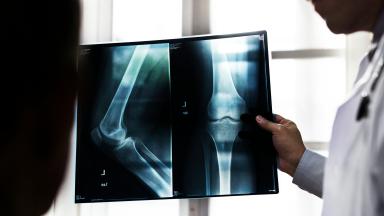
In a placebo-controlled trial of 180 patients with knee osteoarthritis, arthroscopic washing and cleaning of the joint gave no more relief than a sham operation, while realignment and joint replacement relieve pain for years in the right patient. Send standing X-rays of the painful joint and a note on your pain, walking distance and the treatments you have tried, and our orthopedic team will tell you which operation, if any, fits.
No benefit
From arthroscopic cleaning of an arthritic knee in two randomized trials
79%
Knee osteotomies still working at ten years, 413 patients
85%
Osteotomy patients satisfied or enthusiastic at 12 years
Free
Review of your X-rays before you book
Free consultation
Osteoarthritis wears away the cartilage that lines a joint, until bone moves on bone. Knees, hips, the base of the thumb and the small joints of the hand carry most of it, followed by the spine, shoulder and ankle. Age, weight, old injuries and the shape of the joint itself drive it, and the X-ray tells only part of the story, since some people with badly worn joints hurt little and others with mild changes hurt a lot.
Surgery comes after the basics.
When does osteoarthritis need surgery?
Exercise, weight loss where relevant, painkillers and a walking aid form the core treatment and help most people for years. An operation becomes the right step when pain wakes you at night, limits walking to a few hundred meters or stops work and family life despite at least three to six months of that core treatment, and when X-rays confirm the joint has worn.
Waiting too long has a cost of its own.
The case against knee arthroscopy
Washing and trimming an arthritic knee through a camera was once the most common osteoarthritis operation.
In this controlled trial involving patients with osteoarthritis of the knee, the outcomes after arthroscopic lavage or arthroscopic debridement were no better than those after a placebo procedure.
Houston placebo-controlled trial, 180 patients, New England Journal of Medicine, 2002
What arthroscopy still treats
A knee that locks because a loose fragment of cartilage or a torn piece of meniscus catches in the joint, unable to straighten, can still benefit from arthroscopy. Pain and stiffness from the arthritis itself do not.
The surgical options, joint by joint
Preserving the joint or replacing it
Joint-preserving operations, osteotomy above all, shift load away from the worn part and keep the patient's own joint, suiting younger and active people with wear in one area. Joint replacement swaps the worn surfaces for metal, ceramic and plastic, and suits wear that has spread or patients past their working years.
Arthroscopic surgery for osteoarthritis of the knee provides no additional benefit to optimized physical and medical therapy.
Canadian randomized trial, 178 patients, New England Journal of Medicine, 2008
Hip arthroscopy and early arthritis
Hip arthroscopy treats impingement, an abnormal shape of the hip that pinches the joint in young people, before arthritis sets in. Once the X-ray shows clear joint narrowing, arthroscopy no longer helps, and replacement takes over.
A strong recommendation against arthroscopy
An international panel writing in the BMJ in 2017 reviewed the trials and made a strong recommendation against arthroscopic surgery for nearly all patients with degenerative knee disease, including those with meniscal tears, mechanical symptoms or sudden onset. The panel judged that nearly every informed patient would decline it.
- Knee, osteotomy, partial knee replacement or total knee replacement.
- Hip, total hip replacement.
- Thumb base, removal of the small trapezium bone (trapeziectomy), which relieves pain in the large majority.
- Ankle, fusion or ankle replacement.
- Shoulder, anatomic or reverse shoulder replacement.
Choosing between osteotomy, partial and total replacement
The pattern of wear, your age and how active you want to stay point to the operation. A long-leg X-ray shows where the load falls, MRI or stress X-rays show whether the other compartments are healthy, and the surgeon examines the ligaments and range of movement before choosing.
This table scrolls sideways on a narrow screen. Swipe or drag to see every column.
Osteoarthritis operations compared
| Operation |
Best for |
What to expect |
| High tibial osteotomy |
Active patients under 55 to 60 with wear on the inner side |
Keeps the natural knee, crutches for six weeks, a later replacement remains possible |
| Partial knee replacement |
Wear in one of the three compartments, intact ligaments |
Faster recovery and a more natural feel than total replacement |
| Total knee replacement |
Wear across the knee, deformity, older patients |
The most predictable relief of pain for advanced arthritis |
| Total hip replacement |
Advanced hip arthritis |
Walking without a stick in weeks for most patients |
Call the team the same day
A wound that leaks or reddens, a temperature of 38 degrees or more, a calf that swells and aches, sudden breathlessness, or a sudden increase in pain or a deformity of the operated limb.
How long an osteotomy lasts
The Sydney series of 455 patients
Surgeons in Sydney followed 455 closing wedge osteotomies done between 1990 and 2001. Twelve years on, the average Oxford Knee Score was 40 out of 48, 85 percent were satisfied or enthusiastic, and 84 percent would choose the operation again.
Results and other joints
Osteotomy buys time.
This table scrolls sideways on a narrow screen. Swipe or drag to see every column.
High tibial osteotomy, share still working without replacement
| Years after surgery |
Still working |
What helped |
| 5 |
95 percent |
Age under 50 |
| 10 |
79 percent |
Body mass index under 25 |
| 15 |
56 percent |
A torn anterior cruciate ligament, oddly, in the same analysis |
This table scrolls sideways on a narrow screen. Swipe or drag to see every column.
Surgery for osteoarthritis in other joints
| Joint |
Main operation |
Recovery |
| Thumb base |
Trapeziectomy, with or without a tendon sling |
A splint for four to six weeks, grip strength returns over months |
| Ankle |
Fusion, or ankle replacement in selected patients |
No weight on the foot for six weeks after fusion |
| Shoulder |
Anatomic or reverse shoulder replacement |
A sling for four to six weeks |
Hip osteoarthritis
The hip has no proven joint-preserving option once arthritis is established, and total hip replacement relieves pain more reliably than almost any other operation in orthopedics.
Age less than 50 years, normal BMI, and ACL deficiency were independent factors associated with improved long-term survival of HTO.
Sydney series, 455 patients, American Journal of Sports Medicine, 2011
Recovery and the stay in Istanbul
Travel, language and the person with you
Rooms come with a bed for a companion, so a relative stays beside you from the evening of surgery onward. Before you fly, our international office sends the letter consulates ask for with a medical visa, then meets you at the airport and drives you between the hotel and the hospital for each physiotherapy session.
Every message, consent form and ward round can run in English, Arabic, French, Russian, Serbian, Romanian or Spanish, and interpreters cover other languages. Meals follow halal, vegetarian or diabetic needs, there is a room for prayer, and if you prefer a female surgeon, tell us in your first message and the department will arrange it when the rota allows.
What moves the cost
The operation sets most of the figure. An osteotomy plate, a partial knee and a total knee or hip implant differ in price, and the nights in hospital, the physiotherapy sessions, one side or both and the hotel stay add to it. Joint surgery packages advertised in Turkey cover theater, anesthesia, the implant and the planned nights, with physiotherapy, an interpreter and transport thrown in, while flights, insurance and any complication sit outside the price. A written estimate, free after the surgeon reads your X-rays, names the operation and the implant it assumes. Keep it with you.
1
In hospital
One to two nights after osteotomy or partial knee replacement, three to four after total replacement, walking with a frame from the first day.
2
Hotel and physiotherapy
Seven to ten days nearby.
3
Flight home
Ten to fourteen days after surgery, once the wound is checked, with a few weeks of clot prevention injections or tablets and a written exercise plan your local physiotherapist can follow.
Flying home
Book an aisle seat, walk every hour on the flight, and wear the compression stockings.
Swelling of the operated leg after a long flight settles with rest and elevation over a day or two, while a calf that is hot, tight and painful needs a doctor the same day, because it can mean a clot.
Osteoarthritis surgery FAQ
Does knee arthroscopy help osteoarthritis?
No. Two randomized trials, one against a sham operation, found no benefit from washing or trimming an arthritic knee.
Am I too young for a joint replacement?
Age alone rules nobody out. Younger patients with wear on one side of the knee may suit an osteotomy that keeps their own joint for many years.
How long will I stay in Istanbul?
Ten to fourteen days for most knee or hip operations, including the wound check before the flight.
Can my husband, wife or child stay in the hospital with me?
Yes. A companion bed in the room lets one relative stay overnight throughout the admission.
Will the doctors speak my language?
Your coordinator works in English, Arabic, French, Russian, Serbian, Romanian or Spanish and joins your consultations.