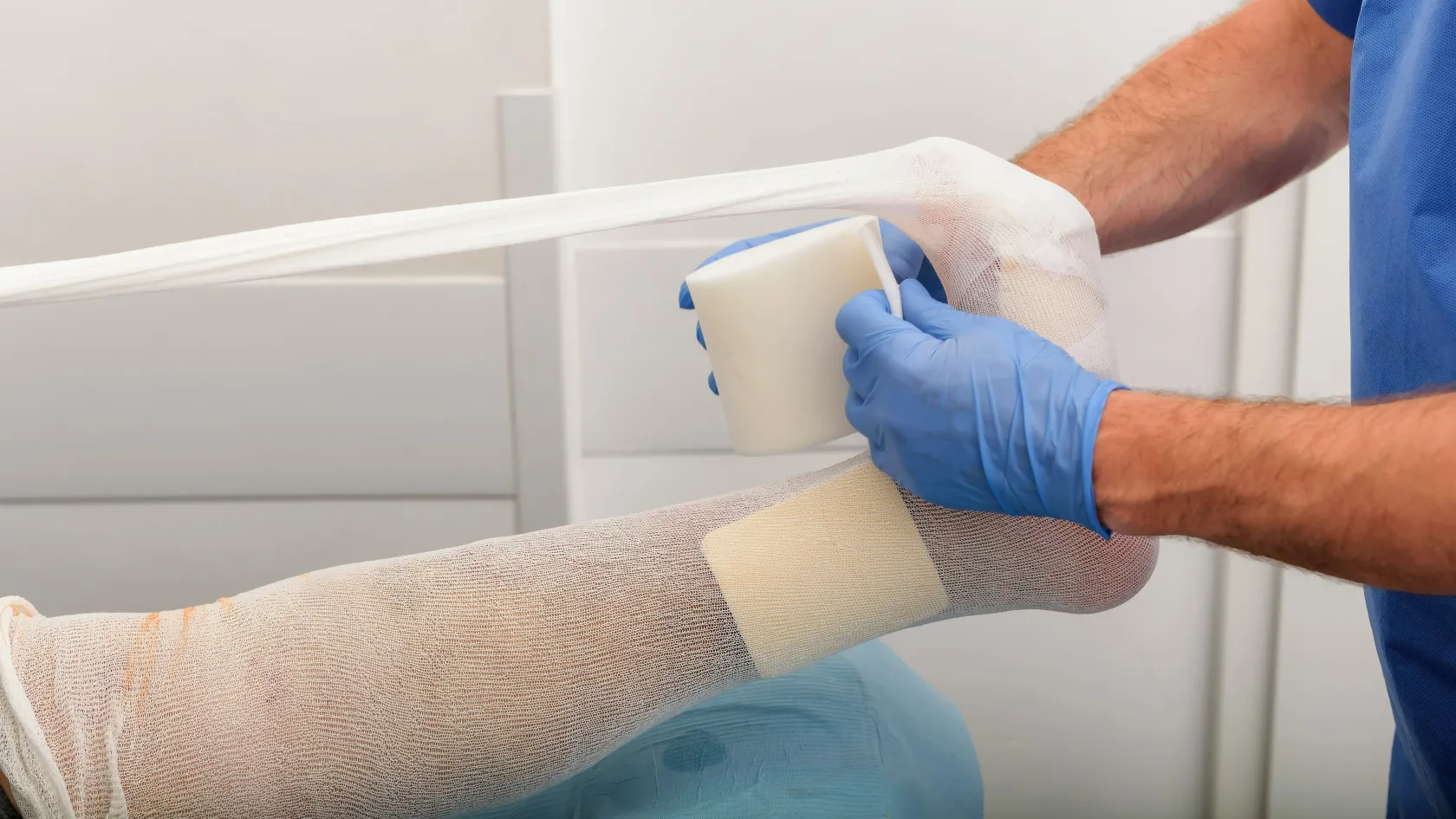
Orthopedic limb salvage surgery removes a bone tumor or a destroyed segment of a limb and rebuilds it with a tumor prosthesis, donor bone or the patient's own bone, keeping the arm or leg. This guide covers who qualifies, survival against amputation, how prostheses fail, growing implants for children, severe leg injuries and the stay.
About This Department
Orthopedics
Microsurgical hand repair rejoins what an injury has cut. Timing decides how much comes back.
Under an operating microscope, surgeons stitch arteries and nerves thinner than a matchstick, reattach severed fingers and repair the tendons that bend them. A review of 2,273 fingertip replantations found 86 percent survived and nearly all patients returned to work. Send photos of the hand, any scans and the date of the injury, and our hand surgery team will tell you what can still be repaired.
86%
Fingertip replantations that survived, 2,273 cases
4 to 5%
Flexor tendon repairs that ruptured, over 3,000 repairs
6% a month
Lower odds of motor recovery for each month a nerve repair waits
A saw, a glass pane, a car door or a press at work. Hand injuries happen in a second and reach several structures at once, the skin, the tendons that move the fingers, the nerves that give them feeling and the arteries that keep them alive.
Microsurgery repairs each one in turn.
What microsurgical hand repair covers
The term covers any hand operation done under magnification of ten to twenty times, with stitches finer than a hair. Four kinds of injury make up most of the work, and many patients have more than one.
This table scrolls sideways on a narrow screen. Swipe or drag to see every column.
Injuries repaired under the microscope
Injury
What we repair
Best window
Amputated finger or thumb
Bone, tendons, arteries, veins and nerves, then skin
Hours, with the part kept cold
Cut flexor tendon
The tendon ends, stitched with a strong core suture
Within the first days
Cut nerve
The nerve sheath, end to end or with a graft
The sooner the better, odds fall each month
Crushed or devascularized finger
The artery, sometimes with a vein graft
Hours
Why the microscope matters
A digital artery measures one millimeter or less across. Stitching it by eye leaves clots at the join and a finger that dies within days, while the microscope lets the surgeon place eight to ten stitches around that millimeter and see the blood flow through before closing.
The common perception that distal replantation is associated with little functional gain is not based on scientific evidence.
Systematic review of 2,273 distal replantations, Plastic and Reconstructive Surgery, 2011
Repairs that come later
Not every repair happens on the day of injury. A tendon that was missed or ruptured, a nerve with a gap, a stiff finger stuck in scar or a thumb lost years ago all have planned operations, among them tendon grafts, nerve grafts and nerve transfers, release of scar, and toe to hand transfer.
The first hours after an injury
Keeping an amputated finger
Wrap the part in damp gauze, seal it in a plastic bag and set the bag on ice and water. Ice must never touch the finger directly, since frozen tissue cannot be replanted. Press on the stump to stop the bleeding, raise the hand and go to the nearest hand surgery center now, because a finger kept cold survives many hours while a hand or forearm, with its muscle, tolerates around six.
Thumb replantation is still recommended for its integral role in opposition.
FRANCHISE study, 338 patients at 19 centers, JAMA Surgery, 2019
If you are abroad when it happens
Replantation cannot wait for a flight. Go to the closest hospital with a hand or plastic surgery team, ask for the operation note and photos afterwards, and send them to us, so we can plan any later reconstruction from what was done on the day.
Who comes to us and when
Patients who live in or near Turkey reach us within hours of an injury. International patients travel for planned repair.
A flexor tendon that ruptured after the first repair, or was never repaired.
Numbness or weakness that has not improved months after a nerve injury.
A missing thumb or several missing fingers.
A finger stiff with scar, unable to bend or straighten fully.
Finger and thumb replantation
Replantation reattaches a finger, a thumb, a hand or part of an arm that has been cut off. Clean cuts do best. Crushed or torn fingers, where the arteries have been stretched over a length, do worse and need vein grafts, and some cannot be saved, in which case the surgeon shortens and closes the stump so it heals well and hurts less.
86 percent survival at the fingertip
Sebastin and Chung pooled 30 studies. Clean cuts survived better than crushed ones, and repairing a vein along with the artery raised survival in both fingertip zones, while feeling came back to a mean two-point discrimination of 7 mm, close to a normal fingertip. Of those followed, 98 percent returned to work. Nail deformity followed in 23 percent and shrinking of the pulp in 14 percent.
1
Bone
The surgeon shortens the bone ends a few millimeters and holds them with fine wires or a small plate, giving a stable base for everything that follows.
2
Tendons
Flexor and extensor tendons, stitched.
3
Arteries and nerves
Under the microscope, one or both digital arteries, followed by the two nerves that carry feeling to the finger.
4
Veins and skin
Two veins for each artery where possible, then loose skin closure so swelling does not choke the new blood flow. A finger takes three to five hours, and a hand with several fingers takes most of a day.
When technically feasible, replantation is recommended in 3 or more digits amputated and in single-finger amputation (excluding thumb) distal to the proximal interphalangeal joint because it achieved better PROs, with long-term functional benefit.
FRANCHISE study, 338 patients, JAMA Surgery, 2019
For a single finger cut off near its base, outside the thumb, closing the stump gives results close to replantation and a faster return to work, and we discuss both openly before surgery.
Tendon repair and hand therapy
Flexor tendons bend the fingers. They glide inside a tight tunnel in the finger, the zone surgeons call zone II, and a repair there has to be strong enough to move within days yet heal without sticking to the tunnel walls. Four or six strands of suture across the cut give that strength.
Early passive range of motion protocols had a statistically significantly decreased risk for tendon rupture but an increased risk for postoperative decreased range of motion compared to early active motion protocols.
Systematic review of 3,010 tendon repairs, Journal of Hand Surgery, 2013
Call the team the same day
A finger that suddenly will not bend after a tendon repair, a replanted finger that turns pale, blue or cold, a wound that reddens or leaks, or a temperature of 38 degrees or more.
Why the splint stays on
A splint on the back of the hand holds the wrist and fingers slightly bent for four to six weeks after a flexor tendon repair. It stops you straightening the fingers hard or gripping, the two moves that pull a repair apart, while the hand therapist moves the fingers gently every day so the tendon glides and does not stick.
Repairing cut nerves
What predicts recovery
A cut nerve grows back from the repair at a millimeter a day, so feeling returns to a fingertip in months and to the hand muscles after a nerve cut at the wrist in a year or more. Three things set the result.
In this individual patient data meta-analysis, age, site, injured nerve, and delay significantly influenced prognosis after microsurgical repair of median and ulnar nerve injuries.
Meta-analysis of 623 nerve injuries, Plastic and Reconstructive Surgery, 2005
When the ends cannot meet without tension, the gap needs a bridge.
Direct repair, end to end, when the ends meet without tension.
A nerve graft, a short sensory nerve taken from the lower leg or forearm and stitched into the gap.
A processed donor nerve or a tube, for short gaps in sensory nerves.
A nerve transfer, rerouting a working nerve branch to the muscle that lost its supply, for injuries found late.
How long is too long
Muscle that loses its nerve supply wastes, and after twelve to eighteen months it no longer responds even when nerve fibers arrive. Feeling has a longer window. A nerve transfer close to the muscle shortens the distance the fibers must grow and helps patients who reach us late.
The odds in numbers
Ruijs and colleagues pooled individual data on median and ulnar nerve repairs, and the figures below come from their analysis.
This table scrolls sideways on a narrow screen. Swipe or drag to see every column.
What changes the chance of recovery after median or ulnar nerve repair
Factor
Effect on recovery
What it means
Age under 16 against over 40
Odds of motor recovery 4.3 times higher
Children recover best
Each month of delay
Motor odds fall 6 percent, sensory odds 8 percent
Repair early
Ulnar against median nerve
71 percent lower chance of motor recovery
Ulnar injuries need closer follow-up
Cut near the elbow against the wrist
Lower odds of motor recovery
Longer distance to grow
Recovery and the stay in Istanbul
Our hand surgeons work with hand therapists from the first day, and the therapy matters as much as the stitches.
1
In hospital
Five to seven days after a replantation, with the finger checked every hour for color and warmth, the room kept warm and smoking forbidden. One night after a tendon or nerve repair.
2
Hand therapy
Daily sessions at the hospital for ten to fourteen days, with a custom splint made on site.
3
Flight home
Once the wound is checked, with a written therapy plan, the splint and video exercises your local hand therapist can follow week by week, and a WhatsApp line to the coordinator who stays in touch with our surgeon on any question.
Tendon repairs follow a fixed timeline.
This table scrolls sideways on a narrow screen. Swipe or drag to see every column.
Hand therapy after a flexor tendon repair
Weeks
Splint
Movement
0 to 4
Day and night
Protected bending exercises with the therapist
4 to 6
At night
Full fist without resistance
6 to 8
Off
Light daily use, no lifting
12
Off
Full grip, sport and heavy work
Follow-up after you return home runs through your coordinator. Your local therapist sends a short video of the hand at six weeks and at three months, and our surgeon reviews it and adjusts the plan. Nerve repairs need a check at six and twelve months, with a nerve conduction test if feeling or strength has stalled. A tendon caught in scar gets a second, shorter operation to free it, called tenolysis, three to six months after the repair once the skin has softened.
The cost depends on the operation, a single tendon or a hand with several replanted fingers, on the nights in hospital and on the therapy weeks you spend with us. A written estimate follows the free review and names the operation it assumes, with travel and accommodation listed separately.
Microsurgical hand repair FAQ
Can a finger be reattached days after the injury?
No. Replantation works within hours. Once that window closes, a toe to hand transfer or other reconstruction can rebuild a thumb or finger in a planned operation.
Will feeling come back after a nerve repair?
Feeling returns slowly, over six to eighteen months, and children recover more than adults. Most adults regain protective feeling, enough to sense heat and sharp edges.
What should I send for a review?
Photos of the hand open and in a fist, photos of the scars, the operation notes from any earlier surgery, X-rays, and nerve conduction results if you have them. A hand surgeon reads the file and the coordinator replies in your language.
Can someone from my family stay in the room?
Yes. One relative sleeps in the room on a companion bed for the whole admission, and the coordinator helps book a hotel near the hospital for the therapy days that follow.
Do the staff speak my language?
Coordinators speak English, Arabic, French, Russian, Serbian, Romanian and Spanish, sit in on every consultation and therapy session, and arrange interpreters for other languages.
References
Sebastin SJ, Chung KC. A systematic review of the outcomes of replantation of distal digital amputation. Plastic and Reconstructive Surgery. 2011;128(3):723-737.
Chung KC, Yoon AP, Malay S, et al. Patient-reported and functional outcomes after revision amputation and replantation of digit amputations: the FRANCHISE multicenter international retrospective cohort study. JAMA Surgery. 2019;154(7):637-646.
Starr HM, Snoddy M, Hammond KE, Seiler JG. Flexor tendon repair rehabilitation protocols: a systematic review. Journal of Hand Surgery (American Volume). 2013;38(9):1712-1717.
Ruijs AC, Jaquet JB, Kalmijn S, Giele H, Hovius SE. Median and ulnar nerve injuries: a meta-analysis of predictors of motor and sensory recovery after modern microsurgical nerve repair. Plastic and Reconstructive Surgery. 2005;116(2):484-494.
Ray WZ, Mackinnon SE. Management of nerve gaps: autografts, allografts, nerve transfers, and end-to-side neurorrhaphy. Experimental Neurology. 2010;223(1):77-85.
Editor's note
Written by the Biruni Hospital medical editorial team. Reviewed by Assistant Professor Şafak SAYAR, Orthopedics and Traumatology.