
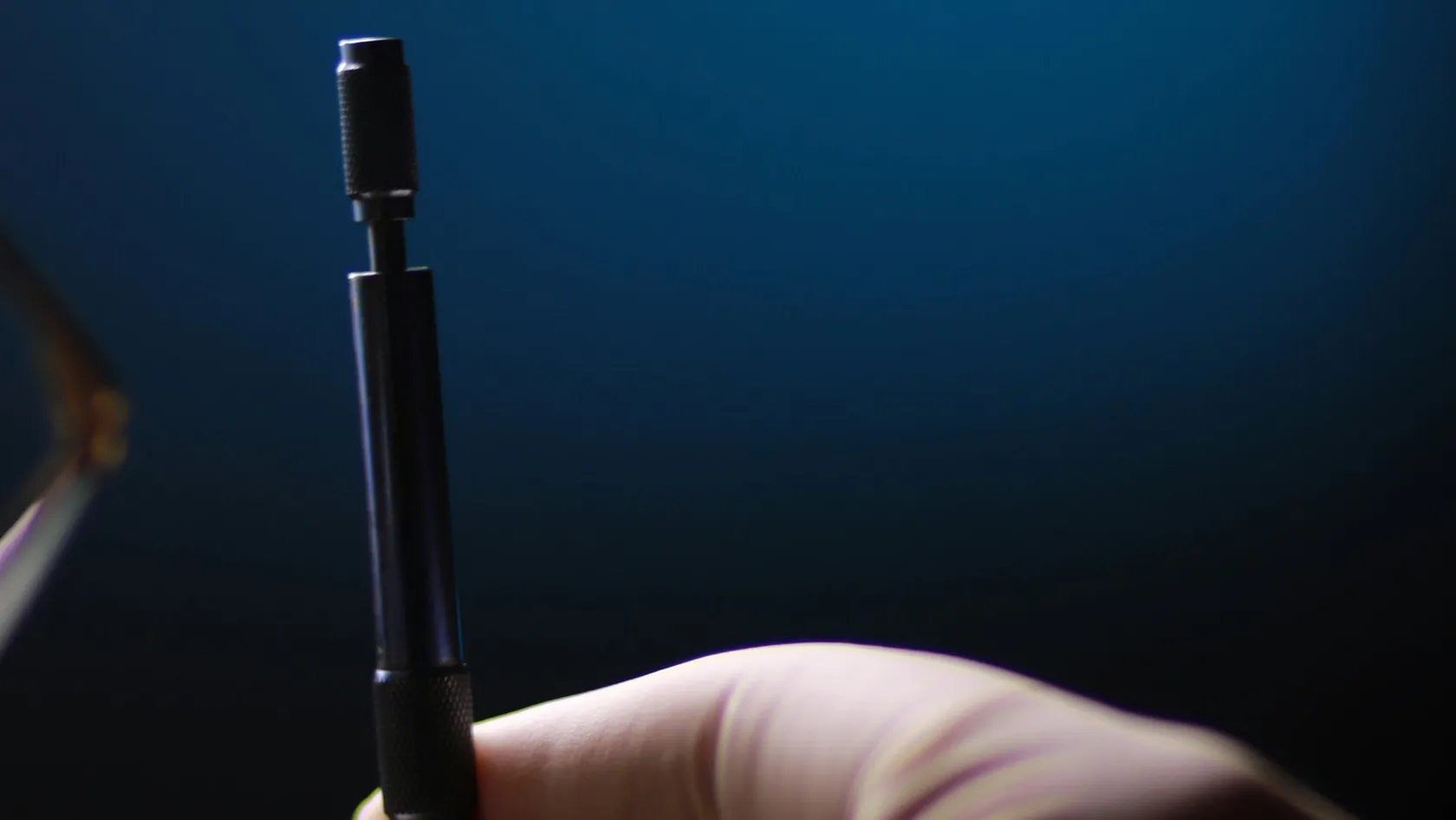
Malleable Penile Prosthesis - Semi-Rigid Penile Implant
A malleable penile prosthesis is two bendable rods, and the rods come in widths. In 183 men followed for a year, the 13 mm rods produced nine times the major complications of the narrower ones, yet almost nobody is told the choice exists. This guide covers the device and the three implant families, who it genuinely suits, hands and dexterity, length and concealment, its role in salvage after infection, what the satisfaction studies report, recovery, and having it done in Istanbul.
About This Department
A semi rigid implant has one measurement that matters. Most men are never told what it is.
Conversations on this device run almost entirely on cost and on whether it can be hidden. Meanwhile the surgeon picks a rod thickness, usually without discussing it, and that single choice moves the complication rate by a factor of nine. This page covers the device, the measurement, the men it suits, and the evidence sitting behind each of those.
The measurement nobody mentions
Almost everybody arrives having already done the comparison. Three facts come up, and all three hold.
This device costs less than a hydraulic one because it contains less. It holds no pump, no tubing and no fluid that can leak, which removes most of what breaks in a prosthesis across a lifetime. And it has to be bent down and left there between times, permanently. Those three points appear on every website in this field and get repeated in every consultation, they are all true, and not one of them is the thing most likely to decide how the next year goes for a given man. The thing most likely to decide that gets measured in millimeters and almost never gets said out loud.
Every semi rigid implant amounts to a pair of rods, and rods come in diameters. Nine and a half millimeters, eleven, thirteen. The surgeon chooses, often on the day, often without a word to the patient, and the instinct in the room tends to run toward the thicker rod because a thicker rod means a thicker penis and a thicker penis sounds like a better result. A prospective study of 183 men at a high volume center took that instinct apart. Everybody in it received the same brand, went through the same protocol, and answered the same satisfaction question at one year. Rods of nine and a half or eleven millimeters produced a major complication rate, meaning infection, erosion or removal, of 1.2 percent. The thirteen millimeter rods produced 11 percent, which is nine times as much. Satisfaction at one year ran at 88.6 percent in the narrow group against 75.7 percent in the wide one, a gap that fell just short of statistical significance in a study of this size.
So the wider rod produced more infections, more erosions, more removals and slightly less satisfaction. Nine times as many, on the headline measure. The bigger number was the worse number in every direction the study looked.
All of that comes from a single center, one brand and one year of follow up, and the satisfaction gap fell just short of statistical significance. Treat it as one strong signal and not as settled law. Diameter still counts as the only variable on the whole list that a five minute conversation before surgery can change, and it costs nothing to ask which width your surgeon intends to use and why.
The words, and the device behind them
Narrow screens scroll this table sideways. Swipe or drag to reach every column.
| Term | What it means here |
|---|---|
| Malleable or semi rigid | Two bendable rods, permanently firm, positioned up for sex and down the rest of the time |
| Rod diameter | Thickness of each rod, commonly 9.5, 11 or 13 millimeters |
| Corpora cavernosa | The two erectile chambers of the penis, which is where the rods sit |
| Corporal fibrosis | Scarring inside those chambers, which makes any implant harder to place |
| Salvage | Washing out an infected implant and putting a new one in during the same operation |
| Erosion | A rod wearing through tissue from the inside, most often near the tip |
| EDITS | A scored questionnaire on treatment satisfaction, reported out of 100 |
Three families of implant exist, and the semi rigid one sits at the simple end. Nothing in it moves, nothing holds fluid, and nothing has a moving part that can wear out, which is the whole of its mechanical argument. A review published in 2023 counted six semi rigid devices on the market, from the Coloplast Genesis and the Boston Scientific Tactra through the Zephyr range, the Rigi10, the TUBE and the Shah prosthesis, and the differences between them come down to how the internal core holds its position, how easily the shaft bends, and how well the thing conceals. Those differences read as small on paper and show up in ordinary use, since a core holding a sharper bend at the base folds the shaft closer to the body. Availability varies country by country. A unit stocking two or three lines can match a device to a man's anatomy in a way that a unit carrying one line cannot.
Columns run past the edge on a small screen. Slide the table across to read them.
| Type | Parts | Where it wins | Where it loses |
|---|---|---|---|
| Semi rigid | Two rods, nothing else | Nothing to operate, shortest operation, fewest mechanical failures | Permanent firmness, hardest to conceal, no change in girth when in use |
| Two piece inflatable | Cylinders and a scrotal pump, fluid held in the cylinders | No abdominal component, so no reservoir to place | Less rigidity and less flaccidity than a three piece device |
| Three piece inflatable | Cylinders, pump and an abdominal reservoir | Closest to a natural erection, genuinely soft when down | Most parts, longest operation, reservoir placement carries its own risks |
What the diameter study found, in full
The figures below come from the prospective series described at the top of this page. Everyone in it was operated on by a high volume surgeon, received the same brand, and was followed for a year, so the comparison is unusually clean for this field.
This table also scrolls sideways on a narrow screen. Swipe or drag to reach every column.
| Measure | 9.5 and 11 mm rods | 13 mm rods |
|---|---|---|
| Major complications, meaning infection, erosion or removal | 1.2 percent | 11 percent |
| Free of any complication at four weeks | 90 percent | 60 percent |
| Satisfied at one year | 88.6 percent | 75.7 percent |
- Length is measured inside the corpora during the operation and cannot be guessed from the outside.
- Diameter follows what the chambers accept after dilation, and the widest rod that fits is rarely the right one.
- Rear extenders adjust the fit in small steps once the rods are in.
Rigidity that never switches off
Rods hold whatever position they are put in. That is the whole mechanism. Bent upward, the penis carries enough rigidity for intercourse. Bent downward it lies along the thigh, and in neither state does it change thickness or length, which is the single largest difference between this device and a hydraulic one. Nothing there is subtle, and any man told that a semi rigid implant behaves like a natural erection has been misled by somebody who wanted the sale.
Almost nobody describes the week to week reality, so we will.
Sitting causes no trouble. Walking causes none either. Loose trousers and boxer shorts cause none. Tight swimwear, a locker room, a medical examination and an airport search make up the short list of moments men actually mention, and briefs that hold the penis flat against the abdomen handle most of what appears on that list. Adjustment takes weeks and not months. After that the habit settles, the device stops being a daily thought, and follow up series report much the same thing once the first few months sit behind the patient.
Sensation does not change. The nerves that carry feeling to the skin and the glans run outside the chambers the rods occupy, so touch, pleasure and orgasm work as they did before, and so does ejaculation where it was working already. An implant of any kind treats rigidity and treats nothing else. If desire has gone, or testosterone is low, or a relationship has been in difficulty for years, those problems survive the operation intact and deserve their own attention first.
Who this device actually suits
Cost comes up first in almost every consultation and ranks last among the good reasons. Money buys fewer parts here, and if money made the only difference then every man who could afford a hydraulic device would be steered toward one, which is roughly what happens in wealthy health systems. Plenty of men should be steered that way. The interesting cases run the other direction, where the simple device answers better for a reason that touches money nowhere at all.
Start with hands. A three piece implant is worked by finding a pump in the scrotum, squeezing it a dozen times, and later pressing and holding a small valve for several seconds, a sequence that needs fine finger control and a reasonable grip, so a man with advanced arthritis, a tremor, neuropathy affecting the fingertips, a stroke that weakened one side or a spinal cord injury above a certain level may never manage it reliably on the night he wants to. He will then own a device he cannot use, which is a worse outcome than the one he came in with. Rods need no grip at all, no sequence, and nothing learned. That single point explains a large share of the men who choose this device deliberately,. Rheumatoid disease in the fingers, Parkinson's disease, multiple sclerosis affecting coordination, severe carpal tunnel syndrome and any condition that costs a man the pincer grip all belong on that list. Test the hands, do not ask the patient how good they feel.
Then consider the corpus that has already been damaged. Scarring changes everything. Severe scarring inside the erectile chambers, from an old infection, from prolonged priapism, or from an implant that had to be removed, leaves a space that a wide inflatable cylinder cannot safely occupy. Narrow rods often can. The same applies during the salvage of an infected implant, where the aim is to keep the chambers open at all, and to men whose general health makes a long operation a bad idea. Implanting rods runs under an hour in trained hands, which matters more than it sounds when the anesthetist is nervous.
One more group deserves naming. Men with a buried penis, where the shaft sits hidden under an abdominal fat pad, sometimes struggle to pass urine standing and cannot have intercourse regardless of whether erections work. A small pilot series of twelve such men reported an average gain of 6.8 centimeters of visible length after semi rigid implantation, with peak urinary flow rising from 8.4 to 18.6 milliliters per second and symptom scores falling. Twelve men makes a pilot and nothing more. The mechanism behind it is easy to follow though, and this use of the device rarely appears in any brochure.
None of those reasons involves money.
Hands, carers and daily life
Anybody weighing the two device types should try the movement before choosing. Hold a soft rubber ball low in a trouser pocket and squeeze it twelve times without looking, then press and hold a bottle cap for five seconds with the same hand. Those two movements match the demand a hydraulic pump makes, and doing them once in a clinic answers the question better than half an hour of discussion. A man who struggles with that test in a calm consulting room will struggle more in a dark bedroom.
Age on its own decides nothing. A serial assessment of men grouped under 45, between 45 and 65, and over 65 found high satisfaction in all three groups after semi rigid implantation, measured at three, six and twelve months. Younger men scored higher early, and by the twelve month mark the gap between the groups had closed. Age earns a careful look at the heart and the anesthetic, and it earns nobody a refusal.
Length, and what surgery can add
Why men report losing some
Loss of length is the single most common complaint after any implant, and it belongs to the disease more than to the device. Years without erections let the erectile tissue shrink, an implant restores rigidity at whatever length happens to remain on the day of surgery, and the comparison that settles the argument between the two device types took 142 men, 81 of them carrying semi rigid devices and 61 carrying a two piece inflatable, and simply asked them what they had noticed. Among those who answered, 61.3 percent of the semi rigid group and 56.8 percent of the inflatable group said they had lost length. The average loss reported was 2.1 centimeters in one group and 2.12 centimeters in the other, a difference of two tenths of a millimeter, which is to say no difference at all. Anybody telling you that a hydraulic device protects length is describing a preference and not a finding. What genuinely helps is coming to surgery sooner, because the tissue shortens while a man waits,.
An operation that does add some
A randomized trial from Cairo tested whether releasing the suspensory ligament and removing the pubic fat pad at the same time as a semi rigid implantation gives visible length back. Sixty one men were randomized, 31 to the combined procedure through a penopubic Z plasty and 30 to a standard penoscrotal implantation. The combined group gained a median of 1.5 centimeters of functional length and 2.5 centimeters of visible length. The standard group gained nothing, with a median of zero in both measures. Treatment satisfaction came out higher in the combined group as well, 95.4 against 85.2 on a hundred point scale,. Visible length means the part of the shaft a man can see when he looks down, and a pubic fat pad hides a good deal of it in a heavy man, so part of that 2.5 centimeters was already there and merely covered. The functional gain of 1.5 centimeters is the harder number and the smaller one.
- The combined operation took 170 minutes against 97.5 minutes for the standard one, and longer operating time raises infection risk in every implant series ever published.
- Penile swelling followed in 77.4 percent of the combined group.
- Instability of the penis at the base and numbness of the glans each occurred in 9.7 percent.
Concealment, honestly described
Every manufacturer claims improved concealability and every claim is relative. A permanently firm penis can be pointed downward and held there by clothing, and it cannot be made soft. That describes the floor of what this device offers, and a man who cannot live with that floor should read the page on hydraulic implants and close this one.
Within that floor, the differences between devices are real. Newer semi rigid designs use an internal core that holds a sharper bend at the base, so the shaft can be folded closer to the body without springing back. Rod diameter matters here too, and it matters in the same direction as everything else in this article, because a narrower rod folds more tightly and shows less. Clothing does the rest. Supportive briefs beat boxer shorts. A slightly longer shirt solves most of what remains.
Buy the underwear before the operation.
Two situations deserve a plan and not hope. Communal changing, whether at a gym, a swimming pool or a workplace, deserves thinking through before the operation and not afterward,. Airport security scanners read shape and not material, so an implant triggers nothing and needs no declaration, and a brief word with a screening officer resolves the rare occasion when a pat down reaches that area. Neither situation counts as a reason to avoid the device. Both count as reasons to have the conversation with a surgeon who answers plainly.
Men living where communal bathing is routine, or where clothing is loose and light, sometimes weigh this differently, and that belongs in the decision as a legitimate part of it and not as a detail to be argued away. We prefer that a man chose a hydraulic device for that reason than discovered the problem afterward.
The device that goes in when another comes out
An infected implant has to come out. Leaving it in never works, and antibiotics alone never work either. The old approach was to remove everything, wash the spaces thoroughly, and leave the man to heal, after which the erectile chambers scar down over weeks into a solid mass that makes any future implantation difficult and sometimes impossible. Salvage exists to prevent that, by washing out and reimplanting during the same operation.
Timing decides this one.
A review of the published salvage literature makes a case for using a semi rigid device for that second implantation. It fills the chambers and keeps them open. It goes in faster, with less foreign material in a space that has just been infected. Eradication of the infection appears to be as good as with a hydraulic reimplantation and possibly better. The detail worth noticing is what happened next, because conversion to a hydraulic device later on was needed less often than the authors expected, which suggests many men found the temporary device good enough to keep.
What the satisfaction studies report
Forty six men who received one widely used semi rigid device between 2009 and 2014 were followed for a mean of 3.19 years. Their erectile function scores rose from 5.86 before surgery to 22.5 afterward, on a scale that tops out at 25 and rarely moves that far for anything else. Treatment satisfaction came out at 71.06 for the men and at 65.08 for their partners, both scored out of a hundred, which is a respectable result for a device that asks its owner to accept a permanently firm penis in exchange for reliability. Asked the plain question, 96.2 percent of the men and 84.6 percent of the partners said they were satisfied overall. Those are strong numbers and they carry the usual caveats of a retrospective single center series, which is that the men who stayed in touch for three years are the men most likely to be doing well. Nobody has ever run a randomized trial comparing implant types with satisfaction as the endpoint, and nobody is likely to, because men arrive with a preference and a surgeon who argues them out of it gets a worse result whichever device goes in.
Notice the gap between the two figures. Men score this device higher than their partners do, in this series by nearly twelve points, and that pattern repeats across the implant literature whatever the device. It is the strongest single argument for bringing a partner into the consultation instead of reporting back to them afterward.
Those comparisons were not randomized and the men choosing each device differed, the inflatable group being five years younger on average. Read them as the shape of the difference and not as its size.
Questions for whoever implants it
Implanting a pair of rods takes less time than a hydraulic operation and fewer steps, and that simplicity tempts units with little prosthetic experience to take it on. The steps that go wrong are the same steps in both operations, namely the dilation of the chambers, the measurement, the choice of size, and the handling of a device that must never touch skin or glove powder on its way in. Experience shows up in all four. A surgeon who has dilated two hundred sets of corpora knows the exact point at which a dilator stops feeling like it is following a channel and starts feeling like it is making one, which is the moment a perforation happens, and that knowledge arrives through repetition and through nothing else. Reading about it teaches nobody. Watching a video teaches nobody. The published series bear this out, since high volume operating is the one surgeon level factor that turns up as protective against infection in study after study.
- How many penile implants of any kind do you put in during a year, and how many of those are semi rigid.
- Which rod diameter do you expect to use for me, and what makes you choose one width over another.
- What is your own infection rate for this operation, and how do you know the figure.
- If the chambers turn out to be scarred once you are inside, what is the plan, and do you keep narrow rods and salvage instruments in the room.
- Who sees me if something goes wrong after I have flown home, and how quickly.
Five questions. A surgeon who answers all five without hesitation has told you most of what you need, and one who shifts in his chair at the third has told you something too.
Recovery and the first weeks
What the timetable looks like
The operation itself takes well under an hour in experienced hands, through a small incision at the junction of the penis and the scrotum or occasionally through the upper penis. A catheter goes in for the night and comes out the following morning. Most men leave the ward the day after surgery. Swelling and bruising of the scrotum peak around the third day, look far worse than they are, and settle across two to three weeks with supportive underwear doing most of the work.
Bruising looks worst on day three. Then it fades.
One thing differs sharply from a hydraulic implant. Nothing needs to be learned. No pump waits to be practiced with, no daily cycling routine protects a capsule, and no activation appointment sits four to six weeks down the line. The device reaches its final state the moment the wound closes, and the only instruction anybody gives is to leave the penis in the down position and keep hands off it while the tissues settle. Intercourse waits four to six weeks, the same as with any implant, and that wait belongs to wound healing and not to the device.
Nothing to learn reads as an advantage to some men and as a loss to others.
Pain stays moderate, answers to simple painkillers, and rarely needs anything stronger past the first few days. Desk work resumes at around two weeks and heavy lifting at six. Two things justify a phone call at any hour of the day or night, the first being a fever alongside a hot, tender, swollen scrotum, which suggests infection, and the second being any point where the skin over the tip of the penis starts to look thin, white or broken, which suggests a rod pressing where no rod should press, and both of those are far easier to deal with in the first week than in the third month.
Having this done in Istanbul
Send four things and a urologist will read them. A recent HbA1c whether or not diabetes has ever been mentioned to you, the operation note from any previous implant or any prostate, bladder or pelvic surgery, an account of what you have already tried for erections and at what dose, and a straight description of what your hands can do. That last one gets skipped by almost everybody, and among the four it is the item most likely to change what we recommend, because a man who cannot work a pump reliably will own a hydraulic device he does not use, and a man whose hands are fine but whose chambers are scarred from an old infection faces a different problem again.
That reply comes in writing, costs nothing, and carries no obligation. It names the device that suits your anatomy and your hands, and where a hydraulic implant would serve you better, it says so plainly. A second opinion on an implant somebody else has already recommended is the same free review, and we are glad to give one.
Seven languages are spoken on the wards and in clinic without an interpreter being called, namely English, Arabic, French, Russian, Serbian, Romanian and Spanish, and anything outside those gets an interpreter booked ahead of your arrival. One coordinator picks up your first message and stays on your case to discharge, then remains reachable on WhatsApp once you are back home. A partner or relative sleeps in the room on a bed the ward provides, hotel nights on both sides of the admission and the airport transfers and every journey between hotel and clinic are arranged before you land, and the invitation letter for a visa application leaves our office roughly ten days ahead of the flight. Meals are halal, vegetarian or adjusted for diabetes as you need them, and a prayer room sits on the ward floor. Men traveling alone should say so at the first message, because the ward arranges an extra check on the first night for anybody without a companion in the room.
Plan five to seven nights. That covers the assessment and blood tests, the operation, one night on the ward, catheter removal the next morning, and two wound checks spread across the rest of the week, which is a shorter trip than a hydraulic implant needs because there is no activation visit waiting at the far end. Fitness to fly is signed in writing at around day four to six, by a doctor who has looked at the wound that morning, and we do not hand that judgment to the patient. Once you are home, a review at six weeks can happen by video, and if a urologist near you prefers to examine you in person we will send them the operation note and the device details.
On cost, we publish no figures. What the price turns on is the device chosen, whether scarring inside the chambers makes the dilation slow, whether this is a first implantation or a salvage after infection, and how many nights the ward keeps you, and none of those can be settled until a urologist has read what you send. Any number quoted before that has been picked to win an inquiry and not to describe an operation.
Malleable penile prosthesis FAQ
Will people be able to tell
Clothed and standing, almost never. Supportive briefs that hold the penis flat against the abdomen do most of the work, and an ordinary shirt covers whatever is left.
Can it be swapped for an inflatable device later
Yes, and it happens regularly. The chambers have already been dilated, which makes the second operation considerably easier than a first implantation into scarred tissue,. The reason men give is almost always a wish for a softer penis between times and not any fault in the device they have. What the conversion does carry is a second exposure to the main risk of this surgery, which is infection, and that risk sits slightly higher in any reoperation than in a first one.
How long does one last
Nothing pumps and nothing carries fluid, so mechanical failure is rare and series report devices working past fifteen years. Infection or erosion ends a device early, and neither counts as wear.
Does it affect passing urine
The rods sit inside the erectile chambers and the urethra runs beneath them, untouched by the operation. Most men notice no difference at all in the stream, the frequency or anything else. Men with a buried penis are the exception and they sometimes find matters improve, since the shaft no longer sits hidden under a fold of the abdominal wall,. An implant treats no prostate problem, so anybody with a slow stream from an enlarged prostate needs that looked at separately.
Will orgasm and ejaculation still work
Implants replace rigidity and leave the nerves alone. Sensation, orgasm and ejaculation carry on as before. Where ejaculation had already stopped, after a radical prostatectomy for instance, an implant brings none of it back.
Is it safe with a pacemaker or an MRI scan
Yes to both. Show the radiology department the device card you were given at discharge.
Should I try injections before choosing surgery
In most cases yes, and properly, which means a supervised dose adjustment across several visits and a fair trial and not two attempts at a starting dose. Surgery here ends every other option permanently, since placing rods inside the erectile chambers destroys the tissue that tablets and injections work on, so the treatments a man can stop deserve a real chance before the one he cannot. The men who regret an implant are almost never the men who tried everything first.
References
- Habous M, Omar M, Farag M, et al. Malleable penile implant rod diameter predicts complications and patient satisfaction. Sexual Medicine. 2022;10(2):100486.
- Akdemir F, Okulu E, Kayigil O. Long-term outcomes of AMS Spectra penile prosthesis implantation and satisfaction rates. International Journal of Impotence Research. 2017;29(5):184-188.
- Chung E, Wang J. State-of-art review of current malleable penile prosthesis devices in the commercial market. Therapeutic Advances in Urology. 2023;15:17562872231179008.
- Lao M, Graydon RJ, Bieniek JM. Salvage penile prosthetic surgery utilizing temporary malleable implants. Translational Andrology and Urology. 2017;6(Suppl 5):S806-S812.
- Bayrak O, Erturhan S, Seckiner I, et al. Comparison of the patient's satisfaction underwent penile prosthesis, malleable versus Ambicor. Archivio Italiano di Urologia e Andrologia. 2020;92(1):25-29.
- Chung E, Ng Hung Shin B, Wang J. Can malleable penile prosthesis implantation improve voiding dysfunction in men with concurrent erectile dysfunction and buried penis. Investigative and Clinical Urology. 2021;62(3):305-309.
- Aboul Fotouh El Gharably M, Ghoneima W, Lotfi MA, et al. The efficacy of suspensory ligament release and pubic lipectomy via penopubic Z plasty during penile prosthesis implantation in improving sexual satisfaction. Journal of Sexual Medicine. 2022;19(5):852-863.
- Ali AI, El-Dakhakhny A, Gabr AH, et al. Post malleable penile prosthesis satisfaction in elderly patients, serial assessments. Andrologia. 2019;51(10):e13399.
Editor's note
Written by the Biruni Hospital medical editorial team. Reviewed by Gökhan Yazıcı, Urology.
Medically reviewed by

Gökhan Yazıcı
Urology
Related Treatments
View All
Bladder Cancer Surgery
Bladder cancer is treated by two operations that share almost nothing. One scrapes tumor off the inside wall through the urethra in twenty minutes. The other removes the bladder and rebuilds the route urine takes out of the body. The short one is treated everywhere as a minor procedure, and how well it is done decides the staging, the recurrence rate and whether the long one ever becomes necessary.
Fusion Biopsy Prostate - MRI-Guided Prostate Biopsy
Software builds a model of your prostate from the MRI and another from the live ultrasound, then deforms one onto the other so the lesion lands somewhere the needle can reach. Every step of that carries a few millimeters of error. This page covers where the error comes from, what the trials comparing the three targeting methods found, who draws the outline the needle aims at, and why good units still take cores from the rest of the gland.

Inflatable Penile Prosthesis
An inflatable penile prosthesis has three parts, and only one of them gets discussed. The reservoir sits inside the abdomen, decides where the operation gets difficult, and causes most of the reoperations men end up needing. This guide covers the hydraulics, the move from the space of Retzius to high submuscular placement, the evidence on palpability and auto inflation, the link between blood sugar control and infection, recovery week by week, and what the operation means in Istanbul.
Kidney Cancer Surgery - Renal Cancer Surgery
Kidney cancer surgery means two different operations, and the choice between them is made from a scan before anyone knows what the tumor is. The only randomized comparison found that sparing the kidney protected kidney function and did not extend life. This page works through that result, the clamp and the clock, biopsy before surgery, surveillance, and what changed when the disease has already spread.
Kidney Stone Surgery
Three measurements on a CT decide which kidney stone procedure suits you, and none of them is a brand name. The stone free rate a clinic advertises is a different kind of number, because it depends on how hard that clinic looked afterward. This page covers shockwaves, ureteroscopy and percutaneous surgery, what the randomized trials found, and why half of stone formers come back.